
Four characters purchased in the same batch from a defunct publisher now have gross medians of between $24.99 and $45.02. As of August 29, 2026, a factor of less than two separates the cheapest from the most expensive: even though their subsequent careers are nothing comparable: one had a successful television series, the other served as a model for a famous work, a third remained unemployed for decades. The market does not remunerate the subsequent career: it values the time of publication.
This is a result that we do not expect, and it sheds light on a mechanism that goes well beyond these four names.
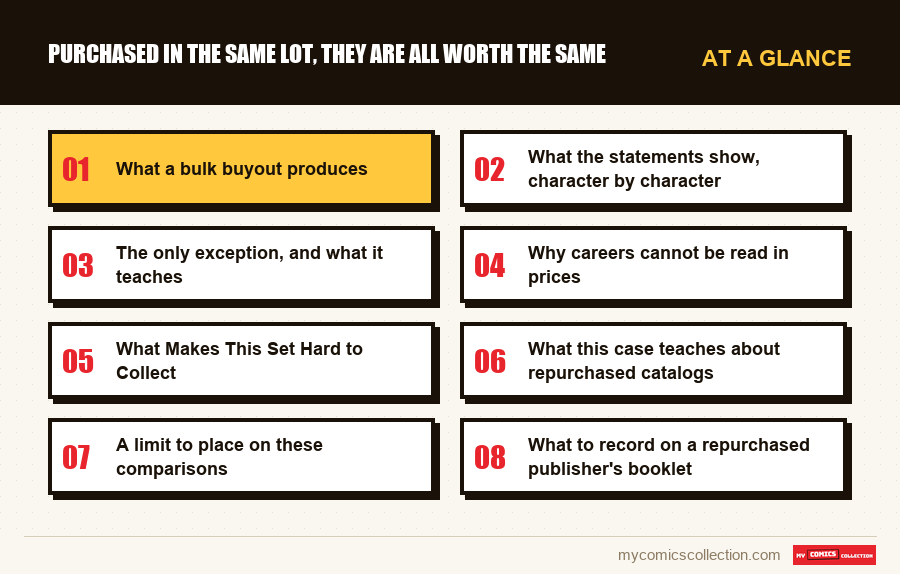
The following examines what this group purchase produced, what the statements show character by character, the only exception that emerges and what it means, then how to keep the inventory of a set inherited from a disappeared publisher.
What a bulk buyout produces
Buying characters in batches is not the same operation as acquiring just one, and the consequences can still be read sixty years later.
The price paid is not divided between them. The buyer pays a sum for a set, without anything establishing what each figure was worth. None of the characters therefore have an original value to refer to, which is unusual.
They all enter at the same time in a catalog that did not expect them. We must find a place for them, a tone, host series, and this assignment is done quickly, often according to the availability of the authors rather than according to the qualities of the character.
Their fate then depends on a single factor: finding an author who is interested in them. None of them comes with a built-up readership to preserve. The person who meets someone to write it exists; the others remain in reserve.
This last point is decisive and rarely said. In a group buyout, each character's trajectory is determined by encounters, not by their merits: and the four trajectories observed here illustrate this lottery exactly.
What the statements show, character by character
Le personnage au scarabée
Brut : 143 annonces, $4.79 to $947.50 asked, median 40,00 $. Certifié : 40 annonces, médiane 250,08 $.
Le héros atomique
Brut : 167 annonces, $3.29 to $899.00 asked, median 29,95 $. Certifié : 22 annonces, médiane 250,00 $.
L'enquêteur sans visage
Brut : 125 annonces, $4.99 to $367.50 asking, median 24,99 $. Certifié : 35 annonces, médiane 200,00 $.
The man who loves peace too much
Brut : 138 annonces, $2.80 to $1,400.00 asked, median 45,02 $. Certifié : 16 annonces seulement, médiane 537,50 $.
These amounts are asking prices observed on August 29, 2026, gross and certified counted separately, and not completed transactions. Each query also picks up issues from other series from the same house, which broadens the population without distorting the order of magnitude.
The first observation is that of uniformity. In the raw segment, the four medians are within a range of twenty dollars. Nothing in these figures would allow one to guess which was adapted for television, which inspired a major work, nor which was almost never published.
In other words, someone who only knew the prices would be unable to reconstruct their careers. This is the most direct demonstration that the old catalog is valued as a whole, by period and by publisher, and not figure by figure.
The only exception, and what it teaches
One of the four stands out, but not where you would expect it, and the detail is worth looking at closely.
The one with the most recent TV exposure has the highest gross median:45,02 $: but the gap with the others remains small, less than twenty dollars on the cheapest character.
It is in the certified segment that the difference is evident: $537.50 median, more than double the three others, on only 16 advertisements. The top of the market is both much higher and much narrower.
This profile is characteristic and is found elsewhere. A recent exhibition does not highlight the ordinary catalog, which remains abundant and inexpensive; it focuses attention and money on a small number of verified copies.
The lesson is clear: the exhibition moves the certified summit, not the floor of the catalog. A buyer who hopes to see his entire box go up because a character appears on the screen is using the wrong mechanism: what goes up is a handful of copies that he probably doesn't own.
It is therefore necessary to distinguish two markets which have the same name. The current catalog, large and stable, obeys the time of publication and the survival rate. The certified segment, narrow, obeys the topicality and the rarity of a state.
Confusing the two leads to two symmetrical errors: believing that an adaptation enriches an ordinary collection, or concluding from a flat catalog that a character interests no one. Both statements are false for the same reason.
Why careers cannot be read in prices
Three reasons combine, and none is specific to these four characters.
The old fascicles do not tell of his later career. A 1966 issue contains what it contained in 1966. What the character subsequently became was written in other issues, by another publisher, and adds nothing to the old object.
The buyer of these booklets is looking for a period, not a figure. The public of this catalog collects a publisher, a format, an aesthetic. The character represented is secondary in his decision, which mechanically smoothes out the gaps between the figures.
The survival rate is the same for everyone. Published by the same house, on the same paper, distributed through the same circuits and thrown away in the same proportions, these issues have survived sixty years identically. Physical rarity does not distinguish them.
These three causes go in the same direction and reinforce each other. They explain how an old catalog can remain perfectly flat despite completely divergent destinies., and invite caution whenever we want to deduce a value from a notoriety.
What Makes This Set Hard to Collect
The obstacles here are specific to a repurchased catalog, and they especially complicate identification.
Two editors for one character
The original fascicles and those after the repurchase bear different logos for the same figure.
Des numérotations reprises
The series of the time sometimes inherited the number of a previous title, unrelated to their content.
Appearances in anthology
Several of these characters begin in series with multiple summaries whose titles do not mention them.
Secondary characters from the summary
Some appearances occupy a few pages at the end of the booklet and are easy to miss.
Ads with popular characters
A booklet is sometimes highlighted under the name of the most sought-after figure it contains.
Poorly documented prints
The printing figures for this house are little known, precluding any estimate of relative rarity.
Collecting this series?
Track what you own, what you are missing and what your collection is worth. 7 day trial.
Start my trial →What this case teaches about repurchased catalogs
Quatre observations transposables à n'importe quel fonds acquis en bloc.
A buyout does not create value, it creates an option. The buyer gets the right to try. What happens next depends entirely on what use is made of it, and most often none is put to it.
The most successful character of the lot is almost never the one we were aiming for. The successes of this group came from unforeseen directions, driven by authors who were interested in them for personal reasons.
Prolonged inactivity does not destroy anything. Many of these figures spent decades without work before returning. A character in reserve does not expire, unlike a series.
The old catalog remains indifferent to all this. Neither successes nor failures are reflected in the original issues, the price of which continues to be fixed by their date and condition.
These four points form a useful reading framework. They allow you to look at any catalog acquisition without overestimating what it promises, and without concluding too quickly that a silent fund is a dead fund.
A limit to place on these comparisons
These four statements lend themselves to a cross-reading, but this has limits that must be named.
The questions do not delimit watertight sets. Searching for a character from this house also brings up booklets from other series that it published, and the populations obtained partially overlap. The order of magnitude remains correct; accuracy to the nearest dollar is not.
These numbers only describe one day. Comparing four medians recorded at the same time provides information on the simultaneous state of four offers, never on the way in which each has evolved. None of the above statements relate to a trend.
The number of certified announcements is low. Sixteen proposals for one of them, twenty-two for another: on such numbers, a median is an indication, not a measurement, and two announcements added or removed significantly move it.
These reservations do not cancel the main observation, which is based on a difference too marked to be due to random sampling. However, they prevent us from drawing a detailed classification between the four figures., and this is precisely the kind of conclusion that it would be tempting to formulate.
What to record on a repurchased publisher's booklet
This type of fund imposes fields that continuous series never require.
The logo actually printed on the cover. This is the only proof of the publisher of the publication, and it takes precedence over the name under which the advertisement was placed.
The title of the home series, not the character's name. Many of these appearances are found in anthologies. Classifying a line under the hero's name makes the booklet impossible to find in the catalog.
The position in the summary. Main story or end-of-issue supplement: this distinction changes what you actually own and does not appear anywhere on the cover.
The original numbering of the title. When a series takes up the counter of a previous title, the printed number alone is misleading, and it is necessary to note to which series it belongs.
The price paid relative to the segment. Note whether it was a raw or verified copy: without this mention, an inventory line mixes two markets whose levels have nothing to do with each other.
On the raw segment, almost: from $24.99 to $45.02 median as of August 29, 2026, a factor of less than two. In the certified segment, no: one of them reaches $537.50 compared to $200 to $250 for the other three. It is the top of the market that separates them, not the current catalog.
It changes the certified segment, where the observed median doubles, on only 16 advertisements. It hardly changes the raw catalog, which remains abundant and accessible. An owner of ordinary copies will therefore not see anything coming, even if the character becomes very visible.
No, and this is a particularity of the characters compared to the series. An interrupted series is difficult to resume; a character in reserve waits without deteriorating. Several figures from this ensemble returned after decades of silence, carried by an author who was interested in them.
By relying on the logo printed on the cover, never on the name used in the ad. The same character exists under two publishers with distinct numberings, and sellers often use the name of the current house for issues published well before the purchase.
The maximums observed range from $367.50 to $1,400.00 gross depending on the character, but these are isolated proposals and not observed prices. On populations of 125 to 167 listings, a single high value provides information about a seller's hope, not the market level: the median is the only prudent reading.
Anthology, supplement, renumbering?
On a repurchased catalog, a line in the name of the character does not allow you to find the booklet.