In the mid-1970s, this publisher printed a detachable stamp in its booklets that readers were invited to cut out to add to an album. To cut out was to obey the instructions, and to amputate the copy. Half a century later, the presence or absence of this stamp separates two different objects bearing the same title and the same number. The sellers understand this: they write it in the title. On August 29, 2026, two advertisements observed on two neighboring issues of the same series from 1976 explicitly indicated this, one at $120.00 for a copy with an absent stamp and in average condition, the other at $16.00 for a copy with an intact stamp. These two announcements relate to different issues: they document the importance given to information, never the price of the stamp.
There is a category of defects that are not accidents. A folded cover, a yellowed spine, a rusty staple: these are damages suffered, produced by time, humidity, handling. The cut stamp does not belong to this family. It is a voluntary amputation, carried out by the reader, on the printed instructions of the publisher, often within days of purchase. The booklet was not damaged: it was used exactly as it was asked to be. This difference in nature has an immediate practical consequence for anyone who buys, sells or catalogs issues from this period, and no one can read this consequence from a cover photograph.
The angle deserves to be clearly stated, because it goes far beyond the case of timbre. Old booklets were made as consumable and interactive objects. There were order forms to return, coupons to fill out, cards to cut out, central posters to extract and pin up. All of these elements share one property: they were designed to be detachable. And the rule that results from this is brutally simple: what was made to be detached was detached, in a proportion that no one knows, copy by copy. The collector who today seeks the physical completeness of an issue therefore comes up against an industrial device which organized its own partial destruction.
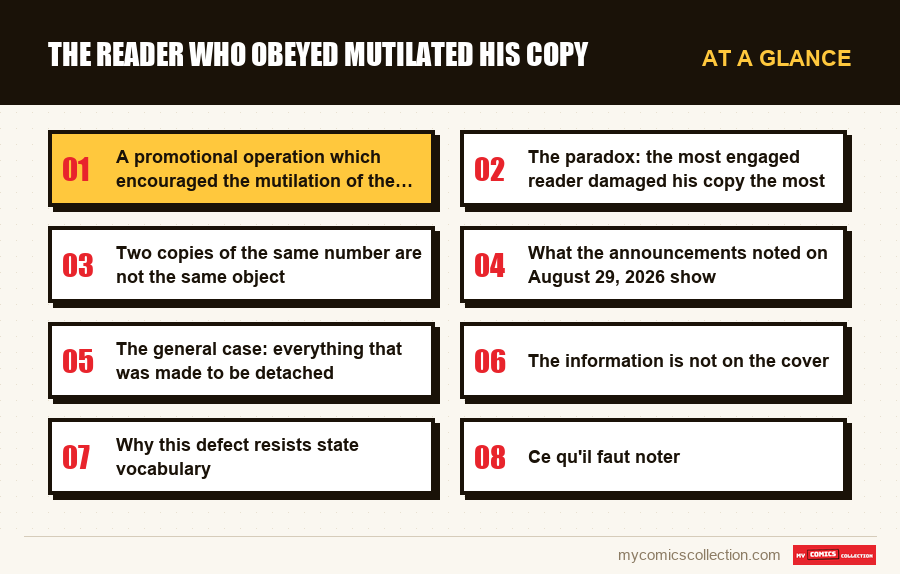
A promotional operation which encouraged the mutilation of the product
The mechanism, described without commercial name or detail that the data does not carry, is perfectly rational from the publisher's point of view. A stamp is printed on an inside page of the booklet. An instruction accompanies the image: cut out, paste in an album provided for this purpose, collect the complete series. The business goal is transparent: build buyer loyalty, turn a one-time purchase into a habit, give a reason to buy the next issue and the one after that. The system works by accumulation: an isolated stamp is worth nothing, a complete board has a symbolic value for the child who created it.
What makes the operation unique is not its promotional principle: bonuses and collections to complete are as old as single-issue sales. This is because here, the premium is not attached to the product: it is dans the product, printed on its paper, inseparable from its pagination. To recover the bonus, you must initiate support. The publisher does not distribute an additional item, he authorizes the reader to take a piece of what he has just purchased. The gesture requested is a cutting gesture, with scissors, on a page bound by staples to all the others.
It is also important to understand that this cutting was not perceived as a sacrifice. In the context of the time, the booklet was a cheap reading object, intended to circulate, to be read then reread then abandoned. The idea that it should be kept intact for a future market does not exist in the mind of the average buyer. Cutting out the stamp does not degrade anything in his eyes: on the contrary, it adds something, an image in an album, a visible progression towards a completed collection. The reader does not destroy, he constructs, and it is precisely this shift in perception that makes the phenomenon so massive and so difficult to quantify today.
The result, half a century later, is a stock of copies that is heterogeneous by construction. Part has been cut out, part has not, and the distribution does not follow any predictable rule: it depends on the age of the reader, their interest in the operation, whether or not the album is present in their home, and whether or not they found a pair of scissors that day. No register, no print run, no period statistics allow us to say what proportion of the copies have survived complete. We only know that the two populations coexist, and that nothing distinguishes them from the outside.
The paradox: the most engaged reader damaged his copy the most
L'obéissance produit le défaut
The reader who cuts applies instructions printed by the editor. He does what he is asked, in the order and at the expected time. The defect that we see today is not negligence: it is the trace of perfect compliance with the instructions for use. This completely reverses the usual moral reading of the state of a fascicle.
L'indifférence produit l'exemplaire intact
The complete copies come largely from readers who did not play the game: those who were unaware of the operation, who did not own the album, who bought the booklet for the story and nothing else. Physical completeness is therefore often the by-product of a lack of interest in the promotional device.
The action is irreversible
A fold partially relaxes, a dog-eared page smoothes out, a stain fades to the eye. A cut page does not return. There is no restoration that restores a removed stamp, and any attempt to fill in creates a composite copy whose descriptive honesty becomes a problem in itself.
Relative scarcity happened by itself
No one decided that intact copies would be rarer. The draw was identical for everyone. It is the sum of millions of individual decisions, taken by children with scissors, which split a homogeneous population into two subpopulations whose proportions we still do not know.
This paradox has a scope that goes beyond folklore. It means that the commitment of the period reader and the conservation of the object are, on these specific issues, in direct opposition. The more well the promotional device has worked, the fewer complete copies remain. The publisher therefore succeeded in its commercial operation to the detriment of the population of objects it produced. No actor at the time had any reason to be concerned about it: the collection market as it exists today was not anticipated, and the booklet was thought of as a perishable product.
A copy described as complete may not be so, and a copy described as damaged may be intact on this specific point. The two pieces of information, the general condition and the presence of the patch, are independent of each other. A very tired booklet, with blunted corners and a rubbed spine, may have retained its entire interior page; A visually stunning booklet may have been cut the day it was purchased.
This is why a classic condition scale, which describes wear and tear, is not sufficient here. It measures continuous degradation. The presence of the timbre is a binary data, which has no intermediary: it is there or it is not. Two different systems of description coexist on the same object, and only one of the two is seen on the cover.
Two copies of the same number are not the same object
This is the documentary consequence, and it is heavier than it seems. The catalog records a number: a series, a rank, a date, a pagination. This entry describes an edition, that is, an industrial intention. It does not describe the physical copies, which became individualized after the fact, in the hands of readers. On booklets with a detachable element, the gap between the edition and the copy becomes structural: two objects attached to the same catalog entry can differ by an entire page.
For a collector who keeps an inventory, this means that a number is not a box to check. You need one more field, a note, a statement: something that records the state of the detachable item at the time of acquisition. Without this, the inventory affirms a possession that it does not describe correctly, and this inaccuracy is paid for at the time of resale, insurance or simply an exchange between collectors. A collection management method seriousness must provide the place for this information which does not fit into a status note.
The problem becomes more complicated when we consider the circulation of copies. A booklet passes from hand to hand, often without the information following. The first seller, the one who had the item in their hands and opened the relevant page, knows. The second, who bought on a photo and resells on the same photo, does not necessarily know. After three transactions, the information was lost, not through bad faith, but through ordinary documentary attrition. This is exactly why titles which carry the explicit mention have an informative value greater than their displayed price.
An important nuance must be added. The fact that the information is reported says nothing about its veracity: a title is a seller's declaration, not an observation. The only thing we can say is that those who mentioned it considered the information sufficiently decisive to include it in the few dozen most visible characters of their ad. It is a signal on market practices, not a guarantee on the object.
What the announcements noted on August 29, 2026 show
Let's move on to the figures, with the precautions they impose. On August 29, 2026, a count of advertisements revealed two titles relating to two neighboring issues of the same series from 1976. The first, displayed at $120.00, specifies that the stamp is missing and that the general condition is average. The second, priced at $16.00, specifies that the stamp is intact. These two amounts are sums requested by sellers on this date: they are not concluded sales, and nothing says that a buyer accepted them.
The second of these two numbers belongs to a larger survey, of which here is the entirety. As for unverified copies: 53 ads, ranging from $16.00 to $299.99, with a median of $34.99. As for verified copies: 6 ads only, from $69.99 to $344.99, median $144.49. These two sets do not compare directly: they describe objects presented differently, and one of the two sets is tiny.
These are requests, not sales
Each amount cited corresponds to the price that a seller displayed on August 29, 2026. None of these amounts proves that a transaction took place at this level. An ad can remain online for months without finding a buyer, and its price never becomes a reference.
A survey is a snapshot of a day
Counting describes the supply visible on a date. He says nothing about what was asked before, nor what will be asked after. No conclusion on a price movement can be drawn from this: several comparable readings would be needed, spaced over time, and that is not what we have available here.
120.00 and 16.00 do not subtract
The two titles relate to different numbers, one of which is clearly more sought after than the other. The difference between the two prices asked therefore combines at least two distinct causes. It is impossible to extract the share attributable to the stamp, and any attempt to do so would produce an invented figure.
Six verified copies do not make a reference
The median of $144.49 is based on 6 listings. A population of this size is too small to support a conclusion on a price level: the removal or addition of a single ad would shift the median considerably. This figure describes a small group of ads, nothing more.
An isolated maximum measures an expectation
The upper limits of the two readings: $299.99 on one side, $344.99 on the other: are single points. They reflect what a seller hopes to get, not what the market sees. Reading them as a ceiling of value amounts to confusing the ambition of an individual with a collective fact.
The useful signal is elsewhere
What these two titles solidly document is the behavior of sellers: the presence or absence of the stamp is considered decisive enough to occupy a place in the title of the ad. This is information about the descriptive uses of the market, and it is the only conclusion that the data allows.
Collecting this series?
Track what you own, what you are missing and what your collection is worth. 7 day trial.
Start my trial →The general case: everything that was made to be detached
The stamp is just one particularly clear example of an entire family. Old fascicles are full of elements designed to leave the medium. Purchase orders often occupy a full page, with dotted lines and sometimes even the explicit mention that it must be cut according to the line. Coupons for participation in a game or competition work on the same principle. The cutting cards, printed in sheets, are made to be separated one by one. And the central poster, held by the staples themselves, is removed with a single gesture which leaves two perforations as the only trace.
Each of these elements creates the same documentary problem. The central poster is perhaps the most vicious case, because its removal leaves a booklet which appears complete until you count the pages: you turn the pages, you read the story, everything seems in order, and yet the middle double page is missing. A seller in a hurry can describe it as complete in good faith. A buyer who receives the item and counts realizes the shortage after the fact, and the transaction becomes a dispute even though no one lied.
Purchase orders pose a symmetrical difficulty. They were made to be sent, which implies that the reader who used them was giving up on his page. But the order also involved a delay, a wait, sometimes an item received by mail: in other words, full use of the device. Here again, the most involved reader is the one who left the most incomplete copy. The pattern repeats itself, mechanism after mechanism, without notable exception.
It should be noted that the cut is not always clean. Children's scissors, a page folded before cutting, an attempt to tear it by hand: the gaps take very variable forms, from a clear rectangle to an irregular tearing which carries text onto the neighboring page. This variability further complicates the description, because the same title, “absent element”, covers very uneven damage. The photograph of the page concerned, when it exists, is then infinitely better than any wording.
For those building a collection around a specific character, the challenge is to know where these traps are concentrated. High-demand numbers attract careful descriptions, because sellers have a direct economic interest in them. Ordinary numbers circulate with summary descriptions. This is why it is worth identifying in advance the key numbers of a collection journey and to treat the rest with the same descriptive requirement, even when the financial stakes seem nil.
The information is not on the cover
Here is the point that concretely changes the way of buying. An online ad almost always shows the cover, sometimes the spine, rarely the inside. But the detachable element is inside. All the iconography available in a standard ad is therefore structurally incapable of answering the question. You can examine a cover photograph for an hour: it will never tell if the inside page is complete.
This asymmetry has a direct consequence. On these numbers, the absence of information is not neutral. A seller who says nothing may not have known the issue, may not have opened the issue, or may have chosen not to raise it. None of these three hypotheses allows us to conclude that the copy is complete. The reasonable default position, in the absence of a mention and photograph of the relevant page, is to consider the point undocumented: not that it is favorably resolved.
Certification shifts the problem without removing it. A verified copy passed into the hands of a third party who examined and described it, which resolves the uncertainty about what the object contains. But the verified copy is also sealed: it is no longer opened, and the buyer depends entirely on the description given on the label. If it is there, the information is solid. If it is not there, we find ourselves with an object that can only be inspected by violating its conditioning.
Practically, this leads to a single question to ask the seller, formulated without ambiguity: is the page containing the detachable element complete, and can we see a photograph of it. A clear answer settles the matter. A refusal, a dodge, or a general response about the status of the booklet signals that the information does not exist on the seller's side, which in itself is a useful response. This requirement is not aggressive: it corresponds exactly to the level of precision that the most serious sellers already apply spontaneously in their titles.
Why this defect resists state vocabulary
Condition scales were constructed to describe progressive wear: a new object deteriorates, and the scale measures the distance traveled since new. This model works well for creases, rubbing, fading, oxidation of staples. It works poorly for a lack, because a lack is not a position on a continuum: it is an absence of matter, a discrete state, a yes-no datum.
Description systems take this type of defect into account, usually by reporting it separately from the main note. But this architecture creates a misleading visual hierarchy: the condition note is highlighted, the lack is relegated to an appendix. A buyer who quickly scans a listing picks up the rating and misses the mention. The very format of the description encourages misreading, without anyone intending it.
There is another, more subtle effect. A cut-up but otherwise very well-preserved copy occupies an awkward position: it is superb and incomplete. Sellers hesitate on how to present it, between promoting its freshness and pointing out its lack. This hesitation explains part of the heterogeneity of the titles that we observe on these issues: some highlight the state, others the lack, and there is no shared convention that decides.
For the collector, the practical conclusion is to treat the presence of the detachable element as an identifying characteristic, in the same way as the edition or print run, and not as a nuance of condition. This means recording it separately, requiring it in descriptions, and never deducting it from an overall rating. The first useful reflex, when we approach a series from this period, is to ask ourselves if it included a device of this kind: a question that we can ask ourselves just as well when exploring the première apparition d'un personnage than by constituting a complete series.
Ce qu'il faut noter
A lack is not wear. The stamp cut out and the central poster removed are not damage suffered: they are voluntary samples, carried out according to the publisher's instructions. Treating them like an ordinary state defect means drowning them in a scale that was not designed for them. They belong to the description of what the object contains, not to the description of its wear.
No cover photograph answers the question. The detachable element is inside the booklet, out of the scope of all the images that a standard ad offers. On these issues, an announcement without explicit mention and without a photograph of the page concerned leaves the point entirely open. The absence of a mention should never be read as a guarantee of completeness.
The two prices recorded on August 29, 2026 cannot be compared. The $120.00 requested for a copy with a missing stamp and the $16.00 requested for a copy with an intact stamp relate to two different issues, one of which is much more sought after. The discrepancy mixes several causes and does not allow us to quantify the effect of the timbre, or anything else. What these two ads establish is that sellers consider the information important enough to put it in the headline.
The full statement should be read for what it is. On the cheaper issue of the two, on August 29, 2026, there were 53 unverified listings from $16.00 to $299.99, median $34.99, and 6 verified listings from $69.99 to $344.99, median $144.49. All these amounts are requested, none are recorded. Six verified copies form too small a number to conclude on a price level, and the upper limits only reflect the hope of isolated sellers.
The rule extends to the entire family of detachable elements. Order forms, coupons, cutting cards, central posters: everything that was printed to be separated from the booklet was, in unknown proportions. On the numbers concerned, the question to ask the seller is always the same (is the page complete, and can we see it) and it must be asked before purchasing, because no restoration will make up for a charge.
Nothing in the available data allows us to confirm this, neither one way nor the other. The statement from August 29, 2026 only shows that sellers mention the information in their titles, including on copies with missing stamps that they offer for high amounts. A cut copy remains a copy of the issue, with its own story. What changes is that it can no longer be described as complete, and that difference must appear in any honest transaction.
The catalog documents the composition of the issues and makes it possible to identify the presence of promotional pages or content intended to be sampled. Failing that, the period and the publisher already give a strong indication: the issues from the mid-1970s are massively affected by this type of device. When in doubt, asking the seller is less expensive than discovering the shortage upon receipt.
A verified copy has been examined by a third party, which resolves uncertainty about what the item contains at the time of examination. The mention must still appear on the label: if it is not there, the information remains unavailable, and the sealed copy can no longer be inspected without being opened. Certification therefore shifts the question towards careful reading of what is written, it does not eliminate it.
We can describe this August 29, 2026 statement for what it is: 53 unverified listings asking for between $16.00 and $299.99, with a median of $34.99. This is a description of the offer visible that day, not an estimate of value. None of these announcements is a sale, and a single statement does not allow any statement on developments. The median indicates where the middle of the requests was located, nothing more.
Yes, and separately from the state rating. A copy with an intact stamp and a copy with an absent stamp share the same catalog entry but are not the same object. A free note attached to the copy, specifying what was checked and on what date, is sufficient to preserve the information over time. Without this, it is lost on the first resale, exactly as it is lost between successive sellers on the market.
Record what the status note doesn't say
A cut stamp, a missing central poster, a missing order form: this information does not fit into any standard box and disappears with the first transaction. My Comics Collection allows you to attach to each copy the details that really distinguish it from all the others of the same issue, and to find them years later.