Before a big event, the publisher publishes prologues: single issues and mini-series which discreetly install elements which the main story will then use. These publications do not bear the name of the event, are not included in its numbering and do not announce anything on their cover. Result: they form the most poorly reported category in contemporary publishing. The list of advertisements carried out on August 29, 2026 confirms this with a telling detail: out of one hundred and fifty-nine uncertified advertisements, only thirteen concerned a verified copy: the market almost does not distinguish these fascicles, and the collector must reconstruct alone a list of membership that nothing, on the object, gives him.
There's a gray area of comic book publishing that no one really talks about, because it doesn't have a name in print. When a publisher prepares a major event, he does not launch the first issue in front of a blank audience. He prepares the ground for months, dispersing publications in his calendar that seem autonomous: a single issue, a short mini-series, an isolated episode slipped into a regular title. These objects do their job without declaring themselves. They introduce a secondary figure, establish a rule of the world, open a narrative door, then the event arrives and uses what has been planted. The reader who has followed everything finds the whole thing crystal clear. Anyone who only bought the event encounters passages where information is clearly missing, without ever knowing where it was.
The difficulty is not that these prologues are rare or expensive. It is that they are invisible in the strict sense: nothing on the booklet, neither the title, nor the numbering, nor the cover banner, nor the mention of the series, indicates that it is part of a larger whole. Their status only becomes readable after the fact, once the event has appeared, and often only for those who have read both. It's a problem of identification before being a problem of money, and that's what makes it particularly painful: you can't buy what you don't know how to look for.
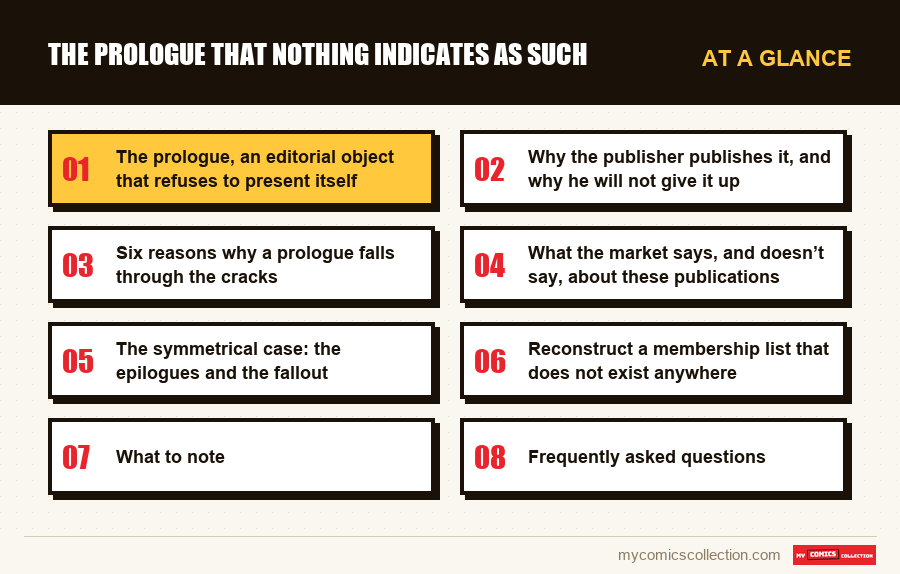
The prologue, an editorial object that refuses to present itself
A prologue is not a failed issue or a second-rate publication. It is a functional part, written to play a specific role in a larger mechanic. He sets the scene. It brings a place, a creature, an object, a threat, an alliance into existence, so that the event can then refer to it without wasting pages explaining it. The reader of the prologue recognizes; the reader who missed it discovers it at the wrong time, and this delay is paid for in confusion.
The paradox lies in the dressing. A number that formally belongs to an event screams it: common logo, cover box, incrementing numbering, explicit mention of the umbrella title. The prologue appears under its own name, with its own cover, often several months before the event is announced. It has no commercial reason to present itself as an accessory to something else: the publisher wants it to sell on its own, and an issue labeled "preamble" sells less well than one labeled "new story."
This lack of labeling is therefore not an oversight, it is a direct consequence of the way in which these publications are sold. We cannot hope that the marking will improve, because the marking would work against the product. You have to deal with it, and doing it with means only one thing: to reconstruct for yourself a list of membership which does not exist on any of the objects concerned.
It should be added that the prologue status is retroactive. At the time of publication, no one knows, not always the author himself, whether the installed element will be included. Some ideas launched in this way are never used again; others become central three years later. The “prologue” category is only stabilized following the events, which prohibits any list established once and for all.
Why the publisher publishes it, and why he will not give it up
Test an idea on a small scale
A single issue costs infinitely less to produce than a full event. It allows you to bring out a secondary figure, a concept, a tone, and observe the reaction. If the reception is good, the element comes to the fore in the main story; if it is lukewarm, it remains an isolated episode that no one will mention again. The prologue is a test bed disguised as an ordinary publication.
Occupy the calendar before launch
Between the announcement of a great story and its publication, there is a gap. The publisher must continue to exist on the shelves, to supply booksellers' orders, to keep people's attention. Prologues fill exactly this hole: they give something to buy now, while preparing for what we will buy next.
Transform a curious person into a regular
A reader who has paid for a preamble is already engaged. He's invested money and attention into a narrative thread, which makes it much more likely that he'll follow through. It's a gradual conversion: the single number serves as a low-cost entry to a regular monthly purchase.
Spread the risk across several securities
Having the entire weight of a launch carried by a single series is fragile. Disseminating the preparatory elements across several publications spreads the commercial risk and multiplies the entry points. Each title concerned benefits from a slight increase in interest, and the main story arrives with an audience already constituted on several sides.
None of these reasons have a negative impact on the publisher, and all of them have a negative impact on the collector. This is the definition of a lasting imbalance: the party making the object has no interest in reporting it, and the party looking for it has no way of finding it other than by investigating. This is not bad faith, it is a divergence of interests written into the model.
The point to remember is not that you should buy more. This is because a collection that aims to be complete around a story cannot be defined by a title and a range of numbers. The real perimeter always exceeds the series, and it exceeds by objects which are not indicated.
In other words, the relevant collection unit is not the issue or the series, but the membership list that one has established oneself. Until this list exists somewhere, the question "am I missing something?" » has no possible answer.
Six reasons why a prologue falls through the cracks
It appears under another title
A collector's natural search starts from the name of the event. The prologue does not contain it. A keyword search, in store or online, will therefore never bring it up, regardless of the precision of the query.
It appears months before
The chronological gap is enough to break the mental association. A booklet released well before the launch is filed, put away, forgotten. When the event arrives, no one makes the link with an issue purchased in another season, in another reading context.
Nothing on the cover says it
No common logo, no banner, no “chapter of” mention. The cover is designed to sell this issue, alone, to a reader who doesn't yet know what happens next. The object bears no trace of its future role.
It does not enter the collection
The bound reissues give priority to the issues formally attached to the story. What does not have the correct logo is frequently found outside the volume, scattered elsewhere or nowhere. The reader who discovers the story through the collection is therefore unaware of the existence of the preamble.
Its numbering does not follow
A unique number has no rank in a series. A mini-series starts from its own beginning. No numbering connects these objects to the main narrative, which deprives the collector of the most basic cue to detect a hole as a whole.
Its status is only established after
We only know that a booklet was a prologue once the event has been read. The designation comes retrospectively, often through conversation between readers rather than from an editorial source. It never goes back to the object itself, which remains silent.
What the market says, and doesn’t say, about these publications
A survey of announcements carried out on August 29, 2026 on these satellite publications gives a fairly clear picture of their position. As for uncertified copies, one hundred and fifty-nine advertisements were online, with asking amounts ranging from $2.59 to $99.99 and a central value of $9.99. As for verified copies, only thirteen announcements, with requests ranging from 49.98 to 175.99 dollars and a central value of 79.99 dollars. These are amounts claimed by sellers on that date, never recorded transactions: an isolated maximum reflects the hope of a seller, not a price paid.
The ratio thirteen to one hundred and fifty-nine is the most informative figure in the survey. Having a fascicle certified represents an expense: sending it, providing it, waiting for it, returning it. This expense is only justified if there is a sufficient price difference between the raw copy and the verified copy to absorb it and leave a profit. On these publications, this gap is practically non-existent on the scale of the whole: no one initiates the process, and the handful of certified copies which appear are more the consequence of a certification made for other reasons than a deliberate strategy. A collector who has these numbers therefore has no economic reason to have them verified; he collects them for the history they carry, not for the extra that certification would provide.
The second useful observation is hidden at the very bottom of the scale. The cheapest ad in the survey, at $2.59, was for an alternate skin for one of these unique numbers. In other words, even a satellite publication, marginal in the calendar and never indicated as a prerequisite for anything, has its own variations of coverage. This adds a whole layer to the identification problem: it is not enough to know that a prologue exists, you must also know in how many different presentations it has been put on sale, and which one you hold in your hands.
Last remark, which is as much a methodological warning as a result: research is porous. Asking the market about these publications brings up issues from several neighboring series, without it always being possible to decide which ones really fall within the targeted scope. This imprecision is not a defect in the request, it is the subject itself which manifests itself. These titles do not have their own scope: they do not belong to any declared group, so no research can properly circumscribe them. The disorder of the result is proof of the disorder of the category.
Collecting this series?
Track what you own, what you are missing and what your collection is worth. 7 day trial.
Start my trial →The symmetrical case: the epilogues and the fallout
The problem exists identically on the other side of the story, and it is even less addressed. A great event doesn't end with its last issue. It leaves a changed world, displaced characters, consequences that must be told somewhere. This somewhere is rarely the main story: it is the regular titles which take over, in the months that follow, with episodes which really complete the story without bearing its name.
The concealment mechanics are the same, reversed in time. The reader who closes the last chapter believes he has finished. He read the formal conclusion, the one that bears the logo. But the fate of a character, the reorganization of a status quo, the consequence of a choice, all of this plays out elsewhere, in issues that resemble ordinary episodes of an ordinary series. The event ended on paper and continues in practice.
Epilogues are even more difficult to spot than prologues, for a simple reason: attention fades. By the time the prologue appears, excitement is building, readers are looking for clues, the conversation is active. By the time the fallout appears, the event has passed, the audience has moved on to something else, and no one methodically takes stock of what comes next. A forgotten preamble often ends up being exhumed; a buried consequence remains buried.
There is also a difference in nature between the two. The prologue is written with the event in mind: someone at the publisher knows what it is for. The epilogue is sometimes written by another team, on another series, with greater freedom of interpretation. He can qualify, contradict, partially rewrite what the event affirmed. A reader who ignores this remains with a version of the story that the sequel has modified, without ever learning it.
For the constitution of a collection, the conclusion is clear: the perimeter of a story extends on both sides of its official numbering, upstream by undeclared preambles and downstream by scattered spinoffs. Both boundaries are blurred, neither is printed, and both must be established by the collector himself. It's the same work, applied twice, in two directions.
Reconstruct a membership list that does not exist anywhere
Since the information does not appear on the object, it must be produced and stored elsewhere. The only thing that makes a set of prologues and epilogues verifiable is a separate list, where each fascicle is explicitly linked to the story to which it relates. This list has no official equivalent: neither the publisher, nor the catalog, nor the seller provides it in a usable form.
The catalog remains essential for the technical identification of a booklet: knowing precisely what object you have in front of you, in what presentation it appeared. But a catalog describes publications, not narrative intentions. He will never say that a number was designed to prepare something else, because that is not a material property of the object. It is a property of the story, and it relates to a layer of information that the collector must add himself.
Concretely, this means never separating the act of putting a booklet away from the act of noting why it is there. A unique issue purchased because it prepares for an event, placed without comment in a box classified by title, becomes again in six months a unique issue about which we no longer know anything. The information that gave it its use value was in the head of the buyer, and it evaporates. This is the most common and most preventable form of loss.
The same requirement applies in reverse. When a reading reveals that a passage presupposes missing information, we must record the lack at the moment we feel it, not hope to remember it. An identified and written hole becomes a possible search; a hole only felt disappears with the reading session. This is what distinguishes a collection that progresses from one that accumulates.
Finally, this list must remain open. As we have seen, the status of prologue is retroactive: an innocuous number can become a prerequisite three years later, when an author decides to take up an abandoned thread. A fixed list becomes false; a list that is completed remains correct. It is not an inventory that we complete, it is a document that we maintain.
What to note
The connection, not just the fascicle. For each number acquired in this framework, the decisive information is not its state or its presentation, it is the story to which it relates and the reason why it relates to it. Without this mention, the object becomes an orphan again as soon as it is put away, and the logic which governed its purchase is lost.
The position in relation to the event. Noting whether the number comes before or after changes the way you read and complete it. A preamble calls for a forward check: is the event itself complete? A fallout calls for backward verification. The two directions do not seek each other in the same way and do not merge.
The precise coverage variation. The statement from August 29, 2026 shows that an alternative designation of one of these unique numbers appeared at the very bottom of the scale of the amounts requested, at $2.59. Cela signifie que ces publications ont, elles aussi, plusieurs présentations. Knowing which one you have avoids buying the same content twice, thinking you're completing a set.
The requested nature of the amounts observed. What was noted on August 29, 2026 were the prices displayed by sellers: one hundred and fifty-nine uncertified advertisements from $2.59 to $99.99, central value at $9.99, and thirteen advertisements of verified copies from $49.98 to $175.99, central value at $79.99. Recording this nature (a request, not a transaction) avoids building a collection estimate on sellers’ hopes.
The economic uselessness of certification here. Thirteen verified copies for one hundred and fifty-nine gross advertisements indicates that the process is practically not undertaken on these publications, due to lack of price difference to be captured. Noting this observation at the category level, once and for all, avoids asking the question issue by issue and paying for a service that would not be reimbursed.
Frequently asked questions
The questions almost always come back to the same points: how to know that a prologue exists, do you really have to have it, and what to do when the search returns results that do not concern the right set. Here are the answers as they emerge from the preceding statement and reasoning.
Not by the subject, which says nothing: neither its title, nor its numbering, nor its cover indicate this. The identification is done by reading, by noting that an element of the main story was already installed elsewhere, or by the conversation between readers who made this connection before you. This is information external to the booklet, and it must therefore be kept outside of it, in a list that you keep.
It can be read, but with gray areas. The event assumes what the preamble has established and does not take the time to re-explain it. The reader then perceives that something is missing without being able to say what, which is the typical sensation produced by an unread prologue. These publications are not decorative bonuses: they carry part of the necessary information.
Because certification is an expense that is only justified if it is recovered on resale. The statement of August 29, 2026 only includes thirteen announcements of verified copies compared to one hundred and fifty-nine gross announcements, which reflects the absence of a sufficient price difference to make the approach profitable in this category. These fascicles therefore circulate essentially in their original state.
Yes, and it’s even revealing. The research carried out on August 29, 2026 was itself porous and reported publications from several neighboring series. These titles have no declared scope: not officially belonging to any group, they cannot be properly isolated by a query. The final sorting is done by hand, from your own list, never from the search engine.
Yes, and you even have to push yourself harder, because the collective attention drops once the event is over. Issues published afterward complete the story without bearing its name, sometimes qualifying what the official conclusion stated. Ignoring them leaves the collection seemingly complete and the story incomplete in reality.
Keep the list that the publisher will never publish
An unnotated prologue becomes an anonymous booklet again in a few months. My Comics Collection lets you link each issue to the story to which it really belongs, indicate whether it comes before or after, specify the exact variation you have and instantly find what is missing around an event: including what does not bear its name.