
In short
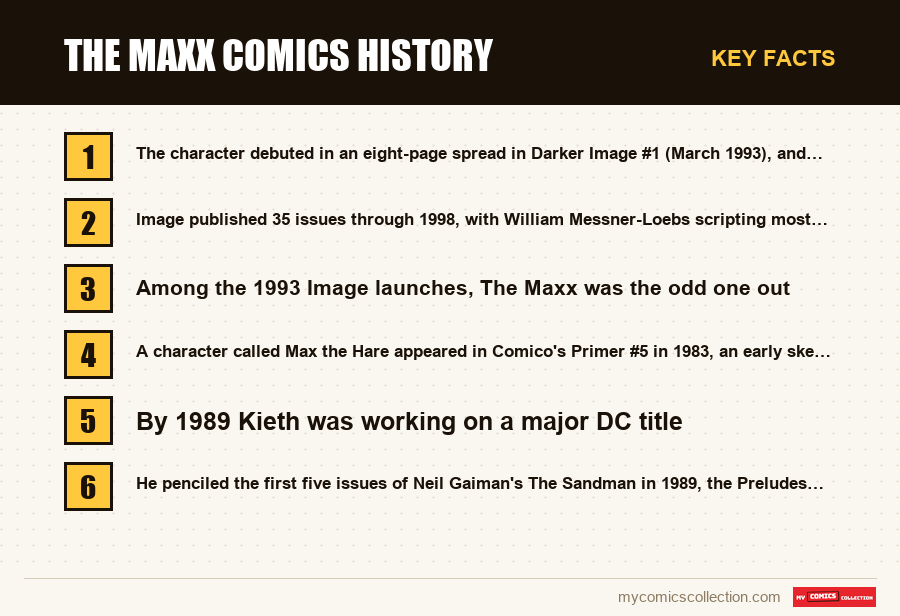
The Maxx is Sam Kieth's Image series about a homeless man who becomes a powerful protector in the Outback, a dream world tied to the social worker Julie Winters. The character debuted in an eight-page spread in Darker Image #1 (March 1993), and The Maxx #1 followed that same month. Image published 35 issues through 1998, with William Messner-Loebs scripting most of them and Alan Moore writing #21. MTV adapted it in 1995.
Among the 1993 Image launches, The Maxx was the odd one out. It had no team of heroes and no cosmic war, only a vagrant in a cardboard box and a world that existed inside one woman's mind. That strangeness is exactly why its publishing history rewards a careful look.
Credits, cover dates and issue ranges here were checked against published references. Our reading of how each stage changed the series is analysis, and the shelf advice at the end is method, not market commentary.
Sam Kieth before the Maxx
The Maxx has an ancestor. A character called Max the Hare appeared in Comico's Primer #5 in 1983, an early sketch of the idea that Kieth would later rebuild into something far more personal. It is the sort of early appearance that collectors of independent history appreciate, even though it sits outside the Image checklist.
By 1989 Kieth was working on a major DC title. He penciled the first five issues of Neil Gaiman's The Sandman in 1989, the Preludes and Nocturnes arc, before Mike Dringenberg took over the penciling. That background explains the look of the later series: a loose, expressive line, exaggerated anatomy and a willingness to let a page turn ugly or tender in the same panel.
Kieth would also illustrate two volumes of Messner-Loebs' Epicurus the Sage, so the two creators had worked together outside the Outback as well.
Darker Image #1 (March 1993)
The character's modern debut came in Darker Image #1, an Image anthology cover-dated March 1993. Kieth is credited as plotter and artist, and the Maxx appeared in an eight-page spread inside the first and only issue. For a collector this is the key early appearance of the modern character: it shares its March 1993 cover month with the series number one, and it carries the anthology title, which makes it easy to confuse with the series itself.
As an editorial move, the anthology spread worked like a trailer. It showed the key ingredients in compact form, a man in a mask who is also a derelict, and let readers decide whether to follow him into a monthly book.
The Maxx #1 and the Outback (1993)
The Maxx #1 came out in March 1993, the same cover month as Darker Image #1. The story moves between two worlds: the real city, where Maxx is a vagrant living in a box, and the Outback, a primeval landscape inside Julie Winters' subconscious, where he is a powerful protector and Julie is the all-powerful Jungle Queen.
The setup begins with an accident. Julie, a freelance social worker, hits a homeless man with her car and covers his body with trash. A lampshade from the Outback becomes a mask that links him to her and transforms him into the Maxx. From then on Julie often bails him out of jail, unaware that the Outback is central to her own story.
The antagonist is Mr. Gone, a serial rapist with a telepathic link to Julie who once posed as her father's friend, "Uncle Artie." His tall tales helped shape her Outback, and he tries to kill Maxx using the Isz, small, eyeless, egg-shaped beings of the Outback. The content is dark, and the series deliberately mixes comedy, trauma and fantasy in a way that the other Image launches of 1993 mostly avoided.
A half issue followed: The Maxx #1/2, cover-dated June 1993. Half-numbered issues are a recurring trap for collectors, since a run that looks complete from #1 to #35 can still be missing it.
Messner-Loebs and the long scripting run
Kieth plotted and drew every one of the 35 issues, and Jim Sinclair inked the series. The scripting was shared with William Messner-Loebs, known as Bill Messner-Loebs, who scripted issues #1 to #15, #17 to #20 and #22 to #23. That is most of the run, so the voice most readers associate with the title is a partnership in which Kieth supplied story and image and Messner-Loebs supplied the dialogue.
Seen across the whole run, this collaboration is what turned a visually bizarre premise into a book with a steady rhythm. The scripted issues build the relationships between Julie, Maxx and the teenager Sara, a depressed girl whose mother sends her to Julie for counseling. In the latter half of the series, Sara's spirit animal manifests itself as Norbert, a homeless man she takes pity on. Sara's own Outback includes pink, flying Isz that explode if they are not kept in water.
A recurring idea in these pages is the spirit animal, a creature linked to a person at a pivotal moment. It is part of what makes the book readable as a psychological story instead of a straightforward fight between hero and villain.
Issue #21 by Alan Moore
Alan Moore wrote The Maxx #21, an outside script in a run otherwise written by Kieth, alone or with Messner-Loebs. The issue sits between the Messner-Loebs stretches (#17 to #20 and #22 to #23), so a collector working through the run in order will find it in the middle of a scripting streak and not at either end.
For anyone who tracks Moore's wider output, it is a short, specific entry in a long bibliography. It also shows the standing the book had by the mid-1990s: a creator-owned Image title that could attract a writer of that profile for one issue.
One practical reading of the Maxx's publishing history is that it divides into four blocks: the 1993 launch, the 1995 to 1997 media and spin-off years, the 1998 close, and the long afterlife in reprints. Each block calls for a different kind of purchase, and keeping them separate makes a want list far easier to manage.
1995 to 1997: MTV, Gen13 and Friends of Maxx
The mid-1990s were the series' widest exposure. MTV adapted it as a 13-episode animated show for its Oddities block, which aired from April to June 1995. The adaptation covered Darker Image #1, The Maxx #1/2 and the first eleven issues of the series, so it follows the early comics closely and gives newcomers an on-ramp.
In December 1995 the series crossed over with Gen13, and from April 1996 to March 1997 the three-issue Friends of Maxx spin-off appeared. Both are optional for a core run, but a completist will want them, since they extend the title beyond the main 35 issues.
The cartoon is a useful marker for dating the series. Readers who first met Maxx on television in 1995 were arriving at a book that was already in its third year and approaching its closing stretch.
Do you collect this series?
Track what you own, what you are missing and what your collection is worth. 7-day trial.
Start my trial →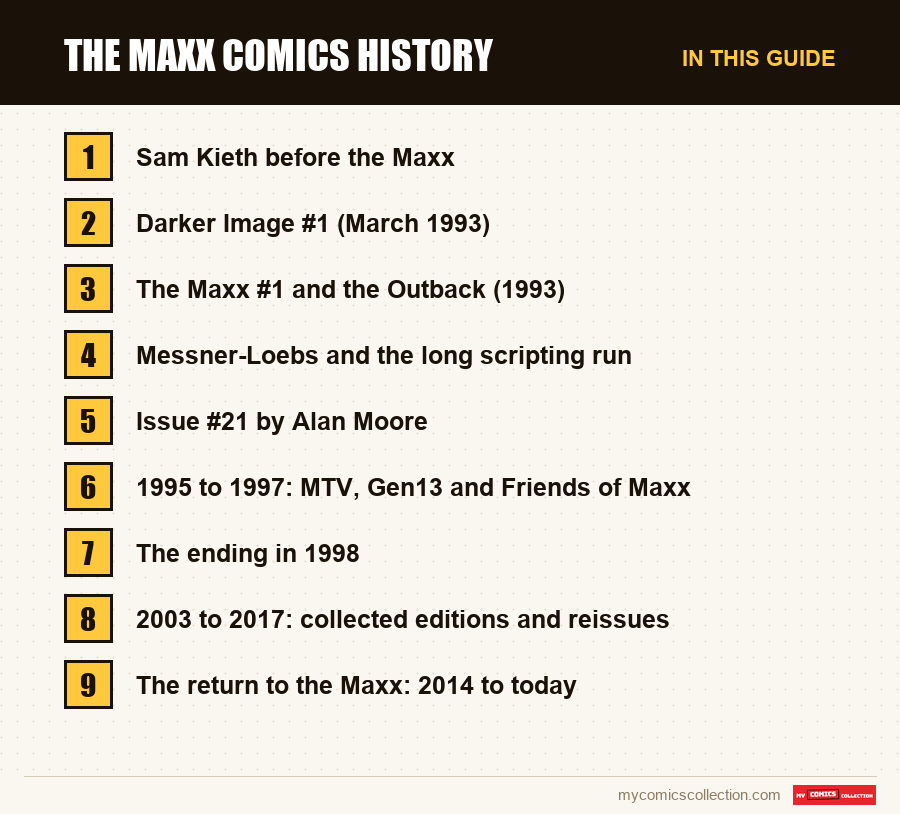
The ending in 1998
Image published the final issue of The Maxx in 1998, closing a run of 35 monthly numbers that had begun in March 1993. The second storyline resolves with its characters disappearing from reality to be reborn in another, and Mr. Gone is killed by the three agents who return with insect heads. In Julie's Outback he is reunited with Sara, who is a child again.
That conclusion is part of what makes the series a rare finished object among 1990s Image titles: it has a defined start, a defined end and a fixed number of issues. A collector can aim at a complete set in a way that is not possible with open-ended series.
2003 to 2017: collected editions and reissues
Image's original run was collected in five trade paperbacks, Books 1 to 5, published from September 2003 by DC's WildStorm imprint. Friends of Maxx was collected as Book 6 in February 2006. Those volumes kept the series in print during the years when the 1990s issues were harder to find.
IDW then republished the series as The Maxx: Maxximized, with new colors and improved scans, from November 2013 to September 2016. Seven hardcovers appeared between July 2014 and December 2016, and IDW later issued three Maxxed Out paperbacks in 2016 and 2017.
For a shelf, the editions represent a choice. The 1990s monthly issues are the original publication; the later volumes are reading copies with recolored pages and different scans. They are not substitutes for each other, and a collector should know which of the two they are buying.
The return to the Maxx: 2014 to today
Kieth drew a Maxx story for Hero Comics 2014 from IDW, his first work on the character in nearly twenty years. Later came a five-issue Batman/The Maxx crossover, published by IDW from October 2018 to February 2019, and the collection Batman/The Maxx: Arkham Dreams arrived in 2021. The crossover pairs the vagrant of the Outback with a character from the opposite end of the market, which is a measure of how far the book had traveled from its Image launch.
In November 2019, Channing Tatum and Roy Lee announced their intent to produce a film based on The Maxx, and in January 2024 Tatum said that production was moving forward. Announcements of that kind come and go, so the safest approach is to treat it as a curiosity until a finished film exists.
Kieth's other work gives context. He wrote and drew the four-issue Wolverine/Hulk miniseries in 2002, Zero Girl for WildStorm in 2001, and Batman: Secrets in 2006, so the Maxx sits at the center of a career that moved between publishers.
The key issues across the Maxx's history
- Primer #5 (Comico, 1983): the Max the Hare ancestor of the character.
- Darker Image #1 (March 1993): the eight-page debut of the modern Maxx.
- The Maxx #1 (March 1993): the first issue of the 35-issue series.
- The Maxx #1/2 (June 1993): the half issue that interrupts the numbering.
- The Maxx #21: the issue written by Alan Moore.
- Gen13/The Maxx (December 1995): the crossover between the two Image titles.
- Friends of Maxx #1 (April 1996): the first of the three spin-off issues.
- Batman/The Maxx (October 2018): the opening of the five-issue crossover.
How to follow the Maxx in a collection
Treat the title as a closed set: Darker Image #1, the 35 issues, the half issue, the Gen13 crossover and the three Friends of Maxx issues. Write the list down before you shop, because the half issue and the anthology are the pieces that get overlooked. The Image first-printing guide explains how to confirm that an early copy is the original.
Decide early whether you want the original 1990s issues or the later collected volumes. The creator-owned comics guide frames how titles like this one differ from work-for-hire books, and the Spawn history shows a contrasting path for another Image founder-era launch.
Finally, log each copy by series name and cover date, not by number alone, since two different books can share a number one in March 1993.
Frequently asked questions
Sam Kieth created The Maxx. He plotted and drew all 35 issues of the Image series, with Jim Sinclair inking. William Messner-Loebs scripted most issues, and Alan Moore wrote #21. Kieth had earlier penciled the first five issues of The Sandman in 1989.
The modern character first appeared in an eight-page spread in Darker Image #1, cover-dated March 1993. The Maxx #1 followed in the same month. An earlier ancestor, Max the Hare, appeared in Comico's Primer #5 in 1983.
Image published 35 monthly issues from March 1993 through 1998. Collectors also look for The Maxx #1/2 (June 1993), the Gen13/The Maxx crossover (December 1995) and the three-issue Friends of Maxx (1996 to 1997).
Yes. MTV aired a 13-episode animated adaptation in its Oddities block from April to June 1995. It adapted Darker Image #1, The Maxx #1/2 and the first eleven issues of the comic.
Yes. IDW reprinted the series as The Maxx: Maxximized from 2013 to 2016, Kieth drew a Maxx story for Hero Comics 2014, and a five-issue Batman/The Maxx crossover from IDW ran from October 2018 to February 2019.
If you hold early Darker Image or The Maxx issues, a quick valuation shows where your copies stand.
Estimate my comic