The 1966 story that introduced Galactus lasted for three consecutive issues, and demand was not evenly distributed between them. As of the August 29, 2026 reading, the opening had a median of $635.00 on unverified listings, while the next two numbers, counted together, hovered around $300.00. The count of verified copies further widens the gap: 137 on one side, 26 on the other. Please note, these two surveys do not relate to the same number of issues, one versus two, and are therefore not strictly comparable; the gap nevertheless remains too wide to be only an effect of this imbalance. What this says: on a story in several parts, the request focuses on the first episode and deserts the sequel, because what is sought is not the story but the moment of appearance.
A story in three parts reads like a whole. It is not collected as a whole. This is the contradiction that any survey of advertisements for a famous arch reveals: the first third lives in one market, the next two thirds in another, and nothing in the narrative quality justifies the border. The reader who opens the first issue wants to know how the story begins; the buyer who pays for it seeks to own the moment a character enters continuity. The two gestures relate to the same object and do not obey the same price.
The following figures come from a snapshot taken on August 29, 2026. These are amounts requested by sellers on that date, not completed transactions: no one paid these amounts, they express an intention to sell. The copies accompanied by a certificate of authentication and note were isolated from the rest, because mixing a raw fascicle and an encapsulated fascicle produces an average which does not describe any real object. And as it is a single photograph, on a single date, it says nothing about an increase or a decrease: to talk about movement, we would need at least two measurements spaced over time, which we do not have here.
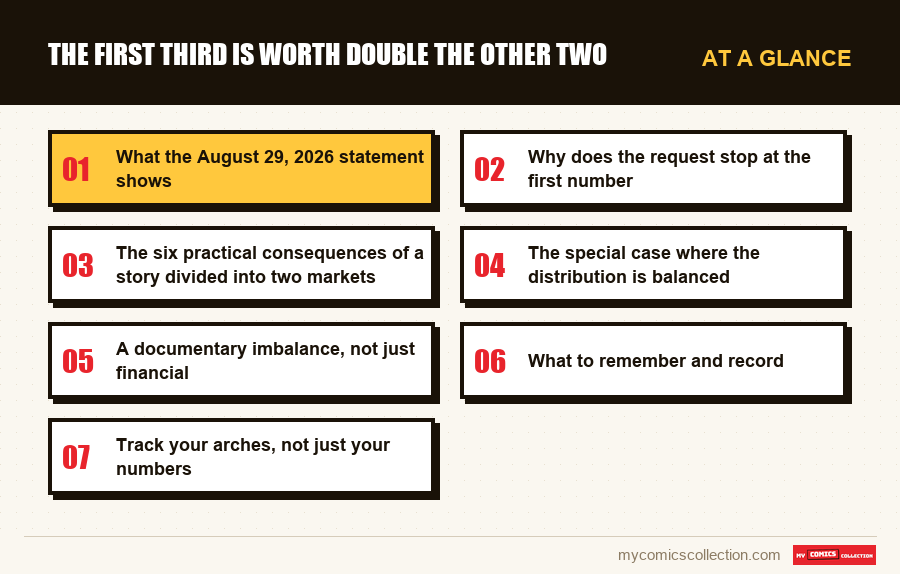
What the August 29, 2026 statement shows
On the open side, 51 unverified listings were placed around a median of $635.00. The verified side had 137 listings, ranging from $29.99 to $35,000.00, with a median of $1,449.00. Across the next two numbers combined, 84 unverified listings ranged from $9.99 to $2,200.00 for a median of $300.00, and 26 verified listings ranged from $300.00 to $7,500.00 for a median of $767.50. Two remarks are necessary before reading. The first: the maximum of $35,000.00 measures nothing other than the hope of an isolated seller, and it should certainly not be confused with a level reached. The second: the 26 verified announcements in the following form a small number, sufficient to note a scarcity of supply, insufficient to establish a firm conclusion on a price level: we will therefore stick to the observation of volume.
The most instructive point is not the price but the counting. 137 verified copies on sale for a single issue, compared to 26 for two issues taken together: the volume ratio far exceeds what the simple number of issues explains. If demand were distributed evenly across the arch, the sequel, two issues, should present more verified supply than the opening, not five times less. Exactly the opposite appears. Certification has a cost, and no one commits it to a booklet that they do not expect to be recovered on resale: the low number of copies verified on parts two and three firstly reflects an economic decision repeated by hundreds of independent owners.
Why does the request stop at the first number
What is purchased is not a story
The buyer of a first episode does not buy a story whose ending is missing. He buys a date of entry into continuity, an object which bears a precise and verifiable mention. This mention is not divided: it is entirely on a single issue, and the following cannot claim a fraction of it.
The reference list stops at the first
The lists of booklets to own, whether published or compiled step by step by collectors, mention the opening and move on. A sequel has no line of its own. As demand is largely formed by copying these lists, the absence of a line is equivalent to an absence of buyers.
The seller adapts his effort to the title
Having a booklet authenticated and noted involves costs and weeks of waiting. An owner only hires them if he expects to get them back. The opening number justifies it; the following ones rarely. The 26 verified announcements noted below therefore do not measure a physical rarity but a rarity of steps taken.
The gap maintains itself
The less certified the suite, the less it appears in filtered searches on verified copies; the less it appears, the less it is in demand; the less it is requested, the less rational it becomes to have it certified. The loop closes on itself and dispenses with any judgment on the quality of the content.
None of these four mechanisms involve narrative. They can be described entirely without ever saying what happens on the pages. This is the best indicator that the price difference does not reward narrative success but a position in a publication order. The first issue occupies a place that nothing can compete with it, and the following two occupy a place that thousands of other issues also occupy: that of an ordinary issue of a long series.
Reminder of method: the two statements compared here do not cover the same perimeter. On one side a fascicle, on the other two aggregate fascicles. A median calculated on two references mixes two ad populations and does not properly replace a median calculated on just one.
That being said, aggregation does not create the gap observed: it would rather tend to reduce it, since it gives the suite twice as many opportunities to attract expensive advertisements. That the verified count remains at 26 against 137 despite this doubling of perimeter is precisely what makes the observation solid.
The six practical consequences of a story divided into two markets
Reading costs a fraction of owning
For those who want to know the entire arch, the remaining two thirds are accessible at a level incommensurate with that of the opening. The unverified median noted on the sequel, $300.00 against $635.00 for the first issue, says it in its own way, and the bottom of the range went down to $9.99. The full story is not reserved for those who can afford its starting point.
Inventories accumulate orphaned first numbers
As everyone buys the opening and neglects the sequel, collections are filled with beginnings without continuation. An inventory can line up dozens of first appearances and contain almost no complete arches. This imbalance is never chosen: it results from the addition of individually reasonable purchases.
The conclusion is the least collected part
The last episode of an arch is often the one where the construction succeeds, where the issue is resolved, where the design unfolds most freely. However, it has no status on the market, because it does not introduce anything. Narrative success and collection demand are here two quantities with no measurable relationship.
The average state of the suite is more uncertain
Not very certified, numbers two and three circulate mainly in their raw state, described by their sellers. The buyer must therefore judge on photographs and description, without the benefit of a rating by a third party. This is the direct reverse of the savings made on the displayed price.
The lots bring together what the market has separated
Part of the offer on the suites takes the form of lots of several issues, because the seller does not find it in the interest of putting together an individual ad for each. This confuses the statements: a lot does not have the same meaning as a single number, and its presence in an announcement list pulls the ranges downward.
The reissue replaces the original for reading
With parts two and three being read rather than hoarded, the demand for reading shifts overwhelmingly to collections and reissues, which satisfy it at an unrelated cost. This flight of demand from the market for original booklets further accentuates the low volumes observed for sequels.
Collecting this series?
Track what you own, what you are missing and what your collection is worth. 7 day trial.
Start my trial →The special case where the distribution is balanced
There is one configuration, and one only, where the gap between the opening and the sequel narrows: the one where the last part of the story also contains a notable appearance. A secondary character who enters the scene in the last episode, an entity presented in the concluding pages, a role which did not exist before: as soon as a second entry point exists in the ark, it creates its own market, independent of the place it occupies in the story. The conclusion then ceases to be an end and becomes a beginning again, which is exactly what the market knows how to value.
This exception confirms the mechanism rather than contradicting it. It is not the quality of the last episode that pulls it to the top in this case, nor its position of resolution: it is the presence, on its pages, of an element which was nowhere before. The criterion remains identical from one end of the arch to the other: the unprecedented -, only the way in which it is distributed between the fascicles changes. An arch with two entry points sees its demand split into two poles; an arch with a single entry point sees its demand crash entirely on the first number.
For a collector, this configuration is worth spotting in advance, because it changes the way you approach the whole thing. On an arch with a single entry point, the suite can be assembled quietly, without competition, at a chosen time. On an arch with a double entry point, the final part behaves like a wanted act in its own right and waits for no one. Confusing the two situations leads either to rushing unnecessarily or to letting an opportunity pass by believing that it will remain available.
Spotting these cases does not require any particular knowledge of the market: you just need to know what each episode contains. This is precisely what an orderly reading of the character provides, and it is yet another reason why the reading timeline and the search number map always end up overlapping, even if they answer different questions.
A documentary imbalance, not just financial
The most enduring point of all this isn't the price: it's what the market structure does to the collections themselves. When demand focuses on openings, inventories end up containing a majority of issues that begin something and a minority of issues that complete anything. A collection thus constituted is very rich in entry dates and very poor in complete stories. It documents the history of the characters perfectly and the history of the stories very poorly.
This bias is then transmitted to tracking tools. A waiting list built from the most requested numbers will mechanically reproduce the imbalance, since it is fueled by what the market puts forward. It takes a voluntary gesture to restore the balance: deciding to include the entire arch, and not just its beginning, in what we wish to bring together. This is a collector's choice, not a natural consequence of the market.
Finally, there is a more insidious effect, on the side of knowledge. As the suites are rarely exchanged, they are little described, little photographed, little commented on. Information on condition, cover variants and printing details circulates abundantly on the openings and much less on what follows. The buyer of a part two or three therefore has thinner documentation, not because the booklet is more obscure, but because no one had a commercial reason to study it.
This documentary deficit is reversible, and it is at the individual level. Each recorded statement, each condition noted precisely, each asking price dated and stored constitutes a piece of information that was missing. A collector who seriously documents the neglected two-thirds of an ark produces, without thought, exactly what the rest of the market is lacking.
What to remember and record
Note the exact perimeter of each reading. The difference presented here opposes one fascicle to two aggregate fascicles, and this asymmetry must accompany the figure wherever it is taken up. Without it, the median of $300.00 seems to describe a specific number even though it describes a set. Systematically record the number of references behind each median: this is the only way to know later what the number could legitimately mean.
Separate the counting from the price in your notes. On this arch, the most robust information is not the median but the ratio 137 to 26 on the verified copies, because a count does not depend on any calculation hypothesis. Therefore, always record the number next to the amount, and consider that a low number, like the 26 verified advertisements below, prevents you from concluding on a price level while allowing you to see a low offer.
Mark the arches, not just the numbers. A first episode entered alone in an inventory does not indicate that it is missing two sequels. Explicitly attach each issue to the arch of which it is a part, with its position within it, and you will immediately see the orphan starts appear that the market has pushed you to accumulate without you having decided to do so.
Report the final episodes carrying a cameo. This is the only configuration where the late part of a story behaves like a wanted number. Mark it with a separate indicator in your tracking, so as not to treat it as a simple suite available at will. This annotation is worth more than any price statement because it tells you what level of urgency to apply.
Date everything, and refuse to conclude on a single point. The amounts quoted here are for August 29, 2026 and these are seller requests, not completed sales. An isolated observation does not show any trend: several spaced readings are required for a movement to appear. Get in the habit of timestamping each price note, and mentioning whether it is a raw copy or a verified copy, otherwise your own records will become unreadable for yourself.
Because what is sought is not the narration but the moment of appearance, and this moment is entirely contained in a single booklet. The following episodes tell the same story but introduce nothing, which reduces them to the status of an ordinary issue of a long series. As of the August 29, 2026 statement, the unverified median was $635.00 for the opening and $300.00 for the two suites taken together.
Not strictly, and it must be said clearly: the first concerns a single issue, the second combines two issues. A median calculated on two references does not have the same meaning as a median calculated on only one. That said, aggregation should have narrowed the gap by subsequently offering twice as many high-advertising opportunities; the fact that the gap remains so marked indicates that it is not due to this difference in scope.
It means that a seller has set this price, nothing more. An isolated extreme expresses an individual hope, not an observed level or a completed transaction. It does not enter into the calculation of the median, which is chosen precisely because it resists the extreme values of the two edges of the range.
No, it means above all that few owners have found it useful to incur the costs and delays of authenticating these documents. The observed rarity relates to the steps taken, not to the existing copies. With only 26 verified advertisements noted, the number is in any case too thin to draw a firm conclusion on a price level.
Yes, when that final episode itself contains a notable cameo. Demand then splits into two poles instead of colliding at the beginning. This is the only known configuration where the distribution is balanced, and it confirms the general mechanism since it still relies on the new, not on the narrative success of the conclusion.
Track your arches, not just your numbers
An inventory which links each booklet to the story of which it is part immediately shows the orphaned beginnings and the missing sequels. My Comics Collection records your copies, their condition and your dated statements, and lets you see at a glance which stories are complete and which stop at their first third.