As a general rule, the comic book market does not pay for story events: the death of a character, even known and even commented on for decades, is commonly traded for a few dollars. The 1982 installment in which Bullseye kills Daredevil's companion escapes this rule. On August 29, 2026, a count of online advertisements gave, for copies without certification, one hundred and thirty-six proposals ranging between 21.99 and 380.00 dollars, with a median asking value of 44.99 dollars; for verified copies, sixty-one proposals between $51.29 and $799.95, median asking value $200.00. These are amounts claimed by sellers, never recorded transactions. The exception does not come from the death itself: it comes from the meeting between a strong event and a period of the series already sought after for other reasons.
We must start by stating the rule before qualifying it, otherwise the nuance becomes a slogan. The American comic book market pays very poorly for narrative events. First appearances have to be paid for, costume changes sometimes have to be paid for, low print runs always have to be paid for, but character deaths, including those which have had an impact on entire readers, most often remain within the range of ordinary booklets. You can find dozens of examples in any convention bin: issues with a major death on the cover, sold for the price of any issue from the same decade. The likely reason is supply: an announced event sells more upon release, so more copies survive, so the relationship between demand and availability remains balanced. An event sells in the moment; it does not create scarcity in the long term, it destroys it.
The 1982 booklet in which the professional killer eliminates the partner of the fearless man constitutes an exception documented by the advertisements. Not a spectacular exception in the sense that the price would be out of reach, but a clear exception: the floor observed on August 29, 2026 was $21.99, which means that no seller offered this issue under twenty dollars. On a booklet from the 1980s, this is very unusual. The production of this decade is abundant, largely preserved, and the majority of titles from the period can be found in lots at a few dollars each. A floor that refuses to go down reflects something other than occasional enthusiasm: it indicates that the holders have no reason to sell off, because they know that the number is finding a buyer. The rest of this article seeks to understand why this death, and not the others, produced this result.
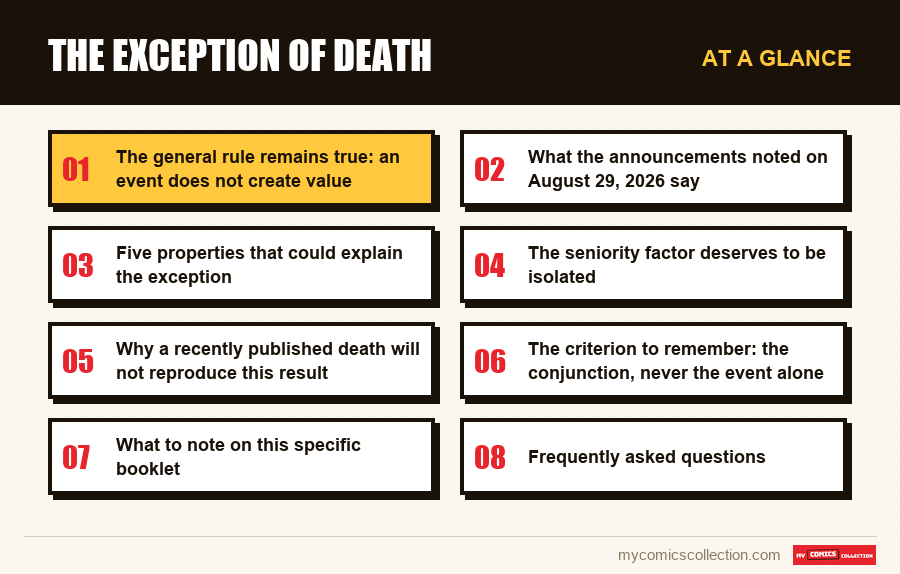
The general rule remains true: an event does not create value
Nothing that follows calls into question the initial principle. A character death, taken in isolation, is a poor indicator of market value. Three mechanisms explain it, and none is specific to a publisher or an era. The first is overprinting: when a death is announced, distributors and readers order more, the publisher prints accordingly, and the surviving stock far exceeds that of neighboring issues. The second is reversibility: the readership has learned, decade after decade, that a dead character returns, and a disappearance perceived as temporary does not constitute a lasting demand. The third is immediate speculation, which empties the market upon exit and then refills it a few years later, when the buyers of the time all resell at the same time. The usual result is a highly commented and inexpensive booklet.
It must be added that value in this market is built primarily around the appearance of a thing rather than its disappearance. A first costume, a first team, a first author on a title: these are starting points, and starting points are sought after because they do not repeat themselves. A death is a finish point, and a finish point can be canceled. This asymmetry explains why long-term collectors build their lists around beginnings and not endings. The exception we are examining does not contradict this logic; it shows that a point of arrival can acquire the status of a point of departure when it concludes something that nothing has canceled in the memory of the readership.
What the announcements noted on August 29, 2026 say
One hundred and thirty-six proposals without certification
For unverified copies, the count retains one hundred and thirty-six advertisements on August 29, 2026, distributed between 21.99 and 380.00 dollars, with a median asking value of 44.99 dollars. The median is the indicator to remember: it separates the offer into two halves and resists extreme proposals, unlike an average which would allow itself to be pulled upwards by a few optimistic sellers.
Sixty-one verified proposals
The certified segment has sixty-one listings on the same day, from $51.29 to $799.95, median asking value $200.00. These two medians cannot be compared directly: the certification mainly retains examples in apparently good condition and adds the cost of the expertise, so that the difference measures as much a difference in selection as a difference in price.
A floor at $21.99
This is the most telling fact of the report. No seller was offering this number for under twenty dollars. On a 1982 booklet, the usual flea market threshold, a few dollars each, appears nowhere. A holding bottom likely signals continued demand rather than a passing spike in attention, since holders do not need to break their price to sell.
Nearly a third of the offer went through verification
Sixty-one verified copies for one hundred and thirty-six unverified: the proportion is high. Having a booklet appraised costs money and immobilizes the object for several weeks. No one incurs this expense on a number that cannot be exchanged. This share of certification is therefore an indirect index of real activity, independent of the prices displayed.
These four observations must be read with the same caution. A listing count measures what sellers hope to get on a given day, not what buyers have agreed to pay. The upper limit of the verified segment, $799.95, proves nothing other than the existence of a seller who set this amount; it can stay online for months. Conversely, the floor at $21.99 does not establish that a copy is trading at that price, only that no one goes below it. A statement of this type describes a status of the offer as of a date. It demonstrates no causality and says nothing about what happens next.
A precision of method which changes the reading: the two segments do not describe the same population of objects. The verified copies are, in the majority, those that their owners considered presentable enough to justify an expertise. Comparing $44.99 and $200.00 as if they were the same issue in two different packages would produce a false conclusion.
In the same way, an isolated maximum is never a market price. On any advertisement, the seller alone chooses his amount, and nothing obliges him to revise it. The upper limit provides information on the hope of a seller; the median provides information on the middle of the offer. Only the second deserves to be retained.
Five properties that could explain the exception
The victim is not a supporting role
Most of the deaths that do not pay off concern secondary characters, or figures that the readership knows serve as an adjustment variable. Here, the victim is a major character, with her own readership, her own stories and a posterity independent of the series in which she disappears. Hypothesis: the demand relates to it as much as to the event.
The scene concludes an arc, not an episode
A death that occurs in an isolated number remains an incident. This closes a construction started much earlier, of which it constitutes the logical endpoint. Hypothesis: A reader who wants to own the conclusion must also want to own what came before, which expands the request instead of focusing it on a single box.
The entire period is searched
This booklet belongs to a sequence in the series which is requested for itself, independently of this episode. Hypothesis: some of the buyers are not looking for death, but for the period, and buy this issue because it is part of it. Demand therefore has two sources and not just one.
An author identified with the series
The period in question is associated with an author that the readership identifies with this specific title, to the point that his name serves as a benchmark to delimit the sequence. Hypothesis: this signature creates a stable clientele, who continues the entire series and not just one issue. An author request behaves differently than an event request: it spreads out and it lasts.
An object from 1982, therefore truly destroyed
Four decades separate the publication of the survey. Over this period, part of the print run was read, folded, moistened, thrown away, or resold by weight. This destruction rate is not theoretical. Hypothesis: the relative rarity of the object in good condition is as important as the content, and this rarity cannot be manufactured.
A death that was not perceived as a process
The readership has developed a distrust of deaths announced with great fanfare. This was received as a consequence of the story and not as an operation. Hypothesis: this reception, independent of the market, contributes to maintaining interest over time, where a death perceived as an artifice disappears once the effect has subsided.
The seniority factor deserves to be isolated
Among these five properties, seniority plays a special role, because it is the only one that does not depend on the content of the story. A booklet from 1982 has gone through forty years of manipulation. It was purchased by readers who, for the most part, did not view their purchase as something worth keeping. He stayed in attics, he was transported, lent, corned. Systematic conservation practices (pouch, cardboard, box protected from light) only became widespread later, and in an uneven manner. The result is mechanical: the number of copies in presentable condition decreases each year, without any editorial decision being made.
This erosion explains why old fascicles are more resistant to trivialization than recent ones. An issue published three years ago still exists in considerable quantities, often in near new condition, often in several copies from the same buyer. Nothing has destroyed it, and nothing will destroy it for a long time, since a significant part of the circulation was purchased precisely to be preserved. Seniority therefore does not add value through nostalgia: it adds value through subtraction of supply. It is a slow, steady mechanism, and impossible to speed up.
You need to add a selection effect. The old copies circulating today have already survived forty years of sorting. Those that remain are, on average, those that someone has seen fit to keep. This further reduces the available population in the lowest states, but it also reduces uncertainty for the buyer: an item that has passed through several hands without disappearing has a good chance of passing through others. This stability probably contributes to the observed floor.
Finally, seniority affects demand and not just supply. A booklet from 1982 is today an object that several generations of readers may want: those who knew it when it came out, those who discovered the series through the collections, those who come from the adaptations. A recent issue has only one audience, that of the moment. Time expands the audience on one side and shrinks the stock on the other. No narrative event produces this scissors effect on its own.
Collecting this series?
Track what you own, what you are missing and what your collection is worth. 7 day trial.
Start my trial →Why a recently published death will not reproduce this result
The practical conclusion from the above is harsh for news buyers. One death published this year does not have any of the properties listed above. It has no seniority, therefore no destruction. It does not yet belong to an identified period, since a period is only delimited after the fact, when we know where it stopped. It is not signed by an author already associated with the title in collective memory, since this association takes years. It was not considered irreversible, since there is nothing to know. And it was printed based on the attention it attracted, so probably in greater quantity than neighboring issues.
In other words, a recent death meets exactly the opposite conditions to those which produce an exception. This is why it is reasonable to consider that the announcement of an upcoming death is a weak reason to buy. The reader who wants to read the episode is obviously right to buy it; the one who buys it in anticipation of a future value relies on a mechanism that the ad statements do not support. The difference between the two gestures is not moral, it is methodological: the first expects nothing from the market, the second gives it a regularity that it does not have.
There is a legitimate objection: forty years earlier, no one knew that the 1982 issue would become an exception. It’s true, and that’s precisely the argument. The exception was not created by the event when it appeared; it was constructed by what happened afterwards: the progressive recognition of the period, the lasting attachment to the disappeared character, the erosion of the stock. None of this was predictable at the time of release, and there is nothing to indicate today, among the current publications, which ones will follow the same path.
The criterion to remember: the conjunction, never the event alone
From all of the above a usable criterion emerges, and it can be summed up in one sentence: it is never the event that is paid for, it is the meeting of an event and a period already requested. The reasoning is verified by breaking it down. A strong event in a period without particular demand produces an ordinary booklet, often abundant because the event caused sales. A sought-after period without notable events produces numbers at the average price of the series, honorable but without deviation. The two together produce an exception, because two distinct requests arise on the same object in limited quantity.
This criterion has the advantage of being verifiable before purchase, and without a complicated instrument. Just wonder if the time period surrounding the coveted number is itself researched, regardless of the scene that made it famous. If the answer is no, the event alone carries all the supposed value, and experience shows that this load is too heavy for it. If the answer is yes, we are in the configuration which produced the reading of August 29, 2026: without guarantee, but with readable logic.
The criterion also works in reverse, to avoid disappointment. He explains why so many issues with a death on the cover end up in shelves at a low price: they have only one argument. He explains why certain issues without any remarkable event sell well: they belong to a requested sequence. And he explains why the conjunction is rare: it supposes that an author has produced a recognized period and that he has placed an outcome there, which cannot be decreed.
What to note on this specific booklet
The floor matters more than the median. On this issue, the median asking value of $44.99 in the unverified segment is useful information, but the complete lack of a proposal under twenty dollars speaks volumes. A median may rise because a few ambitious sellers have joined the market; a floor only holds if the holders, as a whole, consider that there is no urgency to sell. For a booklet from 1982, this is the most difficult signal to falsify.
The proportion of copies checked is an indicator of activity, not quality. Sixty-one certified advertisements compared to one hundred and thirty-six non-certified ones means that almost a third of the offer bore the cost and time of an expertise. This expense is not incurred on a dormant object. It says nothing about the average condition of copies in circulation, but it does say that the issue trades enough to justify the investment: which is exactly the information that a price count does not provide.
The two medians do not subtract. Calculating the difference between $44.99 and $200.00 to deduce the gain from a certification would be a reading error. The verified segment does not contain the same objects: it was filtered upstream by the holders themselves, who only send for expertise what they think is worth it. The gap measures a difference in population as much as a difference in treatment.
The upper limit must be excluded from all reasoning. The proposal at $799.95 in the verified segment, like that at $380.00 in the raw segment, does not constitute a benchmark. A listing can stay online indefinitely without meeting a buyer, and its amount only reflects what a seller has decided to list. Using these limits to estimate a personal example systematically leads to overvaluation.
The statement is from a single day and does not extend. The figures cited describe the state of supply on August 29, 2026, and nothing else. They do not allow any statement about what the number was worth before, nor what it will be worth next. An ad count is a photograph; interpreting it as a trajectory amounts to inventing the missing images. Good practice is to repeat the reading at regular intervals and compare, rather than extrapolating from a snapshot.
Frequently asked questions
The questions that come up Almost all concern the same confusion: that between an amount displayed and a price paid. The answers below stick strictly to the count of announcements of August 29, 2026 and point out, each time, what this count does not allow us to conclude.
No, that's not what the statement says. On August 29, 2026, $44.99 was the median value requested by sellers of uncertified copies, out of one hundred and thirty-six listings. This is the amount that separates the offer into two halves, not a transaction price. A specific copy can trade above or below depending on its condition, the patience of the seller and that of the buyer.
Because they only combine one argument. An isolated death, in a period without specific demand, on a booklet printed in quantity because the event was announced, has no rarity mechanism. The hypothesis defended here is that the 1982 issue benefits from a conjunction: a story outcome placed within a sequence that the readership is already looking for for its own sake.
The statement does not allow us to decide. It shows that sixty-one verified ads coexisted with one hundred and thirty-six unverified ones, and that the requested median was higher in the first group. But these two groups do not contain the same objects: certification selects in advance the examples deemed presentable. The difference in median therefore does not translate mechanically into gain for a given example, and the cost of expertise must be taken into account.
There is nothing to confirm this, and several elements invite doubt. A recent booklet has not suffered any destruction, belongs to a period that no one can yet delimit, and was probably printed in proportion to the attention it aroused. The properties that distinguish the 1982 issue were built up after the fact, over four decades. They are not identifiable at the time of publication.
By counting, on a fixed date, the available announcements, separating the verified copies from the others, and retaining the median rather than the average or the extremes. You then have to start again later and compare the two readings. A single metric describes a supply state; only repetition makes it possible to observe a movement, and even then these are amounts requested, never sales recorded.
Record your readings instead of repeating them
An observation like this only has value when repeated. My Comics Collection allows you to record your issues, the condition of each copy and your market observations to date, to compare from one time to the next without starting from scratch.