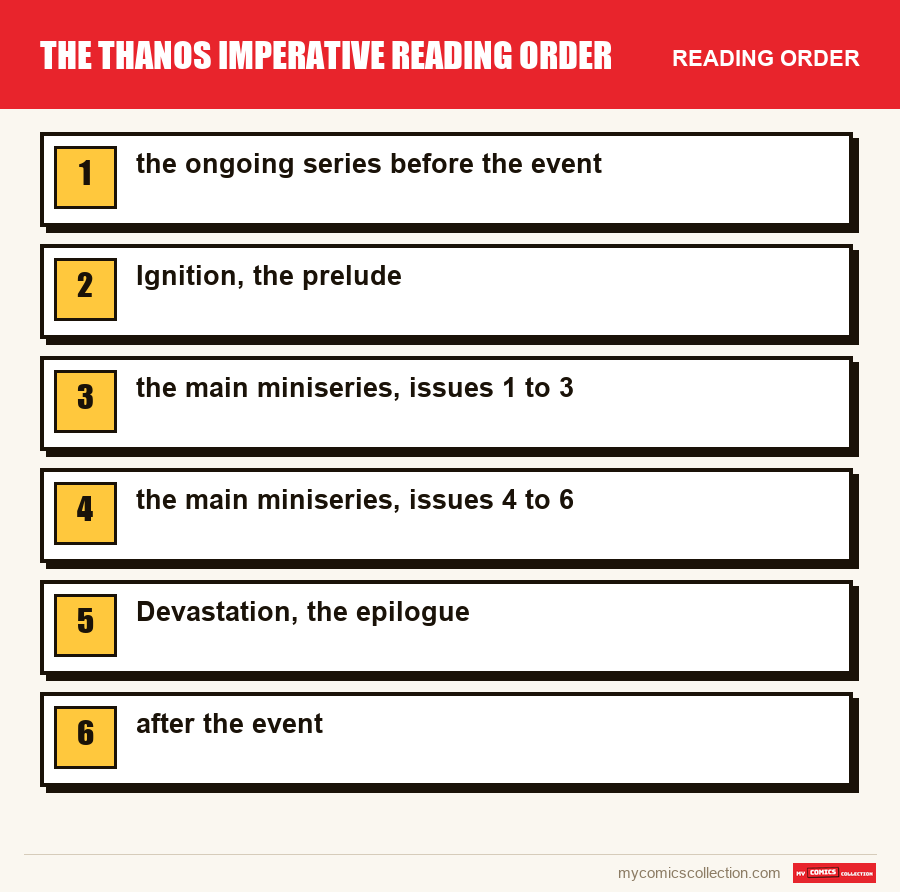
The Thanos Imperative reading order runs from prelude to aftermath: The Thanos Imperative is a six-issue cosmic miniseries launched in 2010, written by Dan Abnett and Andy Lanning and drawn by Miguel Angel Sepulveda, bookended by two one-shots, Ignition and Devastation. Read Annihilation: Conquest and War of Kings first, then Ignition, the six issues in order, Devastation, and finally the follow-ups with the Annihilators team.
Marvel's cosmic side saw, between 2006 and 2010, a run of events built by the same writers. The Thanos Imperative is the finish line: a last miniseries that closes an entire cycle, and one that reads poorly without what comes before it. This guide tells you what to read, in what order, and what to leave aside.
As always in this guide, we state only verified information (creators, issue numbers, dates); the analysis is our own, with no reproduction of protected pages or dialogue.
What to read first
The miniseries is the culmination of the cycle opened by Annihilation, and above all of War of Kings and Realm of Kings: the war between empires ended with the opening of a breach, the Fault, between parallel universes. That is the first test of preparation: without War of Kings, the breach that serves as the setting for the story remains a mystery.
- Annihilation: Conquest, the cosmic event that precedes War of Kings: our Annihilation: Conquest reading order details its issues.
- War of Kings, the war between empires that comes directly before: our War of Kings reading order gives the complete reading plan; the war ends with the opening of the breach.
- Realm of Kings, the chapter that follows War of Kings and that the miniseries picks up from directly.
- Guardians of the Galaxy (volume 2) and Nova (volume 4), the two ongoing series whose writers are also the writers of the miniseries.
A reader in a hurry can limit themselves to War of Kings and the two ongoing series, but will lose the context that Annihilation: Conquest provides. For a first look at the character of Thanos himself, our Thanos reading guide places this title in the bigger picture.
Phase 1: the ongoing series before the event
Two ongoing series, Guardians of the Galaxy and Nova, lead up to the miniseries and stop there. Guardians of the Galaxy #25 and Nova #36 deal with the aftermath of War of Kings and Realm of Kings, after which both titles end. On the Nova side, the fourth volume, written by Abnett and Lanning, therefore ends at issue #36.
Read these two closing issues as you approach the event, around the prelude Ignition: they wrap up the two ongoing series and set out the characters' situation. Richard Rider, who carries the Nova series of this cycle, was born in The Man Called Nova #1 from 1976, a story by Marv Wolfman illustrated by John Buscema. Our page on the key issues of Nova covers that path.
If you read only one issue of each series, read those. The intermediate issues of the two series add depth to the relationships between characters, but reading the miniseries does not require it.
Phase 2: Ignition, the prelude
The one-shot The Thanos Imperative: Ignition came out in 2010. It is penciled by Brad Walker and inked by Andrew Hennessy, with Abnett and Lanning writing. It opens the whole setup: this is the issue you must read before issue #1 of the miniseries, since the writers designed it as its prologue.
Note the change of hands on art: Ignition is not by Miguel Angel Sepulveda, who takes over on the miniseries. The detail matters to collectors, because it sets the prologue apart from the body of the story, and it helps you spot the covers of the different pieces when you shelve them together.
Phase 3: the main miniseries, issues 1 to 3
The miniseries runs six issues, published from 2010 to early 2011, written by Dan Abnett and Andy Lanning and drawn by Miguel Angel Sepulveda. The cover of issue #1 is by Aleksi Briclot. Read issues #1 to #3 in one sitting: they establish the threat, bring the characters together and set the logic of the story.
The starting point, without giving away anything more: the Magus and the Universal Church of Truth reopen the Fault, from which emerge creatures that the Kree, the Shi'ar, Galactus and the Celestials must face. That is the only element we give for this stretch: the rest is better discovered by reading.
A tip on pacing: read the three issues back to back, without slipping in another title, to keep the thread of a monthly miniseries.
Phase 4: the main miniseries, issues 4 to 6
Read issues #4 to #6 right after. This is the part where the stakes sharpen and where the title takes on its full meaning. We reveal nothing about the ending: this article is here to put you in order, not to retell.
Issue #6 closes the miniseries, but not the whole setup: one last one-shot wraps up the set. So do not jump straight to the follow-ups without reading it.
Phase 5: Devastation, the epilogue
The one-shot The Thanos Imperative: Devastation completes the miniseries. It is part of the original setup, just like Ignition, and is read after issue #6. It extends the story without redoing it: it is a conclusion, not a new episode.
The hardcover collected edition released in 2011 does gather issues #1 to #6, Ignition, Devastation and the Thanos Sourcebook. The latter is a collection of profiles of characters and locations, handy for reference but not essential to the reading.
Do you collect this series?
Track what you own, what you are missing and what your collection is worth. 7-day trial.
Start my trial →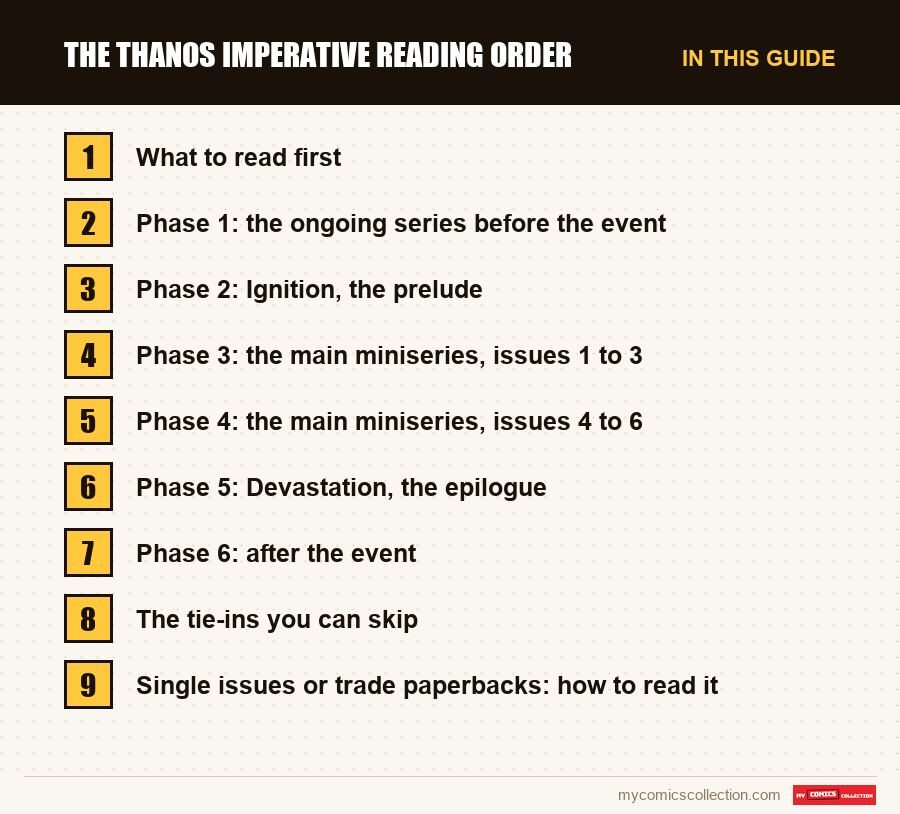
Phase 6: after the event
Before moving on, take stock of your stack: a 2010 one-shot, six miniseries issues by Abnett, Lanning and Sepulveda, a second one-shot. If any of the eight pieces is missing, now is the time to note it, because issues from this period are easier to find together than one by one. For collectors, a complete set of these eight single issues, shelved in reading order, lends itself well to being stored as a single lot.
The logical continuation of the story runs through the Annihilators, the new cosmic team that takes over after the event. We will say no more, because talking about it means giving away the outcome of the miniseries.
If you want to keep going, two paths open up. The first is to read that follow-up directly, to stay on the cosmic line. The second is to go back to the series that preceded the miniseries, and read them in order by trade paperback: the history of the Guardians of the Galaxy in comics gives the context, and the team's reading guide places each period. The earlier issues then read with fresh eyes.
The tie-ins you can skip
A simple rule for sorting: ask yourself whether the issue appears in the list of pieces published around the miniseries by its writers, Dan Abnett and Andy Lanning. If so, it belongs to the setup; if not, it is part of the broader history of the cosmic side, which you can read later, at your own pace, with the help of our character guides.
The list of tie-ins is short, and deliberately so: the miniseries is designed to stand on its own, with its two one-shots as the only direct companions. The ongoing series already mentioned are a prelude, not a mandatory part of the reading.
You can skip, with no harm to your understanding, the intermediate issues of Guardians of the Galaxy and Nova that come before the closing issues. They are not useless: they develop the characters and their relationships. But they belong to run reading, not event reading, and their absence does not change how you understand the miniseries.
The Thanos Sourcebook, collected in the hardcover volume, is also optional: it documents, it does not narrate. Keep it for the end, or consult it as you read when a name escapes you.
Single issues or trade paperbacks: how to read it
The event fits in few single issues: an opening one-shot, six issues and a closing one-shot. It is a format that suits reading in single issues as well as in a trade paperback. A hardcover collection from February 2011, 208 pages long, gathers the six issues, Ignition, Devastation and the Thanos Sourcebook; a softcover edition came out in September 2011.
Two bulkier omnibus editions also exist: Guardians of the Galaxy by Abnett & Lanning Omnibus (2016) and War of Kings Aftermath: Realm of Kings Omnibus (2017). For a reader new to the cycle, the simplest method is to pick up the miniseries hardcover at the end of the journey, and to read War of Kings first in the edition of your choice.
In single issues, the difficulty is gathering all eight pieces without missing one: the prologue shelves with issues #1 to #6, then the epilogue, and the miniseries covers make a coherent set on the shelf. In trade paperback, the hardcover volume settles the question in one go.
The key issues to know
For a cosmic event of this size, the key issues can be counted on one hand. What matters has less to do with character first appearances than with the place of each issue in the setup.
- The Thanos Imperative #1: the opening of the miniseries, with the Aleksi Briclot cover, a natural entry point for a collection.
- The Thanos Imperative: Ignition: the 2010 prologue, with art by Brad Walker, which people sometimes forget to shelve with the rest.
- The Thanos Imperative #6: the closing issue, dated January 2011.
- Nova #36 and Guardians of the Galaxy #25: the closing issues of the two series, which wrap up both titles at the time of the event.
- The Man Called Nova #1, from September 1976: the first appearance of Richard Rider, the Nova character who carries the ongoing series of the cycle.
To place a 2010 copy, reason by comparison: set your issue against copies already sold of the same title, identifying the exact cover and printing. A closing issue of an ongoing series is valued differently from a miniseries #1.
Recap: the complete order
- Annihilation: Conquest, for the cosmic context.
- War of Kings, through issue #6 of the miniseries.
- Realm of Kings, for the immediate aftermath of the war.
- Nova #36 and Guardians of the Galaxy #25, the closing issues of the two series.
- The Thanos Imperative: Ignition, the 2010 one-shot.
- The Thanos Imperative #1 to #3.
- The Thanos Imperative #4 to #6.
- The Thanos Imperative: Devastation, the closing one-shot.
- The Annihilators, the team's follow-up.
Frequently asked questions
The miniseries has six issues, launched in 2010 by Dan Abnett and Andy Lanning, with Miguel Angel Sepulveda on art. Two one-shots bookend it: Ignition, which serves as the prologue, and Devastation, which serves as the epilogue. The whole set comes to eight single issues.
Yes, that is the safest advice: the miniseries directly continues the breach opened at the end of War of Kings. Without that reading, the setting stays incomprehensible. Annihilation: Conquest is a useful complement for understanding the links between the characters.
Yes, as long as you know the cosmic context of the 2000s: the miniseries concludes a cycle carried by the Guardians of the Galaxy and Nova, from Annihilation to War of Kings. Our Thanos reading guide helps place the character.
Yes: a 2011 hardcover collects the six issues, Ignition, Devastation and the Thanos Sourcebook, and a softcover edition followed the same year. Two bulkier omnibus editions, from 2016 and 2017, also exist around the event.
The logical continuation runs through the Annihilators, the cosmic team that takes over; we say no more so as not to give away the ending. You can also go back to the preceding series, through the history of the Guardians of the Galaxy and their reading guide.
Have you gathered all eight pieces of the 2010 event? Get the whole set appraised before deciding how to store it.
Estimate my comic