Tales from the Crypt is EC Comics' flagship horror title, published from October 1950 to February 1955 across 27 official issues (#20 through #46). Published by William Gaines, written by Al Feldstein and drawn by Jack Davis, Wally Wood and Graham Ingels, it remains the ultimate grail of Pre-Code horror. The 10 key issues include #20 (first Tales from the Crypt title, October 1950), #28 (first iconic Crypt-Keeper cover by Jack Davis), #33 (Davis skeleton cover), #37 (Wally Wood splash), #40 (Ingels gothic horror) and #46 (final issue, killed by the Comics Code). CGC 6.0 to 9.0 values range from $600 to $25,000 depending on the issue and artist signature.
⚠️ For reference only: This information is provided for informational purposes only. My Comics Collection is not an investment advisor. EC Comics values fluctuate heavily based on condition, the cover artist's signature, CGC census rarity, and trends in the Pre-Code collector market. Check recent sales on Heritage Auctions, ComicConnect and eBay before making any buying decision on these high-value issues.
Tales from the Crypt holds a singular place in the history of American comics. Published by EC Comics between October 1950 and February 1955, this 27-issue run represents the peak of Pre-Code horror and the artistic high point of a legendary creative team. William Gaines as publisher, Al Feldstein on scripts, Jack Davis on his iconic covers, Wally Wood, Graham Ingels and Johnny Craig on interior art: every one of them left an indelible mark on the medium. Today, these 27 issues are the absolute holy grail for Pre-Code collectors, with CGC values that regularly top $10,000 for the higher grades.
This guide walks you through the 10 key issues to know in order to understand, collect and value Tales from the Crypt in 2026. You'll find the complete chronology of all 27 issues, the founding of EC Comics by Maxwell Gaines in 1944 and the takeover by William Gaines in 1947, the iconic covers from the title's headline artists, updated CGC 6.0 to 9.0 values for the 2026 market, the impact of the cancellation forced by the Comics Code in September 1954, and raw vs. CGC collecting strategies tailored to different budgets. Whether you're just getting into Pre-Code horror or looking to deepen your knowledge of the EC catalog, this guide gives you all the bearings you need.
EC Comics and William Gaines: the 1944 founding and the 1947 editorial revolution
EC Comics, originally an acronym for Educational Comics, was founded in 1944 by Maxwell Charles Gaines, a pioneer of the medium already known for helping create the modern comic book format in the 1930s at All-American Publications. His initial ambition was educational: to publish historical and biblical comics for schools and parishes. Picture Stories from the Bible, Picture Stories from American History, Picture Stories from Science: the catalog was tame, didactic, and partly sold through religious subscription. Commercial success was modest, and the company drifted through the early postwar years with little visibility in a Golden Age landscape dominated by Superman, Batman and Captain America.
Everything changed in 1947. Maxwell Gaines died in a boating accident on Lake Placid, leaving the publishing house in a precarious financial position. His son William Maxwell Gaines, a 25-year-old chemistry student with no initial intention of taking over the family business, inherited the company at his mother's urging. He then radically reinvented the EC initials: Educational Comics became Entertaining Comics. This was the turning point that would define the company's identity for the rest of its existence and leave a lasting mark on the history of the medium.
William Gaines quickly surrounded himself with a key collaborator: Albert Bernard Feldstein, known as Al Feldstein, a young artist and writer who joined EC in 1948. The Gaines-Feldstein duo became the creative architect of the entire New Trend line launched in 1950. Their working method was unique in the industry: Gaines arrived each morning with pitch ideas, often drawn from pulps, O. Henry short stories, Edgar Allan Poe or Ray Bradbury; Feldstein turned those seeds into complete scripts within the day. This editorial discipline, unusual for an era when stories were often written under pressure by scattered freelancers, ensured a remarkable narrative consistency.
The 1950 New Trend line included not only the three canonical horror titles (Tales from the Crypt, The Vault of Horror, The Haunt of Fear) but also science-fiction titles (Weird Science, Weird Fantasy), crime (Crime SuspenStories, Shock SuspenStories) and war (Two-Fisted Tales, Frontline Combat). It was in this context of a complete editorial reinvention that Tales from the Crypt took its definitive title in October 1950, transforming a pre-existing crime title. To understand EC's place in the publishing ecosystem of the era, our feature on Atlas Comics Pre-Marvel offers an overview of its main direct competitors. EC set itself apart through the artistic standards imposed on all its titles: better-than-average paper stock, careful printing, and above all the creative freedom granted to a hand-picked stable of artists.
EC's regular art team for the horror line included Jack Davis (the iconic Tales from the Crypt covers), Wallace Allan Wood known as Wally Wood (science fiction and horror), Graham Ingels nicknamed "Ghastly" (gothic horror, a stylistic signature unmistakable among all others), Johnny Craig (understated covers and interiors), Reed Crandall , Joe Orlando and George Evans. This concentration of talent within a single catalog, at a single moment, remains exceptional in the history of the medium. To place the broader historical context alongside the pre-Marvel era, see our guide to Timely Comics 1939-1949.
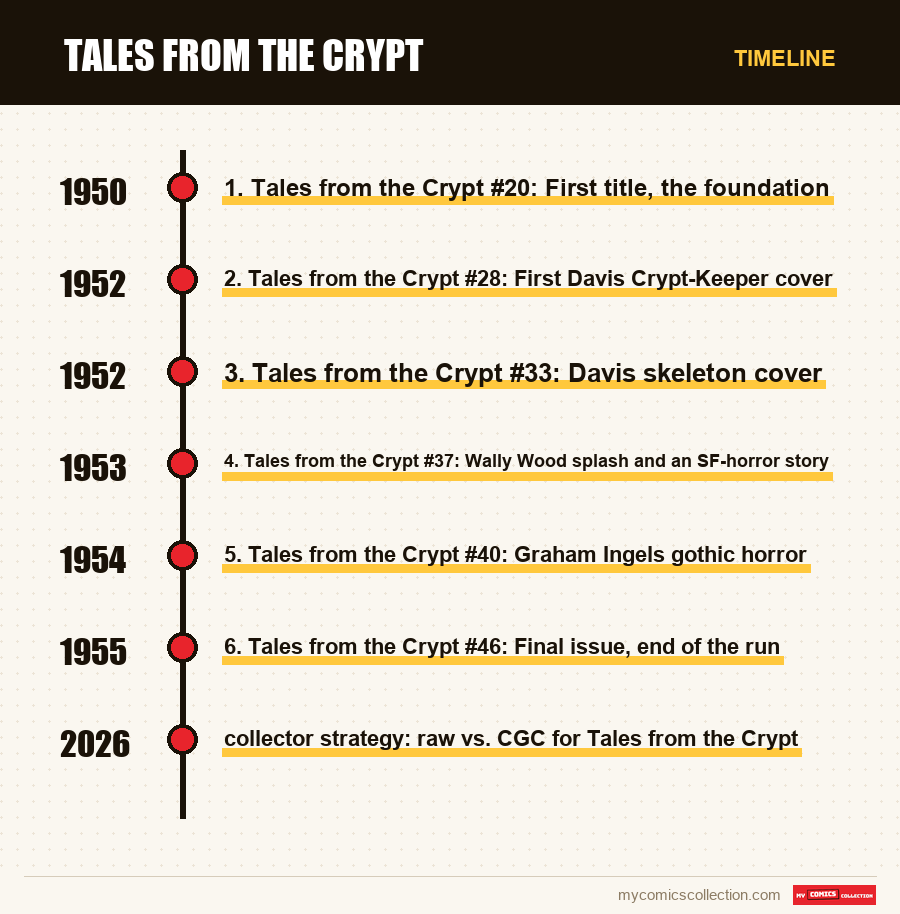
Complete Tales from the Crypt timeline: 27 official issues, 1950-1955
The Tales from the Crypt chronology has an editorial quirk that would throw off an unwary collector: the series doesn't begin at issue #1. It picks up the numbering of an earlier crime title called The Crypt of Terror, itself the product of an earlier transformation of Crime Patrol. This continuous-numbering technique, common in the 1940s and 1950s to preserve second-class postal permits, means Tales from the Crypt officially begins at #20 in October 1950 and ends at #46 in February 1955, for 27 issues officially published under that exact title.
The transformation happened in several stages. Crime Patrol #15 to #16 (1948-1949) are classic crime titles. Crime Patrol #17 to #19 (June-December 1949) were already testing horror stories in a hybrid format, at the prompting of Gaines and Feldstein, who sensed the genre's commercial potential. The Crypt of Terror #17 to #19 (April-September 1950) marked a first stage of full transition to horror but kept the inherited numbering. Finally, Tales from the Crypt #20 from October 1950 locked in the definitive title, which would be kept unchanged until the end of the run.
The publishing schedule was bimonthly. Each issue typically featured four short stories framed by the sardonic commentary of the three GhouLunatics: the Crypt-Keeper (the main host of Tales from the Crypt), the Vault-Keeper (The Vault of Horror), and the Old Witch (The Haunt of Fear). This horror anthology structure with recurring hosts defined the genre for every decade that followed. Below is the complete list of all 27 official issues:
Tales from the Crypt: the 27 official issues (#20 to #46)
- #20 (October-November 1950): First issue under the title Tales from the Crypt
- #21 (December 1950-January 1951)
- #22 (February-March 1951)
- #23 (April-May 1951)
- #24 (June-July 1951)
- #25 (August-September 1951)
- #26 (October-November 1951)
- #27 (December 1951-January 1952)
- #28 (February-March 1952): First Crypt-Keeper cover, now iconic
- #29 (April-May 1952)
- #30 (June-July 1952)
- #31 (August-September 1952)
- #32 (October-November 1952)
- #33 (December 1952-January 1953): Iconic Jack Davis skeleton cover
- #34 (February-March 1953)
- #35 (April-May 1953)
- #36 (June-July 1953)
- #37 (August-September 1953)
- #38 (October-November 1953)
- #39 (December 1953-January 1954)
- #40 (February-March 1954)
- #41 (April-May 1954)
- #42 (June-July 1954)
- #43 (August-September 1954)
- #44 (October-November 1954)
- #45 (December 1954-January 1955)
- #46 (February-March 1955): Final issue, ended by the Comics Code
Worth noting for English-speaking collectors of the original printings: only the 1950s U.S. originals carry meaningful collector value, whether raw or CGC-graded. Later reprint collections and translated editions hold no collector value. The only issues that command a significant price are the original 1950s U.S. books, either raw or in a CGC slab.
Top 10 Crypt-Keeper issues: must-know Davis, Wood and Ingels covers
Of the 27 official issues, ten hold the bulk of the collector value and historical interest. The selection criteria blend first appearance, the cover artist's signature, recognized storytelling quality, and CGC census rarity. Below is the reasoned ranking you absolutely need to know.
1. Tales from the Crypt #20 (October 1950): First title, the foundation
The first issue published under the exact title "Tales from the Crypt," #20 is the chronological entry point for the entire run. The cover is signed by Al Feldstein himself, in a composition still close to the crime aesthetic of the previous title. For a collector who wants to own the strict historical starting point, this issue is essential. CGC census rarity in high grade is extreme: fewer than 30 copies recorded in CGC 8.0 or higher as of 2026. Values: CGC 6.0 between $2,500 and $3,800, CGC 7.0 between $4,500 and $6,500, CGC 8.0 between $9,000 and $13,500.
2. Tales from the Crypt #28 (February 1952): First Davis Crypt-Keeper cover
Jack Davis took over the covers around this period, and #28 marks one of the first iconic depictions of the Crypt-Keeper on the cover, with his trademark grinning skull. This image would become the visual signature of the entire series and would directly inspire the character's design in the HBO television series of 1989-1996. The value reflects both its graphic importance and its rarity: CGC 6.0 between $1,800 and $2,800, CGC 8.0 between $6,500 and $9,500, CGC 9.0 between $14,000 and $22,000.
3. Tales from the Crypt #33 (December 1952): Davis skeleton cover
One of the most famous covers in all of EC Comics history: a grinning skeleton rising from a coffin, in a graphic composition of brutal effectiveness. This cover is regularly ranked among the 10 best in the entire New Trend catalog. Here Davis reaches a peak of stylistic mastery. 2026 values: CGC 6.0 between $1,500 and $2,200, CGC 8.0 between $5,500 and $8,500, CGC 9.0 between $12,000 and $18,000.
4. Tales from the Crypt #37 (August 1953): Wally Wood splash and an SF-horror story
Wally Wood, mainly active on Weird Science and Weird Fantasy, delivers in #37 one of his most memorable contributions to the EC horror catalog. His graphic precision, his eye for technical detail and his trademark lighting turn every page into a museum piece. The cover is by Jack Davis, but the interior Wood art makes this issue a specific target for fans of the artist. Values: CGC 6.0 between $1,200 and $1,800, CGC 8.0 between $4,500 and $6,800.
5. Tales from the Crypt #40 (February 1954): Graham Ingels gothic horror
Graham Ingels, nicknamed "Ghastly" for the signature he scrawled on his pages, is the artist who best defines EC's gothic identity. His morbid linework, his decaying corpses and his haunted architecture created a school of art whose influence can still be felt in the modern comics of Mike Mignola and Junji Ito. #40 contains one of his best gothic stories, "Reflection of Death," regularly cited among the masterpieces of the catalog. Values: CGC 6.0 between $1,000 and $1,500, CGC 8.0 between $3,800 and $5,800.
6. Tales from the Crypt #46 (February 1955): Final issue, end of the run
A historic issue as the last in the series, published just before the Comics Code Authority forced the permanent shutdown of EC's entire horror line. The rarity of this issue is, paradoxically, less extreme than the early ones: print runs stayed relatively steady through the end, but the historical significance makes up for it. Values: CGC 6.0 between $1,200 and $1,800, CGC 8.0 between $4,500 and $6,800, CGC 9.0 between $9,500 and $14,000.
7. Tales from the Crypt #22: First GhouLunatics together
An early issue that brings the three GhouLunatics narrators (Crypt-Keeper, Vault-Keeper, Old Witch) together on a single cover for the first time. A historic piece for understanding EC's editorial mechanics: the three horror titles cross-referenced one another, creating a coherent shared universe before that practice became standard at Marvel and DC. Values: CGC 6.0 between $1,800 and $2,600, CGC 8.0 between $6,500 and $9,500.
8. Tales from the Crypt #29: Jack Davis's "Foul Play" story
#29 contains the story "Foul Play," one of the most infamous EC stories of all: a baseball game played with the organs of a dismembered corpse. This is exactly the kind of story psychiatrist Fredric Wertham used as ammunition in his book Seduction of the Innocent (1954) to attack EC Comics and trigger the U.S. Senate hearings. For that reason, #29 carries a historical importance beyond its visual value. Values: CGC 6.0 between $1,600 and $2,400, CGC 8.0 between $5,800 and $8,800.
9. Tales from the Crypt #35: Classic Davis cover
One of the Davis covers most often cited as representative of the artist's mature aesthetic, with a polished macabre composition and inking work that would be studied in American comic art schools for decades. Values: CGC 6.0 between $950 and $1,400, CGC 8.0 between $3,500 and $5,200.
10. Tales from the Crypt #43: Mature Pre-Code
#43, from August 1954, was published just before the Code took hold: it represents EC horror at its stylistic peak, with no censorship constraints, in a period when the creative team nonetheless knew the end was near. That tension gives the stories a particular intensity. Values: CGC 6.0 between $900 and $1,350, CGC 8.0 between $3,200 and $4,800.
Your complete Tales from the Crypt collection, tracked issue by issue
Import your EC Comics, track your progress across all 27 official issues and see the issues you're missing at a glance.
Create my checklist7-day trial · Every EC Comics series included
CGC 6.0 to 9.0 values by issue: a 2026 market overview
The Tales from the Crypt market has a characteristic unique among American comics: almost all CGC-graded copies are concentrated in the 5.0 to 8.0 grade range, with very few copies above 9.0 available. This market structure comes down to three converging factors: acidic paper that has aged poorly since 1950, frequent handling by children at the time of original publication, and relatively modest print runs compared with mainstream Golden Age superhero titles. To understand the grading methodologies applied to this old paper, our comparison of CGC vs. CBCS vs. PGX details the criteria specific to Pre-Code comics.
The practical consequence for the collector is that a realistic acquisition strategy should target the 5.0 to 7.0 range, where supply exists in sufficient volume to compare several copies and obtain a stable market price. Grades of 8.0 and above become rare collector items, often sold at auction by Heritage Auctions or ComicConnect at prices that can double or triple the reference values in a competitive bidding war.
Below is a summary table of average 2026 values for the title's main issues, expressed in U.S. dollars. The ranges reflect real, documented sales on GoCollect, Heritage Auctions and eBay over the past 12 months.
2026 CGC Tales from the Crypt values: mid grades
- #20 (first title): CGC 6.0: $2,500-3,800 · CGC 7.0: $4,500-6,500 · CGC 8.0: $9,000-13,500
- #22 (3 GhouLunatics): CGC 6.0: $1,800-2,600 · CGC 7.0: $3,200-4,800 · CGC 8.0: $6,500-9,500
- #28 (first Davis Crypt-Keeper): CGC 6.0: $1,800-2,800 · CGC 7.0: $3,500-5,200 · CGC 8.0: $6,500-9,500
- #29 (Foul Play): CGC 6.0: $1,600-2,400 · CGC 7.0: $3,000-4,500 · CGC 8.0: $5,800-8,800
- #33 (Davis skeleton): CGC 6.0: $1,500-2,200 · CGC 7.0: $2,800-4,200 · CGC 8.0: $5,500-8,500
- #37 (Wally Wood): CGC 6.0: $1,200-1,800 · CGC 7.0: $2,400-3,600 · CGC 8.0: $4,500-6,800
- #40 (Ingels gothic): CGC 6.0: $1,000-1,500 · CGC 7.0: $2,000-3,000 · CGC 8.0: $3,800-5,800
- #46 (final issue): CGC 6.0: $1,200-1,800 · CGC 7.0: $2,400-3,600 · CGC 8.0: $4,500-6,800
- Standard issues #23-27, #30-32, #34, #36, #38, #39, #41, #42, #44, #45: CGC 6.0: $600-1,200 · CGC 8.0: $2,500-4,200
CGC 9.0 grades and above deserve a separate mention. For the headline issues (#20, #28, #33), a CGC 9.0 copy can trade between $14,000 and $22,000 depending on the exact issue, and the rare CGC 9.4 copies reach $35,000 to $60,000 at public auction. The all-time record for the series across all categories remains a Tales from the Crypt #46 CGC 9.6 sold by Heritage Auctions for more than $70,000 in 2022, and 2026 values remain above that level for the very highest grades. To understand the dynamics of the most expensive comics, our comic collection feature offers a comparative framework.
The raw (ungraded) market remains accessible but demands extra vigilance. A Tales from the Crypt book in raw VG/FN (roughly equivalent to CGC 4.0 to 6.0) trades between $300 and $900 depending on the issue, versus $600 to $3,000 once graded. This difference reflects both the cost of grading (around $100 per copy at CGC) and the confidence premium associated with a sealed slab. For issues estimated above $1,500 raw, sending the book to CGC almost always pays off.
Collecting this series?
Track what you own, what you are missing and what your collection is worth. 7 day trial.
Start my trial →The September 1954 Comics Code: cancellation and posthumous TV/film adaptations
On April 16, 1954, William Gaines testified before the U.S. Senate Subcommittee on Juvenile Delinquency, chaired by Senator Estes Kefauver. The hearing was filmed and broadcast live on national television. Gaines, despite a reasoned defense of the First Amendment and editorial freedom, was cornered over a Crime SuspenStories #22 cover showing a decapitated woman. The exchange became iconic: Kefauver asked whether the cover was in "good taste," and Gaines replied "for a horror comic cover, yes." That answer, legally defensible, was a public-relations disaster.
The social and political pressure peaked in September 1954 with the creation of the Comics Code Authority (CCA), a self-regulatory body set up by the major publishers under the coordination of the Comics Magazine Association of America. The code explicitly banned:
- The words "horror" and "terror" in series titles
- Depictions of vampires, werewolves, ghouls and zombies
- Stories emphasizing cruelty, torture or physical violence
- Covers suggesting sexual crime or excessive suffering
- Disrespect for established authority (police, parents, the State)
For Tales from the Crypt, the impact was immediate and lethal. The title itself was banned. EC briefly tried to publish watered-down titles under the "New Direction" label (Impact, Aces High, Valor, Extra!), but distributors, under pressure from retailers, refused to circulate anything carrying the EC logo. Tales from the Crypt #46, published in February 1955, was thus the last official issue of the series. The ending was not an editorial choice: it was a regulatory execution.
William Gaines nonetheless pulled off a remarkable strategic turnaround. Amid the ashes of the horror line, a humor-satire title published since 1952 in comic format survived by being converted into an adult magazine format that sidestepped the Comics Code: Mad, launched in 1952 as a comic and then transformed into a magazine in July 1955. For 60 years Mad became the commercial engine that funded the Gaines legacy and allowed EC to survive as a publishing entity into the 1990s. To understand the other horror labels of the era hit by the same censorship, see our feature on 1950s Pre-Code horror comics.
The legacy of Tales from the Crypt has gone through several waves of commercial rediscovery that durably support its values. First wave: the Russ Cochran reprints of the 1980s, which reintroduced the catalog to a generation of adult collectors. Second wave, and the most significant: the HBO television series "Tales from the Crypt," broadcast from 1989 to 1996, which faithfully adapted the original stories across 7 seasons, with the Crypt-Keeper as its iconic animatronic narrator. This series massively revived demand for the original comics and explains the upper end of today's values. Third wave: the film adaptations Demon Knight (1995) and Bordello of Blood (1996), and more recently several rumored adaptation projects announced by various studios since 2020, none firmly confirmed as of this guide.
2026 collector strategy: raw vs. CGC for Tales from the Crypt
Building a Tales from the Crypt collection in 2026 calls for a thoughtful strategy that balances budget, long-term goals and reading enjoyment. Three typical profiles emerge depending on your available budget and collecting horizon. Below are the raw vs. CGC trade-offs that maximize the value of every dollar invested, drawing on the methodologies in our guide to investing in comics.
Tight-budget profile ($3,000 to $8,000 over 24 months): the optimal strategy is to target raw copies exclusively in VG grade (roughly CGC 4.0 to 5.5) for the majority of issues, with a single CGC investment concentrated on #20 or #28 in a minimum 6.0 grade. Across the 27 issues, aim for partial coverage with the 10 key issues identified in this guide in raw VG, plus 8 to 12 standard issues in raw GD-VG. Expect a total of around $4,500 to $7,000, which lets you build a coherent core that will appreciate steadily over time. The buying is best done in lots at U.S. conventions, on eBay by watching for flash sales, or through specialized retailers that list mid-grade Pre-Code stock.
Intermediate profile ($10,000 to $25,000 over 24-36 months): this budget allows for a balanced hybrid strategy. Concentrate three to five star issues in CGC 6.0 to 7.0 (#20, #28, #33, #29, #46) for the heritage core, representing roughly 60% of the budget. Fill out the rest of the series in raw VG-FN (equivalent to 5.0 to 7.0) for 40% of the budget. This approach lets you own a complete collection of all 27 issues averaging raw 6.0-7.0 plus a CGC selection on the headline books. The liquidity-to-preservation ratio is optimal: the CGC copies can be resold quickly if needed, while the raws form the foundational inventory. For deeper auction comparisons, the ComicConnect vs. Heritage Auctions feature breaks down each platform's fees and liquidity.
Long-term investment profile ($40,000 and up): at this level, the sensible strategy concentrates the investment on CGC 7.0 to 8.0 copies for the 10 key issues identified, for an approximate budget of $35,000 to $60,000 for that base. The rest of the series can be completed gradually in raw FN-VF for the visual consistency of the physical collection. At this level of commitment, buying at public auction (Heritage, ComicConnect) becomes preferable to eBay for confidence in authenticity and grade, despite the 20% to 25% buyer's premium. The logic is different from a position in modern comics: here you're buying old cultural heritage whose fan base is no longer growing, but whose absolute rarity continues to tighten.
Secure key issues #20 and #28 first
These two issues hold the bulk of the historical value. Acquire them first, either raw in VG (roughly $1,200 to $1,800 each) or in CGC 6.0 if the budget allows. Without these two issues, a Tales from the Crypt collection lacks its foundation.
Complete the 8 other key issues from the top 10
Next, cover #22, #29, #33, #37, #40, #43, #46 and one additional connecting issue of your choice (#35 or #41) in raw FN, in the $600 to $1,500 range each. This second wave builds out the editorial coherence of the collection.
Fill in the 17 standard issues opportunistically
Acquire the remaining issues as opportunities arise, with no pressure: conventions, estate sales, eBay end-of-auction deals. These issues form the inventory backbone and typically run between $300 and $800 in raw VG-FN.
Grade any book estimated above $1,500
For any raw copy you estimate at more than $1,500 in value, sending it to CGC pays off. The grading cost (about $100) is marginal against the confidence premium gained, and resale liquidity improves significantly.
One last cross-cutting recommendation: always keep your proof of purchase, detailed pre-grading photos, and provenance history if available. The EC Comics market is mature, buyers are demanding, and documentary traceability often makes a 5% to 15% difference at resale on high-value books. For a free, fast estimate of a Tales from the Crypt comic or another EC title, our free estimate tool calculates the value range in 30 seconds from current eBay listings.
Tales from the Crypt FAQ: questions from EC collectors
The first issue published under the exact title "Tales from the Crypt" is #20, dated October-November 1950. This unusual numbering comes from the fact that the series picks up the continuity of an earlier crime title (Crime Patrol, then The Crypt of Terror). This #20 marks the official founding of the EC horror series, which would run through #46 in February 1955, for 27 issues in total. For a collector, this #20 is the essential historical entry point, with a CGC 6.0 value between $2,500 and $3,800 in 2026.
The series has exactly 27 official issues published under the title Tales from the Crypt, numbered from #20 (October 1950) to #46 (February 1955). The publishing schedule was bimonthly. The series ended in February 1955 under pressure from the Comics Code Authority created in September 1954, which banned the words "horror" and "terror" in series titles and imposed narrative restrictions incompatible with EC Comics' editorial identity. The 27 issues therefore form a closed set, easily identified and completable by a methodical collector.
The regular art team included Jack Davis (the iconic covers on most issues, including the Crypt-Keeper signature), Graham Ingels nicknamed "Ghastly" (gothic horror on the interior pages, his morbid linework defining EC's visual identity), Wally Wood (occasionally, more present on Weird Science), Johnny Craig (understated, precise art), Reed Crandall and Joe Orlando. They all worked under the editorial direction of Al Feldstein, the lead writer, and William Gaines, editor-in-chief. This concentration of talent remains exceptional in the history of American comics.
The series was forced to end because of the creation of the Comics Code Authority in September 1954, a self-regulatory body imposed following the U.S. Senate hearings on juvenile delinquency in April 1954. The code explicitly banned the words "horror" and "terror" in titles, vampires, werewolves and zombies, as well as any depiction of excessive violence. Tales from the Crypt #46, published in February 1955, is the last issue before distributors, under pressure from retailers, refused to circulate anything carrying the EC logo. William Gaines did, however, manage to pivot with Mad magazine, converted to an adult format in July 1955 to escape the code.
CGC 9.0 grades and above are extremely rare for Tales from the Crypt. The CGC census records fewer than 30 copies per issue in CGC 9.0 or higher as of 2026, and some issues like #20 or #28 have fewer than 10 copies at that level. Prices reflect this rarity: CGC 9.0 between $14,000 and $22,000 depending on the issue, CGC 9.4 between $35,000 and $60,000 at public auction. For most collectors, the realistic strategy is to target CGC 6.0 to 7.5, which offers a good price-rarity-visual quality compromise. CGC 9.0+ copies are reserved for investment budgets above $30,000 per book.
Never miss another issue of your EC Comics series
Integrated catalog, estimated values, issue-by-issue progress tracking: My Comics Collection manages your Pre-Code collections for you.
Start for free7-day trial · EC Comics and other Golden Age series included