
A significant part of Usagi Yojimbo is a supernatural story, and this part surprises readers who have come for the samurai. Creatures from Japanese folklore, spirits, possessions: they appear without notice in a series that is otherwise strictly documentary. This is not an inconsistency:it is the same requirement for accuracy applied to beliefs rather than to objects. These stories document what people of that time held to be true, with the same seriousness as everything else.
This vein is the main source of disorientation for a reader who discovers the series through a poorly chosen volume.
This article explains what this vein covers, why it does not contradict the historical rigor of the series, how it is staged, and how to find your way around it when you buy.
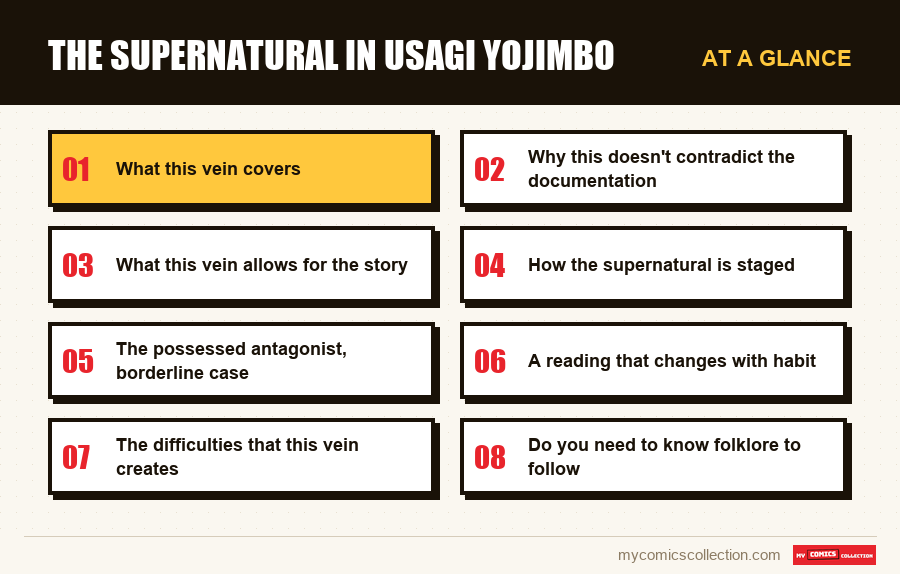
What this vein covers
The supernatural does not enter the series in a single form. Three modes coexist, and distinguishing them helps you know what you are reading.
Creatures of folklore. Figures from the traditional Japanese bestiary, with their attributes, their habits and the precautions that people took towards them. They are treated as elements of the world, not as inventions.
Spirits and ghosts. Often linked to an unrepaired injustice. These stories function like investigations: something went wrong, and its trace persists.
The possessed. A particular case, embodied by a recurring antagonist, where the question of whether we are dealing with the supernatural or madness is never decided.
These three modes have neither the same frequency nor the same effect. The first is the most common and lightest; the third is the rarest and the most worrying.
Why this doesn't contradict the documentation
Document beliefs
A series that documents an era must document what its inhabitants held to be true. Removing the spirits from a story set in a world that believed in it would produce a false reconstruction.
This is the central argument, and it is strong.
Second degree accuracy
The creatures respect their traditional attributes: what they do, what repels them, where they stand. They are not reinvented for the purposes of the plot.
No rational explanation
The story never offers a resolution that would bring the episode back to a misunderstanding. This would be the comfortable solution, and it is systematically refused.
A constant distance
The protagonist is no more surprised than an inhabitant of his time would have been. He takes his precautions and moves on.
What this vein allows for the story
The supernatural here fulfills functions that the realistic register could not assume, and it is worth naming them.
It gives body to ancient wrongs. An injustice committed twenty years earlier has no presence in a realistic story: it is a fact that is reported. In spirit form, she becomes a character, and the protagonist can act on her.
It installs a fear that combat does not produce. A human opponent fights and settles. A creature that we can neither hit nor reason with produces concern of another order, in a series where the violence is otherwise very quickly resolved.
It allows us to deal with death differently than through loss. The ghosts offer access to disappeared characters without the story having to resurrect them or betray their death.
These three functions explain why the vein persists for forty years rather than becoming exhausted. It does not serve to vary the settings: it serves to tell things that the rest of the series cannot achieve.
The disorientation almost always comes from the volume with which you start. A reader who opens a collection bringing together several supernatural stories in a row concludes that the series is fantastic. Another who begins elsewhere concludes that it is strictly historical.
Both are mistaken in the same way: they take a local proportion for the nature of the whole. This vein is present from start to finish, without ever becoming the majority.
How the supernatural is staged
The graphic method is worth describing, because it explains why these stories work despite the animal stylization.
The creatures are not drawn in the same register as the characters. Where these are stylized, round, legible, the apparitions are treated in black masses, in unstable shapes, in silhouettes which cannot be fixed.
This contrast does all the work. In a graphically reassuring world, a form that refuses the same clarity produces immediate discomfort, without any color or texture effects being necessary.
Added to this is a precise use of silence. The apparition sequences contain little text, often none. The lettering, omnipresent elsewhere, is withdrawn, and its absence signals the anomaly even before the image shows it.
It is an economical and entirely graphic solution, consistent with a series which has never had any other means than black ink.
The possessed antagonist, borderline case
One figure deserves separate treatment, because it occupies a position that nothing else in the series occupies.
This adversary believes himself charged with a mission of purification. He kills people he considers bad, with a conviction that never wavers, and the story does not say whether he is right to believe he is invested.
This is the most carefully held ambiguity in the work. Nothing confirms possession, nothing denies it. The elements which would argue for the supernatural (its improbable survival, what it seems to perceive) always find an alternative reading, without this one becoming more imposing.
This indecision produces an effect that neither the monster nor the madman would produce alone. A monster fights itself; a madman complains; this one doesn't fall into either category, and the protagonist never knows what he's dealing with.
A less patient author would have decided, one way or the other, to give the reader the satisfaction of a clear status. Not deciding for decades is a costly choice, and it's what makes this figure the only lasting threat in a series without a continuing plot.
A reading that changes with habit
A phenomenon specific to this vein deserves to be noted, because it rewards long-term reading.
The first encounters with the supernatural read like ruptures. We were progressing in a historical story, a creature appears, and the episode changes its nature before the reader's eyes.
After around thirty stories, this effect disappears completely. The supernatural ceases to be an interruption and becomes a component of the world, just like highwaymen or corrupt officials. The reader ends up adopting the point of view of the inhabitants, which is what the story was aiming for from the beginning.
It's a silent conversion, never commented on, and probably the best argument in favor of continuing reading of this series. What we gain is not the understanding of a plot, there is none, but a shift in our own position as reader.
Those who give up after a few volumes finding the supernatural vein incongruous are not wrong about what they have read. They stopped before the device had its effect.
Collecting this series?
Track what you own, what you are missing and what your collection is worth. 7 day trial.
Start my trial →The difficulties that this vein creates
A poorly calibrated wait
Nothing announces in a volume the proportion of supernatural stories it contains, although it varies greatly from one to another.
A harsher tone than expected
Some of these stories are significantly darker than the series average, which matters when it comes to offering a volume.
Implicit cultural references
The creatures are not presented: the story assumes that we know them, or that we will accept not understanding everything.
Des suites espacées
Some of these stories require a response that arrives dozens of issues later, without a callback.
Do you need to know folklore to follow
The question arises for any non-Japanese reader, and the answer is more reassuring than one might fear.
The story does not present the creatures because it takes the point of view of people for whom they are taken for granted. An inhabitant of the world described does not need to be explained what a river spirit is, and the reader is treated as such.
In practice, everything necessary for understanding the story is shown in the story. We see what the creature does, what it wants, what contains it. The missing knowledge enriches the reading without ever conditioning it.
You simply have to accept one thing: some allusions will not be intended for you, and you will not always know which ones. It is the ordinary discomfort of reading a work rooted in a culture that is not one's own, and it diminishes with practice.
The stories themselves also provide progressive learning: by reading more, we recognize the figures, and the second encounter with a given creature reads quite differently from the first.
What to record
In this vein, the useful field comes from thematic identification, something that a collection inventory rarely provides.
The nature of the story contained in each issue: historical, supernatural, or mixed. This is what makes it possible to offer the right volume to the right person, and to find these stories to reread them together: they form a thematic sequence that the publication chronology disperses.
No summary carries this information and the covers do not suggest it, these stories having no distinct graphic treatment on the front.
The creature or figure concerned, when she is named. This is what makes it possible to identify spaced reminders: a figure encountered in a number can return dozens of numbers later without any reminder warning you.
These two fields transform a scattered vein into a searchable whole, and it is the only way to read it as a sequence rather than as a series of interruptions.
Frequently asked questions
On the contrary, it prolongs it. A series that documents an era must document what its inhabitants held to be true: removing the spirits of a world that believed in it would produce a false reconstruction. The creatures also respect their traditional attributes instead of being reinvented.
No. Everything necessary for understanding is shown in the story: what the creature does, what it wants, what contains it. The missing knowledge enriches the reading without conditioning it. You simply have to accept that certain allusions are not intended for you.
Some, yes, and you should know this before offering a volume. A creature that cannot be hit or reasoned with produces anxiety of a different order than confrontations, which are resolved in a few squares. This is precisely the function of this vein in a series where the violence is otherwise quickly resolved.
Nothing indicates this, neither on the cover nor in the summaries, and the proportion varies greatly from one collection to another. This is the most useful information to note down for yourself as you read: it allows you to offer the right volume to the right person.
Never. The story systematically refuses the comfortable resolution which would reduce the episode to a misunderstanding. The protagonist himself is no more surprised than an inhabitant of his time would have been: he takes his precautions and goes on his way.
Historical, supernatural, or mixed?
No summary says this, and this is what makes it possible to offer the right volume to the right person.