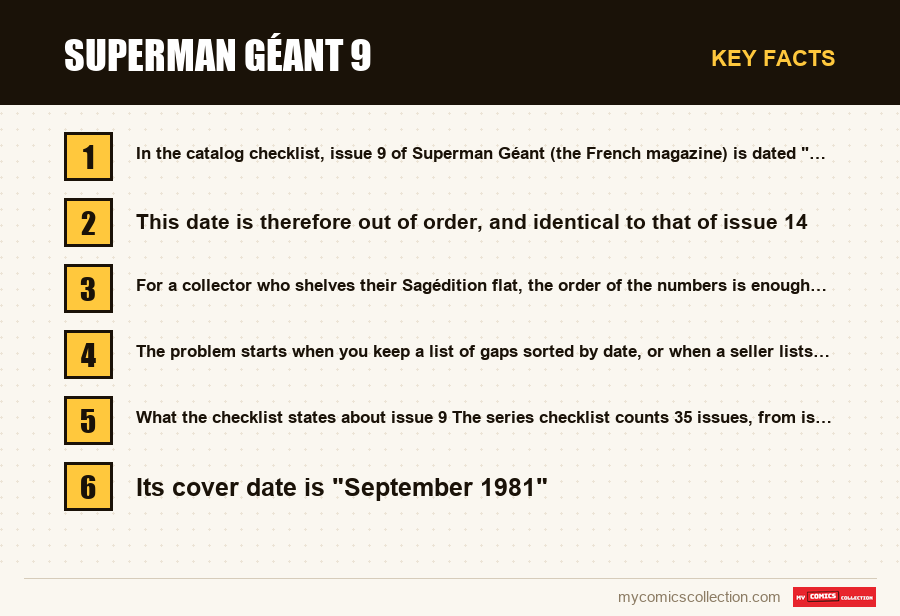
In the catalog checklist, issue 9 of Superman Géant (the French magazine) is dated "September 1981", while issue 8 is dated May 1980 and issue 10 November 1980. This date is therefore out of order, and identical to that of issue 14. The data does not say whether the error comes from data entry or from the printed cover: only your copy can settle it. Identify this comic by its number and its story title.
For a collector who shelves their Sagédition flat, the order of the numbers is enough: issue 9 slips in between issue 8 and issue 10 and the matter is settled. The problem starts when you keep a list of gaps sorted by date, or when a seller lists "Superman Géant, September 1981" without saying which number they mean. In that case, two comics appear under the same date, and one of the two is probably misdated.
As always in this guide, only verified details (creators, issue numbers, dates) are stated as fact; the analysis is our own, with no reproduction of panels or protected dialogue.
What the checklist states about issue 9
The series checklist counts 35 issues, from issue 1 (February 1979) to issue 35 (January 1987), and no number is missing between those two limits. Issue 9 is recorded under the story title "The Rhinoceros of India", with three writers (Cary Bates, Jack C. Harris, Bill Finger) and three artists (Ross Andru, Curt Swan, Don Heck). Its cover date is "September 1981".
These credits are given for the comic as a whole, not story by story, and the catalog retains only one story title per number. The title "The Rhinoceros of India" therefore designates the story retained, not the full contents: nothing can be deduced from it about the rest of the comic.
A date that falls out of line
Issue 8 is dated May 1980. Issue 10, right after it, is dated November 1980. Between the two, issue 9 announces September 1981, that is sixteen months after its immediate predecessor, and then the following issue goes back ten months.
In the checklist, this is the only date that contradicts the order of the numbers: the other 34 entries run in increasing order, including issue 21, whose date is a quarter (July-August-September 1983) and which fits correctly between March 1983 and October 1983.
The rhythm of the neighboring comics reinforces the doubt. Between issue 1 and issue 8, the gap between two consecutive numbers ranges from one to three months.
From issue 11 (December 1980) onward, each number follows the previous one by three months, from issue 12 to issue 20 without exception. Issue 9, dated September 1981, has no place in this cadence: at that date, it is issue 14 that holds the slot.
Issue 14, which carries the same date
Issue 14, "The False Bond Thief", is also dated September 1981, and it is consistent with its neighbors: issue 13 is dated June 1981, issue 15 December 1981. September 1981 is the only date value shared by two numbers in the checklist, and it is precisely the date of the out-of-order issue.
Two distinct comics, then, under one date: "The Rhinoceros of India" (issue 9) and "The False Bond Thief" (issue 14). For a buyer who has only the date, confusion is possible. The story title, or failing that the printed number, removes the ambiguity. On this specific point, do not rely on a listing that gives only the month and year.
The hypotheses that hold up
Four explanations present themselves, and they should be laid out without preferring one in advance.
The first is a data-entry error on the year: "September 1980" would become "September 1981" by a single digit. That date would fit neatly between May and November 1980, with four months before it and two after. One detail weakens it slightly: an interval of four months appears nowhere before issue 9 in the checklist, where the largest observed gap is three months.
The second is an error in the month, or in the month and the year. "August 1980" would split the six months between issue 8 and issue 10 into two intervals of three months, which matches the cadence at the end of the series. But that supposes two errors instead of one, and nothing in the checklist indicates it.
The third is that the printed cover itself carries a wrong date, and that the checklist copies it faithfully. In that case the data entry is flawless and the anomaly lies in the object.
The fourth is that the comic was really published late, out of its place. It is the most costly to defend: it would require an issue released sixteen months after the previous one, then ignored by the regular sequence that surrounds it.
Do you collect this series?
Track what you own, what you are missing and what your collection is worth. 7-day trial.
Start my trial →
What the data can settle, and what it leaves open
It does allow us to establish three things. The numbering is continuous from 1 to 35, so issue 9 is not a "ghost" number inserted by mistake. The anomaly is localized: only one number falls out of order. And the value "September 1981" cannot be correct for both comics at once, at least if we accept that issue 10 and issue 14 are correctly dated.
It does not allow us to choose among the hypotheses. The checklist gives a date field and says nothing about its source: we do not know whether the value was read off the cover, deduced from another document, or taken over from another file. Among "September 1980", "August 1980" or a wrong date printed on the cover, there is no quantified evidence that settles it. Until a copy has been examined, writing anything else would be inventing.
The credits do not settle the question
One might hope the names help. Issue 9 shares Cary Bates, Jack C. Harris, Ross Andru and Curt Swan with issue 14, which looks like a lead. But it also shares Cary Bates, Bill Finger, Ross Andru and Curt Swan with issue 8. Ross Andru is credited on 9 of the 35 issues in the checklist, Curt Swan on 25: these names are widespread and mark no particular period.
Only one name is more telling. Don Heck is credited, in the checklist, only on issue 9 and on issue 17 (June 1982). That second issue comes eight issues later; it therefore brings issue 9 close to none of its immediate neighbors. The credits settle nothing here.
Checking the copy and recording it correctly
With your copy in hand, three steps are enough. Note the printed number, note the main story title, and copy the date exactly as it appears on the cover, without correcting it from memory. If the comic carries another date notice (printer's imprint or legal deposit, depending on what the copy shows), note it separately, with its source. Comparing those two notices is what would tell you whether the error is in the catalog or on the paper.
In a list of gaps, the number is the key, not the date. Write "no. 9" and add the story title in brackets: this keeps you from buying a no. 14 believing you are filling a no. 9 because a listing shows September 1981. If your spreadsheet sorts by date, issue 9 will land beside issue 14 and issue 10 will come before it: sort by number, and keep the date as a simple information column.
For the other issues of the series and their place in time, the blog brings together the collecting guides, and the Superman hub gathers everything about the character.
Frequently asked questions
The checklist dates it September 1981, but that date contradicts its neighbors: issue 8 is from May 1980 and issue 10 from November 1980. The data alone does not prove that 1981 is wrong. It shows that the date is inconsistent and must be checked against the cover.
No, not without first looking at your copy. Record the date printed on the cover as it is, and add a note beside it if it does not fit the neighboring numbers. Correcting it from memory would replace an uncertainty with an unsourced assertion.
Both appear under "September 1981" in the checklist. Tell them apart by the printed number and the story title: "The Rhinoceros of India" for issue 9, "The False Bond Thief" for issue 14. The date alone is not enough.
The data does not allow us to say: it gives neither print run nor demand. A doubtful date says nothing about how rare a comic is. Its main use is to identify the object correctly and to avoid buying it twice or missing it.
In the checklist, no other number falls out of order. Issue 21 is dated to a full quarter, July-August-September 1983, which is a different way of recording the date, not a contradiction. Issue 23 is written "Janvier 1984" with a capital letter, a simple variation in data entry.