Silver Surfer was not designed as a hero but as the auxiliary of a cosmic power much larger than himself. However, he became the notable character, then obtained his own series in 1968. The reason is structural and not sentimental: a force does not have a story, it has effects. A subordinate obeys, then stops obeying, and this shift is already a complete story. For a collector, this genealogy explains why this type of figure occupies a lasting place in a catalog, and why the search for its booklets requires sorting methodically.
There is a category of characters in superhero comics that no one creates for themselves. We invent them because a screenwriter ran into a writing problem: he imagined a power that was too great, too abstract, too indifferent for us to be able to make it speak without ridiculing it. So he assigned someone to him. A messenger, a herald, an enforcer, a servant. A creature who precedes the power, announces it, serves it, and above all who can watch what it does. Silver Surfer belongs exactly to this family. He is born as an instrument. He should be just another silhouette in a cosmic setting. He ended up having a series in his name in 1968, which, for a secondary character on a team that wasn't even his, constituted an unusual promotion.
The thesis of this article is simple and a little counterintuitive: the subordinate makes a better protagonist than his master, and it is not a question of charisma, design or editorial luck. It's a question of narrative mechanics. The power he serves is a force; she acts according to her nature, she does not deliberate, she has nothing to lose and nothing to choose. The subordinate is defined by a relationship: he obeys. However, every relationship of obedience contains the seeds of its own rupture. The day the performer refuses, he not only changes his attitude, he changes his status. It goes from tool to person. That's exactly what we call a narrative, and a cosmic force, no matter how spectacular, will never produce one.
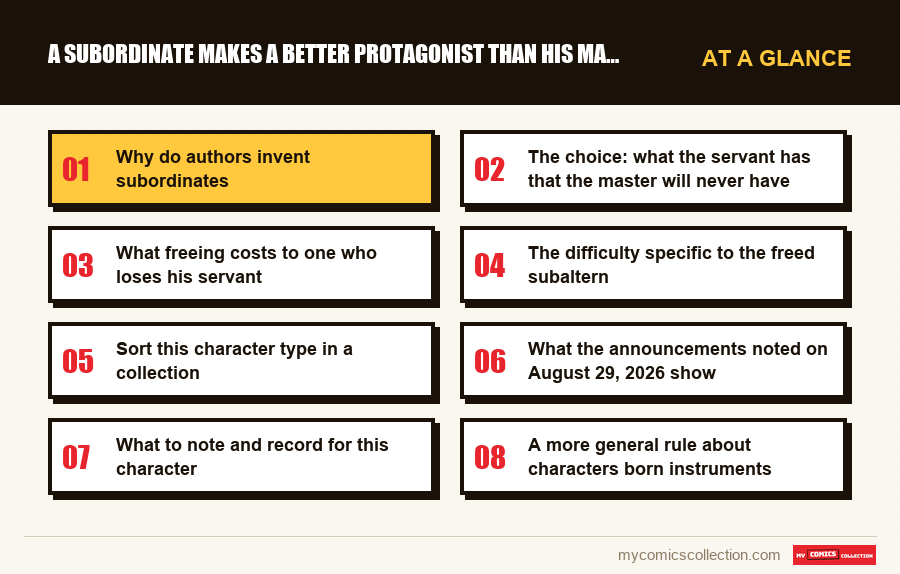
Why do authors invent subordinates
A screenwriter who writes a very large-scale entity finds himself faced with a practical impasse. If he makes her speak like an ordinary character, he diminishes her: a power which negotiates, which hesitates, which jokes, instantly ceases to be a power. If he keeps her silent and distant, he makes her impossible to stage: she crosses the boxes without being able to construct a single dialogue scene around her. The subordinate solves both problems at once. He gives a face and a voice to that which has none, without taking anything away from the figure he serves. He speaks in her place, he explains what she wants, he submits to what she decides, and during this time, she remains intact, incomprehensible, superior.
This invention is first and foremost a workshop convenience. It allows us to treat the immensity as a setting and tell the story at ground level, where readers can follow it. The herald moves, observes, selects, reports. It does the work of exposition that the entity cannot do itself without demeaning itself. It is therefore entrusted, from its creation, with the most precious narrative function: that of the gaze. He sees the consequences. He is the only one to see them up close.
The second use is moral, and it is more devious. An amoral power inspires no judgment: we do not blame a tide for being a tide. But as soon as we place a creature next to her that carries out her orders, we introduce the question of complicity. The reader does not accuse the force, he looks at the auxiliary and wonders what he thinks of his work. The entire ethical burden of a cosmic story thus focuses on the employee, never on the employer. This is where the secondary character begins to steal the story from his sponsor.
The third use is visual. An overwhelming entity occupies the entire page and leaves no room for composition; it can only be drawn from a distance or in fragments. The auxiliary lends itself to everything: it flies, it hovers, it lands, it crosses a board diagonally, it fits in a narrow vignette as in a double page. A designer always prefers a moving body to a stationary phenomenon, and this graphic preference ultimately determines who becomes the star.
The choice: what the servant has that the master will never have
Strength has no alternative
A power defined by its nature cannot act otherwise than it acts. To attribute hesitation to her is to contradict her. She is therefore condemned to constancy, and constancy is the opposite of the story: nothing ever changes there.
The subordinate has one
Obeying presupposes the possibility of refusing. The servant therefore constantly carries a decision that has not been made. Every scene where he carries out an order is also a scene where he could have not done it, and the reader knows it.
He knows the price
Unlike the power he precedes, he sees what disappears behind him. Knowledge without power creates immediate tension, and it is from this tension that the best scenes of the genre are born.
His breakup is dateable
A turnaround occurs at a specific moment, in a specific issue. A force has no founding event other than its appearance. This is why the bibliography of a freed herald is richer than that of his master.
These four points can be summed up in one sentence: the master is a state, the servant is a movement. A state is described, a movement is told. The entire editorial history of cosmic characters lies in this gap, and it explains why regular series almost always fall to the latter and almost never to the former. A power can be brought back as a threat indefinitely; we can't entrust him with twelve issues a year, because there's nothing for him to learn.
A useful clarification for reading the rest: manumission is not only a spectacular scene, it is a change in the narrative contract. As long as the character serves, his actions are externally motivated; we do not need to find a reason for him to act, it is provided to him. The day he breaks up, this source suddenly disappears.
This is why the breakup is easy to write about and the aftermath extremely difficult. Many characters built on this pattern are excellent for around ten issues and then begin to run on empty, not because of weak writing, but because their engine has been removed without replacing it with another.
What freeing costs to one who loses his servant
Emancipation is generally presented as a gain for the liberated character. It is also, and symmetrically, a loss for the one he left. Power without auxiliaries becomes a phenomenon again. She no longer has anyone to give orders to, so no one to talk to, so no more dialogue scenes possible. It returns to the status of a natural disaster: impressive to see happen, impossible to stage other than as a setting.
This degradation is rarely highlighted, and yet it is one of the clearest effects of the process. The herald not only served to announce his master, he served to make him readable. He translated. It gave the entity a human scale by contrast, exactly as a silhouette placed at the foot of a cliff allows one to measure its height. Remove the silhouette: the cliff is still there, but we no longer know how big it is.
Editorially, the consequence is predictable. The power figure returns intermittently, like an event, often to revive a team or close an arc. It does not occupy a long-term series. His former servant gets a title, then relaunches, then appearances in other people's series. In a few years, the number of issues in which he appears greatly exceeds that of his former master, and this gap continues to widen. For a collector, this translates very concretely into the length of the list to be compiled.
There is an irony in this shift. The creature was created to be negligible; it is precisely her negligibility that made her free. A power cannot change without denying itself. A performer can change without losing anything, because he was nothing. The least important character in the system is therefore the only one who can escape.
The difficulty specific to the freed subaltern
Once free, the character finds himself faced with a problem that neither classic heroes nor powerful figures encounter. It no longer has a function. An urban vigilante has a city to protect, a team has a base and recurring threats, a cosmic entity has its nature. The former servant has lost the only thing that organized his existence: his task. It is therefore necessary to invent a motive for action, and experience shows that most of the available motives do not last long.
Revenge runs out quickly, because it ends. Redemption also runs out: once forgiveness is obtained, the story stops. Returning home poses the same problem, since you just have to arrive. Protecting a location or group works, but it turns the character into a local guardian, which contradicts everything that made it interesting: a being designed to traverse immense distances can't just sit somewhere without losing its visual and thematic purpose.
There remains wandering. It's the only diet that lasts over time, and it's no coincidence: wandering is a reason that cannot be resolved. It allows one independent booklet per month, a new setting each time, disposable interlocutors, moral dilemmas that do not need to be drawn out. It transforms the absence of function into a program. The character no longer acts because he is ordered to, nor to achieve a goal, but because he passes by and sees. The gaze, which was its original function in the service of another, becomes its function for itself.
This solution has a cost that readers immediately perceive: without a destination, progress is difficult to feel. The series built on this model therefore alternate long contemplative phases and brutal returns to the past, the only moments where the story seems to move forward. This alternation is the signature of the genre, and it explains the very particular structure of the bibliographies concerned, where a few numbers concentrate most of the attention while the rest forms a long continuous background.
Sort this character type in a collection
Research brings up too many things
The character's name serves as the title of several series launched decades apart. A simple query therefore mixes entire periods. You have to narrow it down before comparing anything.
The period is not in the title
An issue with the same name may belong to the original launch or to a much later relaunch. Without indicating the year, two advertisements with identical wording refer to unrelated objects.
Reissues are everywhere
Reprints, collections and anniversary booklets use the original cover. The visual is therefore never enough to identify a copy: you must read the printing notice and the internal numbering.
Batches distort benchmarks
A batch of several issues appears in the same place as a single copy. Its amount cannot be compared to anything and immediately distorts any overall reading if it is forgotten.
A number is not an identifier
The same number exists in each homonymous series. A reference which does not specify the series of belonging is unusable, and it is the most frequent classification error on this type of character.
Appearances count as much
A character who has become itinerant goes through a lot of titles that are not his. A collection limited to its own series leaves aside an important part of its real presence.
Collecting this series?
Track what you own, what you are missing and what your collection is worth. 7 day trial.
Start my trial →What the announcements noted on August 29, 2026 show
The following figures are a snapshot, and nothing more. They describe what sellers were asking on a given day, August 29, 2026, for copies put up for sale; they do not describe any concluded transactions. A reading carried out on a single date cannot, by construction, show any evolution: it would take at least two measurements spaced apart to speak of an increase or decrease, and this is not the case here. These amounts are therefore used to illustrate an offer structure, not to establish a value level.
On the unverified side, there are 117 listings, ranging from $2.99 to $3,400.00, with a median of $170.00. As for the copies passed by a verification body, there were 75 advertisements, from 59.99 to 16,500.00 dollars, with a median of 525.00 dollars. The gap between the high ends is spectacular, but it must be remembered that an isolated maximum is never an established price: it is the hope of a single seller, displayed without compensation, and it says nothing about what anyone actually paid.
The most interesting fact is neither the median nor the maximum, it is the proportion: seventy-five verified copies for one hundred and seventeen unverified. On a current basis of comparison, the certified share remains very small; here it represents almost two thirds of the unverified volume. This means that an unusual fraction of holders found the verification step economically justified. This is an indicator of attention to the title, not an indicator of price.
An important reservation, finally, and it weighs more than the figures themselves: research is porous. It brings back reissues as well as booklets belonging to a more recent homonymous series, which bear the same name without belonging to the same period. The numbers above therefore contain heterogeneous objects, and it would be imprudent to draw anything other than an order of magnitude from them. Any serious reading involves first reestablishing the series and year before looking at any amount.
What to note and record for this character
The belonging series before the number. As several titles share the character's name, a single number designates nothing. Systematically note the series and its year of launch at the top of the file, and consider the number as secondary information. This is the only way to avoid an issue of the recent homonymous series being silently placed in the middle of the 1968 launch.
The original or reprint status. On a character whose most famous covers have been repeated numerous times, the image proves nothing. Record the printing notice as it appears on the copy, without interpreting it. A file that says “cover identical to that of the first publication” is not a file that says “first publication”.
The distinction between own series and external appearances. A wanderer crosses the titles of others, and a notable part of his bibliography is found outside his own series. Hold two separate sets in your inventory: what is named after him, and what he appears in. Merging them makes completeness impossible to measure, since the second set has no determinate end.
The nature of the role in each fascicle. On this type of character, the difference between a cover that displays them and a story that actually concerns them is frequent and costly. Add a line to each card indicating whether he plays the main role, a secondary role or a simple appearance. This line is worth more than any estimate, because it is stable over time.
The date of each amount statement. Since no snapshot shows movement, the only way to obtain useful information is to accumulate dated readings. Note the amount, date, number of ads observed and verification status. Three spaced statements are infinitely better than a single one commented on at length, and this discipline is what separates an inventory from a simple list.
A more general rule about characters born instruments
If we look at a catalog as a whole rather than one title at a time, a regularity appears. The characters who last the longest are not the most powerful, nor the oldest, nor those who were designed as headliners. These are very often those who were created as instruments of another. The reason is the one we have followed throughout this article: they are the only ones who have a reason to change.
A hero conceived from the start as a protagonist arrives complete. He has his goal, his city, his morality, his entourage. We can put him through many tests, but we cannot easily transform him, because he has no previous state to leave. A figure of power is even more fixed: it is what it is. The instrument begins below itself. He has a status to leave, an addiction to break, a function to lose. Its trajectory is integrated into its initial definition, and an author who takes it up thirty years later still finds material because the question of its autonomy is never definitively closed.
This is why these characters produce, over time, extensive and irregular bibliographies: spaced reminders, contradictory interpretations, periods of silence followed by returns. They tolerate reinterpretation better than others, since we can always replay the scene of obedience and refusal in another light. For a collector, this means that the set to be put together is never given once and for all and that one must agree to work in periods rather than in exhaustive lists.
And that means something else, even more useful when building a collection: the documentary value of a character is not measured by his displayed power but by his capacity to have been something else. Figures that have never been anything other than themselves are quickly collected and quickly sold out. Those who began in the service of someone keep, at each restart, a story that is still available.
Because a monthly series requires a character capable of evolving, doubting and making mistakes. A power defined by its nature cannot learn anything without contradicting itself, which makes it impossible to sustain twelve issues per year. The servant, on the contrary, has a permanent choice, and this choice is enough to fuel dozens of stories.
He loses his interlocutor, and with him any possibility of a dialogue scene. Without someone to give orders to, it becomes a phenomenon again: we can show it happening, we can no longer make it act. It returns to the status of a one-off event, which explains its intermittent presence in the catalogs, much lower than that of its former servant.
Because it is the only reason for action that cannot be resolved. Vengeance concludes, redemption ends, homecoming ends with an arrival. Wandering has no end point: it provides a new setting for each issue and transforms the absence of function, which was the problem, into a principle of writing.
By treating the series and its year of launch as the primary identifier, and the number as secondary data. Several homonymous titles coexist, including a more recent series that research continually brings back. Without mention of year, two advertisements with identical wording can refer to objects without any connection between them.
No, and we have to be clear about that. These are amounts claimed by sellers on a single date, not completed sales. An isolated measurement cannot show any movement, for lack of a point of comparison. It would take several dated surveys, carried out on an area cleaned of reissues and the homonymous series, to start talking about a trend.
Keep track of your homonymous series without making a mistake
When the same name covers several series released decades apart, an inventory that records the series, year and printing status saves you from invisible duplicates and gaps that you would never see otherwise. My Comics Collection holds this structure for you, with dated statements rather than floating estimates.