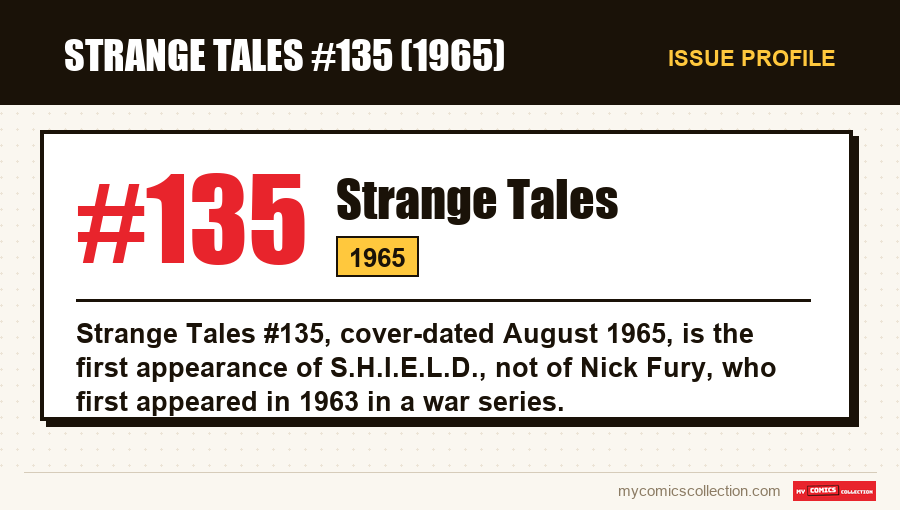
Strange Tales #135, cover-dated August 1965, opens the "Nick Fury, Agent of S.H.I.E.L.D." feature, written by Stan Lee and drawn by Jack Kirby. The colonel is recruited to lead a worldwide espionage agency facing Hydra. The character itself already existed from 1963 in a war series. This issue therefore does not create him: it moves him into the contemporary era and creates the organization. It is this dual status that buyers are looking for.
Few 1965 issues are as consistently mis-sold as this one. On marketplaces, listings alternate between "first appearance of Nick Fury" and "first appearance of S.H.I.E.L.D.", and only one of the two wordings is accurate. The confusion matters to a buyer: it shifts the value, it changes the issue you should be targeting, and it explains why some collectors pay a first-appearance price for an issue that is not one, while not realizing they are indeed buying another first, rarer and more lasting.
As always in this guide, only verified details (creators, issue numbers, dates) are stated as fact; the analysis is our own, with no reproduction of panels or protected dialogue.
The issue: date, creators, what happens in it
Strange Tales #135 carries a cover date of August 1965. The first half of the book launches a new espionage feature: a former sergeant turned colonel is approached, then placed at the head of an international intelligence organization whose acronym becomes the title of the feature itself. Stan Lee writes the script, Jack Kirby handles the pencils; the inking is generally credited to Dick Ayers, who had long worked on the same character's war stories. If that detail matters to you, check the credits in the copy in front of you rather than the listing.
The other half of the issue remains devoted to the adventures of the master of the mystic arts, who had held that slot for several years. This coexistence has a very concrete practical consequence: two different readerships have been hunting the same comic for decades, for opposite reasons. A seller who knows only one of the two audiences regularly undervalues the copy, and the reverse is also true.
Narratively, the story does three things at once: it transposes a character from 1943 into 1965, it founds an agency that will serve as a shared setting for the whole publishing line, and it names the recurring adversary, a pyramid-structured terrorist organization. Three foundations in roughly eighteen pages, a density that is rare even for the period.
What the series was publishing before this shift
Up to issue 134, the slot that from #135 onward belonged to the Human Torch, whose solo stories were losing steam commercially. Replacing a headliner with an espionage feature is therefore not a purely creative move: it is a sales decision, made at a time when the spy genre dominated screens and television. Strange Tales #135 is the issue where that decision became visible on the newsstand.
This context also explains the choice of character. Since 1963, Marvel already had a gruff leader of men installed in a successful war series, with a cast of recognizable supporting characters. Reusing that figure in 1965 cost less, editorially, than inventing a new one: the readership knew him, and so did the creative team. The bet was to project him twenty years forward without losing his identity, and it is precisely this time jump that this issue enacts.
The decisive nuance: this issue is not a character's first appearance
The colonel first appears in 1963, in the first issue of the war series devoted to him, where he is a sergeant and the action takes place during World War II. He then reappears in the contemporary era before 1965, as an intelligence agent, in an issue of the series devoted to the fantastic quartet dated December 1963. Strange Tales #135 therefore comes third in that chain.
What this issue holds exclusively is something else: the first appearance of the organization, and the first time the character wears its uniform and holds its rank. In other words, it is a first of an institution and a first of a role, not a first of the character. The distinction may sound academic; yet it is at the heart of most disputes between buyer and seller over this comic.
For a collector, the consequence is simple. If you are looking for the character's origin, your target is the number 1 from 1963, and Strange Tales #135 will never replace it. If you are looking for the starting point of the espionage universe that then runs through dozens of series, including the Avengers titles, then this issue is the piece, and no other can stand in for it.
Why this issue became a key
Keys that last are rarely the ones that rest on a single argument. This one stacks three. First, the birth of an organization that became a permanent narrative mechanism: whenever Marvel needs an institutional frame, a chain of command or a threat from within, the agency founded here resurfaces. Second, Kirby's presence at the launch, at a time when his work on hardware and futuristic architecture reached a peak. Third, the shift of a war character into the present, a move few heroes of the period managed.
Add to this a screen effect. Each time the organization takes a central place in an audiovisual production, demand for this comic tightens, and it tightens more than it does for the 1963 issue, because the acronym is more recognizable to recent audiences than the name of the war unit. This is a case where modern fame lifts an issue that is not the historical first appearance, and the market accepts that knowingly.
What moves the price: condition, pagination, provenance
1965 paper is acidic, and comics from that era have suffered in predictable ways. On this issue specifically, watch three areas. The stapled spine, because both stories encouraged opening the book fully flat, which fatigues the central staples. The upper corners, which show the marks of spinner racks. And the right edge of the cover, often slightly rounded from repeated handling.
The value gap between a readable copy and a near-mint one, on an issue this scarce, is measured not in percentages but in multiples. One grade step can be enough to move a copy from one buyer category to another, and therefore change the nature of the transaction. Paper browning, the absence of a vertical crease, and the freshness of the cover colors weigh more, on this year, than small edge defects.
Provenance also plays a role. Copies that come from lots found intact, stored flat and away from light can be recognized by the evenness of their tone across all pages. A copy with a bright cover but browned interior pages has probably been stored open or in a stack under weight.
Telling one edition from another
The good news with this comic is that there is no cover variant by ratio and no newsstand edition opposed to a direct-market edition: those practices came well after 1965. The bad news is that the content has been reprinted a great many times, in collections, series reprints and bound volumes, and these reprints circulate in listings with the same cover art.
Three checks are enough to settle the question. Check the format and pagination: the original edition is a thin stapled comic, not a volume. Check the small-print legal notice, which carries a copyright date: any year after 1965 settles it. Finally, check for the period advertising pages that were printed with the original run, which reprints do not reproduce. If a listing shows only the cover and refuses a photo of the interior credits, treat the edition as unestablished.
A special case deserves attention: facsimiles and exact reprints, sometimes flagged by a discreet mention on the cover or by a barcode absent from the original. They are perfectly legitimate to own, and very useful for reading a fragile piece without handling it, but they carry no comparable collector value. The trap is not that they exist; it is that a tight close-up photograph hides the format.
Do you collect this series?
Track what you own, what you are missing and what your collection is worth. 7-day trial.
Start my trial →
Pitfalls when buying
The first pitfall is in the wording, and you will meet it everywhere: the tag "1st appearance of Nick Fury" attached to this issue. It is wrong, and it is often made in good faith. When it appears in a listing, ask the seller whether they mean the first appearance of the character or the first appearance as an agent of the agency. The answer will tell you whether they know their piece, which is a good indicator of the rest of their description.
The second pitfall concerns the integrity of the book. On comics shared between two stories, it happens that a reader kept only the half judged interesting, or that a page from the second story was cut out to be framed. Count the pages, or ask for a photo of the center spread opened flat.
The third pitfall is undisclosed restoration: color touched up along the fold, staples replaced, edge trimmed to remove a tear. Trimming shows up as an unusually clean margin and a format slightly smaller than other comics from the same month. Be wary of a 1965 copy whose edges are more regular than those of a recent reprint.
Neighboring issues that also matter
If your goal is the character's origin, it is the first issue of his war series, dated 1963, that you should target, with the price gaps that a first appearance from that period implies. If you are building a coherent set around espionage, the December 1963 issue of the fantastic quartet series, which shows the character in the present before he enters the agency, forms a logical link and remains noticeably more accessible.
Within Strange Tales itself, the issues immediately following #135 extend the launch and carry the first appearances of several of the agency's setting elements. They are much cheaper, easier to find in good condition, and they show how the setup was put in place: for someone who wants a readable sequence rather than a single piece, these are often the best buys of the month. The earlier issues, for their part, interest mainly fans of the second story in the book.
What grading changes
On an issue where the label itself is ambiguous, grading provides two distinct things. A grade, which settles the question of condition and restoration, which is valuable on 1965 paper. And a descriptive note on the label, which fixes the nature of the appearance. This second point matters most here: a correctly worded label cuts short the confusion this whole article is about, at resale time.
On the other hand, a graded copy trades in a narrower and more comparative market, where the gaps between adjacent grades become abrupt. For a reading copy or a mid-range copy, the cost of grading is rarely justified. For a fine copy, it almost always is, because that is where the price range widens the most and a distant buyer refuses to commit without a guarantee.
How to track it in a collection
This is typically the issue that ends up misfiled in an inventory, because it belongs to several logics at once. In My Comics Collection, record it under its real series and issue number, then use the notes to log the two facts that define it: the creation of the organization and the change of role for the character. You will avoid confusing it, six months from now, with the 1963 issue you may still be looking for.
Also make a point of recording the edition. Many collections unknowingly contain a reprint in place of the original, because the entry was made from the cover rather than the legal notice. One line in the notes, recording the copyright date found inside, settles the question for good. And if you also follow espionage series, linking this issue to your Winter Soldier entries will make your set read as a theme, not as a list.
What to remember
Strange Tales #135 is a key whose value does not come from what most listings claim. It does not create the colonel, who had existed for two years in the 1943 uniform and had already reappeared in the present. It creates the agency, and it creates the role that defined the character for every audience that came after. Buying this issue knowing that is buying the right piece for the right reason, and it is also selling it without bad surprises.
Before committing, ask for a photo of the interior credits and the legal notice, check the pagination, and compare the asking price with that of the immediately following issues, which give a reliable picture of the real state of the market for this series. Our guide library details the condition-checking methods that apply to comics from the mid-1960s.
You own a copy of Strange Tales #135 and you are not sure whether it is the August 1965 printing or a later reprint? Have it identified before any decision.
Estimate my comic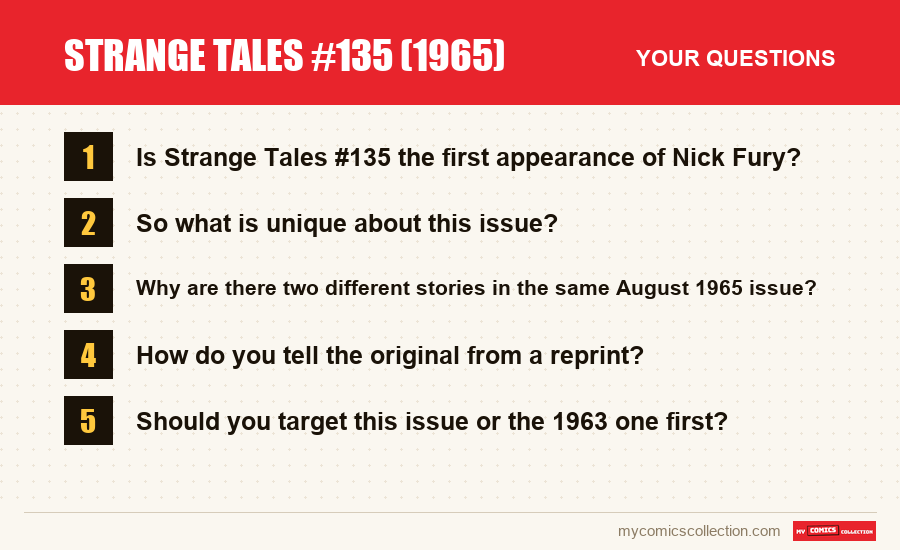
Frequently asked questions
No. The character first appears in 1963, in the first issue of his war series, where he is a sergeant during World War II, and he reappears in the contemporary era as early as the end of that same year. Strange Tales #135 is his first appearance as an agent of the espionage organization, which makes it a first of role.
The first appearance of the organization itself, founded in this story, and the launch of the espionage feature by Stan Lee and Jack Kirby. The agency then becomes a framework shared by many Marvel series. It is in that capacity, and not as the origin of the character, that the issue is considered a key.
Because the second half of the issue remained devoted to the master of the mystic arts, who had occupied that slot for several years. The espionage feature took the space left open by the Human Torch's solo stories, which had ended with the previous issue. Two audiences are therefore looking for the same comic.
Three checks are enough. The format: a thin stapled comic, not a bound volume. The legal notice inside, which carries a copyright date: any year after 1965 rules out the original. And the presence of period advertisements, which collections and reprints do not reproduce.
It depends on your goal. For the character's origin, only the number 1 from 1963 fits, and it commands a price like a first appearance from that period. For the starting point of Marvel's espionage universe, Strange Tales #135 is irreplaceable. The two are not interchangeable and cannot be weighed against each other on price.