
In short
Static, Virgil Hawkins, debuts in a preview in Icon #1 and in Static #1 (1993), written by Dwayne McDuffie and Robert L. Washington III with art by John Paul Leon, for the Milestone line distributed by DC. He becomes a cartoon star in 2000, joins the Teen Titans in 2009, headlines a short New 52 series in 2011, and returns with Milestone's revival in 2020.
Static is a teenager from Dakota who gets electromagnetic powers from a gang showdown, and his publishing history is a study in how a character survives the failure of the company that made him.
Creators, issue numbers and publication years in this timeline were confirmed first, whereas the reading of each period is our own interpretation, and no artwork or dialogue is reproduced.
Milestone and the idea behind the hero
Static belongs to the Milestone line, which opened in 1993 with McDuffie, Cowan, Davis and Dingle among its founders. Milestone comics were published through DC Comics without falling under DC's editorial control, and its first four titles were Hardware, Icon, Blood Syndicate and Static. The ownership structure is the first thing a collector should understand, because it explains why the character spent long stretches outside DC's mainline continuity.
The character was designed as a teen hero in the mold of Spider-Man, with a name for the civilian identity that honors Virgil D. Hawkins. Christopher Priest is credited with suggesting the name Static. The premise gives a young reader a lead who talks too much, has homework and a family, and lives in a city that functions as a character of its own.
That design is the reason Static survives better than most of his Milestone peers. A teenager with a family, a school and a friend group travels well across media and across editorial regimes, and every later revival leans on the same few elements.
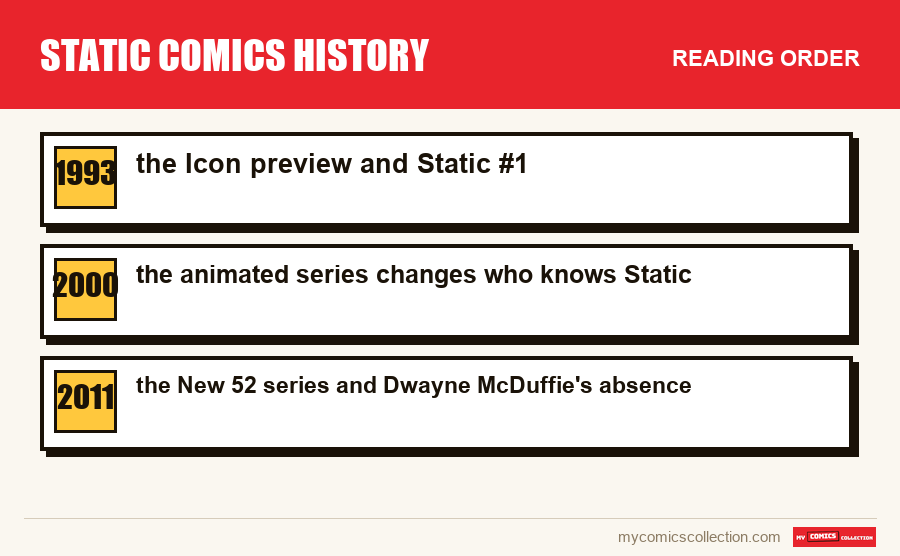
1993: the Icon preview and Static #1
The first sighting is a three-page preview in Icon #1 in 1993, followed by the first full story in Static #1 the same year. Dwayne McDuffie and Robert L. Washington III write the debut, John Paul Leon draws it, and the cover is credited to Denys Cowan and Jimmy Palmiotti. Because the preview and the first issue both belong to 1993, collectors who want the complete debut should plan to own both.
The origin is simple and specific. Virgil Ovid Hawkins, a 15-year-old in Dakota, is caught in a gang showdown where tear gas laced with an experimental mutagen called Quantum Juice is released. The event becomes known as the Big Bang, and the people exposed become Bang Babies. Virgil gains electromagnetic powers, calls himself Static, and keeps his identity from most of his family. Frieda Goren learns the secret.
The setting matters as much as the powers. His father Robert works at Paris Island Hospital, his mother is Jean, his sister is Sharon, and his closest friends are Frieda Goren, Rick Stone and Larry Wade, and Daisy Watkins is one of his romantic interests. The supporting cast gives the book a day-to-day texture that most teenage heroes of the period lacked.
The Milestone years: villains, allies and cancellations
Static's early opponents include Hotstreak, Tarmack, Holocaust, Commando X and Puff. He joins the unofficial group Heroes, and later a corrupt Shadow Cabinet sends a death squad after some of his new friends, which places him inside the shared universe that makes Milestone distinctive. Each Milestone title feeds the others, so Static's world is bigger than the one book.
The line itself did not last. Milestone cancelled several lower-selling series in 1995 and 1996, and in 1997 the comic book division shut down. The company then became primarily a licensing business focused on Static Shock. The sequence is worth remembering: the comics end, and the licensing activity built around Static carries the brand forward.
A 2001 miniseries, Static Shock: Rebirth of the Cool, shows Virgil retired from heroics. It is a late coda, published after the cartoon had already made the name widely known, and it fills the gap between the Milestone era and the DC era.
2000: the animated series changes who knows Static
The animated Static Shock debuts in 2000 and runs to 2004, and it recasts the character in several ways. Virgil is a 14-year-old honors student, the origin involves Quantum Vapor rather than Quantum Juice, and his mother Jean was killed in the Dakota Riots five years before the series begins. Many readers meet the hero through this version, and the show also brings him into the DC animated universe, with a future, older Virgil in a Justice League Unlimited episode and a later version in Young Justice.
The detail that matters for collectors is the mismatch. Someone who comes to the comics after the cartoon will find a Virgil who is a year older and whose family is intact, which changes the emotional center of the book. The screen-versus-page comparison lists the gaps between the two Virgils.
2008 and 2009: Static enters the DC Universe
In 2008 the Milestone characters are merged into the DC Universe. Static's first move is into Terror Titans, a six-issue series running from December 2008 to May 2009, in which Darkseid hires the Terror Titans to capture him in the prelude to Final Crisis. His first canonical DC Universe appearance is in issue #4, and the placement brings the character into the orbit of a villain who dominates DC's cosmic stories. For background on that antagonist, see our history of Darkseid.
The next step is membership in the Teen Titans. Static joins the team in Teen Titans (vol. 3) #69 (June 2009), which gives the character a place in a franchise with a large audience. Our guide to the best Teen Titans runs maps the books of that period. The effect is that Static becomes a teammate of characters from the Robin and Nightwing family, which is why this page connects to those hubs.
In 2010 the limited series Milestone Forever #1 and #2 (February and March) shows the character's later life. It is a short, closing-note story that works as a bookend to the original line and a bridge to the new continuity.
Do you collect this series?
Track what you own, what you are missing and what your collection is worth. 7-day trial.
Start my trial →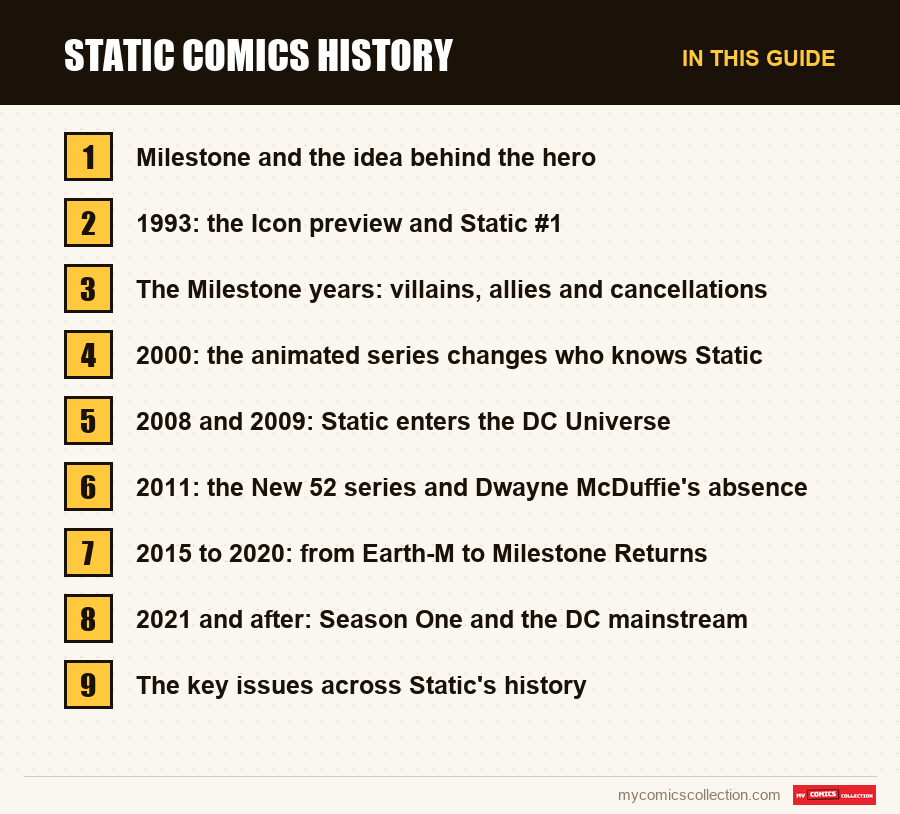
2011: the New 52 series and Dwayne McDuffie's absence
A planned series from Felicia Henderson and Scott McDaniel was cancelled after Dwayne McDuffie's death. A one-shot, Static Shock Special (June 2011), by Henderson and Cowan, was released. In September 2011 the ongoing Static Shock series launched with writer John Rozum and artist Scott McDaniel, who also co-wrote.
The New 52 version moves Virgil to New York with his family, away from Dakota. Hardware provides a new costume, a modified flying disk and an after-school internship at S.T.A.R. Labs. The series was cancelled with issue #8 in the Second Wave of titles. He also appears in Teen Titans (vol. 4) #6 (April 2012), where his work on Red Robin's costume and a stabilizing suit for Kid Flash is part of the story.
The New 52 run is short, and its relocation away from Dakota makes it the version that least resembles the Milestone original. It is nevertheless a useful completion item for anyone who wants every Static series, and it documents the editorial decision to detach the character from his home city.
2015 to 2020: from Earth-M to Milestone Returns
The Milestone name comes back slowly. In January 2015 Reginald Hudlin discussed a relaunch with the surviving co-founders Denys Cowan and Derek Dingle, and in July 2015 DC announced Earth-M as a part of its multiverse. In October 2017 DC announced five titles for 2018, and in September 2020 the line was revived in Milestone Returns #0.
The revival reimagines the Big Bang at a protest, with tear gas supplied by Alva Industries. A new digital Static Shock series was announced in August 2020 and released in February 2021. Rick Stone becomes Richie Foley, the hero Gear, so a reader who knows the 1993 supporting cast will notice the change. The new setup reflects the point of the revival: preserve the premise and update the context.
2021 and after: Season One and the DC mainstream
Static: Season One runs for six issues, the sixth dated March 2022. It depicts Virgil's early career for a new generation and was collected in hardcover on June 7, 2022, in paperback in 2023 and in a DC Compact edition in 2025. The Milestone Compendiums reprint the original line in volumes dated February 2022, January 2023, February 2024, June 2025 and June 2026.
The latest phase is integration. Mark Waid's The New History of the DC Universe and its one-shot The Dakota Incident, released in February 2026, bring the Milestone characters into the DCU. The six-issue Batman/Static: Beyond, by Evan Narcisse with art by Draper-Ivey, ran from 2025 to 2026, and New Titans #37 carries a short bridging story before Virgil becomes a major character in the series from #38.
A live-action Static Shock film was announced at DC FanDome in August 2020, with Michael B. Jordan joining as co-producer. In July 2025 James Gunn said there were no immediate DCU plans because of rights issues. The film remains an announcement, not a release.
The key issues across Static's history
- Icon #1 (1993): the three-page preview of Static before his own title.
- Static #1 (1993): the first full story, by Dwayne McDuffie and Robert L. Washington III with John Paul Leon.
- Static Shock: Rebirth of the Cool (2001): the miniseries that shows him retired from heroics.
- Terror Titans #4 (2008 to 2009 series): his first canonical DC Universe appearance, as Darkseid's hired team hunts him.
- Teen Titans vol. 3 #69 (2009): Static joins the team.
- Milestone Forever #1 and #2 (2010): the later life of the Milestone heroes.
- Static Shock (2011): the New 52 series by John Rozum and Scott McDaniel, cancelled at #8.
- Milestone Returns #0 (2020) and Static: Season One #1 to #6 (through 2022): the revival and its first story.
How to follow Static in a collection
Start with the 1993 launch and treat the Icon #1 preview as part of the same purchase. The Milestone run is the core of the character, and the Compendium reprints are the efficient way to read the original line without hunting for every back issue.
The DC years are scattered across other titles, which means the checklist is cross-series: Terror Titans, Teen Titans vol. 3 and vol. 4, and the 2011 solo series. Note the volume number on each Teen Titans entry, because the appearances sit in different volumes. The revival is the opposite case, with a clear run of Milestone Returns #0, the digital series and Static: Season One.
A good rule is to separate three collections: the Milestone original, the DC integration and the revival. Each has a different continuity, and mixing them leads to wrong assumptions about who knows whom. The Teen Titans guide helps with the second group.
Frequently asked questions
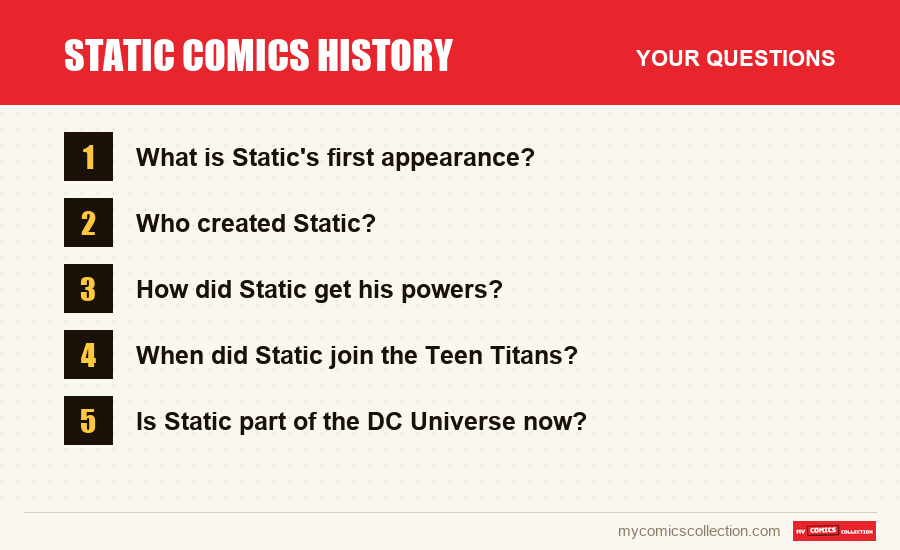
Static debuts in a three-page preview in Icon #1 (1993), with his first full story in Static #1 the same year. McDuffie and Robert L. Washington III wrote the debut, and John Paul Leon drew it. The hero was published through Milestone, an imprint of DC.
Dwayne McDuffie, with Denys Cowan, Christopher Priest, Michael Davis and Derek T. Dingle as Milestone's founders. Priest suggested the name Static, McDuffie and Robert L. Washington III wrote Static #1, and John Paul Leon drew it. Virgil's civilian name honors Virgil D. Hawkins.
In the comics, Virgil Hawkins, 15, is exposed during a gang showdown in Dakota to tear gas spiked with the mutagen Quantum Juice. The event is the Big Bang, and the exposed are Bang Babies. In the animated series he is 14 and the substance is Quantum Vapor.
He joins in Teen Titans (vol. 3) #69 (2009). Just before, in Terror Titans, Darkseid hires the Terror Titans to capture him, and issue #4 is his first canonical DC Universe appearance. He later appears in Teen Titans (vol. 4) #6 (2012).
Yes. The Milestone characters were merged into the DC Universe in 2008, and the line was revived with Milestone Returns #0 in 2020. More recent works include The Dakota Incident, Batman/Static: Beyond and his role in New Titans from #38.
Holding a copy of Static #1 or an Icon #1 from the 1993 Milestone launch? Get an estimate of the condition and the market for it.
Estimate my comic