The character does not enter comics through the front door: in 1959, he appears at the end of the issue, in a short story added to the summary of a series that belongs to someone else. Nothing announces this on the cover, and the summary can only be read once the booklet is opened. Direct consequence for a collector: two people can have the same number for two completely different reasons, and their inventory line will nevertheless be identical. The August 29, 2026 statement shows 28 unverified listings ($8.00 to $2,895.00, median $250.58) and 26 verified copy listings ($599.99 to $22,500.00, median $2,491.91): modest numbers, to be read as orders of magnitude and not as a rating.
There is information that the old comic book market has always incorporated, that experienced sellers know how to formulate in one sentence, and that almost no collector's inventory keeps: the position of a story in the summary. A booklet is not a homogeneous block. It is an assembly of several stories, hierarchized by the publisher at the time of production, and this hierarchy makes a judgment: on what is worth the cover, on what deserves fifteen pages, on what will only be entitled to six pages at the end of the book. When a major character is born in these last pages, the gap between what the object says and what the card retains becomes yawning.
The case which concerns us is the clearest of all. The character began in 1959 in an end-of-issue supplement, within a series devoted to another hero. No cover, no ad, no logo. A handful of pages slipped in after the main story, in a space that the industry used precisely for this kind of essay. The market eventually learned to identify this number. Personal inventories generally have nothing to distinguish them from an ordinary number of the same series, and it is this asymmetry which is costly, both for resale and for insurance.
What was an end-of-number complement?
The word designates a manufacturing practice that has become so commonplace that it has ceased to be named. A booklet has a number of pages fixed by the format and the cost of the paper. The featured story never takes up all of this pagination: there remains, at the end of the notebook, a space of a few pages once the advertising, readers' letters and service pages have been removed. This space is filled with a short, self-contained narrative, often unrelated to the main story.
The complement is not a fall. It is a structural, planned location, with its own editorial logic. It is frequently entrusted to a team different from that of the main story: another designer, sometimes another screenwriter, regularly beginners or second-rate collaborators who are given reduced space to prove themselves. The reader of the fifties and sixties therefore purchased, without necessarily thinking about it, an object with several voices, the composition of which he only knew once the cover was turned.
This autonomy explains everything else. An add-on can launch a character without committing the series that hosts it. He can propose a different tone, a different genre, an idea that the editor does not dare to put at the center. It can be abandoned the following month without anyone noticing. On an industrial scale, these few pages functioned as a zero-cost laboratory: the booklet was sold anyway, the space was paid for anyway, and the essay risked nothing other than itself.
This is also what makes the supplement difficult to document today. A main story is indicated by the cover, by the title of the series, by collective memory. An addition is only indicated by the summary, printed on the inside page, in tiny font, on paper that is sixty-five years old. You have to open the booklet to find out what it contains, and opening an old booklet is precisely the action you avoid.
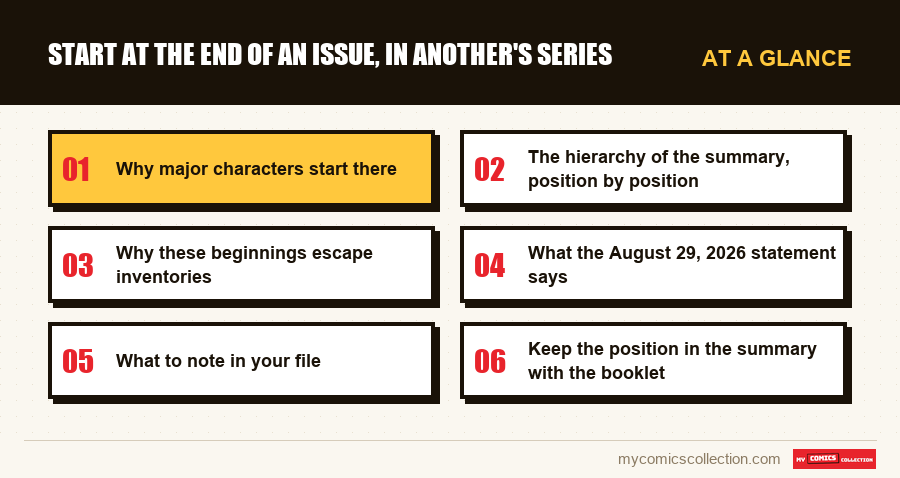
Why major characters start there
A test that does not commit the coverage
The cover is the only selling point on the newsstand. Placing an unknown character there means betting on the monthly turnover. The supplement makes it possible to present the idea to the entire existing readership without risking anything on the sale: those who buy the title for its usual hero buy it anyway, and discover the novelty inside.
An audience already constituted
Launching a standalone title requires finding a readership from zero. Placing the essay in an installed series amounts to borrowing its audience for an issue. The feedback is immediate and relates to real readers, not to a circulation estimate: it is the cheapest and most reliable test available to a publisher.
A costless failure
A supplement that does not take disappears silently. No title to stop, no broadcast contract to undo, no announcement to deny. This reversibility explains why the supplements welcomed concepts that the editor himself considered uncertain: some of which became lasting pillars.
A delayed recognition
As the complement is invisible from the outside, its documentary value only appears after the fact, when the character has established itself. The market then reconstructs the genealogy and goes back to the original booklet. This gap of several decades is the reason why these issues circulate for a long time at the price of an ordinary issue.
The mechanics are always the same: the editor seeks a space where failure costs nothing, and this space is structurally invisible. The consequence is paradoxical: the starting point of the strongest characters is also the one that the physical object signals least well. The complement is made not to be seen, and it keeps its word, even sixty-five years later, on a shelf.
The amounts cited here are those claimed by sellers on August 29, 2026, on a single statement. These are prices asked, displayed at the time of measurement: not completed transactions, not a quote, and especially not a trajectory: a single photograph by construction shows no movement, neither rise nor fall.
Twenty-eight announcements on one side, twenty-six on the other: these numbers remain modest. A median calculated over a few dozen lines gives a useful order of magnitude to situate yourself, never a value to oppose to a buyer or an insurer.
The hierarchy of the summary, position by position
To use the position in the summary, you still need to know how to read it. A fascicle from this period distinguishes in practice three or four rows, and each expresses a measurable degree of editorial confidence in the pagination and the space given in the notebook.
The main story opens the booklet and matches the cover. This is the maximum commitment: the publisher has paid for a cover illustration, mobilized its most reliable team and bet the month's sale on it. The confidence is total, and by construction it relates to what already exists: an established hero, a proven formula. The main story is conservative: it confirms, it does not invent.
Le second récit comes next, shorter, often with a secondary character from the title universe or a parallel formula. The trust is real but partial: the publisher judges the content solid enough to occupy a substantial space, not enough to entrust him with the sales argument. This is the position of characters in the process of consolidation, of those who have already passed the complement test and have not yet obtained their own title.
Le complément court closes the summary. A few pages, often different team, complete autonomy. Trust is minimal: not in the sense of contempt, but in the sense of deliberately reduced commitment. This is the position of the essay, of the concept that we want to submit to the reader without defending it publicly. The beginnings of 1959 are located here, and this position is in itself historical information: it says that the editor did not yet know what he had in mind.
Service pages: letters, sections, short texts: complete the whole without carrying a story. They are mentioned because they occupy the pagination and explain why the complement is so brief: what remains of space after them defines the format of the essay, and not the other way around.
Read in this order, the table of contents becomes a document on the state of mind of a publishing house on a given date. A character who migrates from the back row to the second, then from the second to the cover, leaves a material trace of his rise in importance. This progression is visible booklet after booklet, provided you have noted it somewhere: which no inventory software does spontaneously.
Collecting this series?
Track what you own, what you are missing and what your collection is worth. 7 day trial.
Start my trial →Why these beginnings escape inventories
The cover says nothing
The only element that a collector looks at when storing, photographs or puts away his booklet is precisely the one that ignores the complement. The most decisive information is absent from the visible side of the object.
The summary is on the inside page
You have to open the booklet to read it, a gesture that you avoid on an old and fragile copy, and impossible on a sealed copy after verification by an organization. The information exists but remains inaccessible in practice.
The form does not have a field for that
Series, number, date, status: the standard structure of an inventory line does not provide any location for the position of a story in the summary. What has no field cannot be grasped, and what cannot be grasped disappears.
Deux exemplaires identiques, deux motifs
A reader who bought this issue for their regular hero and a collector who bought it for the supplement are holding the same item. Their inventory lines are indistinguishable, while their intention, their requirement on condition and their resale horizon have nothing to do with each other.
The number is not speaking
A key located in a series which bears the name of another character is not indicated by any numbering anomaly. It is in the middle of a continuous series, between two issues of no particular interest, and nothing in the classification makes it stand out.
The pattern memory is erased
The reason for a purchase is clear the day it is made, unclear three years later, lost at the time of inheritance or resale. It is the most fragile piece of data in the entire collection, and it is also the one that determines the value.
What the August 29, 2026 statement says
The report separates two populations of adverts. Unverified side: 28 offers, $8.00 to $2,895.00, median $250.58. As for copies passed by a verification body: 26 offers, from $599.99 to $22,500.00, median $2,491.91. The most instructive fact is not the gap between the medians, it is elsewhere.
Twenty-six verified copies for twenty-eight unverified: the two segments are equal. This is very unusual. On an ordinary issue, the raw copies largely dominate, with verification only being carried out on a minority of pieces. Here, half of the available market considered the expenditure justified: which reflects an already established recognition of the importance of the number, regardless of what the amounts themselves are worth.
Second point: the floor of the verified segment, $599.99, well exceeds the median of the unverified segment, $250.58. The two distributions hardly overlap in their lower part. An $8.00 listing and a $22,500.00 listing do not describe the same item in the same condition, and averaging them would not make sense. The maximum at $22,500.00, in particular, expresses a single seller's expectation: it indicates how much someone dares to ask, not what someone paid.
Finally, the method caveat. Twenty-eight and twenty-six lines are modest numbers. A median calculated on this basis moves as soon as three announcements change, and the reading having only been done once, it says nothing about what happened before or what will happen after. It is used to establish an order of magnitude and to understand the structure of the market, two clearly separated segments, never to assert a price.
What to note in your file
The position in the summary, in full. Write “end of issue supplement”, “second story” or “main story” in a free field on the card. This is the information that distinguishes your copy from an ordinary issue of the same series, and it is the only one that the object will never carry on its visible side. Without it, your inventory line describes any issue from 1959.
Le motif d'acquisition, daté. Write down why you bought this specific issue: for the main story, or for what's in the final pages. Two strictly identical copies do not have the same meaning according to this answer, and this is the first thing that a buyer, an heir or an expert will seek to reconstruct: most often without succeeding.
The nature of the segment, verified or raw. The August 29, 2026 reading shows two separate markets whose price ranges hardly overlap. Recording whether your copy has passed through a verification body or not is not an administrative detail: it is what determines which of the two distributions your piece should be compared to.
The condition of the affected part, not just the general condition. A booklet whose last pages are detached, yellowed or incomplete loses exactly what makes it valuable, while a cover defect, which is more visible, affects a less decisive part. Describe the condition of the end book separately: the mention “good general condition” will not protect you from any dispute.
The source of the figures and their date. Note that your amounts come from asking prices recorded on August 29, 2026, on 28 raw and 26 verified advertisements, and not from concluded sales. A number without date or provenance ages poorly and silently transforms into certainty. A dated and sourced figure remains usable, including to indicate that it needs to be redone.
By consulting the summary, printed on the inside page, or the issue sheet in the catalog, which details the stories contained in each issue. The cover provides no guidance. On a sealed copy after verification, direct consultation is impossible: you must then rely on the description of the catalog, which makes it all the more useful to copy this information into your own file.
Because the market values precedence, not staging. The first documented appearance of a character remains the first, whether it occupies six pages at the end of the notebook or twenty at the opening. The position in the summary influences the difficulty of locating the number, and therefore its circulation, but it does not cancel the status of starting point.
No. These figures are modest and the resulting medians: $250.58 and $2,491.91: are valid as orders of magnitude, not as odds. Added to this is a heavier limit: the measurement was taken only once, on August 29, 2026. A single photograph cannot by definition show any evolution, neither in one direction nor the other.
She points out that the importance of the number is widely recognized by the holders themselves. Verification represents a cost and time that is not incurred on an ordinary fascicle. That half of the available supply has taken this step indicates consensus on the status of the coin: a structural signal, distinct from the amounts demanded.
Under the series, since that is how it physically exists and will end up in storage. But the form must clearly indicate the character starting in the complement, in a note field or a label. It is this double registration which allows the piece to be found by both routes, without distorting the classification.
Keep the position in the summary with the booklet
A field of notes, a label, a dated reason for acquisition: it's all that separates any inventory line from a card that really documents why this number matters. My Comics Collection lets you save this information along with the booklet, and find it years later.