In short
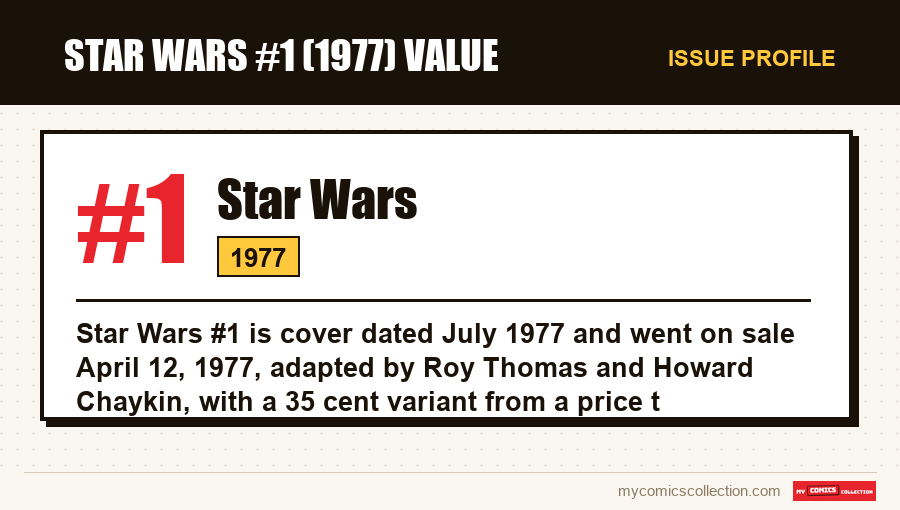
Star Wars #1 is cover dated July 1977 and went on sale April 12, 1977. Roy Thomas and Howard Chaykin adapted the film in issues #1 to 6, and the cover is credited to Chaykin and Tom Palmer. The standard copy carries a 30 cent price, while a 35 cent variant comes from a 1977 price test that Marvel ran across its line. A copy's standing rests on four checks: the printed price box, the grade, any restoration, and a label that names the variant.
Few Bronze Age comics are described with as many caveats as the first issue of Marvel's Star Wars. The same cover exists in a common printing, in a scarce test-market version, and in several later editions that look close enough to fool a hurried buyer. Here the issue is handled as an object to identify before anyone prices it: the print on the cover, the pair who made it, the copy in your hands, and the questions a seller should answer.
The creators, the July cover date, the April street date and the 1977 price test were checked before writing; the advice drawn from them is ours, and no amount appears on this page because a figure goes stale faster than a method does.
The issue at a glance
Star Wars #1 is the opening chapter of Marvel's adaptation of the 1977 film. The cover of the issue says July 1977, the date that retailers and census labels use, yet the book reached stands on April 12, 1977. That gap matters when you read old references: a source that says April is describing the street date, and a source that says July is describing the cover. Both can be right about the same copy.
The creative team is Roy Thomas and Howard Chaykin. Thomas and Chaykin adapted the film's events across issues #1 to 6, and the cover of #1 is credited to Chaykin and Tom Palmer. This page does not list interior inker, colorist or letterer credits, because only the cover pair and the writer and artist pair are confirmed. If a seller prints a longer credit list, treat it as something to check, not as a feature of the book.
The series that opens here runs 107 issues plus three Annuals and ends in May 1986 with issue #107. That length is worth keeping in mind: a long licensed run means a large shared supply of ordinary back issues, and it is the opening issue that attracts the collecting attention, particularly because of the price variant described below.
How Marvel ended up with the license
The license began with a meeting that was hard to obtain. Lucasfilm's Charles Lippincott had trouble getting a meeting with Stan Lee until Roy Thomas joined him. Lee negotiated a deal in which Lucasfilm received no royalties until sales passed 100,000 copies.
The series did well enough that the 100,000 threshold was crossed quickly, and that allowed Lippincott to renegotiate the royalty terms. Jim Shooter later said that the strong sales of the Star Wars comics saved Marvel financially in 1977 and 1978, and the title was a strong candidate for the industry's top-selling comic book in 1979.
For a collector this history has a practical consequence. A title that sold strongly from the start was printed in large numbers, so the standard first printing is not a scarce object. The scarcity in this issue is concentrated in one narrow place, the 35 cent copies, and the rest of the discussion about value follows from that fact. If you want the wider map of the license, from the 1977 run to the series launched in 2015, our Star Wars Marvel collecting guide covers the eras, while this page stays with one number.
What the first six issues adapt
Issues #1 to 6 together carry the adaptation of the first film, with Thomas and Chaykin as the team. Original stories start with issue #7, cover dated January 1978. For a buyer, that boundary is useful: #1 to 6 is a six-part block with a single narrative job, and #7 is where Marvel begins telling stories that the film did not supply.
The 1977 price test behind the 35 cent copies
The standard copy of Star Wars #1 carries a 30 cent cover price. In 1977 Marvel tested a five cent increase by printing 35 cent copies of some of its comics and sending them to selected markets, while the 30 cent copies went everywhere else. A 35 cent copy of a Marvel book from that test is therefore a regional oddity, not a later printing.
The result is a pair of editions of the same book that differ in the price printed on the cover, and in the case of Star Wars the difference has drawn a great deal of collector attention. Far fewer 35 cent copies were printed than 30 cent copies, and no print run has been published for either edition. Treat any precise number of copies as folklore, and any seller's claim of a specific survival count as unsupported.
Issue #1 is the number with the heavier reputation, because it opens the adaptation and the run. If you meet a 35 cent copy of a later issue of Star Wars, the same identification checks apply, and the same caution about unproven claims.
How to tell a genuine 35 cent copy from the rest
The price printed on the cover is the first thing to look at, and it is also the least sufficient. On a Star Wars #1 that claims the 35 cent price, study the upper left price box, the July line beneath the number and the lower left barcode area together, then lay the copy next to a certified example of that variant. Any difference in shape, print or content deserves immediate suspicion.
Later editions of the issue, the 2019 Star Wars #1 Facsimile Edition among them, are a separate matter. If your copy does not match a verified first printing, it is most likely a later edition, which is a legitimate collectible in its own right but a different purchase. The way to avoid mistakes is to put your copy beside a certified one and compare shapes, not to rely on a description.
The warning that applies above all others is about altered covers. A 30 cent price box can be altered to read 35 cents, and such work tends to show in font, ink and spacing when set against a genuine copy. Because the "35" is easy to add to a common copy, a raw copy sold on a bare description carries a risk that no condition grade can offset. For that reason a certified label that names the variant is the practical standard for this particular issue, and a raw copy should be priced as if the claim were unproven until it is verified.
Do you collect this series?
Track what you own, what you are missing and what your collection is worth. 7-day trial.
Start my trial →
Later editions that get confused with the first printing
In December 2019 Marvel reprinted the first issue of the 1977 series as Star Wars #1 Facsimile Edition. It reproduces the look of the original, which is why it turns up in mislabeled listings, but it is a modern book with its own market. Check the indicia before anything else: a facsimile reproduces the 1977 issue, but it is not a 1977 copy.
What drives the value of a copy
Four factors do most of the work, and they stack in a predictable order. The first is which edition it is: the 35 cent variant sits in a different market from the 30 cent first printing, and a reprint sits in another. The second is the physical condition of the copy. The third is whether the copy has been restored or repaired. The fourth is whether the identification is certified.
Condition on a mass-market 1977 comic is judged on the usual points: spine stress and splits, corner wear, color breaks and creases on the cover, staple condition, page color, and centering. A copy that grades high is far more significant than a copy that grades low, and the difference between two grades is not a fixed multiple from one year to the next. That is why this page quotes none. Compare the sold results of certified copies at the same grade and with the same label, not asking prices, and compare them to the same variant, not to the other edition of the number.
Restoration changes the story. A cleaned, pressed, color-touched or otherwise worked copy sits apart from an unrestored one, and a label that notes restoration tells you so openly. A raw copy with a bright cover and a flat spine should prompt a question about whether it has been pressed or touched up. For a variant that is already hard to authenticate, the combination of an uncertain edition and an uncertain restoration history is the worst place to buy from.
The label itself is the last factor. A label that names the 35 cent edition confirms it in a way a photograph cannot. A label for the 30 cent copy confirms only the grade. If you plan to resell, the label also makes the copy comparable to others, and comparability is what produces a stable price.
Before you buy: a checklist for any copy of #1
Start with the cover and nothing else. Read the price, the month and the barcode box, and compare the shape and print of the price box with a certified example. Next, turn the book over and look at the back cover and the spine for creases, tape, or signs of cleaning. Open it as far as it safely goes and check the staples for rust and the interior pages for brittleness or tanning.
Ask the seller four specific questions. Does the copy have a certified label, and what does the variant line say? Has it been pressed or restored in any way? Can the seller provide photographs of the price box and the barcode box at full resolution? What is the return policy if the copy fails a third-party authentication? A seller who cannot answer these questions has told you something about the listing.
For a 30 cent copy the work is lighter, since there is no variant claim to authenticate, and the grade and restoration questions are the heart of it. Because the print run for the standard edition was large, there is no reason to rush: copies come up regularly, and you can wait for one whose condition and labeling you are happy with. A buyer who treats the standard copy as scarce is paying for a scarcity the issue does not have.
Where the series goes after issue #1
Issues #2 to 6 finish the adaptation. Issue #7, cover dated January 1978, begins the original stories. Archie Goodwin and Carmine Infantino took over with issue #11, from May 1978. The series ends with issue #107 in May 1986. Those four markers give you a reading order and a collecting order that coincide: finish the six-part adaptation, step into the original material at #7, and treat #11 as the point where the creative team changes. The license returned to Marvel decades later, and the modern crossover Hope Assembles belongs on a separate shelf from the 1977 run.
Frequently asked questions
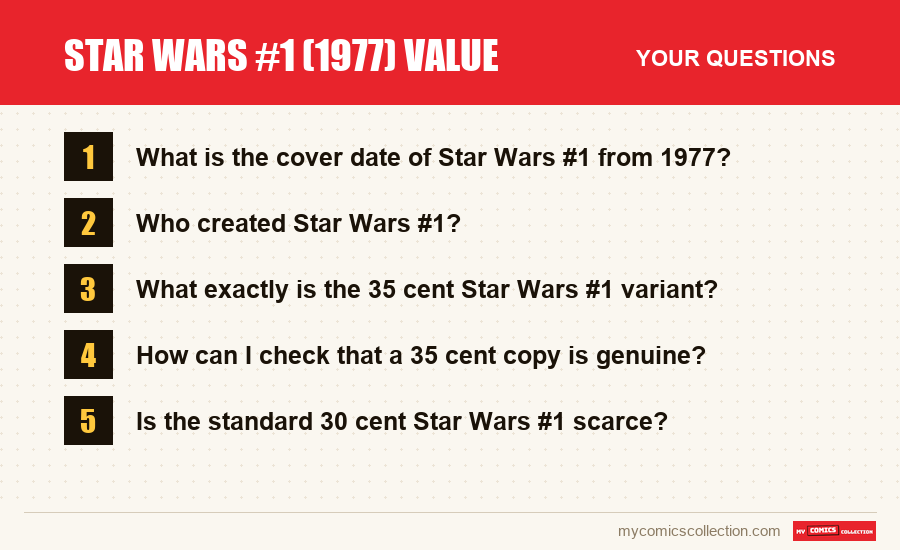
The cover date printed on Star Wars #1 is July 1977, which is the date census labels and retailers use. The book reached stands on April 12, 1977, so a listing that says April gives the street date and one that says July gives the cover date.
Roy Thomas and Howard Chaykin adapted the film in issues #1 to 6. The cover of #1 is credited to Howard Chaykin and Tom Palmer. Archie Goodwin and Carmine Infantino took over the series with issue #11 in May 1978, after original stories began at #7.
It is a copy printed with a 35 cent price instead of 30 cents as part of a 1977 price test that Marvel ran on its line, with the 35 cent copies sent to selected markets. Far fewer of them were printed than the 30 cent copies, and a certified label can name that edition.
Compare the price box, the month under the issue number and the barcode box with a certified 35 cent copy of the same issue, looking at shape, print and spacing. Because a 30 cent price can be altered to read 35 cents, a certified label that names the variant is the practical proof for this issue.
No. The series sold strongly from the start and the issue was printed in large numbers, so the standard edition comes up regularly. The scarcity belongs to the 35 cent copies, which is why the standard copy should be judged on grade, restoration and labeling and not on the variant's reputation.
Not sure whether your copy of Star Wars #1 is the 30 cent or the 35 cent edition? Start with a free estimate before you look at the market.
Estimate my comic