“Key number” is not a feature of the booklet: it is a phrase that the seller chooses to write. No authority issues it, no rules regulate it, no one withdraws it when it is abusive. In a survey of current advertisements carried out on August 30, 2026 on a general auction site in the American market, the mention accompanies both a copy claimed for $0.99 and copies claimed for several hundred dollars. A label that appears at both ends of an interval does not separate anything at all. What really distinguishes the ads in this statement is the declared state and whether or not they have passed independent verification: not the vocabulary used.
The scene is banal for anyone browsing the advertisements for the first issue of the anticipation series launched in 1992: two offers follow one another, both display the words “KEY ISSUE” in capital letters, and the price difference between them is measured in double-digit multiples. The beginning collector often concludes that one of the two is wrong. This is an error in reasoning. Neither is wrong, because there is no frame of reference against which to be wrong. The formula is not bibliographic data like the year of publication or the publication number: it belongs to the register of commercial arguments, in the same way as “rare”, “sought after” or “not to be missed”.
This confusion has a practical cost. It pushes people to pay for a mention rather than an object, and it then contaminates the holding of the collection, because the word copied from the advertisement is found written opposite the booklet in the buyer's personal notes. The reading of August 30, 2026 makes it possible to show very concretely why this label does not carry any usable information, and above all what to replace it with. Let us make it clear from the outset: all the amounts cited here are sums requested by sellers on this date, for advertisements still open, and not for completed transactions. A reading taken at a single moment says nothing about an evolution, in one direction or the other: it photographs a state of demands, nothing more.
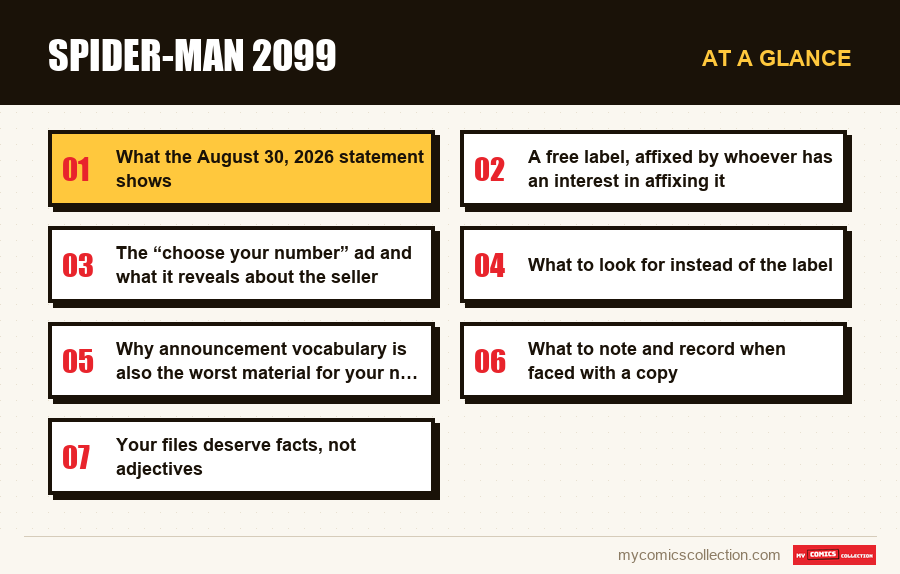
What the August 30, 2026 statement shows
The request related to the first issue of the series launched in 1992. It found 127 advertisements for unverified copies, that is to say sold as is, based solely on the seller's description. Of this set, the lowest amount requested was $0.99, the median was $14.99, and the highest was $159.00. The maximum deserves an immediate warning: an isolated announcement at the top of an interval reflects the hope of its author, not a level that the market would have validated. As long as it has not found a buyer, it remains in demand.
Copies that have passed independent verification have been counted separately, as they should, since they do not trade under the same conditions. They made up 54 listings, with a minimum of $38.25, a median of $99.50 and a maximum of $499.99. The most telling fact of the statement can be read in the comparison of the two series: the floor of the verified segment, $38.25, is located well above the median of the gross segment, $14.99. The two populations do not overlap in their lower part. In other words, the cheapest verified copy already costs more than half of the unverified copies: the dividing line is verification, not vocabulary.
It is in the raw segment that the decisive announcement for our subject is found. The cheapest offering of the entire set, at $0.99, explicitly has "KEY ISSUE" in its title: "Spider-Man 2099 #1 (1992) FN- (5.5) KEY ISSUE NEWSSTAND boarded Combine!" ". This is not a neighboring issue or a disguised reprint: the seller describes the first issue well, in a condition that he himself announces as poor. The same qualifier also appears on advertisements claiming a hundred times this sum. A label that accompanies both the floor price and the top of the basket has, by construction, no discriminatory power.
The bottom of the interval is also populated with neighboring numbers, which makes reading a list of results trickier than it seems. The statement includes an ad for the second issue in its newsstand version, dated December 1992, at $1.17; another for this same second issue, without mention of channel, at $2.50; a third for this second issue presented as a first print in NM condition, at $4.99. These offers do not concern the number sought but are displayed next to it, and their amounts visually pull the whole thing down in the mind of the reader in a hurry.
A free label, affixed by whoever has an interest in affixing it
Nobody delivers her
There is no body that would assign “key number” status, no official list to which a seller should refer, no dispute procedure. The mention is born in the ad title input field, and it dies there. It does not commit anything or anyone.
It costs zero to write
Adding two capitalized words to a title requires no costs, time or justification. Any gratuitous statement ends up becoming generalized: when everyone can write it without compensation, everyone ends up writing it, and the signal is diluted until it no longer signals anything.
It serves internal referencing
In a marketplace, the title is what the search indexes. A seller who slips the formula into his title captures the queries of those who type it. The interest is in visibility before being descriptive: the mention speaks of the need to find the ad, not of the content of the booklet.
She survives all conditions
The statement proves it: the formula remains attached to the booklet whatever its declared state, including on a copy advertised in FN- at $0.99. A characteristic that never varies, whatever the circumstances, cannot be used to sort anything.
None of these four points accuse sellers of bad faith. Most write the formula because it is customary, because competing advertisements carry it, and because they believe it is descriptive. The problem is not moral, it is logical: a word that everyone can affix unconditionally no longer carries information once it is universally affixed. The collector therefore does not have to wonder if the mention is sincere. He simply has to stop expecting information from her that she is not designed to give.
The useful question is never “is this number a key number?” ", but "what verifiable fact justifies the difference in price requested? ". In the statement, only two facts structure the interval: the announced state and the passage through an independent verification. Everything else depends on how you write the ad.
Rephrased like this, the question has an answer. A condition can be seen in photographs, a verification can be read in an accompanying document: the first formulation only calls for an opinion, and the opinion in question is that of the person who sells you the object.
The “choose your number” ad and what it reveals about the seller
One offer from the survey deserves particular attention: “SPIDER-MAN 2099 #1 to #46 (1993): Pick”, at $3.00 per issue, to choose from throughout the advertised range, in conditions ranging from VG to FN+. The seller therefore applies a single rate from the first to the forty-sixth number. For him, all the issues in this range are worth the same thing individually, and he wastes no time in differentiating them.
This behavior speaks volumes. It reflects a seller who sells stock by volume, who favors simplicity of management over line-by-line optimization, and who probably does not have detailed knowledge of the series he is offering. This is exactly the situation that the informed buyer is looking for: when the buyer opposite does not sort, sorting becomes profitable for you, provided you know what you are looking for before opening the ad. This supposes having in mind what, in the editorial history of this series, corresponds to real steps, and not to rely on what the title of the ad suggests to you.
This flat price offer also constitutes an additional demonstration of our thesis. If the “key number” label had price-setting power, it would automatically prevent a seller from offering an entire range at the same price. She doesn't prevent it. The price is formed here on a commercial decision (to sell quickly, without arbitrage) and not on an intrinsic property of the booklets concerned.
One last element of the statement deserves to be noted without being overinterpreted: the word “newsstand” appears on several advertisements, including the one for $0.99 and that of the second issue at $1.17. He points out that the same issue circulated through two distinct distribution channels at the time. The distinction exists and deserves to be recorded when it is visible. On the other hand, this survey does not provide any separate measurement per channel: there is nothing to suggest that one channel would trade above the other, and it would be dishonest to suggest this. We write down the information, we don't make him say a number.
Collecting this series?
Track what you own, what you are missing and what your collection is worth. 7 day trial.
Start my trial →What to look for instead of the label
The state, observed and not announced
The statement gives states declared by the sellers: FN-, VG, FN+, NM. These statements are useful as a starting point, but they remain statements. It is the photographs that confirm or contradict them, and an advertisement whose images do not allow the angles and folds to be judged must be treated as an advertisement without status.
The exact year and number
The majority of low offers in the statement relate to the second number, not the first. A cover figure and a year of publication are enough to eliminate confusion, and these are two facts that the seller cannot color: they appear on the object itself.
The distribution channel
The words “newsstand” appear several times. It is a material characteristic of the print, therefore information of a different nature from a sales argument. We record it when it is visible, without attributing to it a quantified effect which this reading does not allow us to measure.
Independent verification
This is the only criterion in the statement which clearly shifts the interval: floor at $38.25 and median at $99.50 for verified copies, against a median at $14.99 for the others. This isn't magic, it's risk transfer: someone outside the transaction has examined the item.
The position in the interval
An isolated amount says nothing. Compared to a median, it becomes interpretable: at $0.99 we are far below the raw median of $14.99, at $159.00 we are far above. Knowing where an ad is located is better than knowing what adjective it uses.
The editorial reason, if it exists
When a number really counts, it is for a documented fact of publication, not for an announcement mention. This fact is verified outside the sales site, in the catalog and in editorial sources, before opening any bid.
Why announcement vocabulary is also the worst material for your notes
The collector who buys online very often copies the title of the ad in his own notes, for convenience: it's already written, it's already there. This innocuous gesture imports into the collection everything that made the ad persuasive, including what is neither verifiable nor durable. Two years later, the sheet indicates “key number” and no one, not even its author, no longer knows what this statement was based on.
The fault propagates. A false note does not remain isolated: it serves as the basis for an estimate, which serves as an argument for a resale, which in turn produces an advertisement using the same formula. The chain closes, and the label gains in apparent legitimacy with each turn, without any facts being added along the way. It is precisely this mechanism which explains why an empty formula ends up seeming consensual.
The rule to follow is simple: in a collection sheet, only enter what could be checked by a third party by looking at the object or an accompanying document. The year of publication, the number, the channel when it is identifiable, the condition noted, the presence or absence of verification, the date and the amount actually paid. Everything else (the adjectives, the superlatives, the promises) remains in the ad and does not enter the collection.
This discipline pays off especially when you stop being a buyer and become a seller, or simply when you want to know what you own. A collection kept with facts can be reread; a collection held with sales arguments is re-negotiated at each consultation, against oneself. The distinction between versions of the same number also obeys the same requirement, as detailed in our guide to circumstances of the character's first appearance, where only the material elements allow us to decide.
What to note and record when faced with a copy
Write the publication number and year rather than the assumed rank. In the statement, several low offers concern the second issue of December 1992 and not the first of 1992; without these two fields, a collection sheet no longer allows you to know which of the two you hold. These are the only coordinates that identify the booklet without depending on anyone's judgment.
Write down the condition exactly as you saw it, not as it was told to you. A copy presented in FN- must be checked upon receipt and the notation corrected if the photographs flatter the object. Also note the source of the assessment: “announced by the seller” and “observed by me” are not the same information and should not share the same box.
Record the distribution channel when it is identifiable on the copy. The word “newsstand” recurs on several announcements in the statement: it is a material fact which belongs to the file. On the other hand, do not associate any numerical estimate as long as you do not have a separate measurement per channel: noting the fact is enough, interpreting it would be premature.
Radically separate verified copies from raw copies in your tracking. The survey shows two populations which do not overlap in their lower part, with a verified floor at $38.25 compared to a raw median at $14.99; mixing the two in the same average produces a number that describes neither. A dedicated column definitively solves the problem.
Date each amount you record and specify whether it is a request or a payment. The figures cited in this article are sums claimed on August 30, 2026, for advertisements still open; they do not establish any trend, since a single observation cannot by definition show movement. A form that bears neither the date nor the nature of the amount becomes unusable from the next consultation.
Person, in the sense of an authority. The mention is entered freely by the seller in the title of his ad, without prior validation or possibility of dispute. This explains why it appears, in the August 30, 2026 statement, both on an offer at $0.99 and on offers asking for several hundred dollars.
Not necessarily. The seller describes a copy of the first issue in FN- condition, which is consistent with a low amount; it simply adds a usage formula. The ad is not false, it is only uninformative on this specific point, and this is the criticism that we address to the label, not to its author.
No, and the statement says the opposite of such a clear-cut thing. It shows a wide interval where very low demands and very high demands coexist, with a raw median of $14.99 and a verified median of $99.50. These are amounts requested at a given date, not established values, and they do not allow any conclusion on a trajectory.
Because they are not exchanged under the same conditions: their condition has been examined by a third party outside the transaction, which shifts the risk borne by the buyer. The statement makes it visible, with 54 verified listings whose minimum, $38.25, exceeds the median of 127 unverified listings. Merging the two together would produce an average that would describe neither.
It can be for a buyer who knows precisely what he is looking for, since the seller applies $3.00 to the entire range without differentiating its numbers, in states announced from VG to FN+. It is not for those who buy at random: the single price means that the sorting remains entirely your responsibility, and it is this sorting, not the advertisement, which makes the difference.
Your files deserve facts, not adjectives
My Comics Collection lets you record for each copy the year, number, channel, condition noted, presence of verification and the amount actually paid, each dated. None of these boxes accepts superlatives: that is exactly the goal.