A series relaunched at number 1 can, a few years later, resume the historical count of the publication: the issue which follows number 32 is not called 33 but 800. The same series then bears two numberings which follow one another, and the number printed on the cover ceases to indicate the position of the issue. The ads noted on August 30, 2026 for the query “Spider-Gwen Amazing Spider-Man 9 2015” show the concrete result: in a set launched in 2015, a number 9, a 14, a 15 and an 800 coexist. Two sellers out of five specify the volume; without this mention, a single-digit number is nowhere to be found.
The numbering of a booklet seems obvious: a number, a place in a queue, a reading order. This evidence holds as long as the publisher lets the counter advance by one unit per publication. It breaks as soon as he decides to reset it and then go back. The August 30, 2026 statement on a general auction site, American market, gives a direct overview of what this produces in the sales lists. The query "Spider-Gwen Amazing Spider-Man 9 2015" returns 127 listings without a verified copy, with a minimum claimed amount of $5.00, a median amount of $19.00, and a maximum posted of $338.45. The verified copies form a second set, counted separately: 47 ads, minimum $24.99, median $107.99, maximum $500.00. All of these figures are amounts requested by sellers on a single date, not completed transactions; none of them say at what price a booklet actually changed hands.
What makes this statement interesting is not the level of the amounts but the composition of the whole. Among the listings is “Amazing Spider-Man 800 - 2015 series - 1st print: Red Goblin” for $5.40. The wording itself carries the apparent contradiction: an 800 issue in a series from 2015. Two other listings, "Amazing Spiderman (Vol 3) 15 from 2015" at $5.42 and "Amazing Spiderman (Vol 3) 14 from 2015" at $6.77, take the trouble to write the volume in the title. Others don't. The same set of results therefore mixes one or two-digit numbers and a three-digit number, without any apparent rule allowing them to be ordered. This is exactly the problem posed by taking a cumulative count, and it is a problem of identification before being a problem of price.
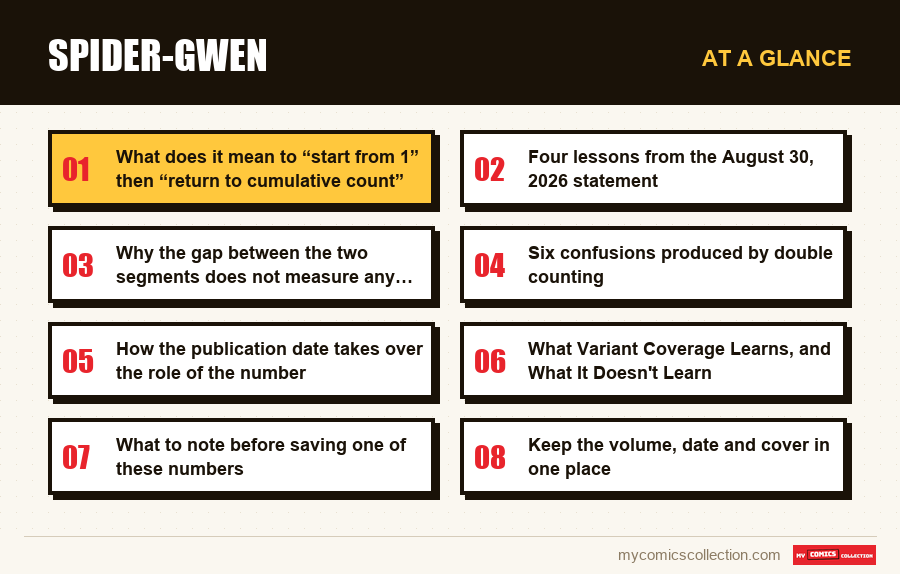
What does it mean to “start from 1” then “return to cumulative count”
A relaunch at number 1 is a commercial and editorial decision. It offers the reader an entry point without a past, and the seller an object that presents itself as a beginning. However, nothing obliges the publisher to stick to it. After a few dozen publications, he can choose to make the longevity of the publication visible by adding up all the issues published since the beginning, all series combined, and printing this total on the cover. The counter then no longer progresses from 32 to 33: it jumps to a round and spectacular number, chosen precisely for its effect.
The result is a series that contains two successive numbering systems, with no change in title or format between the two. The first fascicles carry low numbers, the next ones high numbers, and the boundary between the two is marked by nothing other than the jump itself. For someone who discovers an isolated issue, the information printed on the cover becomes ambiguous: a number 9 can belong to the lower part of a recent series, and a number 800 can belong to this same recent series without having anything old.
The survey confirms that this ambiguity is not theoretical. An ad sells an 800 by explicitly linking it to the 2015 series; others sell numbers 9, 14 and 15 linked to the same year. If we only have the printed number, these objects seem to come from different periods. They actually come from the same publication, within a few years of each other. The number has ceased to provide information on seniority; it only provides information about a position within a system whose rules must be known.
We must add a clarification which thwarts a common intuition: a high number is not an index of rarity, and a low number is not an index of value. In the data collected here, the booklet with the highest number is also the one for which the amount requested is the lowest among the advertisements cited, at $5.40. Another, bearing a simple 9, is asking $5.00. The difference between these two amounts is negligible and is part of the noise of an ad market. No hierarchy is deduced from number.
Four lessons from the August 30, 2026 statement
Two numberings in one set
The announcements noted relate numbers 9, 14, 15 and 800 to the same 2015 series. The coexistence of these four numbers in the same set of results is enough to demonstrate that a single counter does not govern the publication. The reader who sorts by ascending number obtains a classification which does not correspond to any order of publication.
The volume, the only mention that decides
Two of the five advertisements noted write the volume in their title, in the form “Vol 3”. This mention removes the ambiguity: it indicates which reminder it is, and the number then takes on its meaning. The three other announcements do not require this, and their number alone does not allow the issue to be located either in the series or in time.
Alternative coverage for the same amount
Two ads are for the same number 9 and both are asking $5.00. One describes alternative coverage, the other does not. At this price level, the mention of a variant does not come with any extra charge. The announced rarity of a cover design therefore does not automatically produce a difference in the amount requested.
Two segments, two contents
The median for ads without verification is $19.00, that of verified copies is $107.99. This report does not measure what the verification adds to a given issue: the whole mixes several numbers from the same series, and the objects present in one segment are not the same as those present in the other.
These four observations hold because they describe the composition of a list of announcements, and not a market movement. A single observation date does not allow any conclusion on an evolution: to say that an amount is going up or down, there would need to be at least two separate statements over time, and this article only has one. Everything that follows therefore reads like a photograph, without direction or trend.
The maximum of $338.45 in the non-verified segment, like that of $500.00 in verified copies, says nothing about what a buyer would be willing to pay. An extreme amount is a request made by a single person, often left online for months with no takers. It indicates a seller's ambition, not an observed price.
Conversely, the 127 listings in the regular segment and the 47 in the verified segment are large enough that the medians of $19.00 and $107.99 actually describe the middle of each listing. These two figures remain requests, but they do not depend on an isolated case.
Why the gap between the two segments does not measure any premium
The temptation is great to divide 107.99 by 19.00 and announce that the check multiplies the value by five or six. This calculation would be wrong, and it would be for a structural rather than a statistical reason. The two sets do not contain the same objects. The query combs an entire series, with its low numbers, its 800 number, its alternate covers and its current editions. Nothing guarantees that the distribution of these objects is identical on both sides.
Verification has a cost, and this cost weighs in the decision to request it. The owners have the booklets checked from which they hope to obtain a sum that justifies the approach, and leave out of the circuit those whose expected value does not justify it. The verified segment is therefore filled by selection, not by drawing lots. The difference between the two medians firstly reflects this selection: it describes who enters which segment, and not what the passage from one segment to the other would gain for a given fascicle.
A second factor is added, specific to the subject of this article. When a series contains two numberings, a textual query captures issues of very different nature. The first issue of a relaunch, a booklet marking an appearance, an ordinary mid-series episode and a three-digit anniversary issue do not have the same buyers. Mixing them in the same median produces a number that does not correspond to any real object. The median of the ordinary segment, at $19.00, describes the middle of a heterogeneous list, not the price of a specific issue.
The practical conclusion is simple: to compare, you must compare with constant identity. Same series, same volume, same number, same cover description, same declared condition. As soon as one of these elements varies, the observed difference measures the difference in object rather than the difference in treatment. This is true for verification, it is just as true for the comparison between a current edition and an alternative cover, where the statement here shows two strictly identical amounts at $5.00.
Six confusions produced by double counting
A research that mixes eras
Searching for a number by its number alone brings up issues from both numbering systems. The result is a list where unrelated objects coexist, and where the comparison of amounts loses all significance as long as the volumes are not distinguished.
Poorly estimated seniority
A three-digit number spontaneously suggests a long-term, therefore old, publication. The statement shows an 800 number explicitly linked to a series launched in 2015. The intuition which associates large numbers and great seniority leads here to an error of several decades.
Incomplete sales wording
Three of the five advertisements noted do not mention the volume. Their title therefore leaves the buyer alone to reconstruct the ownership of the booklet, based on the year when it is indicated and the cover when it is visible. The number printed is not enough.
Unintentional duplicates
A collection classified by number alone may receive the same issue twice under two separate entries, or refuse a missing issue believing that it already exists. Double counting mechanically creates collisions between low numbers that belong to different raises.
An invisible serial hole
Identifying what is missing requires a continuous sequence. When the sequence jumps from a two-digit number to a three-digit number, the apparent difference is in the hundreds even though nothing is missing. Conversely, a real gap of one or two issues is hidden in this disorder.
A broken reading order
The reader who wants to follow a plot in order can no longer rely on increasing numbers. It needs the publication date, the only data which maintains a strict order through a change of counter. The number becomes a label, no longer a rank.
Collecting this series?
Track what you own, what you are missing and what your collection is worth. 7 day trial.
Start my trial →How the publication date takes over the role of the number
When a meter ceases to be reliable, it must be replaced by a quantity which is not decided by the publisher. The publication date fulfills this function: it always advances in the same direction, it does not jump, and it never resets. Two issues ordered by date are necessarily placed in their real order, regardless of the number printed on their cover.
This shift changes the way a series is put together. The number remains useful to designate an object in a conversation or in an announcement, but it loses its role as a sorting key. The pair formed by the volume and the date becomes the work identifier: the volume tells which reminder the issue belongs to, the date says where it is placed within this reminder and in relation to the others. The printed number comes third, as a confirmation label.
This hierarchy explains why the two ads that say “Vol 3” are more usable than the other three, even though they cost neither more nor less. At $5.42 and $6.77, they are in the same zone as the $5.00 ad which doesn't specify anything and the $5.40 ad with the number 800. The precision of the wording is priceless here: it doesn't have to be paid for, it has to be sought. An attentive buyer therefore obtains, for the same amount, information that another will have to reconstruct.
It remains that this reconstruction is possible when the seller indicates the year, which several advertisements noted do by writing “2015” in their title. The year alone is not enough to order issues published in the same year, but it is enough to rule out confusion with a homonymous series from another era. This is a first barrier, insufficient but real. OUR reading guide dedicated to Spider-Gwen is based on this principle: reestablishing order through chronology rather than following numbers.
What Variant Coverage Learns, and What It Doesn't Learn
The statement contains a rare and clear case: two advertisements for the number 9, each asking for $5.00, one of which explicitly indicates an alternative cover. This connection deserves to be taken for what it is, no more and no less. It shows that at this level of amount, the presence of a variant did not lead its seller to ask for more. It doesn't show that the variants are never worth more, and it doesn't say anything about what these two announcements became.
The logic that makes alternative covers exist is based on relative scarcity: a cover produced in less quantity than the current edition should, all things being equal, be more difficult to find. This logic works when the difference in quantity is strong and known. It becomes diluted when the variants are numerous, when their edition is not public, or when the issue concerned is already abundant. The case observed here is clearly in this second configuration.
For a collection, the consequence is methodological rather than financial. An alternate cover and a current edition of the same issue are two separate items that bear the same number. Recording them without noting which is which produces exactly the kind of ambiguity that double counting already creates on a series scale. The description of the cover therefore becomes an identification field in its own right, in the same way as the volume.
What to note before saving one of these numbers
The volume of the series. This is the data that is most often missing and most cruelly lacking. Two out of five ads indicate it as “Vol 3”; the other three leave the number alone. Without a volume, a number 9 can belong to any of the successive relaunches of a long-term title, and two unrelated issues find themselves classified at the same rank in a collection.
The year the series was launched. It distinguishes a relaunch from all the others, and it is this which makes intelligible the presence of an 800 number in a set stamped 2015. Several advertisements noted include it directly in their title. Noting this year next to the volume gives a stable series identity, independent of the counter in force at the time of publication.
The publication date of the booklet. Distinct from the year of launch, it locates the number within its series and makes it possible to reconstruct a reading order when the numbers cease to be continuous. It is the only size of the file which always progresses in the same direction, and therefore the only one on which a sorting remains just after a change of numbering.
The possible mention of a cumulative count. When a booklet bears a number resulting from the addition of all previous publications of the title, it must be written in black and white on the card. An 800 attached to a 2015 series only makes sense if we keep track of this mechanism; without this note, the sheet will appear erroneous to anyone who rereads it, including its author a few months later.
The description of the coverage when it is alternative. The statement shows two advertisements on the same number 9, at the same amount of $5.00, only one of which indicates alternative coverage. The difference between these two objects can be seen neither in the number nor in the amount requested: it can only be read in the description. Recording this information when recording avoids having to find it later on a copy that has already been stored.
Questions fréquentes
Because the publisher interrupted the restart counter to return to the cumulative count of the title since its origin. The printed number then adds up all previous publications, all series combined, instead of continuing the current series. An advertisement noted on August 30, 2026 specifically sells a « Amazing Spider-Man 800 » by attaching it to the 2015 series, for an asking amount of $5.40.
By the volume, when the seller specifies it, and failing that by the publication date. In the statement, two out of five advertisements write “Vol 3” in their title and immediately remove the ambiguity. The other three require you to go by the year indicated, or even by the appearance of the cover. Numbers alone do not allow any conclusions.
Not in this statement. Two ads for the same number 9 each ask for $5.00, one describing an alternative cover and the other not. On this level of amount, the variant did not give rise to any supplement. This observation applies to these two announcements on this date and does not generalize to all alternative coverages.
It means that the two segments do not contain the same objects. The 127 advertisements without verification and the 47 verified advertisements relate to several issues of the same series, distributed differently on each side. The ratio between these two medians measures a difference in composition, not what the verification would bring to a given issue.
Neither. The statement was carried out on a single date, August 30, 2026, and it lists sums claimed by sellers on a general auction site, not sales concluded. A single observation does not contain any movement information: at least two measurements spaced over time would be required to speak of evolution.
Keep the volume, date and cover in one place
A double-numbered series does not follow one another from memory. Recording each issue with its volume, year of launch, date of publication and description of its cover transforms a mess of numbers into an ordered list, where the real holes are visible and where duplicates no longer pass through. My Comics Collection maintains this register for you and detects missing issues even when the publisher's counter changes rules along the way.