Searching for "Spider-Gwen 1 2015" returns not one posting but several, all numbered 1. The August 30, 2026 listing report on a US general auction site has 143 unverified bids for this query, between $2.99 and $350.00 claimed, with $15.00 in the middle of the pack; copies passed by a verification body are counted separately, 46 offers, from $34.95 to $880.00 with $77.47 in central value. However, the five cheapest ads cover at least three distinct publications, including two different volumes published in the same year. The word “first” is no longer enough to designate an object: only the exact title, word for word, and the volume do so.
There was a time when a character's number 1 was a single coordinate. A series started, it had a name, this name lasted for decades, and saying “number 1” was tantamount to designating one object and one only. This era is over for a large part of contemporary production. Current editorial practice relaunches the series at a rapid pace, sometimes barely changing the title, sometimes simply starting again under the same name a few months later. A character launched under these conditions therefore accumulates number 1s in just a few years, under similar labels that nothing distinguishes when reading quickly.
Spider-Gwen provides a clear illustration of this, and the demonstration requires no expertise: just look at the five cheapest ads in an ordinary query. They do not describe the same object. They don't even describe the same object three times. This observation, taken from a single dated statement, says nothing about the value of a publication or its evolution: it says something much more useful on a daily basis: the way in which a collection must be maintained to remain fair.
When two volumes are numbered 1 in the same year
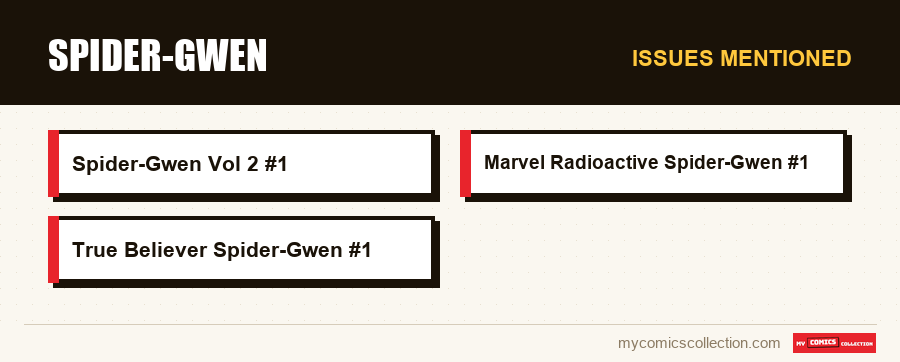
The survey highlights a situation which alone is enough to dismantle the logic of the benchmark: among the five cheapest offers there are both a booklet presented as “Spider-Gwen 1 2015” and a booklet presented as “Spider-Gwen Vol 2 #1” also dated 2015. Two different volumes, the same number, the same year of publication.
This configuration has an immediate consequence. In most amateur classification methods, a booklet is identified by three elements: the name of the series, the number, the year. This triplet is deemed sufficient. Here it is no longer. The name seems identical, the number is, the year too, and yet the objects differ. The only element that separates them is the volume statement, that is to say precisely the information that most collectors omit because it seems redundant to them.
We must measure what this implies for research. A reader who types the name of the character followed by “1” and “2015” thinks he is narrowing his search. In reality he has just written a query which allows several distinct publications to pass. The restriction he believes he has posed does not exist. The 143 unverified offers counted that day therefore do not relate to a homogeneous population of comparable objects: they mix publications that nothing in the request made it possible to separate.
This is also why we must be careful not to interpret the amounts as a price. A minimum of $2.99 and a maximum of $350.00 in the unverified column do not describe a range for an object: they describe the spread of several objects confused by a query that is too broad. The ratio between the two limits measures nothing other than this confusion, to which are added the declared state and the hope of the seller.
What the August 30, 2026 statement says, and doesn’t say:
Amounts requested, not collected
The 143 unverified offers and the 46 verified offers counted that day are proposals posted by sellers. None are completed transactions. A number listed in an ad indicates what a seller wants to get, not what a buyer has agreed to pay.
A single date, therefore no trajectory
This reading was taken on August 30, 2026 and on this date only. An isolated measurement cannot show a movement: there is nothing to compare. Any phrase like “it’s going up” or “it’s going down” would be invented. At least two spaced readings would be required to sketch a comparison, and that is not what we have available here.
Two populations, never mixed
Copies passed by a verification body are counted separately: 46 offers, from $34.95 to $880.00, central value $77.47. Bringing them together with unverified offers would amount to adding two markets which do not obey the same presentation constraints nor the same guarantees.
The extremes represent no one
The top $350.00 of the unverified column and the top $880.00 of the verified column are single requests. An isolated maximum reflects a seller's expectation; it describes neither the market environment nor what a buyer will find in practice. The central values: $15.00 and $77.47-much better place where the deals are concentrated.
These precautions are not lip service. They condition the only honest reading possible of the statement, which is an identification reading and not an estimation reading. What the statement solidly documents is not a price level: it is the fact that the same string of characters, typed by a reader in a hurry, brings back different publications rows side by side, apparently interchangeable, in reality not at all.
A query consisting of a character name, a number and a year seems precise. On a character relaunched often, it is not: the number is reused at each relaunch, and the year no longer separates anything as soon as two volumes start in the same year.
Accuracy is gained elsewhere: in the full title, word for word, including the words added before the character's name, and in the volume number when it exists.
The five cheapest labels, read one by one
The shortest wording, at $2.99
“Marvel Spider-Gwen 1 2015 NM” only includes the essentials: publisher, character, number, year, declared condition. It is the reference wording, the one to which a reader implicitly compares all others. Its very brevity is misleading: it does not specify any volume, so it does not resolve any of the ambiguities that the other announcements will reveal.
A second volume the same year, at $4.36
“SPIDER-GWEN VOL 2 #1 [...] 2015 [...] b-78” places a second number 1 in the same vintage. The year, which is usually used to distinguish two reminders, loses its function here. Without reading the volume mention, nothing signals to the reader that he is looking at a publication other than the previous one.
A word added in front, at $3.49
"Marvel Radioactive Spider-Gwen #1 [...] Direct edition 2015" extends the title with a single word placed before the character's name. A reader scanning the list stops at the name he or she recognizes and considers the extra word an editorial ornament. It is not: it changes the designated publication.
The mention of a distribution channel
This same wording bears the mention “Direct edition”, which indicates a particular distribution channel. This is information of a different nature from the condition or number: it describes the way in which the copy was placed on the market, and it is found in the wording as one attribute among others, without visual hierarchy.
Two labels ending with a storage code
“b-78” on one side, “NM5B189” on the other: these suffixes belong to the seller's internal classification and have no meaning for the buyer. They remind us that a search built on numbers also catches these codes, and that the end of a label does not necessarily carry information about the publication.
A line of inexpensive reissues, at $4.79
“True Believer Spider-Gwen #1 November 2015” is part of a line of inexpensive reissues, advertised as such. It occupies the lower limit in complete transparency, makes the story accessible to anyone who wants to read it, and at the same time distorts any calculation that would confuse this limit with the floor of the original publication.
Why the lower limit of a search is almost always another object
A very common reflex is to sort by increasing price and look at the first line to get an idea. The gesture seems rational: it provides the entry point. However, it is based on a never-verified hypothesis, namely that the first line describes the publication we are looking for. The survey shows that on five consecutive lines at the bottom of the list, at least three different publications coexist. The hypothesis falls in the second line.
A line of inexpensive reissues plays a particular role in this mechanism, and it must be described without doubt of intention. These reissues hide nothing: their nature is written in their title, and their existence responds to a legitimate request, that of the reader who wants to read the episode without acquiring a collector's item. The problem is not their presence, it is arithmetic. As soon as they are counted in the same population as the original draws, they pull the lower limit down and make the range unusable as a benchmark.
The same reasoning applies to elongated one-word labels. A title that adds a term in front of the character's name designates another publication, with its own numbering, its own continuity and its own market. The reader in a hurry reads the name he knows, skips the rest, and mentally places the ad in the same box as the others. The wording does not mislead him in the strict sense, the information is there, but it does nothing to alert him either.
Finally, the storage codes at the end of the description produce a third type of noise. They are made up of letters and numbers, they look like references, and a search engine that works with numbers treats them like any other sequence of characters. A restrictive search built around a number therefore brings back ads where the relevant number was not that one.
Collecting this series?
Track what you own, what you are missing and what your collection is worth. 7 day trial.
Start my trial →What frequent reminders change for those who keep a collection
The rapid revival of the series is not an isolated accident specific to a character. It is a publication choice that has become widespread, and it transforms the very nature of the inventory. Over a long, continuous series, a collector can describe what he or she owns with a name and number range; the description fits on one line and remains true for years. On a character relaunched several times in a short time, the same description becomes ambiguous after two relaunches.
The contrast with the historical series is instructive. On a publication that has been running continuously for decades, the number is still enough to identify an issue, and this is what makes the identification exercise relatively comfortable: see the editorial history of the character's parent series to measure the extent to which long numbering simplifies the life of those who file. This convenience does not exist on recent launches, where the number 1 returns at short intervals.
This results in an asymmetry that few collectors anticipate. On old series, the identification effort focuses on the condition and the particular prints; the title poses no problem. For characters that are often relaunched, the effort is first made on the title itself, before even talking about the state. These are two different disciplines, and the second requires a rigor of input that the first tolerated not having.
This requirement has a very simple practical translation: an inventory line which only mentions the name of the character and a number is, on this type of character, an indeterminate line. It describes a set of possible publications, not an exemplar. And as it appears complete, no one corrects it: it goes through the years giving the illusion of a kept inventory.
Reconstructing the identity of a booklet when the number is no longer enough
The method is based on one principle: never reduce a booklet to its number until the full title has been noted. Concretely, this means copying the wording of the publication as it appears on the cover, without mentally shortening it, including the words placed before the character's name. A word omitted during entry is never found again: nothing in the inventory line will indicate that it was missing.
The second gesture consists of noting the volume as soon as it exists. This is the information most often considered superfluous and the most decisive in the present case, since it is this, and this alone, which distinguishes two issues 1 published the same year. A collector who notes the volume can answer without hesitation the question "which of the issues 1 do I own?" » ; a collector who does not note it will have to reopen the box.
The third gesture consists of distinguishing reissues from the original prints, not to depreciate them but to prevent them from polluting the comparisons. An inexpensive reissue has its place in a reading collection, and many collectors own them willingly. It simply doesn't belong in the same column as an original print when it comes time to compare ads.
The fourth move is to ignore wording fragments that belong to the seller. A code like “b-78” only has meaning on the shelves of the person who wrote it; copying it into an inventory would amount to importing a foreign classification into one's own. You have to know how to recognize these suffixes to rule them out, and know that a search by number can catch them.
These gestures do not require more time than an approximate entry. They just require you to decide once and for all what an inventory line should contain, and then stick to it. A reader who first wishes to build a coherent reading path before thinking about classification will find in the reading guide dedicated to the character the sequence of stories, which is another, complementary entry into the same problem.
What to save on a frequently revived character
The full title, word for word, including words placed in front of the character's name. This is the only discriminator that remains when two publications share the number and the year. A title extended by one word designates another publication; an inventory line that has dropped this word will never again allow us to know which of the two objects is stored in the box.
The volume number, systematically, even when it seems obvious. The statement shows two different volumes bearing the number 1 for the same year. From there, the year ceases to be a separating criterion and the volume becomes the information that carries the identification. This is the exact opposite of ordinary intuition, which treats the year as reliable and the volume as incidental.
The nature of the print: original or reissue announced as such. A line of inexpensive reissues rightfully occupies the lower end of the announcements. Recording this nature avoids two symmetrical errors: believing you have an original print that you do not have, and comparing the price of a reissue to that of an original print as if they were the same object.
Mentions of distribution channel found in the label. An indication of the “Direct edition” type provides information on how the copy was distributed. It does not occupy the same place as a state or a number and deserves its own location in the file, otherwise it will be buried in a free comment field where no one will read it again.
The date of the statement, next to any amount recorded. The figures in this article were observed on August 30, 2026 and are amounts claimed by sellers, never completed sales. An amount noted without its date becomes a permanent statement after a few months; with its date, it remains what it is, a photograph taken on a given day and which does not claim to describe any evolution.
Frequently asked questions
By noting the full title printed on the cover, without removing any words, then the volume number if it appears somewhere on the booklet. On this character, the statement of August 30, 2026 shows two distinct volumes bearing the number 1 in 2015: neither the number nor the year is enough to decide, only the exact title plus volume couple succeeds.
Yes. Among the five cheapest ads noted, one has an additional word placed in front of the character's name. This is not a variant of the seller's wording: it is the title of a different publication, with its own numbering. A reader who stops at the name he recognizes will confuse the two without realizing it.
No, on two counts. Firstly because it is an amount requested on August 30, 2026 and not a sale made. Then because the neighboring lines in this same lower zone do not all describe the same object: at least three different publications coexist there, including a line of inexpensive reissues. This bound measures the heterogeneity of the query, not the floor of a publication.
Because the two groups do not describe the same thing. The 46 verified offers noted that day range from $34.95 to $880.00 with $77.47 in central value, while the 143 unverified offers go down to $2.99 and gather around $15.00. Merging the two together would produce a range that would not correspond to any actual purchasing situation.
No, and no single statement would allow it. It was taken on August 30, 2026, on this date alone. Describing a movement requires at least two observations separated in time, which could be compared to each other. Here there is only one point: it locates a state of requests at a given moment, nothing more.
An inventory line that has the full title
On a character relaunched several times in a few years, the only useful record is the one that records the exact title, volume and nature of the print run, with the date on which an amount was observed. My Comics Collection allows you to hold these fields without overwriting them in a free comment, and then find which of the issues 1 is actually in your boxes.