Space Usagi transposes the character into a future of space ships and clans, without changing either his character or his obligations. This is the only branch of the work where the author allows himself a setting foreign to the rest. The statement of August 29, 2026 shows a rare discrepancy: numbers from the 1990s count 51 classified ads for a requested median of $149.99, when the recent recovery displays 168 raw ads and zero graded ads. Two markets with nothing in common under the same title.
This branch is regularly dismissed by readers of the main series, due to a misunderstanding as to what it changes.
This article describes what Space Usagi transposes and what it keeps, what its two periods show from two foreign markets to each other, the opportune moment to approach it, and the field of inventory that it makes necessary.
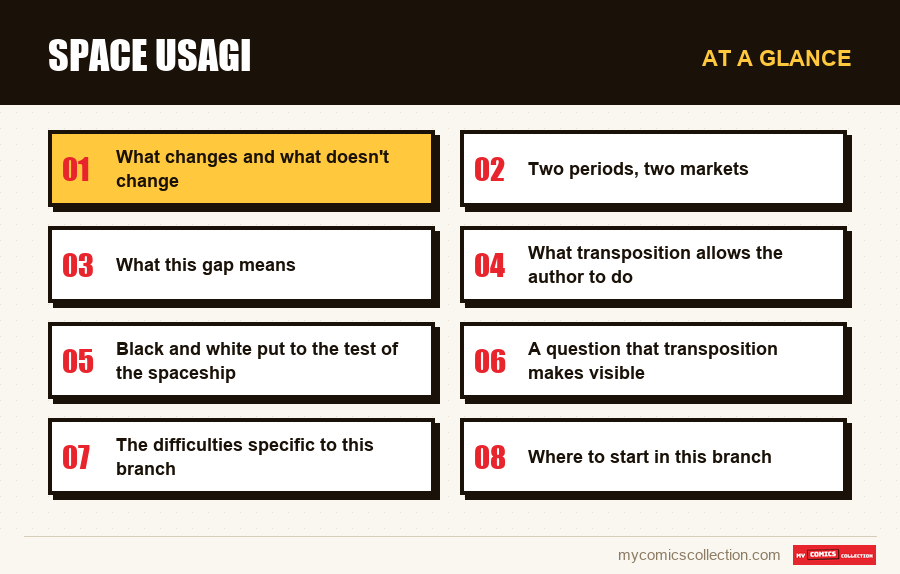
What changes and what doesn't change
The transposition is more economical than one would expect, and that is what makes it interesting.
What changes: the decor. Ships, combat armor, interplanetary distances, technologies. The complete paraphernalia of the science fiction story, used without reservation.
What doesn't change: everything else. The structure of the clans, the relationship of service to the lord, the code of honor, the weight of loyalty, the way in which a breach is paid for. Ships replace horses, but the obligations are identical.
This device reveals something about the main series: what makes it hold is not the historical setting but the structure of the relationships between characters. Remove the decor, replace it with anything, the mechanics still work.
It is an unintentional demonstration of the solidity of the source material, and the reader who approaches these stories looking for a betrayal of the setting misses their main interest.
Two periods, two markets
The figures below are asking prices observed on August 29, 2026, recorded separately for rough and for grade. A seller displays what he hopes to get; no transactions are measured here.
1990s issues, raw
104 ads raised, from $4.50 to $224.99 requested, median $24.51. The gap between the minimum and the median is considerable for issues of the same title.
The least expensive listings have high condition markings, which rules out condition as the only explanation.
The same numbers, graded
51 ads raised, from $38.00 to $877.75 requested, median $149.99. Or a ratio of approximately six times the raw median.
An unusual proportion of certified copies for a derivative published on a small scale.
The recent recovery, gross
168 ads, of 0.99 to $85.56 requested, median $7.45. Multiple alternate covers per issue, including guest artist variations.
The recent recovery, graded
No graded announcements noted. Not a single one out of 168 ads. This is the clearest case encountered: a security exists only on the raw market.
What this gap means
The same title presenting 51 certified copies on one side and zero on the other deserves an explanation, and it is instructive.
Certification has a fixed cost per copy. It only makes economic sense if the copy is worth significantly more than this cost: which mechanically excludes any issue whose gross median is $7.45.
The numbers from the 1990s cross this threshold, those from the recovery do not. The total absence of gradation in the recent series is therefore not a value judgment: it is an arithmetic consequence of the base price.
The opposite reading is tempting and false. We readily conclude that a title without certified copies is “of no interest to collectors”. It is just too recent and too available for the operation to be justified.
This distinction applies beyond this specific case. Counting graded ads is a good indicator of the maturity of a market, and a very poor indicator of the quality of a work.
When to read it. After a hundred pages of the main series, not before. The shift only produces its effect if we already know the original frame.
Read first, it would be a correct science fiction story whose codes of honor would seem arbitrary. Read next, it is a variation which retrospectively sheds light on what the main series was about.
What transposition allows the author to do
Three freedoms that the historical framework prohibited, and which explain why this branch exists.
The scale. A conflict between clans in a historical setting plays out over a few dozen men. Transposed, it can engage fleets without ceasing to be credible.
Documentary franking. The main series is limited to an accuracy that limits what it can show. There are no such constraints here: the author invents his objects instead of documenting them.
The break in tone. The register allows scenes that the historical setting would make improbable, and the author uses them with obvious satisfaction.
These three freedoms have a price, which must be named: these stories lose the documentary density which is part of the value of the main series. We gain in breadth what we lose in thickness.
Black and white put to the test of the spaceship
A concrete graphics problem arises here, and the way in which it is solved is worth noting.
The author's line was formed on matte materials: wood, fabric, paper, clay. These are surfaces that absorb light and render well in hatching, without requiring effects.
A ship, combat armor, a console: these are reflective surfaces, which in black and white pose a real difficulty. Rendering metal without grayscale requires suggesting reflection through pure contrast, and many authors struggle with this or switch to color.
The solution adopted is to simplify rather than detail. The machines are drawn in large flat areas, with very few internal lines, which makes them readable without trying to imitate the material. The contrast with the characters, who are always finely hatched, produces an unexpected effect: the vessels appear inert and the living beings, dense.
This is probably unintentional. It's also consistent with what these stories are about: huge machines serving human obligations that haven't changed.
Collecting this series?
Track what you own, what you are missing and what your collection is worth. 7 day trial.
Start my trial →A question that transposition makes visible
The shift in frame reveals a tension that the historical setting masked.
In the main series, the order of the clans and the duty of service are self-evident: this is the world as it was, and the reader accepts it as documented fact. The question of whether this order is just does not arise, or is posed as a historian's question.
Transposed into an imaginary future, the same structure becomes a choice of company. People who have interstellar ships have retained a clan organization and a demanding code of honor: why? Nothing forced them to do so.
The story doesn't respond, and it's probably for the best. But the question, once asked, carries over to the main series and makes it a little less obvious.
This is the most lasting benefit of this branch: it transforms an accepted setting into an object of reflection, without having to comment on it.
The difficulties specific to this branch
An uncertain continuity
The relationship of these stories to the main series is never explicitly decided. Finding where they fit is a dead end.
Scattered reissues
The ancient stories have been included in several different collections over the years, with summaries that do not overlap.
Numberings that start again
Several successive series start from one. The number alone designates nothing without the year.
Recent multiple covers
The resumption divides each issue into several covers, sources of involuntary duplicates.
A practical remark arises from this for those who buy online. The advertisement photographs do not reflect these large flat areas: a correct copy and a tired copy look very similar in thumbnail form, where a finely hatched page would reveal the folds and friction. In this branch, a written statement of condition counts more than the image that accompanies it, and the price difference noted between the minimum and the median is partly explained by this difficulty of assessing from a distance.
Where to start in this branch
The question is less asked than it seems, and the answer is simple.
The stories are short and largely self-contained. Either can be read without the precedent, which is consistent with the author's practice elsewhere in his work.
The only useful advice is therefore to start with what is available and inexpensive, which the statement makes easy: the recent recovery is asking for a median of $7.45, with copies at $1.99.
If you hang on, old numbers at $24.51 median asking become a reasonable second time. If they don't interest you, you'll have known for the price of a regular issue: it's the best possible use of the price difference between the two periods.
What to record
The decisive field here is neither the condition nor the price, but something that is not used anywhere else in this work.
The contained story, under its proper title. The same stories have been republished in collections with different summaries, without anything on the cover indicating the overlap. Noting the stories and not just the volumes is the only way to know if a new collection adds something or repeats what you already have.
This is the opposite of the usual practice, which consists of registering the container. On this specific branch, the container does not provide information on anything.
The year remains essential to decide between numberings which start from one in each series.
These two fields answer the question that really arises here: have I already read this story, under another title?
Frequently asked questions
Not particularly. The setting is science fiction but the mechanics remain those of the main series: clans, service, code of honor, price of failure. A reader indifferent to the genre will find exactly what he likes elsewhere, with ships instead of horses.
Their relationship to the main series is never explicitly decided, and looking for where they fit in is a dead end. These are autonomous variations, to be read as such rather than as a chapter to be placed in an order.
Because certification has a fixed cost per copy, which is not justified on issues whose gross median requested is $7.45. This is an arithmetic consequence of the base price, not a judgment on the work: counting graded ads measures the maturity of a market, not the quality of a story.
By the cheapest available. The stories are short and largely self-contained, so order doesn't matter. The recent recovery is at a median of $7.45 with copies at $1.99; if you hang on, the numbers from the 1990s at $24.51 median form a reasonable second time.
Yes, and it must be said: documentary density. The main series draws part of its value from its historical accuracy, a constraint which disappears here since the author invents his objects instead of documenting them. We gain in breadth what we lose in thickness.
Have I read this story before under another title?
On a branch republished in collections with shifting summaries, this is the only question that matters.