Silver Surfer #34 belongs to the Surfer's third series, launched in 1987. Dated 1990 (sources cite February), this issue by Jim Starlin and Ron Lim opens the "Rebirth of Thanos" arc: Mistress Death raises the Mad Titan, who died in 1977. It is the entry point to the saga that leads to The Infinity Gauntlet, and a regular-series issue, therefore more affordable than its sequels.
In the pricing of modern Thanos books, people look first at the 1991 Gauntlet, then at the prestige miniseries that precedes it. Yet the issue that relit everything is a newsstand monthly, with a barcode, a regular-series cover and a Surfer in the foreground. This sheet is for the reader who wants to understand why this issue, and not another, serves as the starting point of the saga.
As always in this guide, only verified information (creators, issues, dates) is stated as fact; the analysis is our own, with no reproduction of protected panels or dialogue.

Silver Surfer #34: date, team, what the issue contains
Silver Surfer #34 is part of volume 3 of the series, the one that started in 1987 and lasted until 1998. The issue carries the date 1990, and reference databases do not always agree on the exact month between the cover date and the newsstand release: keep "early 1990" in mind and look at the date printed on the copy in your hands. The creative team is the one the public associates with this moment in the story: Jim Starlin on script, Ron Lim on art.
The issue features the Surfer, then a cosmic wanderer in search of meaning, and brings on stage Mistress Death, an entity Starlin had already set up in his 1970s stories. She holds the key to the return: Thanos had fallen thirteen years earlier, in two 1977 annuals written by Starlin. His return is therefore a resurrection in the strict sense, willed by Death in person.
What the issue does not contain matters just as much to the buyer: it is neither the first appearance of Thanos (Iron Man #55, 1973), nor the appearance of the Infinity Gems in their 1990 form, nor the miniseries that will fill the whole summer. It is a pivot issue, which announces a direction rather than carrying it out. It reads in two stages: first as a Surfer adventure, then as the opening scene of the saga that follows.
The Surfer in 1990: what the series was publishing
The Surfer's third series had begun with Steve Englehart on script and Marshall Rogers on art, in a philosophical and cosmic vein that extended the melancholy of the character created by Jack Kirby and Stan Lee. Starlin and Lim set this hero among the stakes of deep space: empires, entities, threats on the scale of galaxies.
For anyone who read the first issues of the series, the tone changes markedly. The stories tighten around readable cosmic threats, with arcs of several issues that end on twists. This arc rhythm matches the moment when Marvel thinks of its publications as chained episodes, which explains why #34 is not a standalone story but the start of a tight sequence.
Lim is no beginner on the Surfer: his clean line, his cosmic silhouettes and his sense of space settings become the visual signature of the series. When the Gauntlet miniseries arrive, he will be one of the two artists of The Infinity Gauntlet, after George Pérez. #34 is thus the first place where you see the "Lim" Thanos before he becomes the one known to the general public.
Why this issue became a key: a return, not a birth
Thanos keys fall into three families: the original appearance, the moments of death and resurrection, and the events. Silver Surfer #34 belongs to the second. No character turn is as charged for a 1990 reader as the return of a villain believed buried for more than a decade.
The second reason lies in the chain. The Titan's return leads to Thanos Quest, then to The Infinity Gauntlet, which established Thanos as a front-rank antagonist. The movies of the 2010s then drew on this material, and each release revives curiosity about the original link. #34 therefore benefits from a trickle-up effect: people trace the story back to the first issue of the return.
Third reason, less visible: the print run. A widely distributed monthly stayed in the hands of many readers, often unprotected, folded in half in a pocket or stored loose. Copies in very high grade are therefore fewer than you might think, even if the issue is easy to find at all. The real scarcity sits in the upper range of grading, not in the overall volume.
What moves the value of Silver Surfer #34
The first factor is condition. On a 1990 issue printed in bright colors, the typical flaws are blunted corners, a spine marked by one or more stress lines, and small handling stains on the glossy cover. Going from a reading copy to a copy graded in the upper range costs a multiple of the starting price, because demand concentrates on the latter.
The second is the gap between current supply and high copies: current listings for a copy in ordinary condition stay modest, while completed sales of very high graded copies stand out clearly from them. This gap defines the whole stake of the issue: the smart purchase is the ungraded copy in good condition, to be compared afterward with the value of a graded copy at the same level.
The third factor is the momentum of the arc. When the saga revives (series, movie, new Thanos publication), the entry issues of the chain move in cascade. For the patient buyer, that means choosing the moment: a purchase in a lull, outside a release period, is made on better terms than in the wake of an announcement.
Recognizing the original edition
Silver Surfer #34 was published as a stapled single issue, in the standard format of the era. Some copies were sold at newsstands and others in specialty shops (the so-called "direct" market). The identification comes down to the barcode area: a printed code block signals newsstand distribution, while a box in series colors signals direct distribution. The difference is not always valued, but it matters for anyone building a reference collection.
The content of the issue was later reprinted in collected editions. The compilations of the return arc, then those of the wider saga, present the episodes in order without the same advertising pages or the same coloring on paper. If you want to read, a collected edition of the saga is enough; if you are after the original piece, only the 1990 single issue counts. Always check the year printed in the copyright line, which must be 1990.
Some listing pages sell a "later printing" without saying so. We cite no cover variant for this issue. If a listing promises one, demand photos of the title page and the barcode before paying a premium.
Do you collect this series?
Track what you own, what you are missing and what your collection is worth. 7-day trial.
Start my trial →
Buying pitfalls
The main pitfall comes from numbering confusion. Several Silver Surfer series coexist: the 1968 one, the 1987 volume 3 and the later relaunches. The #34 we care about is indeed the one from the 1987 volume, published in 1990; a #34 from another volume has nothing to do with Thanos. Check the year in the listing title.
Second pitfall: the conflation with neighboring issues. Listings readily group the follow-ups (#35 to #38) under the heading "Rebirth of Thanos" and wrongly add the mention "first appearance". Remember that Thanos was born in 1973 in Iron Man #55: #34 cannot carry that mention, even if the return scene is spectacular.
Third pitfall: restorations. An issue of this era repaired with glue on the spine or recolored at the corners can go unnoticed in poor-quality photos. Raking light, front and back, reveals the touch-ups. When the seller refuses to provide close-up shots, that is an answer in itself.
The neighboring issues that matter too
#34 must be read with its immediate follow-ups. The episodes that follow continue the return arc: the Titan regains his footing there, and the issues prepare the quest that will fill the miniseries. The whole forms the "prelude" that the market looks at as one, with #34 as the first link and a more advanced issue of the chain as the high point.
Outside the series, the obvious sequel is the prestige miniseries Thanos Quest, published the same year, in which the Titan sets out to find the Gems; we cover it in its own sheet, with its own format and its own pitfalls. Next comes The Infinity Gauntlet in 1991, detailed in the dedicated sheet. To place the Surfer issues in the whole, the guide to the series' key issues gives the general hierarchy.
And if your interest lies in the Titan's origin, the article on the first appearance of Thanos explains how to go about it: it is a different budget and a different buying logic from that of this 1990 issue.
What grading changes
Grading by a third-party company serves two purposes: guaranteeing condition and freezing the copy in a case. On a 1990 monthly, it is mainly useful if the copy is truly in the upper range; the value gap between a graded average-condition copy and the same ungraded one remains small. Note, however, that the cost of grading (fees and turnaround) is hard to recoup on a base issue of modest value.
If you are aiming for a graded copy, favor those whose label shows the right volume and the right year, and compare several completed sales at the same level rather than just one. The market for high copies of this issue is narrow: a single exceptional sale does not make a price.
To put a number on a copy already in hand, start from the listings currently displayed, compare them with concluded sales at the same condition level, then adjust for your own flaws. You can also use the free estimate to get a starting point.
How to track this issue in a collection
File Silver Surfer #34 in the 1987 series, in its numerical place, and not with the Thanos books: its function as a key reads mostly within the continuity of the series. If you follow the character rather than the series, create a "return of Thanos" subset that groups #34, its immediate follow-ups, the prestige miniseries and the Gauntlet. That makes a coherent reading and buying path.
For each issue, note the precise condition, the barcode mention (newsstand or shop) and the printed year. These three pieces of information prevent disguised duplicates and let you cross-check your copies against listings. A photo of the cover and back of the copy, taken once, saves you a second check later.
Finally, to read the whole, the Thanos reading guide offers an order that places #34 where the story calls for it.
Conclusion: a monthly that relaunched a villain
Silver Surfer #34 is not a birth, it is an awakening: the Mad Titan returns by the will of Death, in a series issue that can still be found in good condition. Its collecting value comes from its place as the first link in the chain that leads to the Gauntlet, from a wide but fragile print run, and from the sharp difference between an ordinary copy and a top-end copy. Buy it for what it is, a starting point, and keep your big-key budget for the following links.
Frequently asked questions
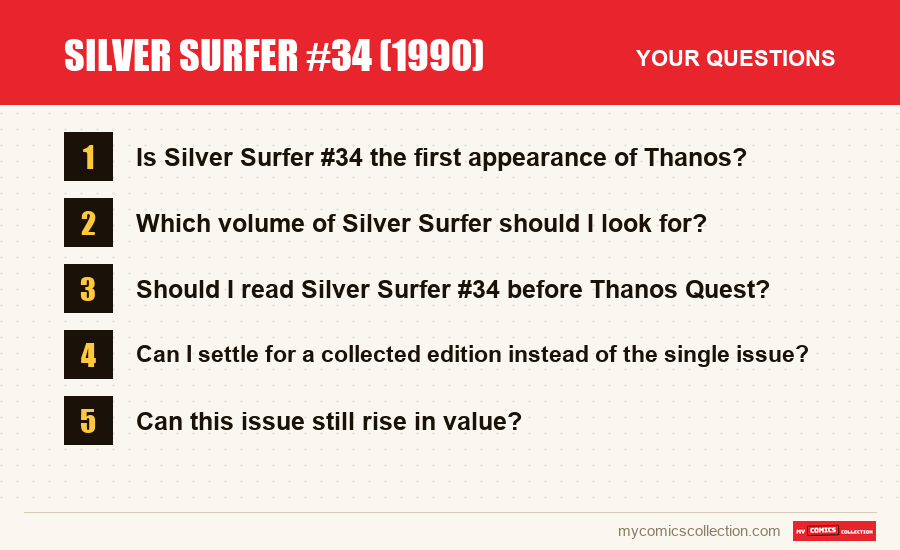
No. The character's birth dates to Iron Man #55, in the early 1970s. #34 of the Surfer's series records his reappearance in 1990, after the end of 1977: any listing that gives it the first-appearance mention has the wrong issue.
Volume 3, launched in 1987. The 1968 volume and the later relaunches also carry the Surfer's name but have no link to the return of Thanos. Check the series year in the listing, then the year printed in the copyright line of the issue, which must be 1990.
It is preferable. The issue shows why Thanos returns and what Mistress Death expects of him, then the prestige miniseries unfolds the conquest of the Gems. Reading Thanos Quest without #34 is possible, but you lose the return scene that gives the sequel its meaning.
For reading, yes: the saga's collected editions reprint the arc in order. For collecting, no: only the 1990 single issue is the original piece. Choose according to your goal, and do not pay a single-issue price for a poorly described collected edition.
Nothing guarantees it. It benefits from the rebounds of the Thanos saga, but its wide print run caps average copies. The only truly scarce segment is that of very high copies, which depend on exceptional preservation for a 1990 newsstand monthly.
Do you have a 1990 Silver Surfer #34 in a box? Have it estimated from its actual condition.
Estimate my comic