A signature only adds value when an independent third party has seen the author's hand touch the paper and has recorded it. That witness, not the elegance of the signature, is what turns a mark of ink into verifiable data. An unattested signature stays unverifiable after the fact: without proof, the market treats it at best as a detail with no effect, and at worst as damage to the cover.
The question comes up at every flea market and every online sale: this copy has a signature, is it worth more? The honest answer comes down to a change of perspective. It is not the signature that carries the value, it is the proof attached to the signature. An author's ink does not follow the same logic as a print: it cannot be examined, it has to be documented. And documentation cannot be produced retroactively.
As always on this guide, only verified information (creators, issue numbers, dates) is stated as fact. The analysis is our own, with no reproduction of any panel or protected dialogue.
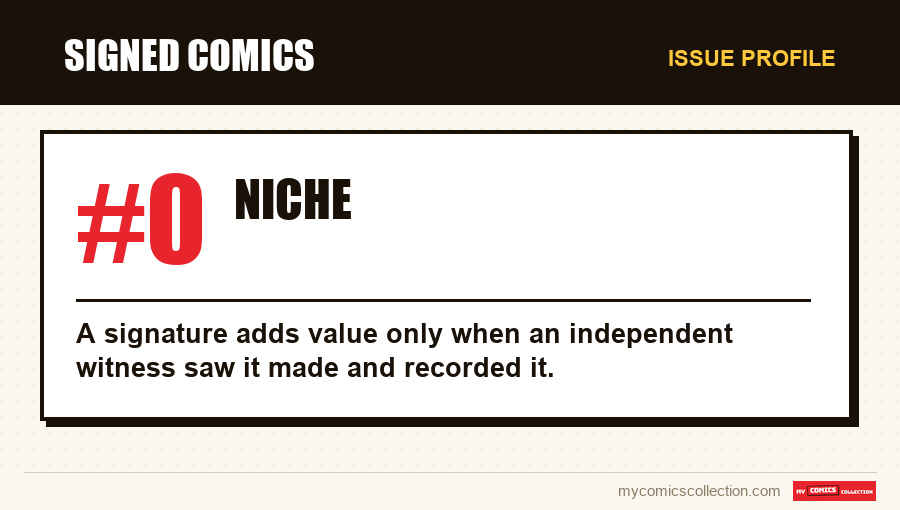
What a signature adds, and under what exact condition
A signed copy is a hybrid object. On one side, a comic printed in series, identical to tens of thousands of others, whose value depends on its condition, its print run and its edition. On the other, a unique manual intervention, made on a given day, in a given place, by one specific person. The market agrees to pay for the second layer, but only when it is documented to the same standard of rigour as the first.
Take the reasoning of a serious buyer. Faced with an unsigned issue, they examine the object and decide. Faced with a signed issue, they must judge two things: the object, and a past event they did not witness. Nothing on the paper will tell them whether the ink was laid down by the author or by someone who imitates well. Handwriting offers no accessible counter-test: you cannot trace back from the mark to the gesture.
Hence the rule that structures everything else. The added value of a signature is proportional to the strength of the proof, not to the fame of the signer. A very sought-after author who signs without a witness produces a copy that is hard to resell. A less famous author who signs in front of a recorded witness produces a clean, clear, transferable copy.
The witness: proof is built before the ink, never after
The mechanism of authentication is simple to describe and impossible to get around. A third party, who is neither the seller nor the author, is present at the moment the copy is signed. They see the comic beforehand, they see the hand write, they take charge of the copy immediately afterwards and do not let go of it until their identifier has been applied. The chain of custody has no break.
This point should be understood for what it is: a physical constraint, not an administrative formality. If the copy leaves the witness's sight, even for the length of a trip in a bag, the proof is broken. No one can then state that the object handed over is the one that was signed. This is why attestation cannot be requested after the fact: the moment when it was possible has passed.
Many collectors discover this logic on the day they want to value a signed copy obtained at a bookshop event ten years earlier. The memory is real, the signature is genuine, and yet nothing can be demonstrated. Between a true signature without proof and a false signature without proof, the market has no way to choose, so it applies the same discount to both.
An attested signature versus a certificate supplied by the seller
The most costly confusion concerns the paper that comes with the copy. A seller can print a certificate, sign it, add a stamp, number the document, attach a photo. All of this looks like proof and is not one, because the issuer is the interested party. A certificate is worth exactly the credibility of whoever signs it, and the person selling is never in a position to attest to what they sell.
The counterexample is an attestation issued by a third party with nothing to gain from the transaction. The difference is not one of form but of structure: on one side, a seller who tells the truth or does not, on the other, a witness whose model rests on the reliability of their own registers. The question to ask when facing an attached document is therefore not "does it look serious", but "who issued it, and did that person have an interest in the sale".
A practical clue: a seller's certificate often describes the signature and the character, sometimes with emphasis, rarely the circumstances. A witness attestation, by contrast, is almost always reduced to a dry identifier, traceable to a searchable register. Sobriety is a good sign here. The more a document tells, the less it proves.
What the death of the author changes
As long as an author is active, their ink remains a renewable resource. They can sign new copies, so the supply of attested signatures keeps growing, and the relative scarcity of each signed copy stays moderate. On the day an author dies, that supply closes for good. The existing stock of attested signatures becomes the final stock.
This closure produces two opposing effects that must be held together. On one side, correctly attested copies become the only pool available, which supports their position on the market. On the other, and this is the point many overlook, the unattested signatures of this author become permanently unverifiable: there is no longer anyone to confirm or refute a gesture, and no longer any possibility of comparison under controlled conditions.
Practical consequence for anyone building an author-based collection, for example around the landmark runs you follow in the Daredevil hub or the Hulk hub: if a signature matters to your project, have it attested while the author is alive, at the moment it is made. Waiting is not a delay, it is a total loss of the possibility.
Ink, support and time: why felt-tip ages badly
A signature is not a stable object. It is a deposit of pigment on acidic paper, exposed to light, humidity and oxygen for decades. Solvent-based felt-tip inks have two defects well known to conservators. First, they migrate: the pigment spreads into the fibres and the stroke thickens, gradually losing its sharpness. Second, they fade, often unevenly depending on exposure.
The worst case is thick felt-tip on a dark cover, where the stroke is barely visible from the start and disappears over time. Next comes felt-tip on untreated paper, which bleeds into a halo. The most stable signatures are generally those made with a pigment marker on a light, smooth surface, where the stroke stays crisp and keeps its density.
For you, this means checking a photo before any purchase. A sharp signature, with clean edges and even density, reads well and will still read in twenty years. A signature that is already blurred, or whose line is broken, will keep deteriorating. And the deterioration of an attested signature does not cancel the attestation, but it weakens the visual appeal, which also counts in a buyer's decision.
Where the signature is placed changes its effect
Placement is an underestimated parameter. A signature in the upper band of a cover, in an area of plain colour, blends into the composition and stays legible. The same signature across a face or a series logo is seen as a degradation of the visual, even when it is perfectly genuine and properly attested.
Signing the inside front page is a more discreet option, which fully preserves the cover. It reduces the showcase effect but protects the value of the object as a printed item. Some collectors favour it for exactly this reason: the copy remains presentable as a comic, with a surprise on opening. Conversely, a signature on the spine or across the fold should be avoided, because that area flexes and the ink does not hold up well there.
Do you collect this series?
Track what you own, what you are missing and what your collection is worth. 7-day trial.
Start my trial →
Reading a listing: what to demand before paying
A listing for a signed copy must answer four questions, and a listing that does not answer them should be dismissed without discussion. First, who attested, and is that issuer distinct from the seller? Second, is there an identifier that can be traced to a register you can consult yourself, without going through the seller? Third, does the photo show the signature and its attestation support in the same frame, so that one cannot be substituted for the other? Fourth, does the description clearly separate the condition of the print from the condition of the signature?
Be wary of evasive wording. "Signature guaranteed authentic" commits only the person who writes it. "Obtained in person" describes an anecdote, not a proof. "With certificate" says nothing until the issuer is named. Conversely, a seller who writes that the signature is not attested and adjusts the price accordingly shows a candour that deserves to be taken seriously: at least you know what you are buying.
Having an already signed copy attested: how to decide
Here is the turning point. A copy already signed without a witness cannot receive a signature attestation, by construction. What you can possibly do is submit the copy to a condition assessment that will mention the presence of a handwritten mark without ruling on its origin. This is not the same thing, and you need to weigh what it produces.
The result depends almost entirely on a trade-off. If the copy is a sought-after issue in very fine condition, formally recording the existence of a mark that cannot be attributed may crystallise a discount that the ambiguity was leaving floating. If the copy is a common issue in average condition, the step brings neither information nor value and costs the price of the operation. In both cases, the operation creates no proof of signature.
The useful question is therefore a different one: is your copy worth more as a comic or as a keepsake? If it is worth more as a comic, and the signature sits in a visible area, you hold a damaged copy that should be valued as such. If it is worth more as a keepsake, keep it, document the circumstances yourself for your heirs, and give up on selling it at a premium.
When a signature actually lowers the value
It must be said plainly: an unattested signature on a cover is, for part of the market, a mark foreign to the print. A buyer looking for a clean copy of a specific issue will treat that ink the way they would treat an ownership inscription or a price written by hand, that is, as a defect.
The mechanism is easier to grasp by comparison. A fold can be measured, a stain can be described, a grade can be debated. An unattested signature, by contrast, is both irreversible and undetermined: it can be neither removed nor proved. It therefore moves the copy out of the category of interchangeable objects without entering the category of documented pieces. That is the worst position on a market that pays for legibility.
Tracking signed copies in a collection
A signed copy does not file like the others, because it carries information that is not in the catalogue. In your inventory, always keep three fields apart: the condition of the print, the status of the signature (attested or not), and the attestation identifier when one exists. Mixing the three in a free-text note exposes you to forgetting, and forgetting is expensive at the time of a resale or an estate settlement.
Also note what nobody notes: the date and place of the signature, the signer's name written out in full rather than the scribble, the position of the ink on the object, and the type of marker if you know it. These details create no proof, but they make your collection readable by someone other than you, which is the purpose of an inventory. The guides gathered on the blog regularly come back to this separation between the condition of the object and the information attached to it.
What to remember
A signature is a promise that only holds if someone outside saw it being made. Before signing or having a copy signed, decide whether you want a keepsake or a collector's piece, because the procedure is not the same and the choice cannot be undone. If it is a keepsake, enjoy it and forget about its value. If it is a piece, arrange the witness before the ink, choose the placement, watch the type of marker, and keep the identifier with the same care as the copy itself.
And when facing an already signed copy whose history you do not know, apply the simplest rule: value it as a comic carrying a mark, not as a signed comic. If the asking price matches that reading, the deal may be a good one. If it matches a signature premium that nothing demonstrates, walk away, there will be other copies.
Unsure how to read a signed copy, attested or not, and want to know whether the mark works for you or against you?
Estimate my comic
Frequently asked questions
No, not as a signature. Attestation relies on the presence of a witness at the moment the ink is laid down, followed by an unbroken chain of custody. Ten years later, that chain does not exist and cannot be reconstructed. You can have the condition of the copy assessed, but the report will mention a handwritten mark without attributing its origin.
Very little, because the issuer is the party who collects the sale. A certificate is worth the credibility of its author, and a seller is never in a position to attest to their own goods. Look instead for an identifier issued by a third party with no stake in the transaction, and check it yourself in its register before paying.
Generally yes, but the decisive factor is the nature of the ink more than the thickness of the stroke. Solvent inks migrate into the fibres and fade, while pigment markers hold their density better. On a dark cover, a stroke that was already low in contrast becomes very hard to read after a few years of exposure.
It depends on how you plan to use the copy. The cover gives an immediate showcase effect but exposes the ink to light and can cover the artwork, which some buyers judge negatively. The inside front page preserves the print and protects the pigment better. Decide before the event and state the placement, because the author will not choose for you.
Only those that are attested, because the supply of new signatures closes for good. Unattested copies, on the other hand, become permanently unverifiable, since no one can confirm a gesture under controlled conditions any more. If a signature matters to your collection project, have it attested at the moment it is made, never later.