A census is the public tally of copies of a given issue that have been submitted for grading and then recorded. It totals submissions, not a population. Nothing enters it until someone has paid to have a copy graded, and nothing ever leaves it, even after a resale, a loss or a resubmission. Read as an inventory of the market, it misleads. Read as a measure of what has been judged worth grading, it becomes a formidable decision tool.
Most of the bad buying decisions seen on older issues come down to one misunderstood sentence: “there are only a few dozen in the census.” That sentence does not describe the number of copies that exist in the world; it describes the number of owners who decided, one day, to entrust their copy to a grading service and pay for it. Between the two, the gap can be a factor of ten or a factor of a thousand, and it is not constant from one title to another. Understanding what a census records means understanding why two figures of the same order, on two issues from the same decade, can almost never be compared directly.
As always on this guide, only verified information (creators, issue numbers, dates) is stated as fact; the analysis is our own, with no reproduction of panels or protected dialogue.
What a census counts exactly
A census aggregates the records created each time a copy is graded and registered under a series, issue and edition reference. The unit counted is therefore not a physical object but an administrative event: an accepted submission. As long as a copy sleeps in a box, in a cellar, in a bookshop stock or in an unsettled estate, it does not exist for the census, even if it is in perfect condition and perfectly identified.
This definition has a consequence that many buyers refuse to accept: the figure displayed measures a market behavior, not a quantity of paper. It says how many times the question “is this copy worth the cost of grading?” received a positive answer. On an issue sought after from the 1940s, that answer is positive almost systematically, because the fees are a negligible fraction of the resale price. On an ordinary issue from the 1980s, it is almost always negative, because grading would cost more than the comic itself.
You must therefore translate each figure in your head before using it. “Three hundred in the census” does not mean “three hundred survivors,” but “three hundred people found it rational to have this copy graded.” The difference seems theoretical; yet it determines the price you should be willing to pay.
Why expensive issues are overrepresented
The first distortion is economic, and it is massive. Grading a comic has a fixed cost: postage there, insurance, service fees, return postage. This cost hardly depends on the value of the object, whereas the expected gain depends on it entirely. There is therefore a threshold below which nobody submits, and above which everybody does.
The result: the most expensive issues of the medium come close to an almost exhaustive census of their presentable copies, while modest issues appear in the census only by accident, most often when they traveled in a lot submitted in bulk by a dealer. A title from the late 1970s without a notable first appearance may have been printed in several hundred thousand copies and yet show a ridiculous total in the census. That total says nothing about its rarity. It says that nobody has an interest in having it graded.
This asymmetry also explains why the census thickens as an issue rises. A screen adaptation, an editorial relaunch, a rumor of casting is enough to push copies that were sleeping above the break-even point. The figure then jumps, not because copies have appeared, but because submission has become profitable.
Resubmissions counted twice, exits never deducted
The second distortion is technical. A copy already graded may be taken out of its holder and resubmitted, in an attempt to obtain a more favorable assessment, after a restoration, or simply because the owner feels the first pass was harsh. Each pass produces a new record. Depending on how the census handles withdrawals of earlier records, the same physical object can therefore weigh twice, or even more, in the total.
The phenomenon is not marginal on high-stakes issues, precisely those where one grade step changes the resale value significantly. On these references, part of the total corresponds to no additional copy: it is internal circulation. A buyer who reasons “how many exist” therefore overestimates the population, and a buyer who reasons “how many are available” overestimates it even more, since a resubmitted copy is not two copies offered for sale.
A third distortion follows from the same mechanism, and it is the most counterintuitive. A census of this type is cumulative by construction: it records entries, it does not record exits. A copy destroyed in a fire, lost in a move, damaged when a holder is reopened, or withdrawn from circulation by a collector who will never resell it, remains counted exactly as before.
The figure you read is therefore a historical maximum, not a status report. On an old issue recorded for decades, the gap between the displayed total and the population actually intact has silently widened, and nobody can measure it. A census should therefore be read like an odometer: it tells you what has passed, never what remains.
Reading a distribution by grade rather than a total
The raw total is the least useful piece of information in a census. The distribution, on the other hand, is the decisive one. The same total can cover two opposite situations: a mass concentrated in the middle grades with an almost empty top, or on the contrary a population spread all the way to the top of the scale.
In the first case, the high-grade copy is structurally expensive and will remain so, because demand shifts onto a handful of objects. In the second, paying a premium to climb one grade is often a mistake: supply exists above, and it will cap the resale price. This is why the right question in front of a census is never “how many in total” but “how many above the grade I am aiming for, and how many just below.” The number of copies immediately above yours sets your resale ceiling; the number immediately below sets the competition you will face when buying.
Why a low figure does not prove rarity
A low total admits at least four explanations, and only one of them is rarity. First explanation: the issue interests nobody, so nobody submits it. Second: it interests people, but its value stays below the break-even point for grading. Third: it is recent, and the flow of submissions has not yet had time to build up. Fourth, finally: it really is rare.
Nothing in the figure itself allows us to decide. The information has to be sought elsewhere: the era, the nature of distribution, whether the issue contains a first appearance, whether the series appears in reprint collections. An issue from the 1950s by a defunct publisher, whose catalog records few editions, and whose census is low, is probably rare. A 1994 issue with a low census is almost certainly common and simply ignored.
The simplest test remains comparison with neighboring issues of the same title. A total clearly lower than those surrounding it, with no editorial break to explain it, signals disinterest, not scarcity. If the entire segment of the title is low, then it is the whole title that escapes the census.
Do you collect this series?
Track what you own, what you are missing and what your collection is worth. 7-day trial.
Start my trial →
Why a high figure does not prove abundance
The reverse reasoning is just as faulty. A high total does not mean it will be easy to find a copy: it means that many owners judged grading profitable, which is the symptom of strong demand. On some highly sought-after references, the census counts a large number of copies and yet almost nothing comes up for sale in a given year, because holders keep their copies.
Saturation must also be taken into account. When an issue approaches an exhaustive census of its presentable copies, its total stops growing, and this stability is sometimes read wrongly as disinterest. It means the opposite: there is not much left to submit.
Multiple editions fragment the count
A subtle trap lies in the way editions are separated in the census. The same issue may exist as an original edition, a reprint, a cover variant, a foreign edition, a promotional version or a late facsimile. Each in principle receives its own entry, and therefore its own total.
Two symmetrical errors follow. The first is mentally adding up lines that do not describe the same object, which inflates the population of the edition you are interested in. The second, more costly, is reading the total of a niche variant as if it were that of the original edition, and concluding exceptional scarcity. Before using a figure, always check which line you are reading: the edition mention, the printing indication and the cover description must match exactly the copy you are considering buying. Our issue-by-issue guides detail, title by title, the markers that distinguish one edition from another.
Using it nonetheless to decide on a purchase
Nothing above condemns the tool. A census remains the only public, continuous and comparable data point on the graded population of an issue. Used correctly, it answers three precise questions.
First question: is my copy in the disputed zone? If the grade you are aiming for holds most of the recorded population, you are buying a liquid object, easy to resell, but without a scarcity premium. If you aim for a grade where the population becomes sparse, you are buying a more volatile position, which sells more slowly but can sell much better.
Second question: is the premium asked consistent with the thinning of supply? Compare the price gap between two neighboring grades with the population gap between those same two grades. When the population divides sharply from one grade to the next, a large premium is justified. When it stays of the same order, paying that premium amounts to buying a catalog line, not a scarcity.
Third question: is the figure moving right now? A total growing fast over a short period signals a wave of submissions, and therefore usually an anticipation of a price rise already underway. Buying in the middle of that wave exposes you to a correction when the wave subsides and the graded supply turns out wider than before. Our hubs devoted to heavily adapted characters, such as Batman, offer many examples of this cycle.
Documenting the census in your own collection
A census figure has no value unless it is dated. Recorded today, it will be wrong in six months, and you will have no way of knowing by how much. The good practice is therefore to note, for each significant copy, three elements: the exact edition line consulted, the date of the reading, and the position of your copy within the distribution at that moment. It is this triplet that will later let you say whether your position has strengthened or diluted.
In a collection of several hundred titles, this discipline only holds with a structured notes field per copy, not with approximate memory. Recording the edition mention and the reading date at the time of purchase takes a few seconds; reconstructing them three years later, in front of a buyer asking why your price is what it is, is impossible. The census is read at a given moment; it is only useful over time.
What to remember
A census counts accepted submissions, not existing copies. It overrepresents the expensive, ignores the modest, sometimes counts the same object twice, and never decreases. These four biases are not defects to correct: they are the properties of the tool, and knowing them is enough to stop making mistakes.
Always read the distribution before the total, the edition line before the distribution, and the date of the reading before any conclusion. A low figure invites you to look for why nobody submits; a high figure invites you to look grade by grade. In both cases, the buying decision is made on the copy in front of you, not on an aggregate statistic whose scope and age you cannot control.
To compare a census figure with what your copy is actually worth, in its condition and in its edition, an appraisal remains the starting point.
Estimate my comic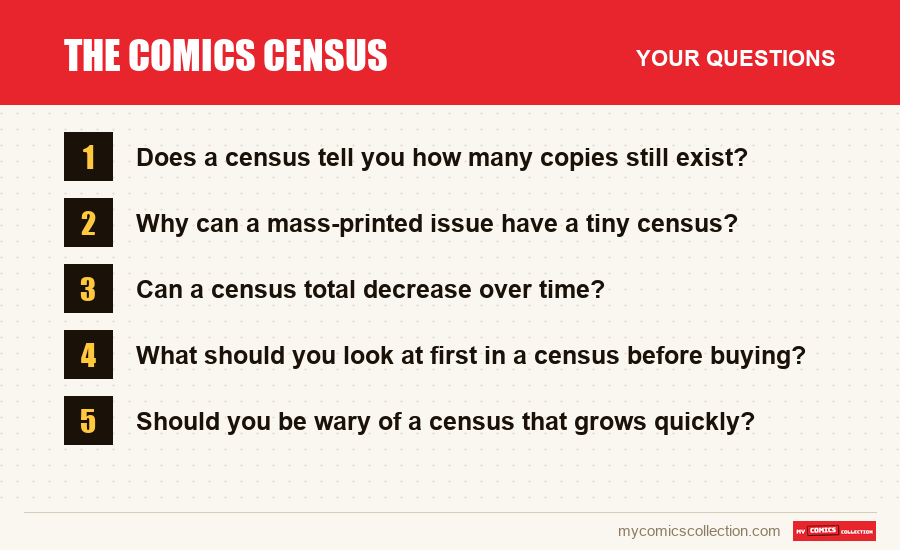
Frequently asked questions
No. It tells you how many records were created when copies were submitted for grading, under a given edition reference. Copies never submitted, which are the vast majority for most issues, are not included. Copies destroyed or lost after recording remain counted. The total is therefore a historical accumulation of submissions, never an inventory of survivors.
Because grading has a roughly fixed cost, while the expected profit depends on the value of the object. Below a certain level of value, submitting a copy costs more than it returns, so nobody does it. A print run of several hundred thousand copies can therefore appear in the census only in the dozens, with no scarcity whatsoever.
No, and this is a structural property of the tool. The census records entries, not exits. A resale, a loss, a destruction or a permanent withdrawal from the market removes nothing from the total. A resubmitted copy can even add a second record. A total can therefore only stagnate or grow, and it should be read as a ceiling, not as an available stock.
The number of copies recorded just above the grade you are aiming for, since it sets your resale ceiling, and the number just below, which measures competition at the point of purchase. Also check that the line you are reading matches your edition, and note the date of your reading. The overall total, taken alone, guides no useful decision.
Yes, especially over a short period. An acceleration in submissions almost always reflects an anticipation of a price rise, often linked to an adaptation announcement or an editorial relaunch. Buying during this wave exposes you to two risks at once: paying a stretched price, and seeing the graded supply widen a few months later, just as speculative demand recedes.