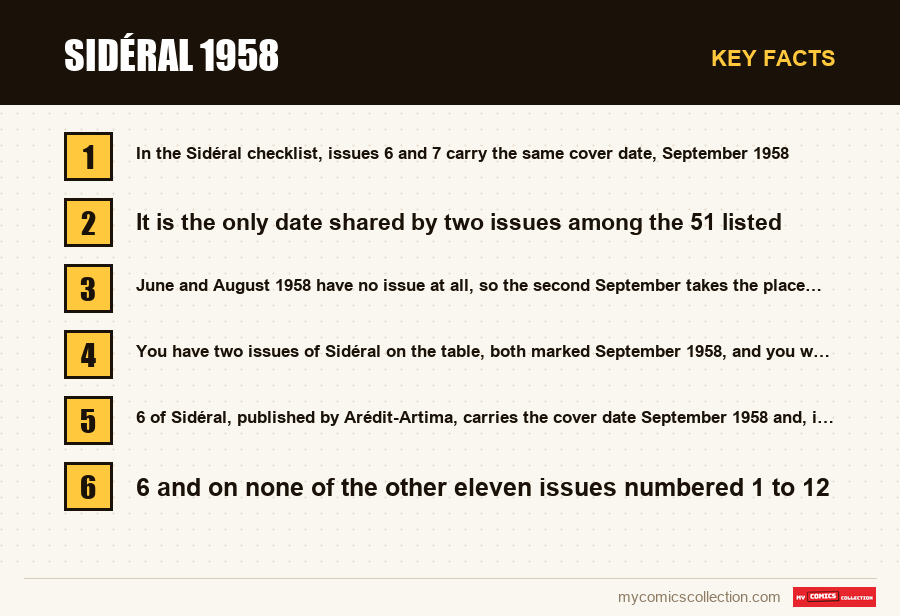
In the Sidéral checklist, issues 6 and 7 carry the same cover date, September 1958. It is the only date shared by two issues among the 51 listed. June and August 1958 have no issue at all, so the second September takes the place of an empty month in the calendar. The date does not tell the two apart. The printed issue number does.
You have two issues of Sidéral on the table, both marked September 1958, and you want to know which one comes first. The date will not help you, and that is exactly the point of this pair: it forces you to sort by issue number and to understand why the calendar of this early part of the series is irregular.
As always on this guide, only verified information (creators, issue numbers, dates) is stated as fact. The analysis is our own, with no reproduction of any panel or protected dialogue.
The two issues, side by side
Issue No. 6 of Sidéral, published by Arédit-Artima, carries the cover date September 1958 and, in the catalogue, the story title "Le secret de la plaque du chauffeur" (the French catalogue title). Issue No. 7 carries the same date, with "Suivez le guide". For the rest, the catalogue only gives credits at the level of the issue.
No. 6 is credited to Otto Binder, Gardner Fox and Edmond Hamilton for the scripts, and to Gil Kane, Joe Kubert and Sid Greene for the art. No. 7 is credited to Ed Herron, John Broome and Otto Binder, with Gil Kane, Carmine Infantino and Sid Greene. Three names appear in both issues: Otto Binder, Gil Kane and Sid Greene. The names that change are the ones that let you tell the two apart when you have them in hand.
A useful detail: Joe Kubert appears on No. 6 and on none of the other eleven issues numbered 1 to 12. If you are unsure about an issue with no readable number, that name in the credits is a clue, not proof, since the catalogue does not say which story he drew.
What the first twelve months show
The first four issues follow the calendar without a gap, from February to May 1958. No. 5 jumps to July, so June is missing. No. 6 is dated September, so August is missing as well, and No. 7 is also dated September.
After that the series settles into a regular rhythm: No. 8 in October, then one issue per month up to No. 12, dated February 1959.
The result, read from this single checklist: seven issues for the eight months from February to September 1958, with two months without an issue and one month that has two. In other words, the doubled September does not create an extra issue. In the count, it fills one of the two months left empty.
One collision, and not the only irregularity
When you recount the 51 issues in the checklist, September 1958 is the only month that carries two issues. No other pair of issues shares a date, either in the first twelve issues or further along the series.
The missing months are more numerous: four, over the period from February 1958 to July 1962. They are June 1958, August 1958, March 1959 and March 1962. The first two come before the collision, the other two are further away.
Over this period, four empty months leave fifty months with dates, and the 51 issues are spread across them: the extra unit is the doubled September.
For a collector, this changes how you read a list of gaps. In Sidéral, a hole in the calendar is not a missing issue. Always look for the printed issue number, and never work out a rank from a month.
What the data proves, and what it leaves open
It proves two things: both issues exist under ranks 6 and 7, and their cover date is the same. It does not say why. Three explanations are possible, and the catalogue settles none of them: a publication delay caught up by a closer release, a date copied approximately onto one of the two, or a month printed as it stands without matching the actual day the issue went on sale.
It is therefore safer to speak of a cover date than of a release date. Nothing in the checklist gives a precise day: every date in this series is given to the month. Writing "released on the same day" would be an invention; "bearing the same date" is accurate.
The catalogue also does not let us say which of the two issues came out first. The order of the numbers is the order of the series, not proof of the order of delivery.
Do you collect this series?
Track what you own, what you are missing and what your collection is worth. 7-day trial.
Start my trial →
Recognising the copy
The rule is simple: sort by the printed issue number, not by the month. If both issues are in front of you, No. 6 comes before No. 7 whatever the date. If only one is there, check the number before filing it, because a September 1958 without a readable number could be either one.
The story title in the catalogue is a second marker, to be handled with care: it covers only one story per issue, and the checklist does not say whether the issue contains others. Do not look for it on the cover, since nothing guarantees it appears there. It helps to confirm a number, not to establish it.
An issue in this series can also carry, as its title in the checklist, a heading that looks more like a regular column than a story: this is the case for No. 4 and No. 10, both listed under the heading "Artima vous offre". Two distinct issues therefore share a title, just as two others share a date, and in both cases the printed issue number remains the only reliable criterion.
Completing a list of gaps without mistakes
Note your issues by rank, never by month. A list entry reading "Sidéral, September 1958" is ambiguous: it covers two issues, and you might believe the gap is filled when one is still missing. Write "No. 6" and "No. 7" on two separate lines, with the date in a comment.
Conversely, do not look for a No. 5 bis or an August issue: the checklist places No. 5 in July and No. 6 in September, and the numbering runs without a break from 1 to 51. An issue offered to you as "the August 1958 one" should be examined with suspicion, since its date matches no issue number in the catalogue.
The immediate neighbours
Before the pair, No. 4 (May 1958) and No. 5, whose date skips a month. After it, Nos. 8, 9 and 10, one per month from October to December 1958. These are the issues to look at first when sorting a stack: they frame the zone where the calendar is least regular.
For other cases of dates or numbers that overlap, the blog groups several of them, series by series.
Frequently asked questions
Yes, in the checklist both carry September 1958 as their cover date. It is the only shared date among the 51 issues. The day is not known, only the month is, and the order of the two is read from the issue number.
June and August 1958 have no issue in the checklist: No. 4 is from May, No. 5 from July, then come the two September issues. October 1958 has an issue again, No. 8, and the monthly rhythm resumes until February 1959.
No. The numbering in the checklist runs from 1 to 51 without a break: an empty month in the calendar does not correspond to an absent issue. August 1958 simply has no dated issue, and the September collision balances the count.
Read the issue number printed on the issue. As a supplement, the story title "Le secret de la plaque du chauffeur" belongs to No. 6 and "Suivez le guide" to No. 7, but the catalogue gives only one title per issue, so this marker is partial.
On two lines, No. 6 and No. 7, with September 1958 as the date comment for each. Never sort by month: a line dated only September 1958 would hide the fact that two issues are needed, and you would believe the pair complete with a single issue.