
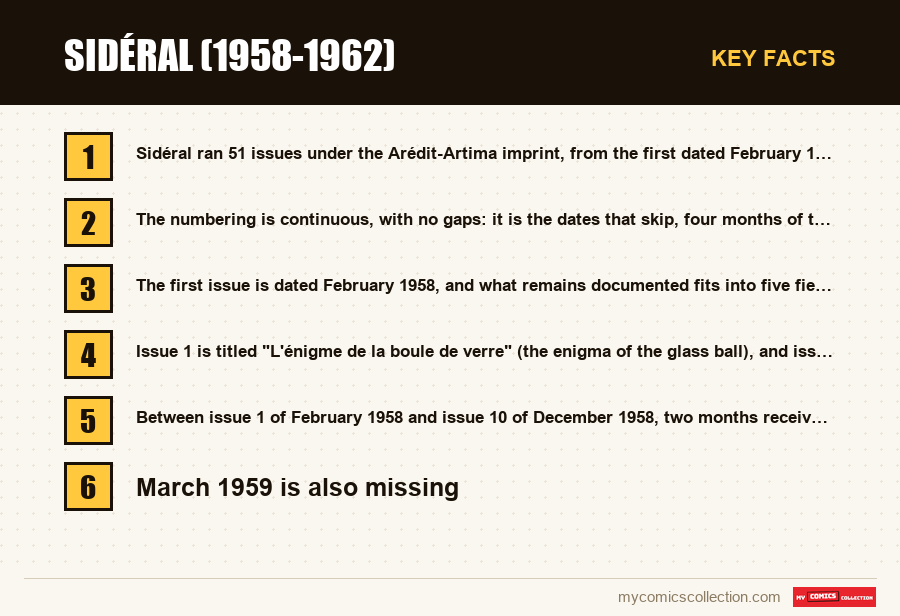
Sidéral ran 51 issues under the Arédit-Artima imprint, from the first dated February 1958 to the last dated July 1962. The numbering is continuous, with no gaps: it is the dates that skip, four months of the period carrying no issue and September 1958 carrying two. The catalog records only one title and at most three creators per issue, sometimes an advertising text in place of a story. Collecting this series therefore means working with deliberately partial data.
When you build a collection of French magazines, Sidéral occupies an uncomfortable place: it is too old for the usual landmarks to work. The magazines of the 1970s are searched by contents, by character, by first-appearance number. Here, none of that is reliably available. The first issue is dated February 1958, and what remains documented fits into five fields per issue. This article starts from that little and draws out what a buyer can actually use.
As always in this guide, only verified information (creators, issue numbers, dates) is stated as fact. The analysis is ours, with no reproduction of panels or protected dialogue.
What Sidéral published, read from its story titles
The editorial line can be read directly in the recorded French titles. These are short science-fiction stories set in near space and its creatures: "Les visiteurs interplanétaires" (the interplanetary visitors), "Le clochard interplanétaire" (the interplanetary tramp), "Les créatures fantômes de Phobos" (the ghost creatures of Phobos), "La pierre magique de la lune d'Io !" (the magic stone of Io's moon). Mars recurs like an obsession, from the satirical "Le Martien qui voulut devenir maire" (the Martian who wanted to become mayor) to the funereal "Les derniers jours de Mars" (the last days of Mars). For a buyer, this means the series is homogeneous: an issue picked at random resembles the others, and the interest does not concentrate on two or three headline issues.
The second dominant motif is the question of scale. "Voyage dans l'univers miniature" (a journey into the miniature universe), "La menace du spaceman qui change de taille !" (the threat of the spaceman who changes size), "La menace de la bombe réductrice" (the threat of the shrinking bomb), "Prisonnier du robot géant" (prisoner of the giant robot): growing, shrinking, facing something bigger than oneself. This was the common stock of illustrated science fiction of the period, and it explains why the covers of the series look so alike that they blur together in a poorly photographed flea-market listing.
A third observation, more useful still: the titles are built on a narrow grammar. Five of them begin with "La menace de", four with "Le secret de", three with "L'énigme de". Issue 1 is titled "L'énigme de la boule de verre" (the enigma of the glass ball), and issue 42, published more than three years later, "L'énigme du globe-verre" (the enigma of the glass globe). Two issues separated by four-fifths of the numbering carry almost the same title. If you search by keywords in a seller's list, this resemblance will lead you to reserve the wrong number.
A publication that searches for its rhythm, then holds it
The first year is irregular, and it can be measured. Between issue 1 of February 1958 and issue 10 of December 1958, two months receive no issue, June and August, while September receives two. March 1959 is also missing. In other words, the magazine took more than a year to find a rhythm, and that hesitation is the signature of its early run.
Then something locks in. From issue 13, dated April 1959, to issue 47, dated February 1962, the series strings together thirty-five issues over thirty-five consecutive months, without a single empty month. This is the most telling fact in the dataset: a science-fiction magazine held to a strict monthly schedule for nearly three years. For the collector, this stretch is the easiest to complete, because it was printed under regular conditions and because the dates there serve as a reliable check.
The end is abrupt. After February 1962, March is skipped, four issues follow, and issue 51, dated July 1962, closes the series. There is no gradual slowdown, no move to quarterly: the monthly schedule holds almost to the end, then stops. The last issues are therefore not harder to find because of a confused publication pattern, but because a series' final issues always circulate less than its middle ones.
The issues to concentrate on
Issue 1 is the only one whose status is not up for debate. Dated February 1958, it carries the whole age of the series on its own, and it is the issue sellers pull out first from a lot. Its recorded title, "L'énigme de la boule de verre", is in fact your best search key, provided you do not confuse it with its near-homonym from issue 42.
Next come the two issues dated September 1958, numbers 6 and 7. Their interest is technical rather than narrative: two consecutive issues share the same cover date. A seller who files stock by date, or a buyer checking the consistency of a lot, will run into an apparent anomaly that is not one. Knowing that the collision exists keeps you from taking it for a duplicate and rejecting an issue you do not own.
Finally, issue 51, the last of the series, dated July 1962, with "Prisonnier du robot géant" (prisoner of the giant robot). An ending has an obvious value of its own: it closes the run. But unlike later magazines, there is no special issue here, no hors-série, no renumbering that would complicate the list. Fifty-one slots, and that is all.
Three names per issue: what the catalog says, and what it does not
The recorded credits outline two clear periods. In the first half, Gil Kane is the artist on most issues up to number 32, with a few scattered absences, and Otto Binder is writer on twenty consecutive issues, from 4 to 23. In the second half, these two names become rare and others take their place: Gardner Fox ends up credited on the last ten issues without exception, and Murphy Anderson appears on the art of the last three. If you buy by creator rather than by series, the break falls in the middle of the numbering, not at a change in editorial formula.
But the limits of this reading must be stated right away. For fifty of the fifty-one issues, the catalog records exactly three artists. Three, never four, never five. Such regularity does not describe an editorial reality; it describes a ceiling on data entry: the record stops where the space stops. A magazine of this format published several episodes per issue, and the list of names you read therefore covers only part of them.
The same caution applies to spelling. The same contributor appears under two forms depending on the issue: "Edmond Hamilton" then "Ed Hamilton", "Ed Herron" then "France Herron". These are not four people, they are two, each entered twice by different hands. The practical consequence: if you build your own inventory by counting occurrences of a name, you will get a wrong result without ever noticing.
Recognizing a copy and placing it in the series
Dating is your first tool, and it is usable because each issue carries a month and a year. A copy whose cover date does not fall within the window February 1958 to July 1962 does not belong to this series, whatever title is printed on it. And within that window, the link between number and date is one-to-one, with the single exception of the two issues dated September 1958.
The second tool is the recorded title, to be used with caution. For eight numbers, what the catalog keeps as a title is not a story but a page of text: "Artima vous offre" (Artima offers you), "Suivez le guide" (follow the guide), "Digest petits livres grand succès" (digest small books, great success). Numbers 46, 47 and 48 even carry the same advertising formula, word for word. Three consecutive issues without a usable story title: they can be told apart only by their number and date.
This point is worth understanding rather than lamenting. It means that for this series, the real contents can only be checked on the copy and nowhere else. Before buying, ask for a photo of the contents page or of the first story page, not just the cover. That is the only check that settles the matter.
Do you collect this series?
Track what you own, what you are missing and what your collection is worth. 7-day trial.
Start my trial →
The condition of an object nearly seventy years old
An issue from February 1958 has lived through a span that changes the nature of the problem. You are not assessing a defect of origin; you are assessing an accumulation: decades of storage, often in cellars or attics, sometimes with amateur bindings put on by a reader who wanted to keep a series. Such bindings appear precisely on regular series, and the monthly stretch from 1959 to 1962 provides the ideal ground for them, since it forms complete years.
The two checks to run first follow from the age. First, the inside block: make sure the pages are still held by the staples, and that the opening at the center of the issue is not coming away. Second, the date, which must remain legible: on a copy whose cover has been trimmed or covered, losing the month removes your only means of placing the issue in its position in the series.
One last reflex, specific to series of this age: establish the condition before speaking of completeness. A number 1 from 1958 that is worn but whole is still a number 1 from 1958. A copy rebuilt from two damaged issues is no longer anything identifiable, and this is an accident seen on the oldest publications, the ones for which people have had the most time to tinker.
Buying traps specific to this series
The first trap is the confusion of titles, already mentioned and genuinely costly. Between "L'énigme de la boule de verre" and "L'énigme du globe-verre", between the five "La menace de" and the four "Le secret de", a listing written from memory by a seller who is not a collector has every chance of describing a different issue from the one they think they are selling. Always confirm by number.
The second trap comes from the absence of a recorded contents list. You will sometimes read that an issue of this series contains the first French appearance of a given character, or that it corresponds to a given American issue. Nothing in the available data allows this to be established, since only one story title is recorded per issue of a contents that held several. Such an assertion is not information; it is a seller's hypothesis, and it is paid for as if it were a certainty.
The third trap is the "complete" lot announced without a list. The series has fifty-one pieces, a number low enough for a seller to estimate by eye and high enough for them to get it wrong. Ask for the list of issue numbers present, and check it against the dates. A lot that skips June or August 1958 has no gap; a lot that skips May 1958 does.
Completing all fifty-one numbers
The strategy follows from the structure of publication. Start with the monthly stretch from number 13 to number 47, the longest and most regular: it circulates in blocks, often by years, and each grouped acquisition moves you forward several slots. Lots of this type are also where date-checking works best, since the months follow one another without exception across the whole stretch.
Save the first twelve numbers and the last four for later. The first are hard for a period reason: they date from the launch, before the magazine had found its public. The last are hard for a release reason: a series that stops dead stops being bought back. In both cases, patience costs less than haste, and the search window stays narrow: four numbers on one side, twelve on the other.
A method tip: keep your list by number, not by title. With eight issues whose recorded title is an advertising text, an inventory kept by title will produce identical lines and invisible gaps. Collection-tracking tools are built for exactly this, and you can keep this series alongside your more recent magazines; the blog describes inventory methods that apply to older publications.
What the series is worth, and how to follow it
No price can be stated in absolute terms for a publication of this age, because the number of surviving copies and their condition vary too much. What can be stated are ratios. A first issue cannot be compared with the rest of the series, and the more beautiful the copy, the wider the distance. Conversely, between two mid-series issues, one from 1960 and one from 1961, the gap is small: they belong to the same monthly stretch and enjoy the same relative abundance.
The second useful ratio sets the single issue against the lot. On a series of fifty-one pieces, most of which belong to a regular stretch, the lot almost always loses value per piece, because the seller trades speed for price. Buying in lots and reselling duplicates one at a time is therefore the natural mechanism of this collection, provided you have checked the numbers beforehand.
To track it, work from dated records rather than impressions. Note what you see pass by: the number, the described condition, the price obtained, and compare from one season to the next. On a series this old and this poorly documented, your own record ends up being the most reliable source you will have, and it is worth more than any general price guide.
What to take away
Sidéral comes down to a short list and sparse data, and these two traits go together. Fifty-one issues, a numbering without gaps, a publication window from February 1958 to July 1962: the target is clear. But the recorded titles are sometimes advertising inserts, the credits are capped at three names, and two contributors appear under two spellings. You will not complete this series by reading records; you will complete it by opening copies.
That is also what makes it an interesting terrain. For the magazines of the 1970s and 1980s, everything has been catalogued and the buyer adds nothing. Here, every issue checked in hand adds a piece of information that did not exist before, and the collector becomes their own source.
Frequently asked questions
The series has 51 issues, from the first dated February 1958 to the last dated July 1962. The numbering is continuous: no number is missing from the sequence. It is the cover dates that show irregularities, four months of the period receiving no issue while September 1958 carries two.
Numbers 6 and 7 are both dated September 1958, while June and August of the same year stay empty. The magazine had not yet found a stable rhythm in its first year. For the collector, the consequence is simple: sort by number rather than by date, or these two issues will look like a duplicate.
It is not a story title but the text of an advertising page, kept as the issue heading for lack of anything better. Eight issues are in this situation, including numbers 46, 47 and 48, which carry exactly the same formula. For those, the real contents can only be known by opening the copy.
Not from the available data. Only one story title is recorded per issue, whereas the contents held several, and the artists are systematically capped at three names. Any claimed correspondence with an American issue is therefore a hypothesis, and must be checked page by page on the copy.
Aim first for the stretch from number 13 to number 47, which covers thirty-five consecutive months from April 1959 to February 1962 and tends to circulate in annual blocks. Save for later the first twelve issues, from the launch, and the last four, which suffer from the magazine's abrupt end in July 1962.