The grail of Neil Gaiman's The Sandman series is Sandman #8 (1989), the first appearance of Death of the Endless: in high grade its documented record reaches $690 (standard edition) and up to $4,560 for the rare Karen Berger editorial variant. The #1 (eBay median €8 on 76 listings, June 2026) follows, lifted by its high-grade CGC copies. Note: the 1989 Sandman is a Copper/Modern character: no "Silver" or "Bronze Age" issue of his series exists.
Launched in January 1989 at DC (later Vertigo), Neil Gaiman's The Sandman ran for 75 issues (1989-1996). Its hero, Dream / Morpheus, is a 1989 creation, so there is no earlier "grail" of THIS series.
This guide sticks to the verifiable: real-time eBay medians (via our estimator) and documented sale records. When the listing volume is too thin to cite a precise price, we state it qualitatively rather than inventing it.
The Sandman grail ranking (real values, June 2026)
Values = median of active eBay listings, all editions and grades combined (our estimator, eBay.fr + eBay.com). The record sale is the best documented public transaction, generally in high-grade CGC.
| Issue | Significance | eBay median | Documented record |
|---|---|---|---|
| Sandman #8 (1989) | First appearance of Death of the Endless | €66 · 8 listings (thin volume) | $690 (standard) / $4,560 (Berger variant) |
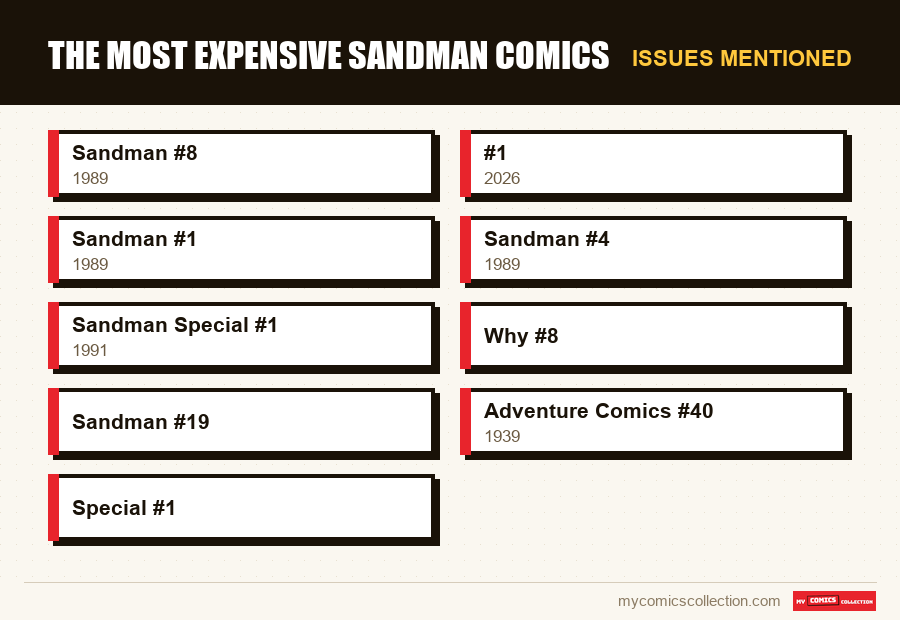
| Sandman #1 (Jan 1989) | Sleep of the Just, first issue of the series | €8 · 76 listings | $650 |
| Sandman #4 (1989) | Appearance of Lucifer | €6 · 16 listings | |
| Sandman Special #1 (1991) | First appearance of Destruction, Orpheus tale, glow-in-the-dark cover | not directly indexed |
Record sources: SellMyComicBooks, GoCollect, Heritage Auctions.
Why #8 tops the ranking (the first Death)
Sandman #8 is the most sought-after issue of the series, because it introduces Death, Dream's older sister and a cult favorite of the Gaiman universe. Two important value nuances:
- Thin listing volume. Our estimator finds only 8 active listings for #8 (€66 median). That's too few to treat as a "precise" value, so we read it as indicative only. For high grade, lean on the documented records.
- The Karen Berger editorial variant. A corrected, rarer version (fewer than 80 copies on the CGC census) reached a documented record of $4,560 , versus $690 for the standard edition in high grade (source: SellMyComicBooks). It's the most dramatic spread in the series.
#1: the most liquid, lifted by high grade
Sandman #1 ( Sleep of the Just, January 1989) is the most-traded issue: 76 active listings, an €8 median across all grades. That low median is misleading: it's pulled down by raw copies. In high-grade CGC, the documented record sale climbs to $650 (source: SellMyComicBooks), and a signed CGC 9.4 copy from Neil Gaiman's personal collection reached $2,640 at Heritage (source: Heritage Auctions). Grade and signature make all the difference.
Special, Overture and the World Fantasy Award premium
- Sandman #19 ( A Midsummer Night's Dream) is the only single comic ever to win the World Fantasy Award. Huge prestige, but a modest per-issue value (very few listings, median around €5): an issue to own for its history, not to speculate on.
- Sandman Special #1 (1991) marks the first appearance of Destruction and an Orpheus tale, with a sought-after glow-in-the-dark cover. Not directly indexed by our estimator.
- Sandman: Overture (2013-2015), Gaiman's return illustrated by J.H. Williams III, is a recent object: low on speculation, but its special editions and variants appeal to completists.
The trap of "older" Sandmen (different characters)
Before you hunt for a "Golden Age" or "Bronze Age" Sandman, know that these are different characters, unrelated to Gaiman's series:
- Wesley Dodds, the Golden-Age Sandman (DC), debuts in Adventure Comics #40 (1939): a separate, much older and pricier comic.
- The Simon & Kirby Sandman (1974) is a Bronze-Age character, also distinct from Morpheus.
Gaiman's series (Morpheus) begins in 1989: its true keys are #1, #8 and Special #1: not some improbable earlier issue.
Collector strategy (grounded in real data)
- #8 = the centerpiece for the first Death, but check the edition (standard or Berger variant) and the grade: the gap runs into thousands.
- #1 = the entry point, affordable raw (€8 median), with real upside in high-grade CGC.
- Grade is everything. The medians above are from June 2026 and prices move; always check live value before buying.
Own a Sandman comic? Get a free valuation with our tool based on real eBay sales to find its low, median and high value.
Frequently asked questions
Sandman #8 (1989), the first appearance of Death of the Endless, Dream's elder sister and a cult character of Neil Gaiman's universe. The series runs 75 issues (1989-1996), and as Dream/Morpheus is a 1989 creation, there is no earlier grail for this series.
It is a corrected editorial version and far scarcer: the CGC census records fewer than 80 copies. The gap with the standard edition in high grade is the most spectacular in the whole series, so check the edition before buying.
Sandman #1 (Sleep of the Just, January 1989) is the most traded issue, and its median is dragged down by raw copies. In high CGC grade its documented sales are of a completely different order, and a signed copy from Neil Gaiman's personal collection has also been sold.
Sandman #19 (A Midsummer Night's Dream) is the only comic to have won this award. Its prestige is immense, but its value remains modest as a single issue: one to own for its story rather than to speculate on.
No, they are different characters. Wesley Dodds, the Golden Age Sandman, debuts in Adventure Comics #40 (1939), and the Simon and Kirby Sandman (1974) is a Bronze Age character, distinct from Morpheus.