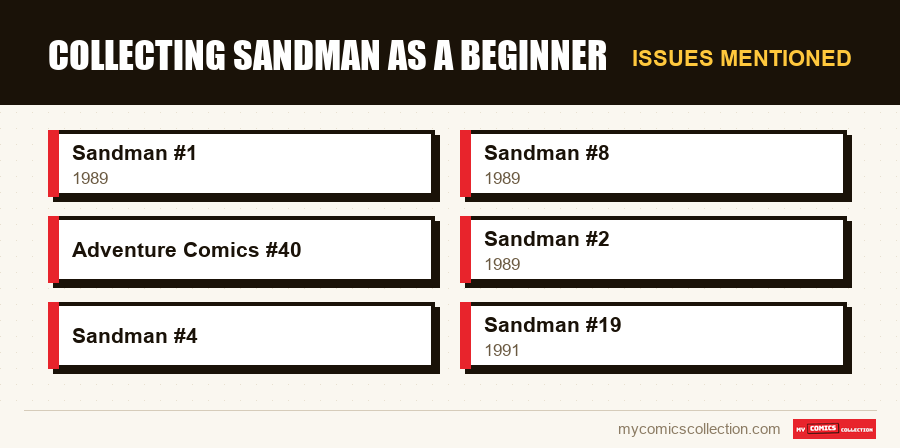
To start collecting Neil Gaiman's The Sandman (DC/Vertigo, 1989), two issues frame everything: Sandman #1 ("Sleep of the Just," cover-dated January 1989), affordable with an eBay median around €8 across 76 active listings (June 2026), and Sandman #8 (August 1989), the first appearance of Death of the Endless and the only genuinely pricey key in the run. Everything else reads comfortably in collected trades or omnibus.
Good news for newcomers: apart from a handful of issues, Gaiman's run is one of the most accessible cult works on the market. You can build a complete, readable collection without a grail-sized budget.
This guide sticks to the verifiable: real-time eBay medians via our estimator, documented publication facts, and public records where they exist. When a figure isn't solid, we state it qualitatively rather than inventing it.
First, a clarification: which Sandman?
Before you buy, know that there are three distinct characters named Sandman. Don't mix them up:
- Wesley Dodds, the Golden-Age Sandman (first appearance Adventure Comics #40, 1939): a gas-mask hero, unrelated to Gaiman.
- The Kirby/Simon Sandman (his own 1974 series, Bronze Age), yet another character.
- Dream / Morpheus of the Endless , Neil Gaiman's Sandman, created in 1989 (Copper/Modern age): the one in the Netflix series, and the subject of this guide.
What this means for collectors: Gaiman's run has no "Silver Age" or "Bronze Age" issues whatsoever. If a seller offers a "vintage Sandman" from the 1960s-70s, it's necessarily a different character. Morpheus's real keys start in 1989.
The two key issues to know
Values = median of active eBay listings, all editions and grades combined (our estimator, eBay.fr + eBay.com, June 2026).
| Issue | Significance | eBay median |
|---|---|---|
| Sandman #1 (Jan. 1989) | "Sleep of the Just," first issue, first appearance of Dream/Morpheus | ~€8 · 76 listings |
| Sandman #2 (1989) | Immediate continuation of the opening arc | ~€8 · 29 listings |
| Sandman #8 (Aug. 1989) | First appearance of Death of the Endless | too few listings for a reliable median (see below) |
Sandman #1 is surprisingly affordable: despite its status, its median sits around €8 and, crucially, it trades across 76 active listings: comfortable liquidity for a beginner. The top of the range (~€37) reflects high-grade or slabbed copies.
Sandman #8 is the only real "investment" issue in the run, because it introduces Death. A caveat: on our estimator it shows only a handful of active listings: far too few to publish a reliable median. What can be said in documented terms: in slabbed copies, CGC 9.6 sells around $600 and CGC 9.4 around $260 at retail (sources: DaleRobertsComics, CGC market). A rare "Karen Berger editorial" variant even hit $10,200 in CGC 9.8 (source: CGC forums), but that's an exception that doesn't apply to the standard copy.
Also worth knowing: Sandman #4 introduces Lucifer, and Sandman #19 ("A Midsummer Night's Dream," 1991) remains the only comic ever to win the World Fantasy Award: two issues of strong historical value that nonetheless stay cheap raw.
Singles, trades or omnibus: which to choose?
This is THE beginner's question. Three paths, depending on your goal:
- Singles (individual issues). The series ran 75 issues (1989-1996). Apart from #1, #2 and #8, the overwhelming majority are cheap. This is the "completist" path for collectors who want to hunt down every issue: ideal if the thrill of the chase matters as much as the reading.
- Trades (collected editions). The series is split into 10 volumes (from Preludes & Nocturnes , covering #1-8, to The Wake, #70-75). It's the best entry point to read the work: cheap, easy to find new, and you get Death's first appearance without paying single-issue #8 prices.
- The omnibus. For those who want the definitive object: the run exists as a 3-volume omnibus (large hardcover collections). Pricier per unit, but unbeatable on pages-per-dollar and gorgeous on the shelf.
Our beginner advice: start with the trades to discover the story, then hunt singles #1 and #8 if the collection becomes a passion.
Condition: what changes everything
- Grade drives price on #8. On other issues, condition barely matters (everything is affordable). But on #8, going from a mid-grade raw copy to a high-grade CGC slab adds several hundred dollars. If you target this issue as a centerpiece, condition is criterion number one.
- Slabbed or raw? For reading and for most issues, raw is plenty. CGC grading really only pays off to secure and resell a high-grade #8.
- Always check live values. The medians above are from June 2026 and move. A low-volume issue can show a misleading price on any given day.
Already have a Sandman in your collection? Get a free valuation with our tool based on real eBay sales to find its low, median and high value.
Frequently asked questions
Sandman #1 ("Sleep of the Just", January 1989) and Sandman #8 (August 1989), the first appearance of Death of the Endless. #8 is the only truly costly key of the series; everything else reads comfortably in collected editions or omnibuses.
There are three distinct characters: Wesley Dodds, the Golden Age Sandman (Adventure Comics #40, 1939), the Kirby and Simon one (1974 series), and Dream/Morpheus of the Endless, created by Neil Gaiman in 1989. Only the latter is the television series' Sandman.
No. The series has no Silver Age or Bronze Age issue: its real keys start in 1989. A "vintage Sandman" from the 1960s-70s is necessarily another character.
The series runs 75 issues (1989-1996) and 10 collected volumes, from Preludes & Nocturnes (#1-8) to The Wake (#70-75). The guide's advice: start with the trades to read the story, then hunt singles #1 and #8 if the passion takes hold. The 3 omnibuses are the definitive version.
Sandman #4 introduces Lucifer, and Sandman #19 ("A Midsummer Night's Dream", 1991) remains the only comic to have won the World Fantasy Award. Both have strong historical value and stay inexpensive in raw condition.