The same series changes in price from simple to double depending on the name of the character you use to search for it. In the statement of August 29, 2026, questioned under the name of the first tenant of its pages, it displays $61.11 raw median; questioned under that of her second tenant, 30,74 $. However, it is only one title. An anthology does not have a price: it has as many as sections, and the two queries simply don't hit the same numbers.
It is the most effective trap of this period, because it is not seen in the figures or in the announcements, and it silently distorts any estimate.
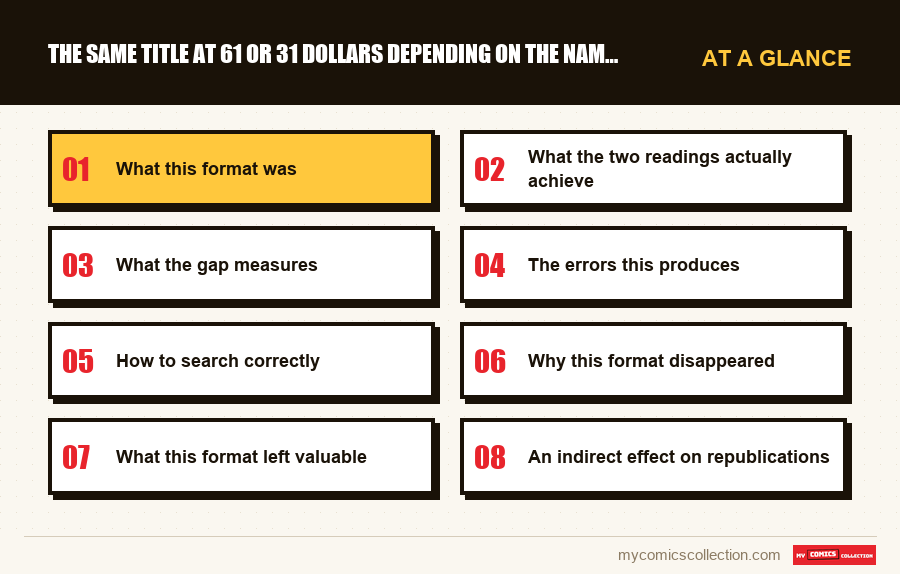
The following describes what this format was, what the two statements actually achieve, what the gap measures, the errors it produces, and how to properly search a multi-heading title.
What this format was
The multiple-heading booklet was the norm of an era, and it has almost entirely disappeared since then.
One issue contained several unrelated stories. Two or three different characters shared the pages, each with their own episode, with nothing connecting them other than the common cover.
The coverage didn't always show everyone. It highlighted the section deemed the best seller of the month, which makes identifying the content impossible from the image alone.
The sections followed one another over time. A character occupied the series for two or three years, then gave way to another, sometimes suddenly. The title remained, the occupants changed.
This last characteristic is the key to everything that follows. Searching for a title by the name of one of its sections does not bring back the entire series: it brings back the range of years when this section appeared there.
What the two readings actually achieve
Query under first name
148 annonces brutes, médiane 61,11 $, maximum 8 249 $. Vérifiées : 50 annonces, médiane 495,00 $.
Question under the second name
168 annonces gross, $1.99 to $299.00, median 30,74 $. Vérifiées : 27 annonces, médiane 190,00 $.
The numbers brought back
The first query returns issues located between the fortieth and seventieth numbers. The second, numbers beyond the seventy-fifth.
Une troisième rubrique
Several titles mention a third character sharing the same numbers as the second, which adds an additional layer.
Asking prices observed on August 29, 2026, raw and verified segments counted separately, never sales concluded. The details of the numbers reported come from reading the ad titles, the only way to see the phenomenon.
The two questions hardly overlap. They sample two distinct slices of the same series, separated by around ten numbers, and therefore produce two medians which do not describe the same object.
It is therefore not a comparison between two characters. It is a comparison between two periods of the same title, which completely changes the interpretation.
What the gap measures
Three factors combine, and the first is by far the most important.
The seniority of the numbers. The first tranche predates the second by approximately three years. In booklets from the early 1960s, a three-year difference weighs heavily on the survival rate.
The presence of points of origin. The early installment contains the first appearances of several characters, some of which are highly sought after. These booklets lift the entire population upwards.
The unequal notoriety of the sections. A real but probably minor factor here, since it works in the opposite direction to the difference observed: the second section is by far the best known to the general public, and yet it is the least expensive.
This last point is worth emphasizing. The more famous character of the two occupies the cheaper bracket, which is enough to rule out the idea that the difference measures a public preference.
The conclusion to remember is methodological: on a title with multiple headings, a median obtained by character name is a median by disguised age group.
Nothing in the figure indicates that it only covers a third of the series. Two people searching for the same title under two different names will obtain two irreconcilable results, without either of them being able to suspect where the difference comes from.
The errors this produces
They are frequent, silent, and concern both purchasing and inventory.
Numbers never seen before
Searching by a section name permanently hides numbers where it does not appear.
A wrongly transposed estimate
Applying the level of one slice to the fascicles of the other produces a single to double error.
A misleading cover
The image highlights a single section, while the booklet contains several.
Ads with the seller character
The same number is offered under the name of the most searched section it contains.
A collection classified twice
Arranging the booklets by character breaks up a single series into several incomplete sets.
Partially unknown content
Without a summary, it is unknown which secondary stories appear in a possessed issue.
How to search correctly
Four reflexes are enough to neutralize most of the problem.
Search by series title, never by character. This is the only question that covers all the numbers. It brings back more noise, and that's the price of complete coverage.
Check the number range obtained. Going through the headings to identify the scope actually covered takes a minute and immediately reveals a question that is too narrow.
Query each known item separately. Adding two or three researches gives a more complete vision than a single one, provided you know that they relate to distinct periods.
Refer to the summary in the catalog. It is the only source that indicates which stories appear in a specific issue, information that no cover provides.
These four reflexes can be practiced in a few minutes and require no prior knowledge of the series. The first rule alone resolves the majority of cases. The title is the actual object; the character is only a rubric, and reversing the two is the original error of all others.
Collecting this series?
Track what you own, what you are missing and what your collection is worth. 7 day trial.
Start my trial →Why this format disappeared
Understanding its disappearance sheds light on the difficulty it poses today.
It was used to test characters at a lower cost. Giving eight pages to a new figure made it possible to gauge reactions without committing to an entire title. The ones that worked got their own series.
It allowed you to occupy a sales location. Keeping a title on newsstands mattered more than what was in it, and an anthology was filled with what was available.
It has become incompatible with sales in specialized stores. A public that follows characters and not titles does not buy a booklet for a third of its content, and the format died out with the circuit that carried it.
His disappearance explains why he is so confusing. A reader trained in dedicated series spontaneously applies character logic to objects constructed according to title logic, and the misunderstanding is total.
What this format left valuable
It is also necessary to say what these booklets offer, because they are underestimated.
They contain unexpected first appearances. Characters who have become important have started in secondary sections, in issues that nothing is mentioned and that few people monitor.
They provide access to two stories for the price of one. At the same price level, a section booklet offers more reading than an issue of a dedicated series from the same period.
They document an editorial method. Seeing which figures were tested, which survived, and which disappeared provides direct testimony to the making of a catalog.
This latter interest is real and has no commercial value, which makes it accessible. The numbers where the tested item failed are the least expensive in the series, and these are often the most informative.
An indirect effect on republications
This format also complicates access to stories in ways that we do not anticipate.
Modern collections follow characters, not titles. Republishing an entire anthology is of no interest to anyone; we therefore republish a character's section while skipping the entire rest of the issue.
The result is compilations which reconstitute a continuity which never existed in this form, and which delete without saying it half of what the reader of the time had before his eyes.
Some of these stories are therefore never republished at all. Sections in which the character has not made a breakthrough are of no interest to any collection, and their only support remains the original fascicle: which gives them a documentary value that nothing can replace.
This is a case where the old object retains a real advantage over any reissue. The fascicle is the only place where the issue exists in its complete state, with its secondary sections, its advertising pages and the order originally intended.
What to record for a multi-topic booklet
This format imposes fields that a dedicated series never requires.
The title of the series as the main entry. This is the real object; classifying by character mechanically breaks up the series into incomplete sets and makes any verification impossible.
The list of sections present in the issue. Two or three lines, to be entered once. This is the information that no cover gives and that we will not find without reopening the booklet.
The section highlighted on the cover. Distinct from the actual content, it explains why an announcement or souvenir refers to the number by one name rather than another.
The position of each story in the summary. Main or complementary story: this hierarchy determines the real interest of the issue for each of the characters it contains.
The slice of the series to which the number belongs. On a title whose occupants change, noting the period avoids applying to an issue the price level of another period of the same title.
Because they don't bring back the same numbers. On a title with multiple sections, searching by character name only returns the range of years in which this section appeared. The two readings from August 29, 2026-$61.11 and $30.74 median: relate to two distinct periods of the same series, separated by around ten numbers.
No, and one detail shows it: the character by far the most famous of the two occupies the cheaper slice. The difference first measures the age of the numbers (three years older, on paper from the early 1960s) and the presence of the original points in the old section.
By the summary indicated in the catalog, never by the cover. This highlights the section deemed the best seller of the month and does not always show the others. It's the only information that lets you know what you really have, and it disappears if you don't write it down.
Especially not. An issue contains two or three characters; Putting it under one of them breaks up a single series into several incomplete sets, none of which is verifiable. The title is the real object, the character is only a heading: reversing the two is the error that produces all others.
Often, and for a reason that is rarely mentioned: characters who have become important have started in a secondary section, in issues that nothing is mentioned and that few people monitor. At the same price, a title with sections also offers more reading than a dedicated series from the same period.
Two or three characters per issue: which ones?
Without the list of headings present, a booklet from this period remains half unknown.