Around the big Carnage event of 2019, the publisher didn't just publish one story: it deployed a whole range of official objects which all bear the same name. The announcement statement from August 29, 2026 shows this clearly: 144 uncertified proposals, from $0.99 to $400.00, median requested at $9.99; 25 verified copy submissions, $29.99 to $399.99, median asking $100.00. And of the five cheapest offers, two are not historical issues: a sheet of promotional temporary tattoos at $0.99 and a reissue from a collection of reprints at a starter price at $1.94. A third, at $2.49, is an alternate cover copy. It's not the second-hand market that confuses the search: it's the publisher himself.
We readily imagine that the disorder in a list of results comes from the sellers. Approximate titles, stacked keywords, poor quality photos: the designated culprit is always the one who writes the ad. The statement of August 29, 2026 tells something else. The titles observed at the bottom of the range are accurate. The seller of the $0.99 temporary tattoo sheet describes precisely what he is selling: a promotional temporary tattoo sheet, bearing the name of the event, produced by the publisher. Whoever offers a reissue for $1.94 mentions the collection of premium reprints from which it comes. The one that displays $2.49 clearly indicates that it is an alternative hedge. Nobody cheats. Each person faithfully describes the object they hold. And yet, the buyer who types the name of the event finds himself in front of a wall of heterogeneous objects of which he does not know which ones belong to the story.
The cause lies upstream, in the editorial strategy itself. A modern event is no longer a series of booklets: it is a commercial program spread over several months, which simultaneously produces history booklets, promotional items without narrative content, low-cost reissues intended to recruit new readers and alternative packaging of the same content. They all bear the name of the event, because that is precisely the goal: to occupy space, to make oneself visible, to multiply points of contact. When this range lands, years later, in an ad search engine, it finds itself compressed into a single list where the common name serves as the denominator. The name of the event no longer designates a series. It designates a range.
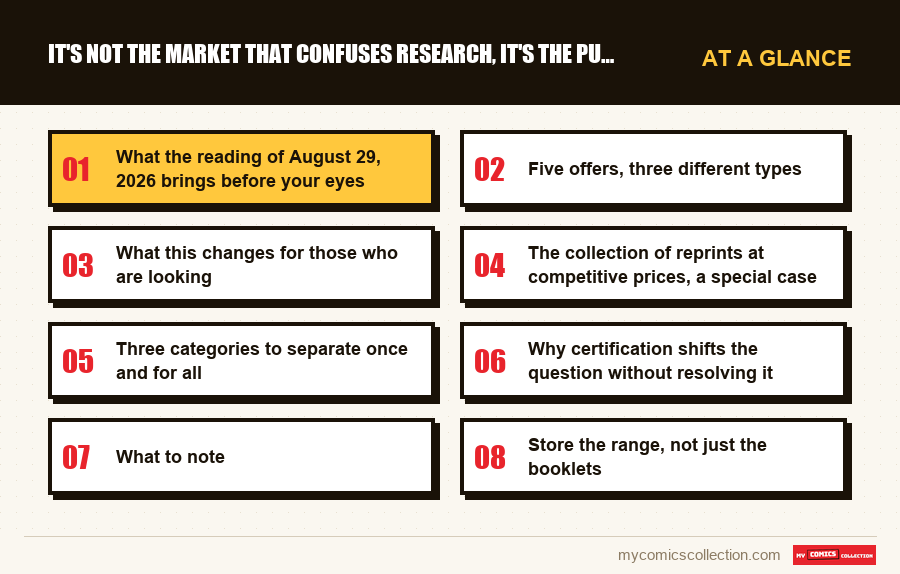
What the reading of August 29, 2026 brings before your eyes
Two populations coexist in the results, and they don't have much in common. On the uncertified side, 144 proposals were online, with amounts requested ranging from $0.99 to $400.00 and a midpoint requested at $9.99. As for the copies verified by certification, only 25 proposals, with amounts requested ranging from $29.99 to $399.99 and a midpoint requested at $100.00. It is necessary to reiterate what these numbers are: amounts displayed by sellers on a given date, not concluded transactions. A $400.00 ad establishes nothing but the hope of the person who wrote it. The top of a range is an intention, never an observation.
The midpoint is more informative, because it summarizes where the mass is located. A asking midpoint around ten dollars on the raw segment signals abundance: there are lots of things, they are accessible, and no one is fighting for them. This is consistent with a recent, widely publicized event, the print runs of which have not had time to become scarce. But this abundance alone does not explain the confusion. What produces it is the nature of the objects that make up the bottom of the range.
Five offers, three different types
A promotional item for $0.99
The cheapest proposal in the survey is not a booklet. This is a sheet of promotional temporary tattoos, produced by the publisher, bearing the name of the event. It has no pagination, no narrative, no place in continuity. It exists to be distributed, seen, remembered. In a list sorted by increasing price, it nevertheless occupies the first line.
A reissue at a bargain price of $1.94
The second cheapest offering is a reprint, from an editorial collection designed to sell old stories for a few dollars. The content is authentic, the subject is official, but it is not the original booklet. Nothing in a list distinguishes it, except the wording printed on the object itself.
Two ordinary issues at $2.00 and $2.25
These are the only proposals at the bottom of the range which correspond to what a reader is spontaneously looking for: ordinary issues of the series, with their standard packaging. They cost less than the alternate cover copy that immediately follows them, which is enough to disorient anyone who assumes that the price categorizes the content.
An alternative cover for $2.49
The fifth proposition contains exactly the same story as the two previous ones, in a different format. It is more expensive, not because it offers more, but because its packaging was produced in less quantity. It is a third status, distinct from the ordinary issue as well as from the reissue.
The fact deserves to be stated bluntly: of the five least expensive proposals in the August 29, 2026 statement, two are not fascicles of history, and a third is an alternative presentation. In other words, a majority of what appears at the top of a list sorted by price does not answer the question the buyer is asking. This is not a platform anomaly. It is the faithful reflection of an editorial catalog which produced, around the same name, objects of three types.
The ads cited here are accurate and the sellers are not misleading anyone. Everyone correctly describes what they hold, and the notices appearing on the objects are consistent. The problem is not the fault of any of them taken in isolation.
What produces the confusion is the cumulative effect of a very wide official range. When a publisher himself creates around ten categories of objects sharing a single name, no honest description alone can restore the hierarchy that the name has erased.
Why does a publisher produce all this?
The temptation is to see this proliferation as a form of cynicism. It is rather a matter of perfectly readable commercial logic, each part of which meets a distinct objective. Understanding these objectives already means knowing how to recognize objects.
Occupy shelf space for several months. An event must remain visible well beyond the week of release of its first issue. Multiplying objects means multiplying the display surfaces: a display, a pile of reissues, a promotional item placed on a counter. Everyone reminds the name of the event to someone who did not come for them. The range is an occupation device.
Provide a low-cost entry point. A reader who discovers a character will not immediately buy a complete series. A reissue for a few dollars removes this obstacle: it transforms a curiosity into a purchase. It's a recruitment mechanism, and it works: which is also the reason why these objects are circulating in large numbers on the second-hand market today.
Multiply purchases per reader. An alternative packaging doesn't sell a story to someone who doesn't have it: it sells a second copy to someone who already has it. The promotional item is often not initially sold at all: it accompanies a purchase. Each category targets a different moment in the relationship between the publisher and its reader, and the sum of these moments constitutes the turnover of the event.
What this changes for those who are looking
The name is no longer enough
Typing the event name into an ad engine doesn't return a series: it returns a range. It is necessary to add to the query what distinguishes a booklet from an object, otherwise the sorting by price first returns what is not searched for.
The date of printing matters more than the year of the story
A story from 2019 can exist as a printed object long after. The date associated with the story and that associated with the copy do not necessarily coincide, and this is precisely where the reissue slips in.
Price does not prioritize content
In the statement, the most expensive copy at the bottom of the range is an alternative cover, and the two ordinary issues are less expensive than it. Assuming that the requested amount ranks the narrative value leads to choices opposite to the intention.
An official object is not a chapter
A sheet of temporary tattoos is an authentic product from the publisher. It has its place in a thematic collection, not in a continued reading. The two uses do not have the same requirements and should not share the same search list.
Two populations, two scales
The raw segment and that of verified copies form two distinct markets as of August 29, 2026, with very distant requested medians. Comparing them without saying it produces false conclusions in both directions.
The printed statement is the sole judge
What separates a reissue from an original booklet cannot be seen in the title, nor in the visuals, nor in the price: it can be read on the object. Any serious verification requires a photo of the instructions page or a question to the seller.
The collection of reprints at competitive prices, a special case
This category deserves attention, because it is the only one whose trial would be unfair. A collection of reprints sold for a few dollars makes an old story accessible to readers who would never have paid the price for a period copy. This is a real service, and it must be said clearly: these objects have put important stories into hands who, without them, would not have read them. Nothing in this article disqualifies them as reading material.
The problem is not their existence, it is their indistinguishability. Once photographed from the front and described by its title, a copy from a collection of reprints resembles an original booklet. Same cover design, same title, same character, same layout. In a list of announcements, where we see a thumbnail and a line of text, nothing separates them, except the wording printed on the object, often relegated to a banner or on the interior information page. As of August 29, 2026, one of these reissues appeared at $1.94 among the five cheapest proposals in the survey: therefore it was at the top of the list for anyone sorting by increasing price.
This misalignment creates two symmetrical misunderstandings. The first concerns the buyer in a hurry: he thinks he is purchasing a period copy and receives a perfectly honest reprint, described as such, but which he had not read carefully. The second concerns the non-specialist seller: he inherits a lot, sees a visual that he recognizes, and publishes an announcement accurate on the content but silent on the origin: not by calculation, but because he is unaware that the distinction exists.
The practical rule can be summed up in one sentence: when faced with a very low price on a well-known story, the first question is not “why so cheap?” » but “what impression? ". A price difference of an order of magnitude between two visually identical examples almost never signals a good deal; it points out two different objects. This reflex also applies well beyond the 2019 event, as shown by the broader editorial history of the character traced in our overview of the history of Carnage in comics.
Collecting this series?
Track what you own, what you are missing and what your collection is worth. 7 day trial.
Start my trial →Three categories to separate once and for all
All the clarity that can be regained lies in a three-pronged distinction, to be applied before even looking at a price. There is nothing scholarly about it, but it resolves almost all of the confusion produced by a wide official range.
The first category is the history booklet: the object published at the time, the content of which is part of the story of the event. This is what anyone who wants to read is looking for, and it is the reference to which everything else is compared. Its covering can vary: this is the nuance of alternative covers, which belong to this category but constitute a separate variation, produced in smaller quantities and therefore valued differently.
The second category includes official objects that are not part of history. The sheet of promotional temporary tattoos in the statement is a clear example of this, but the family is much larger: everything that the publisher creates around an event to accompany it, signal it, extend it, without adding a page of story. These objects are authentic, sometimes sought after for their own sake, and perfectly legitimate in a thematic collection. They just don't belong in a playlist.
The third category is the later reissue of the same story. The content is that of the first category, the object is not. This is the most slippery branch, because it is the only one which can be confused with the first by a good faith observer. It is also the most useful to the pure reader, and the least relevant for those documenting a collection by copies. The same object therefore changes status depending on its use: all the more reason to explicitly name the use before purchasing.
Applied upstream, this grid transforms an unreadable list into three readable lists. It does not make any object disappear; it simply makes visible the question that the list silently posed: “which of these three objects do I want?” » To situate each of them in a larger whole, our overview of the Carnage universe provides the narrative context that is often missing when arbitrating.
Why certification shifts the question without resolving it
Faced with this disorder, the reflex is often to turn to verified copies. The August 29, 2026 statement actually shows a much narrower population: only 25 proposals, with a median requested at $100.00 compared to $9.99 in the raw segment. The difference is dramatic, and it's partly because of what verification eliminates: a promotional item without pagination or a premium reissue has no economic reason to go through an expensive process.
Certification therefore acts as an implicit filter: it does not sort the categories, but its cost makes it absurd to apply it to low-value objects. The result is a mechanically more homogeneous list. However, it would be a mistake to conclude that the problem is solved for those who pay the high price. Verification certifies a state and an identity; it is not intended to answer the question “is this object part of the story?” », which remains a question of catalog and reading.
We must also refuse the direct comparison between the two requested medians. A difference between $9.99 and $100.00 does not measure the added value of a procedure: it compares two populations that do not contain the same objects. The raw segment mixes three categories and all states; the verified segment only retains what was worth submitting. Putting the two numbers together without saying so produces a false conclusion, whichever way you draw it.
Finally, the same caution is required at the extremities. A $399.99 listing in the verified segment and a $400.00 listing in the raw segment look similar, but neither sets a price: they are two sellers hoping, on a given date, and nothing more. The ranges tell where the demands are, never where the agreements are.
What to note
The name of a modern event refers to a range, not a series. Around the 2019 Carnage event, the publisher produced story booklets, promotional items, premium reissues and alternative designs. All share a name, none share the same function. Any search that stops at the name mechanically inherits this confusion, and no platform will correct it for the buyer.
Two of the five cheapest offers on August 29, 2026 are not historical documents. A sheet of promotional temporary tattoos for $0.99 and a reissue from a collection of reprints for $1.94 occupy the top of a sort by ascending price. A third proposal, at $2.49, is an alternative skin. The only two ordinary issues in the lot, at $2.00 and $2.25, are sandwiched between objects of another nature.
The ads are accurate and the sellers honest. Each title observed correctly describes the proposed object. What is problematic is not any description taken in isolation, but the cumulative effect of a very wide official range dumped into a single list. Looking for a culprit on the sellers' side means completely missing the origin of the phenomenon.
The reissue at a premium price provides a real service and creates a real trap. It puts an ancient story within reach of a few dollars, which is valuable for reading. But nothing distinguishes it from an original booklet in a list, except the mention printed on the object. Faced with an abnormally low price on a well-known story, the right question concerns impression, never luck.
The two survey populations are not comparable. 144 uncertified proposals from $0.99 to $400.00 with a median asking at $9.99 on one side; 25 verified proposals from $29.99 to $399.99 with the median asking at $100.00 on the other. These are amounts claimed on August 29, 2026, not transactions, and the two lists do not contain the same categories of objects. Maxima, in particular, express a seller's hope and nothing else.
Yes, as long as you know what is stored there. It is an official object produced by the publisher around the event, authentic and coherent in a thematic collection dedicated to this character or this campaign. What it is not is a chapter in the story: it contains no page of history. The confusion therefore does not come from its presence in a collection, but from its presence in a list of results consulted by someone who is looking to read.
Neither the title, nor the cover sticker, nor the asking price allows us to decide, since the three can be identical. The only reliable element is the notice printed on the object itself, generally on the instructions page or in a cover banner. Concretely, this means asking for a photo of this area, or asking the question directly to the seller: who, in the vast majority of cases, will answer without difficulty.
Because the price here does not pay for the content but for the quantity produced. In the statement of August 29, 2026, the alternate cover copy was priced at $2.49 when two ordinary issues were priced at $2.00 and $2.25. The discrepancy reflects a difference in availability, not a difference in reading. For those who simply want to read the story, the standard packaging is strictly equivalent.
No, and the nuance is important. This figure is the midpoint of the sums claimed by sellers in the uncertified segment on August 29, 2026, from a population that mixes story booklets, promotional items, reissues and alternative packaging. It describes where demands for an entire range are concentrated, not the value of a specific item, and says nothing about what actually changed hands.
Certification actually produces a more homogeneous list, because its cost discourages its application to low-value objects: the 25 verified proposals in the survey are narrowed down where the 144 raw proposals are broken up. But it attests to a state and an identity, not a narrative belonging. It therefore does not exempt you from the question “is this document part of the story?” », which is part of the catalog and not the procedure.
Store the range, not just the booklets
Promotional items, reissues at competitive prices, alternative packaging, story booklets: a modern collection mixes four types of objects under the same name. My Comics Collection allows you to register them separately, instantly find what you already own before purchasing, and no longer confuse an original copy with its reprint.