In short
Ronan the Accuser makes his entrance in Fantastic Four #65, dated August 1967 on the cover, from the Lee and Kirby team: Stan Lee scripting, Jack Kirby drawing. The Kree Supreme Intelligence sends Ronan to Earth to look into a Kree Sentry that the Fantastic Four destroyed in the preceding issue. He arrives as the Kree empire's official prosecutor, a judge and enforcer rather than a conqueror, and the same issue gives the Kree their first on-panel appearance.
Few Silver Age cosmic debuts carry as much future weight as the August 1967 issue of Fantastic Four. Ronan has since fought the Avengers, married into the Inhumans and moved into film, yet the cover in question is a team book from the middle of the Lee and Kirby run, and its price in the market has little to do with the character's popularity on screen.
The credits and cover dates below were checked against published publication histories for Ronan, the Kree and the Supreme Intelligence; anything about condition, grading or buying method is analysis rather than reported fact, and no market values are quoted.

The issue at a glance: Fantastic Four #65
The identity of the book is simple. This is the original series, number 65, with a cover that reads August 1967, made by the pairing that defined the title: Stan Lee wrote and Jack Kirby drew. Those two names are the creators of the character, and they are the two you can credit with confidence.
This guide leaves the inking, lettering and coloring credits of the August 1967 Ronan debut blank. That matters for a collector, because a surprising number of online listings add such credits from memory or copy them from the wrong issue. When a seller's description of a 1967 book names a full credit chain, treat it as a claim to check against the indicia and the printed credits on the first page rather than as settled fact.
Finally, keep the issue number straight. This is volume one, number 65. Later Fantastic Four volumes restarted their numbering, and Ronan returned in some of them, so a shorthand like "FF 13" can mean very different things depending on which volume a seller has in mind. The debut sits in the original numbering, which ran for decades before any restart.
How Ronan is introduced
The setup is a chain reaction. A Kree Sentry, a robotic guardian, has been destroyed by the Fantastic Four in the issue before, and that destruction draws the attention of the Kree leadership. The Supreme Intelligence, the artificial ruler of the Kree, dispatches Ronan to Earth to investigate. That single sentence is the entire reason the character exists on the page: he is an investigator and a judge, sent to determine who is responsible.
This framing is more specific than the usual "alien villain arrives" template. Ronan comes with a title, the Accuser, which describes a function inside Kree society. He represents authority, and his arrival is an act of procedure before it is an act of violence. Readers meeting him for the first time are given a representative of a state, with a state's hierarchy behind him, rather than a lone menace.
The same story establishes the Kree on panel for the first time. Before this issue Marvel readers had no visible Kree civilization; after it they have an empire, a ruling artificial mind and an enforcer with a recognizable look. A collector should read that as the real significance of the book: it launches a whole branch of the Marvel cosmos, and Ronan is the face of it.
It is worth being precise about what the issue does not do. It does not make Ronan the permanent leader of the Kree, it does not introduce his later feud with the Avengers, and it does not tie him to the Inhumans. Those developments arrive in other books and other decades. The debut presents the beginning of a character, and anything beyond the investigation of the destroyed Sentry belongs to later writers.
Who created him, and the editorial moment
Stan Lee and Jack Kirby were the creative team of Fantastic Four at this point, and issue 65 reads as a link in their run rather than an isolated stunt. The Kree story is a two-part arrangement: the destruction of the Sentry comes first, and the arrival of the investigator follows. Mar-Vell, the Kree hero, was introduced separately in Marvel Super-Heroes #12, and the two threads later merged into one civilization. For that side of the story, see the guide to Mar-Vell's debut in Marvel Super-Heroes #12.
That two-part structure has a practical meaning at the longbox. If you are assembling the story rather than hunting a single slab, the issue before the debut is the setup, and the debut itself resolves into the first Kree confrontation. Buyers who focus only on the headline number sometimes find that the narrative payoff makes more sense when the previous issue sits next to it on the shelf.
Why #65 is a key issue
Three reasons stand behind the label, and it helps to keep them separate. First, it is the debut of Ronan the Accuser, a character with decades of later use. Second, it carries the first on-panel appearance of the Kree as a people. Third, it is the debut of the Supreme Intelligence, the ruling artificial intelligence of the Kree, dated to this same August 1967 book. Together those make the issue a foundation for a long list of later stories.
The strongest proof of that foundation is how often the elements return. Ronan plays an important role in the Kree-Skrull War, the Avengers storyline that ran in The Avengers #89 to #97 between June 1971 and March 1972. Roy Thomas scripted the whole arc, and the penciling passed from Sal Buscema to Neal Adams and John Buscema. Ronan appears in it as a Kree outlaw, the culprit behind the Sentry attacks and the architect of Plan Atavus, a scheme to turn Earth back into a prehistoric world, a very different posture from the investigator of 1967.
Later, he is at the center of the Annihilation event and has his own four-issue miniseries written by Simon Furman in 2006, and he features in War of Kings in 2009 and The Thanos Imperative in 2010. Each of those appearances gives collectors a reason to revisit the debut. Demand for a first appearance tends to follow the character's visibility, and Ronan has stayed visible across several generations of cosmic Marvel.
Do you collect this series?
Track what you own, what you are missing and what your collection is worth. 7-day trial.
Start my trial →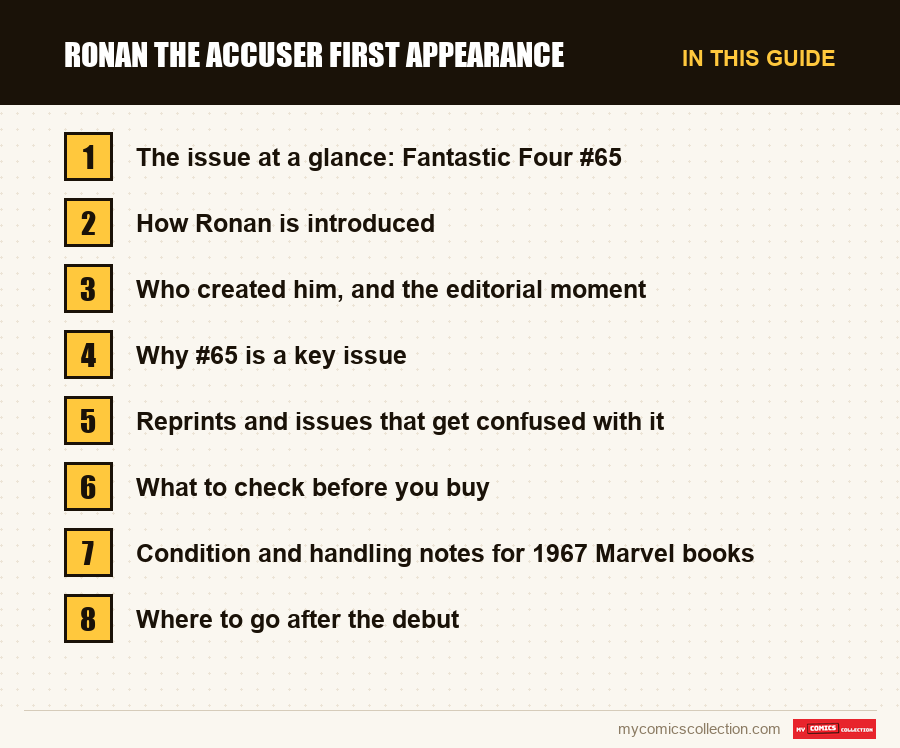
Reprints and issues that get confused with it
The first confusion is with the Avengers. Because Ronan's best-known story is the Kree-Skrull War, some buyers assume his debut is in The Avengers. It is not: the Avengers arc comes years later, in 1971 and 1972, and the debut is the Fantastic Four issue from August 1967. If a listing leads with "Ronan" and an Avengers number in the 80s or 90s, it is a key story, not the first appearance.
The second confusion is with Marvel Super-Heroes #12, which introduces Mar-Vell. That issue is the debut of a Kree character, so it is easy to merge with the Ronan story in memory. They are separate books with separate creative histories, and they belong to different series. If you want a Kree set, you are collecting two distinct numbers.
The third confusion is with later Fantastic Four volumes. Ronan appears in volume three, including issues 13 and 14, and a hasty search for "Fantastic Four 13 Ronan" can surface the wrong run. Always confirm the volume and the cover date before you pay. The 1967 book is volume one, and the printed date is August 1967.
As for reprints, collected editions of Lee and Kirby material exist, but reading copies are not a substitute for the original periodical if your goal is the first appearance. A reprint reproduces the story and typically changes the paper, the printing and the cover treatment. When a seller describes something as a "reprint" or a "facsimile", it is a different object from the 1967 original, and it should be classified that way in your records. Ask for the cover scan and the indicia whenever the description is vague.
What to check before you buy
Start with identification. Read the masthead, the number 65 and the August 1967 date straight off the cover, then hold the image up against a trusted scan of the same issue. Silver Age books of this era are often misdescribed, and a quick comparison of the masthead and the cover layout catches most errors.
Next, look at the structure of the book. On a comic from the late 1960s, the usual weaknesses are a loose or detached cover, a spine that has split along the staples, centerfold separation, and rust or discoloration where the staples meet the paper. Ask for photos of the staples and the spine, not only the front cover, and request a clear view of the back cover where the paper often shows toning and creasing first.
Then consider restoration. Pressing, color touch, tear seals and cleaning all alter how a sixty-year-old Kirby book looks. A worked copy still has a place on a shelf, yet it sits in its own category, and a label with a restoration note tells you exactly that. Treat an unlabeled copy that looks unusually bright with some caution and compare it to other books of the same age.
If the book is slabbed, read the label rather than the number alone. The printed issue, the grade and the notes sit side by side, and the serial on the label can be looked up with the grading company. Our guide to grading and what labels tell you explains how to read one, and the method applies to Fantastic Four as much as to Avengers books.
Finally, compare several copies of similar condition when you are deciding. Look at completed sales over time, not a single listing, and compare like grades against like grades. Holding a copy already? The estimate form below takes the same condition details. The point of the method is to separate a fair price from a hopeful one without quoting any figure here.
Condition and handling notes for 1967 Marvel books
Marvel books from the mid-1960s were printed on newsprint-grade paper, and that paper ages in predictable ways. It yellows and eventually browns, it becomes brittle at the edges, and it can crack when a page is turned too far. This is why even a well-stored copy of a 1967 comic shows its age, and why collectors give so much weight to paper quality in the grading notes.
Where to go after the debut
Once you have the debut, the natural next stop is the Kree-Skrull War in The Avengers #89 to #97. It is the story that turned Ronan from an investigator into a threat to Earth, and it is collected in a trade paperback, The Avengers: Kree-Skrull War, first released in 2000 and reissued in 2008. For readers who want the story without chasing the originals, that collection is the practical way in. Our guide to Bronze Age Avengers key issues places the arc in context.
Next comes the 2006 four-issue series written by Simon Furman, in which Tana Nile falsely accuses the Accuser of treason and he discovers that a high-ranking member of a Kree house framed him. It is a character study of the Accuser at a low point, and it leads into Annihilation, where he plays a leading role. These later books are a different type of purchase from a 1967 key, and many collectors treat them as reading material rather than investments.
The Kree storyline then runs into War of Kings in 2009, where Ronan agrees to help the Inhumans against the Skrulls on the condition that the Inhuman princess Crystal marry him, and into The Thanos Imperative in 2010. If you collect the cosmic side of Marvel, those books link Ronan with Thanos and the wider space-opera line. The broader guide to where to start with Ronan lays out a reading sequence if you would rather read than hunt.

Frequently asked questions
The debut is Fantastic Four #65 from August 1967, in the original series, by Stan Lee and Jack Kirby. Ronan is sent to Earth by the Kree Supreme Intelligence to investigate a Kree Sentry that the team destroyed in the previous issue.
It carries the first on-panel appearance of the Kree as a people, and the Supreme Intelligence's debut is dated to the same August 1967 book. Mar-Vell, a Kree character, was introduced separately in Marvel Super-Heroes #12, so a Kree set involves two different numbers.
No. The Kree-Skrull War fills The Avengers #89 to #97, dated June 1971 through March 1972. Ronan plays an important part in it, but he had already debuted in Fantastic Four #65 four years earlier. The Avengers arc is a key story, not the debut.
The debut is in volume one, issue 65, dated August 1967. Ronan reappears in later volumes, including volume three issues 13 and 14, so check both the volume and the cover date on any listing. A search that returns the wrong volume is a common source of mistaken purchases.
Compare the volume, the number 65 and the August 1967 date with the cover, then request crisp photos of spine, staples, centerfold and rear cover. Spine splits, retouched color and mended tears should make you pause. For a slab, read the notes and look up its serial.
Own a copy of the issue that introduced Ronan and the Kree? Get a free estimate based on its condition.
Estimate my comic