
Adding the year of publication to a search seems prudent: this should rule out homonymous issues. In practice, a general ad engine does not have a “year” field. It receives four digits and treats them like any other word in the query. The statement of August 30, 2026 on a general auction site, American market, shows this unambiguously: the query “Red Skull Captain America 1941” returns 48 unverified advertisements, the five least expensive of which are all number 41 of a series launched in 2005 and published in 2008. The engine matched “41” inside “1941”. All amounts cited here are sums claimed by sellers on this date, on advertisements then in progress, never sales concluded.
The advice circulates everywhere and it is well-intentioned: when a number is ambiguous, specify the year. The same title has often gone through several successive series, each starting from number one, and the year of publication seems the shortest way to distinguish two issues which bear the same number. The reasoning is fundamentally correct. What he doesn't know is the mechanics of the device to which the request is addressed. A bibliographic catalog has a date field: it knows that a number placed in this field is a year and it will refuse to confuse it with anything else. A commercial ad engine does not have this field, or does not use it when you type freely in the search bar. It reads a string of words and looks for matches in handwritten listing titles from thousands of independent sellers.
The result is not a visible failure. It is a silent failure, and that is what makes it formidable. The query returns dozens of ads, with a minimum price, a median, a maximum: all the encrypted apparatus of a serious statement. Nothing in these numbers indicates that the whole measured is not what we thought it was measuring. You have to open the ads one by one to see it. This article starts from a specific case, noted on August 30, 2026 around the character of Red Skull, to show how precaution backfires, how it is detected, and what consequences can be drawn from it for the maintenance of a collection.
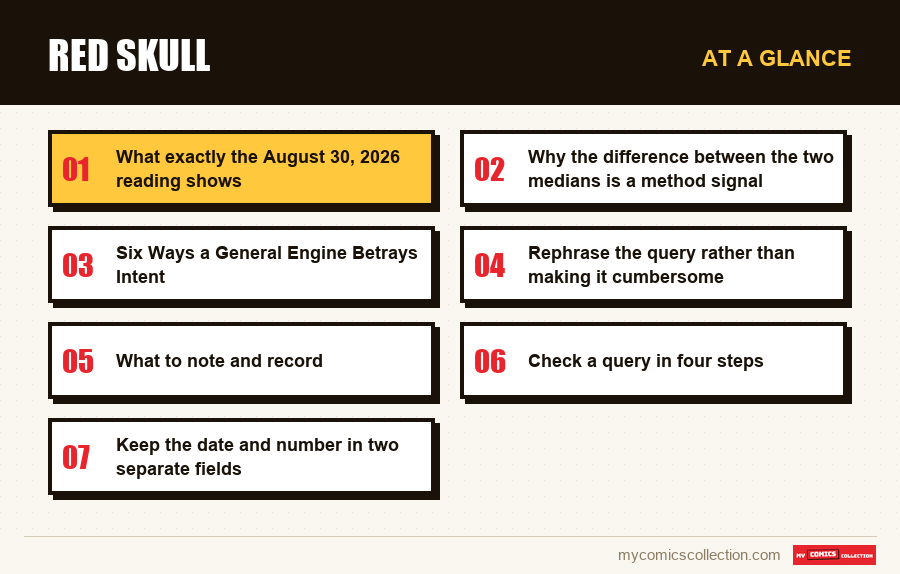
What exactly the August 30, 2026 reading shows
The query tested is “Red Skull Captain America 1941”. It aims, in the mind of the person who formulates it, at a booklet from the 1940s. On a general auction site, American market, she returned 48 unverified ads that day. The lowest amount claimed is $1.20, the median is $9.00, the highest amount is $225.00. Counted separately, the copies passed by a verification body are 8 in number: minimum $69.99, central value $7,749.00, maximum $29,999.99.
Taken in isolation, these two sets of figures read like a classic contrast between raw and verified copies. This is precisely the interpretation that must be rejected here. A median of $9.00 for a set purporting to describe a booklet from the 1940s makes no bibliographical sense. A print from this period does not command a median of nine dollars out of forty-eight advertisements, whatever its condition. The number is false not because the calculation is erroneous, but because the whole to which it relates contains something other than what we believe.
Inspection of the ads confirms this immediately. The five cheapest proposals in the request are all the same item: issue 41 of a series launched in 2005, published in 2008. Their titles speak for themselves: “Captain America No. #41 2008 [...] G/FN+” at $1.20, “Captain America #41 Marvel 2008 [...]” at $2.59, “CAPTAIN AMERICA (2005) #41 (MARVEL 2008)” at $2.90, “CAPTAIN AMERICA (5th Series) #41 (Marvel, 2004) VF/+” at $3.00, “Captain America #41 (Marvel Comics October 2008)” at $3.00. None of these titles contain the sequel “1941”. The engine compared the “41” present in each of them to the “1941” in the query, and judged them to be relevant.
A remark is necessary on the other segment. Eight verified announcements are too small a number to support any conclusion on a price level. Neither the central value of $7,749.00 nor the high of $29,999.99 describes a market: they describe eight sellers. An isolated maximum, in particular, reflects a person's hope, not an actual amount. And as all the figures in this article come from a single day of observation, they cannot in any way indicate a trend: a measurement taken on a single date shows no movement, neither increase nor decrease.
Why the difference between the two medians is a method signal
A factor that no certification explains
Between $9.00 unverified median and $7,749.00 verified central value, the ratio far exceeds what verifying a copy usually adds to its claim. Certification moves a price; it does not multiply it by several hundred. When the gap crosses this order of magnitude, the “certification is expensive” hypothesis ceases to be the most probable.
The correct hypothesis is the composition
The first thing to look at is not the price but the contents of both sets. Here, the verified segment contains many old issues, a copy submitted for verification is rarely verified for a recent three-dollar print, while the raw segment is invaded by modern issues captured by the collision of numbers. The two series do not describe the same object.
The low figure contaminates the entire statistic
Five ads between $1.20 and $3.00 are enough to pull a median down when the total membership is 48. Each additional intruder moves the midpoint. A median is said to be robust to extreme values, but it offers no protection against a set of which a substantial part is irrelevant.
The minimum is the best detector
A minimum of $1.20 in a query for a print from the 1940s is enough of a red flag in itself. Before calculating anything, you must open the cheapest ad and read its title. If it describes an object other than the one sought, all the figures derived from the set are to be thrown away.
This reasoning is becoming generalized. Whenever a survey reveals two populations whose price levels have no common measure, the first question to ask is not "why is one worth more than the other?" » but “do these two populations really contain the same object? ". The price difference is what you see; the difference in content is what produces it. Reversing the order of the questions leads to telling a market story where there is only a lack of query.
A poorly formed query is not reflected in the numbers it produces. It produces figures that appear perfectly normal: a minimum, a median, a maximum, a respectable number. None of these indicators bears a distinctive mark when the whole is polluted.
Only inspection of the ads reveals it. Concretely: open the five least expensive, open the five most expensive, read the titles. If the two ends do not describe the same thing, the whole is heterogeneous and no average makes sense.
Six Ways a General Engine Betrays Intent
No typed field
A commercial ad engine indexes freely written titles. It has no “year of publication” column, no “number” column, no “publisher” column. Everything you type comes into the same bag of keywords, and everything it compares is text against text.
A year is just a number
“1941” is not interpreted as a date. It is a sequence of four digits. The engine can find it whole, truncated, or partially match it according to its internal tolerance rules. Adding a year means adding one more keyword: never add a filter.
The ad title is free prose
Each seller writes his title in his own way: abbreviations, variable punctuation, state mentions, multiple years. The same issue can bear in its title the year of the series, the year of the issue and the year of the reprint. The engine does not distinguish them.
Lots mixed with parts
Nothing formally distinguishes an advertisement relating to a single copy from an advertisement relating to a set. Both arrive at the same result, with amounts that do not compare. This is a second source of heterogeneity, independent of the collision of numbers.
Neighboring numbers answer each other
Adding a number to a query, whatever it may be, increases the collision surface with all other numbers present in the headings: numbers, printed prices, internal codes, quantities. The more numbers the query contains, the more unrelated objects it catches.
The reminders replay the trap
A revived series that continues its numbering mechanically reaches number 41, then one day other two-digit numbers that appear years from now. The collision is therefore not an isolated accident: it reconstitutes itself as the series progresses.
Collecting this series?
Track what you own, what you are missing and what your collection is worth. 7 day trial.
Start my trial →Rephrase the query rather than making it cumbersome
The natural reflex, when a search returns noise, is to add words. This is exactly the opposite of what you should do when the noise comes from a number. Each additional number in a query is a new opportunity for collision, since the engine has no way of knowing what that number refers to. A year added to a query already loaded with numbers does not restrict the whole: it expands it in an unpredictable direction.
The useful path is through words, not numbers. A rare word appearing in the exact title of the issue, a period term, a specific editorial mention discriminates much better than a date, because they do not have a numerical homonym. Conversely, if the engine offers real structured filters (a box, a drop-down list, an interval) these deserve to be used: they apply to a typed field and are not confused with anything. The distinction to remember is in one sentence: what you type in the bar is a keyword, what you check in a panel is a filter.
Then there remains one step that nothing can replace: reading. Open extreme announcements, check that the object described corresponds, exclude lots, exclude reprints, exclude derived objects. This manual work seems tedious, but it is the only one to distinguish a usable reading from a decorative table of numbers. Of the 48 unverified ads in our query, this reading would have taken a few minutes and would have avoided an entirely false conclusion. To locate the fascicles themselves before opening an engine, a detour via the story of Captain America in comics is better than a guessed query.
Finally, you must accept that a request may not be successful. When a segment is reduced to eight ads, as here for verified copies, the correct conclusion is that there is nothing to conclude. A small number allows no median, no range, no comparison. Noting it as such and moving on is a methodological decision, not a renunciation. Those looking for affordable entries will find more material on the side of accessible Captain America booklets, where the numbers are large enough for orders of magnitude to emerge.
What to note and record
Keep the exact query next to the number. An amount recorded without his request is unusable: we can no longer verify what it measured. Note the literal wording, here “Red Skull Captain America 1941”, the date of the statement, the fact that these were current listings and not sales, and the number of listings retained. Without these four elements, a figure read again six months later is worthless.
Record the publication date in its own field. This is the directly transposable lesson from the case above. As soon as the date lives in its own field, it is filtered, sorted, compared. Concatenated with the number in the same character string, it becomes what it was for the ad engine: a series of numbers indistinct from the rest. Two distinct fields are filtered; a character string is not filtered.
Also separate the series from the number. The case of the five low-cost advertisements shows that the number alone does not identify anything: the 41 in question belongs to a series launched in 2005. A number only has meaning in relation to its series, and a series is only identified by its title and its launch date. These three elements deserve three separate locations in a form, never a single line.
Mark verification status as a property, not a price. The statement includes 8 verified advertisements apart from the 48 others, and it is this separation which made the anomaly visible. In a collection, the information “verified copy or not” must be a characteristic of the record, independent of any estimate. Mixing the two populations in the same statistic reproduces exactly the error analyzed here.
Note the number next to each estimate. A value backed by 48 ads and a value backed by 8 ads do not have the same weight, and nothing in the two numbers themselves says so. Entering the number next to the estimate avoids treating a fragile observation later as a solid benchmark. Under the dozen announcements, the statement to be made is simply “insufficient to conclude”.
Check a query in four steps
The method takes just a few things and does not require any special tools. First step: read the minimum. A very low amount in a search for an old coin is the most economical signal there is. It doesn't prove anything on its own, but it does indicate where to look.
Second step: open the five cheapest ads and read their titles in full. This is what caused the repetition of number 41 and the years 2004 and 2008 to appear here. Five readings were enough to invalidate a median calculated on forty-eight advertisements.
Third gesture: repeat the same operation at the other end. The maximum can also describe something else: a lot, a derived object, an unrelated piece whose title contains the same words. A set is only homogeneous if its two ends describe the same object.
Fourth gesture: reformulate without numbers and compare. If the query stripped of its year returns a more coherent whole than the “precise” query, the demonstration is made: the year did not provide precision, it added noise. This test is quick and resolves the question without discussion.
These four actions do not guarantee a perfect reading. They guarantee that we will not publish a figure of which we do not know what it describes, which is already the essential thing. The rest (the choice of states, the comparison between periods, monitoring over time) presupposes several readings on different dates, a condition that a single observation never meets.
No, but you have to know what you're doing. In a bibliographic catalog with a date field, the year is a legitimate and effective filter. In the free search bar of an ad site, it becomes a keyword among others, likely to match any sequence of numbers present in a title. The same gesture produces two opposite effects depending on the tool.
The most reliable sign is a minimum amount incompatible with the intended object. On the request analyzed, a minimum of $1.20 for a book supposedly from the 1940s was enough to raise alarm. Opening the five cheapest ads then confirmed that they all described an issue 41 published in 2008. Reading the titles is the only verification that decides.
A gap normally exists, with verification having an effect on demand. What is suspicious is its order of magnitude. Between a median of $9.00 and a central value of $7,749.00, the ratio exceeds what a simple certification effect explains. In this case, the first hypothesis to test is that the two sets do not contain the same object.
Nothing usable. Eight listings describe eight individual seller decisions, not a market level. There is no range, no reliable median, no comparison possible based on such a number. The correct point to note is that the segment is too sparse to conclude, and the temptation to draw a benchmark from it must be resisted.
Because a revived series automatically ends up reaching double-digit numbers that also appear years from now. The number 41 collides with 1941 for the sole reason that “41” is contained within “1941”. The phenomenon depends neither on the title nor on the publisher: it arises from the writing of the numbers and is reconstituted as the numbering progresses.
Keep the date and number in two separate fields
My Comics Collection stores the series, issue, and release date in separate fields, and maintains verification status as a separate property. Your booklets remain filterable and sortable, without ever depending on a character string that only a search engine could interpret: poorly.