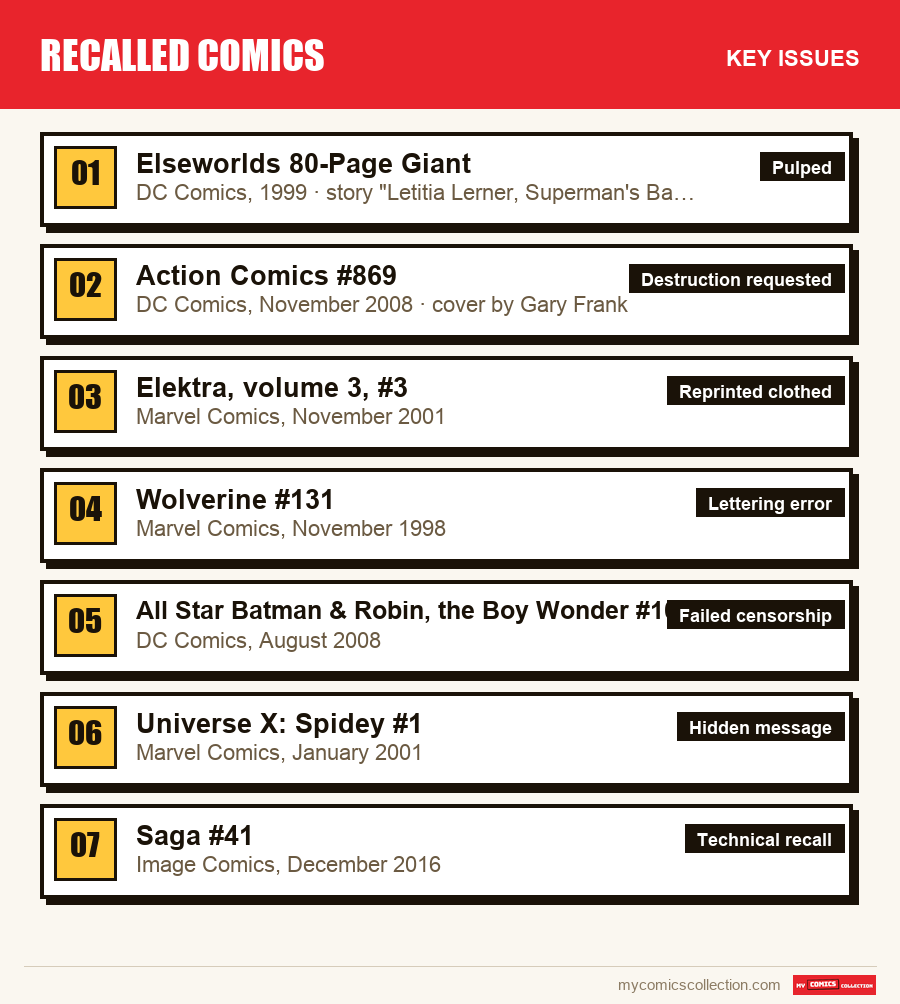
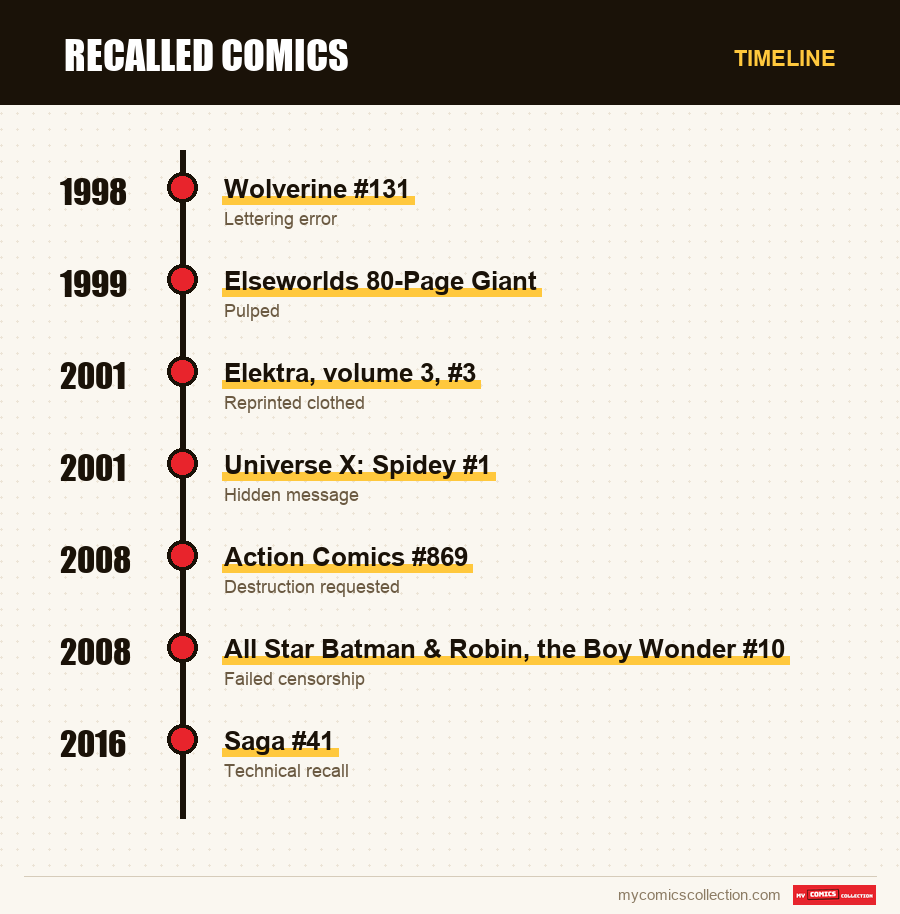
Truly documented publisher recalls number in the dozens, not the hundreds, and they do not resemble one another. Elseworlds 80-Page Giant (DC, 1999) was pulped for the North American market because of a story showing baby Superman climbing into a microwave oven, but about two thousand copies already shipped to the United Kingdom survived. Wolverine #131 (Marvel, November 1998) was pulled because a letterer misread a handwritten correction received by fax and set an ethnic slur in place of the intended word. Action Comics #869 (DC, November 2008) saw DC ask for the destruction of copies whose cover suggested that Superman and Jonathan Kent were sharing a beer. The rule to remember: what creates scarcity is not the announcement of the recall, it is the number of copies that escaped the destruction order, and whether you can prove that you hold this one.
There are few areas of collecting where the gap between rumor and record is this wide. One listing in two that promises a "recalled comic" actually describes a printing typo corrected in the next print run, an issue that retailers were allowed to return, or a cover retouched in a reprint without a single copy ever being pulled from sale. The three situations produce different objects, with levels of scarcity that cannot be compared.
This article does not reason about the principle of the recall but about the records themselves: the title, the issue, the month of publication, the exact reason, the instruction given to retailers, and what is known about the surviving volume. The stakes are practical. Faced with a copy presented as recalled, you need to know three things: did the recall take place, at what point in the distribution chain did it land, and what physical detail distinguishes the affected version from the one that replaced it. Without these three answers, there is no scarcity, only a story.
Five situations that the market all calls "recall"
Before opening the files, we need to separate what everyday vocabulary confuses. The five scenarios below describe distinct industrial realities, and only two of them produce a truly rare object.
Pulping before distribution. The publisher stops the press, or intercepts the pallets before they leave for retailers, and has the print run destroyed. The situation most favorable to scarcity, because the surviving volume depends only on leaks: copies already shipped abroad, advance shipments, file copies.
Withdrawal after shipment. The cartons are already at retailers, sometimes on the shelf, when the publisher asks for return or destruction. The instruction is followed unevenly, and it is this partial disobedience that determines the residual volume.
The issue made returnable. The publisher orders nothing, it only agrees to take back the copies that retailers do not want to sell. In a channel where sales are normally firm and non-returnable, this concession matters to professionals but it creates almost no scarcity.
Correction in the next printing, with no recall. The publisher lets the first printing live and changes only the following ones, the bound editions and the digital file. There was never a withdrawal, and the original version is rare only if that first printing was itself limited.
Cancellation before printing. The project is abandoned upstream, or a cover is pulled from the schedule before going to press. There is then no copy to collect. This category nonetheless feeds a good share of the legends, because the affair was widely discussed and the public assumes that "something" was indeed printed.
Pulping before distribution: the truly rare files
Three documented files illustrate this category, with totally different motives: content, the ambiguity of a cover image, and nudity.
Elseworlds 80-Page Giant
The collection contained a ten-page story written and drawn by Kyle Baker, co-written with Liz Glass, in which a still-infant Superman climbs into a microwave oven. DC's president, Paul Levitz, judged the scene unacceptable and had the copies intended for the North American market destroyed. The detail that makes all the scarcity: a lot of about two thousand copies had already left for the United Kingdom, out of reach of the destruction order. Estimates of the number of copies actually available today range between seven hundred and two thousand.
Action Comics #869
The cover showed Superman and Jonathan Kent in front of the Kent farm, bottles in hand, with labels vague enough to suggest it was beer. DC sent retailers a recall notice with an instruction to destroy copies with the original cover, then had the issue reprinted with labels bearing the legible words "soda pop".
Elektra, volume 3, #3
A few panels around pages 17 and 18 showed the character nude. Marvel recalled the issue and reprinted it after having underwear added to the pages concerned. The marker is therefore an interior page, and not the cover, which means you have to flip through the copy before believing it.
Withdrawals decided when the cartons have already left
In this family, the surviving volume depends not on the publisher but on the retailers' rate of obedience. That explains considerable gaps from one file to another, and sometimes within a single file.
Wolverine #131
The file has become a textbook case of production. Editor Mark Powers had crossed out a line from Brian K. Vaughan's script and handwritten the replacement word "killer". This handwritten correction, sent by fax to the lettering studio, was misread in the rush, and an ethnic slur went to print. The issue had already reached retailers through an early distribution channel when Marvel discovered the error, asked for the faulty copies to be returned and released a corrected version.
All Star Batman & Robin, the Boy Wonder #10
The dialogue's profanities were to be masked by black boxes. Two slightly different shades of ink were used for the text and for the box, which left the words still legible under the mask. DC pulled thousands of copies already shipped.
Universe X: Spidey #1
Inker Al Milgrom had hidden, on the spines of books on a bookshelf drawn in the background, a disparaging message aimed at the editor in chief of the time, Bob Harras. The message had been spotted and erased, then restored by accident during production. Marvel recalled the issue once the discovery was made at retailers, and the inker lost his job, with the obligation to cover the recall costs in order to keep working as a freelancer.
Saga #41
The most useful file for defusing the "recalled therefore valuable" reflex. The cover came off the presses far too dark, the gap between the supplied file and the printed result being judged unacceptable. The publisher announced the recall on December 22, 2016, a few days before the official release date of December 28, and a reprint appeared on January 4, 2017. Many shops had nonetheless already received the faulty copies.
Rights, trademarks and image rights: a family of its own
Withdrawals motivated by a legal problem follow a different logic from content withdrawals. The publisher acts not out of editorial caution but to extinguish a lawsuit risk, and sometimes does so very quickly, which can produce tiny surviving volumes.
The most telling file is The League of Extraordinary Gentlemen, volume 1, issue 5, published in June 2000 under an imprint owned by DC. The issue reproduced, as part of the period pastiche that gives the series its spice, a genuine early-twentieth-century advertisement for a feminine hygiene product whose brand was "Marvel". Fearing that the joke would be read as an attack on the house's main competitor, Paul Levitz ordered the print run destroyed, and the reprint replaced the word "MARVEL" with "AMAZE" in the ad. The marker is therefore a single word, on a single page, but it is perfectly clear. The number of copies that escaped is estimated at a few hundred, essentially a lot shipped to the United Kingdom before the destruction, which makes it one of the most authentically rare withdrawals of the modern period.
Conversely, the existence of a dispute does not necessarily lead to a withdrawal. Doctor Strange: Sorcerer Supreme #15 (Marvel, March 1990) carried a cover on which a character had been drawn from a photograph of singer Amy Grant, without authorization. She contested the use of her image and the association of her face with an occult context, and the matter was settled out of court. No recall, no taking back of copies: the issue stayed on sale and is not at all rare. It is a useful reminder that legal controversy, even real and even publicized, is not proof of withdrawal.
What looks like a recall and is not
This section is the most useful when buying, because this is where almost all the misleading listings lodge. None of the following cases is a recall, and yet all are regularly presented as such.
Correction limited to reprints and digital. Batman: Damned #1 (DC, September 19, 2018) made a lot of noise because a scene in the Batcave showed the character's nudity, with the editors attributing it to a color lightening decided in production. About one hundred fifteen thousand uncensored copies were printed and sold. DC censored the digital version and removed the nudity from later printings, but never recalled the issue. Same pattern for X-Men Gold #1 (Marvel, 2017), where artist Ardian Syaf had hidden references to Indonesian political demonstrations of 2016: Marvel announced the removal of these elements from reprints, digital versions and collected editions, ended the artist's contract on April 11, 2017, and did not recall the issue. Same pattern again for Immortal Hulk #43 (Marvel, 2020), whose background panel was judged antisemitic: the image was indeed printed in the issue and was removed only in the bound editions.
The issue simply made returnable. Spider-Man: Reign #1 (Marvel, December 2006) is the most often distorted example. The panel showing an elderly, undressed Peter Parker did not trigger a recall: the publisher made the issue returnable with a content warning, and the second printing added a shadow to mask the panel. The Adventures of Superman #596 (DC, November 2001), published the day after the September 11 attacks with a panel showing burning skyscrapers, was also made returnable, with a reprinted version offered to retailers. In both cases, the original copies stayed in circulation by the tens of thousands.
The printing error with no measure at all. The Sandman #18 and #19 (DC, August and September 1990) had, for one, a small number of copies whose first panels are printed in blue instead of the intended yellow, and for the other an inversion of two pages. No recall, no return. Ka-Zar the Savage #12 (Marvel, March 1982) had an entirely empty panel because of an engraving error, publicly acknowledged by the editor in chief a few months later, without any taking back. Death: The High Cost of Living #3 (DC, May 1993) was reprinted after a double-page spread ended up non-contiguous, the faulty copies simply being accepted back. These objects interest fans of production defects, who form a real niche, but they do not belong to the category of pulled issues.
Cancellation before printing. The alternate cover of Batgirl #41, drawn by Rafael Albuquerque and drawing on Joker imagery, was pulled from the schedule in March 2015 at the artist's own request, before any printing. The issue came out in June 2015 without it. Likewise, Mark Russell's series Second Coming was dropped by DC and its Vertigo imprint in 2019 before publication, then appeared at another publisher, the first collected edition coming out in March 2020. In both cases, there is no printed copy of the abandoned version. Any listing claiming to sell one describes either a fake or a working print with no commercial status.
What really creates scarcity in these files
Putting the surviving volumes side by side, a ranking appears, and it does not follow the order of the affairs' notoriety at all.
| File | Moment of withdrawal | Estimated surviving volume |
|---|---|---|
| League of Extraordinary Gentlemen #5 | Print run destroyed, export lot escaped | A few hundred |
| All Star Batman & Robin #10, main cover | After shipment | A few hundred |
| Elseworlds 80-Page Giant | Pulping of the North American market | Seven hundred to two thousand |
| Action Comics #869 | Destruction requested of retailers | About a thousand |
| Elektra vol. 3 #3 | Recall then corrected reprint | Two thousand to five thousand |
| Saga #41 | Recall announced before the release date | Abundant |
| Wolverine #131 | After early distribution | Abundant |
Three lessons emerge. Timing weighs more than the seriousness of the motive: a resounding content scandal arriving late in the chain leaves more copies than a legal trifle handled before shipment. Export leaks are the dominant survival mechanism on older files, because a lot already shipped materially escapes a decision made at headquarters. Finally, and this is the most counterintuitive, the official announcement of a recall can guarantee abundance: when it lands before the release date, retailers easily keep copies they have not yet put on the shelf.
Add to this a variable that listings almost always ignore: a withdrawal does not hit an issue but a precise combination of issue, cover and printing, as shown by the gap between the two covers of All Star Batman & Robin #10. A copy described by its title and number alone therefore remains incomplete information, whatever the seller's good faith. The method here matches the one used for ratio variants, where the exact designation of the printing conditions all the value.
Checking a listing that invokes a recall
The six checks below are carried out before any commitment, and in this order. Each eliminates an entire category of false claims.
Demand the decision, not the story
Ask what the publisher actually did, in one verifiable sentence: did it have copies destroyed, ask for their return, accept returns, or only modify later printings? If the answer does not distinguish these four gestures, the seller does not know their file. A recall leaves a trace: a notice to retailers, an announcement, a date.
Place the withdrawal on the calendar
Compare the recall date to the release date. Before shipment, it signals possible scarcity. After shelving, unlikely scarcity. And in the frequent case where it lands before release but after delivery to shops, it often signals abundance, the copies having stayed intact in the back rooms.
Name the physical marker
Have the physical detail stated that separates the withdrawn version from the one that replaced it: a word in an ad, a bottle label, a panel on an interior page, a cover shade, an order code. If nobody can say where to look, there is nothing to authenticate, and therefore nothing to pay for.
Ask for a photograph of the marker
A cover photo proves nothing when the marker is interior. Ask for the image of the exact page and panel, under lighting that does not hide ink differences: on failed-censorship files, the ink shade is what makes the proof.
Specify the cover and the printing
Verify that the copy matches the combination affected by the withdrawal, and not a spared alternate cover or a reprint. The print mention, when it exists, and the credits page often give the answer in seconds.
Look for the volume, not the emotion
Ask the only question that determines scarcity: how many copies escaped the withdrawal? Certified populations give a useful order of magnitude, to be read as a floor and not a total. A well-documented file always comes with a range; a legendary file comes with a superlative.
A seventh reflex, a negative one, deserves mention. Beware of phrasings that shift the burden of proof: "it is said that", "most copies were reportedly destroyed", "unfindable in the original version". These turns of phrase almost always signal the absence of a file. Real withdrawals are dated, motivated and told by people who took part in them. The same verification principle applies, moreover, to identifying rare comics in general: a scarcity that cannot be measured is not a scarcity.
What certification changes, and what it does not
On these files, the value of certification is not the grade but the notation on the label. When CGC explicitly writes that it is a recalled edition, and sometimes the reason itself, it attests that the copy belongs to the version concerned and freezes this attestation in a case that the next buyer can read without having to prove anything. On Saga #41, the label indicates both the recalled-edition status and the cover's coloring error: a debatable marker becomes a remotely verifiable fact.
The same logic applies in reverse. Some files receive a label that describes the content rather than the status, like Elektra volume 3 issue 3, whose notation refers to the nude version. The absence of the word "recalled" on a label therefore does not mean the recall did not take place, and its presence does not guarantee scarcity: Saga #41 is labeled as recalled and remains very common. The label answers the question of the copy's identity, not that of the volume. For this second question, you have to read the populations, an exercise detailed in our guide on reading the census.
One blind spot remains, and it concerns mostly the files where the marker is an interior page. A sealed copy can no longer be flipped through. If you buy a pulled issue in a case and the label does not mention the status, you find yourself unable to verify the marker yourself without breaking the seal. In this specific case, a raw copy whose page you can check is better than a sealed copy that is silent on the point that matters. It is one of the rare situations where certification can work against the careful buyer.
For anyone building a thematic set on this subject, good practice is therefore documentary before being financial: note, for each copy, the reason for the withdrawal, the month of the decision, the marker observed and how it was verified. A well-kept file outlives memories and travels with the copy. Issue-by-issue tracking tools are made for exactly this, and printing defects fall under the same note-taking discipline, even when no withdrawal is involved.