
The alternative covers of this character, printed in much fewer copies than the normal covers, start at $0.99. As of August 29, 2026, they display $7.99 gross median out of 186 announcements: the lowest level in this entire file, below that of ordinary issues of the same series. A purposely manufactured rarity produces no value. Only the scarcity suffered in product, and the difference between the two is the most useful fact to understand in this market.
The observation directly contradicts the stated reason for these editions, which deserves to be examined directly.
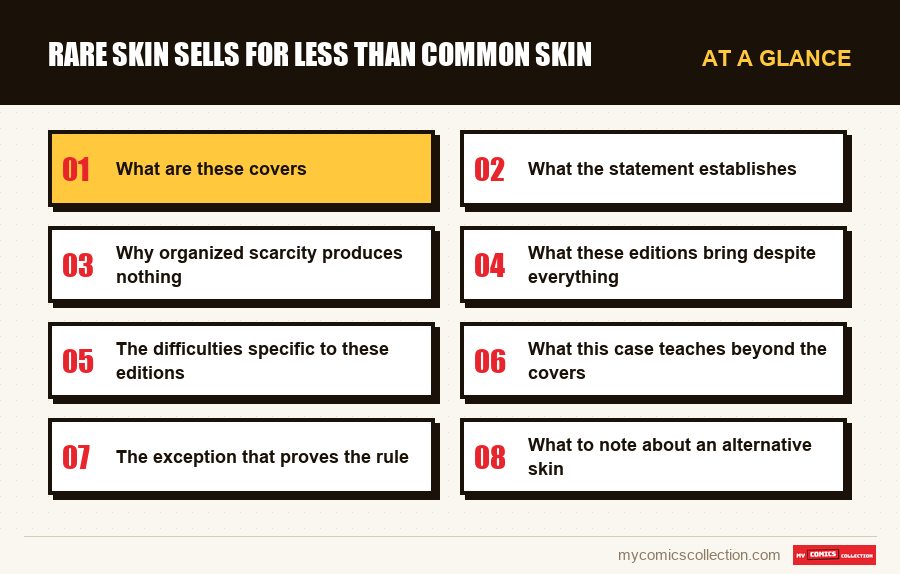
We will see what these covers are, what the survey establishes, why organized rarity fails where accidental rarity succeeds, what these editions bring despite everything, and how to record them without distorting an inventory.
What are these covers
The principle is simple and its commercial logic is clear.
The same issue appears under two or more covers. The interior content is strictly identical; only the cover illustration changes, generally entrusted to a designer different from that of the series.
One of the skins is printed in reduced quantity. Its availability is sometimes conditional on an order volume, which makes it an object whose existence is digitally regulated from the start.
The announced objective is to reward the commitment of points of sale, and the real objective of making part of the readership buy the same story twice.
On paper, the system meets all the conditions supposed to produce value: low circulation, documented existence, graphic desirability. The survey shows that none of these conditions is sufficient, and we need to understand why.
What the statement establishes
Alternative covers
186 ads in gross, of $0.99 to $200.00 requested, median $7.99. In certified, seven proposals, median $135.00.
The bottom of the range
Several copies marked as alternative and unread wonder between $0.99 and $1.79, the mention appearing in the title.
Comparison with the series
The same series on normal cover displays $14.99 of raw median. The rare packaging is therefore worth less than the current dressing.
The certified summit
Seven verified listings, median $135.00. Number too small to conclude anything other than the existence of a small isolated summit.
These amounts are those requested on August 29, 2026, gross and certified, counted separately, and do not correspond to any recorded sales. As always, such a statement describes the state of the offer at a moment in time and does not authorize any conclusion on any developments.
The central result can be summed up in one sentence: the copy printed in small numbers costs less than the copy printed in large numbers. This is the exact opposite of what the logic of scarcity leads us to expect, and the difference is not marginal: it goes from simple to double.
This result is all the clearer as the advertisements concerned explicitly indicate the alternative nature of the coverage. The information is therefore in front of the buyer, and it does not trigger anything.
Why organized scarcity produces nothing
Four mechanisms explain this failure, and they apply to any voluntary scarcity system.
Scarcity does not create demand, it reveals it. A reduced circulation only makes an item rise if people are looking for it. Without prior demand, restricting supply only produces a rare item that no one wants: which is exactly the observed situation.
The object is not an origin point. The entire grammar of this market is organized around the first publications. Alternative coverage tells nothing, inaugurates nothing, and therefore cannot occupy any of the places that the market pays for.
The reduced circulation remains more than sufficient. A few thousand copies on a supporting character exceed the number of people who will ever look for them. Relative scarcity only makes sense in relation to demand, never in absolute terms.
These copies are carefully preserved. Purchased as objects and not as reading material, they immediately enter into protection and are not destroyed. The survival rate therefore approaches one hundred percent, which prohibits any further depletion.
This last point is the most decisive and the least intuitive. An item bought to keep never becomes rare: it is the opposite of an ordinary booklet, read, lent and thrown away, of which each year reduces the surviving population.
We must distinguish two rarities which have the same name and have nothing in common. The scarcity suffered results from destruction: an object that was abundant when it appeared becomes rare because it was destroyed without thinking about it. Organized scarcity results from a decision: an object is rarely printed, then carefully preserved.
The first produces prices because it concerns objects that people already wanted. The second does not produce any, because it produces scarcity before demand, and no device can reverse this order.
What these editions bring despite everything
To conclude that they are of no use would be unfair, and false from a documentary point of view.
They show designers absent from the series. An alternative cover is often an author's only intervention on a character, and sometimes the best image of him that exists.
They constitute a coherent and accessible whole. Bringing together the alternative designs of a series represents a defined, achievable collection objective, the total cost of which remains insignificant at the levels observed.
They document an editorial era. The generalization of these editions tells a precise way of selling booklets, and keeping them has an interest that is not financial.
These three uses have one thing in common: none is based on an expectation of valuation. These are great collectibles as long as you don't buy them as investments, and the prices recorded make this approach perfectly feasible.
However, a nuance is necessary on the third point. Documenting an editorial practice does not require having all the examples: a few well-chosen issues tell the story of the period as well as a complete series, and at an even lower cost.
The difficulties specific to these editions
Above all, they complicate identification and maintaining an inventory.
Non-standardized suffixes
A letter added to the number designates the design, but the convention varies from one source to another.
Several alternatives per number
The same booklet sometimes exists in three or more versions, which are difficult to list afterwards.
Ads without exact visual
A generic image does not indicate which skin will be shipped.
Forgotten order conditions
The volume required to achieve a build-up is almost never documented after the fact.
Incomplete titles
The word indicating the alternative is sometimes absent, sometimes wrongly applied to ordinary coverage.
Covers included in the collection
The compilations reproduce these covers in galleries, which blurs the memory of their original support.
Collecting this series?
Track what you own, what you are missing and what your collection is worth. 7 day trial.
Start my trial →What this case teaches beyond the covers
Three lessons transposable to any form of announced rarity.
A rarity communicated in advance is worthless. If the item is presented as rare at the time of sale, all buyers know this, buy it accordingly and hold on to it. The mechanism self-destructs.
Survival rate matters more than drawdown. An object produced in fifty thousand copies of which two hundred remain is rarer than an object produced in a thousand copies of which there are a thousand remaining. The second number is always ignored, and it is the only one that counts.
Demand always precedes scarcity. No device can create desire for an object by limiting its availability. The opposite order-desiring, then finding that there is no more-is the only one that produces prices.
These three rules are enough to evaluate any edition presented as limited. They almost always lead to the same conclusion, and today's reading confirms it without nuance. on a population of 186 advertisements.
The exception that proves the rule
There are alternative dressings which reach considerable amounts, and the objection deserves a precise response rather than silence.
These cases exist, but they all share one characteristic: the rare skin is on a number that the market was already looking for. A first appearance, the opening of a highly requested series, an image that has become iconic.
In other words, the value does not come from the rarity of the skin but from the number on which it is placed. Dressing adds a supplement to a pre-existing request; he never creates it.
This is exactly what this statement allows us to verify by the absence. On a supporting character with no issue in organized demand, the rare cover has nothing to fall back on, and it falls below the price of the regular cover.
The rule is therefore formulated more precisely than at the start: an organized scarcity only has a multiplicative effect. Applied to zero demand, it gives zero, regardless of the weakness of the circulation.
What to note about an alternative skin
These copies require fields that ordinary covers do not require.
The precise identifier of the skin. The letter or mention that distinguishes it, copied as it appears on the ad or in the catalog: this is the only way to find out what it is.
The name of the cover designer. It differs from that of the series and is often the very reason for the purchase. Omitted, it makes the line indistinct from other skins of the same number.
The number of skins known for this issue. Noting that there are three avoids, years later, believing that we have the whole set when two are missing.
The destination of the item. These fascicles are purchased to be viewed, which justifies immediate protection: a decision to be recorded, since it explains why the copy was never opened.
The price paid, without associated expectation. Recording it at the observed levels documents an item purchase. Attaching an expected value to it would amount to entering into the inventory a hypothesis that nothing supports.
No, and this statement clearly shows it: $7.99 gross median for the rare cover versus $14.99 for the series in ordinary cover, as of August 29, 2026. Rarity does not create demand, it reveals it. Without prior buyers, restricting supply only produces a rare item that no one is looking for.
Because they are purchased as objects and not as reading material. Protected from the moment of acquisition, they are not destroyed, and their survival rate approaches one hundred percent. An ordinary booklet is read, lent and thrown away: it is this destruction, and this alone, which creates the rarity of ancient periods.
Yes, provided you don't expect anything financially. All of the skins for a series constitute a defined and achievable objective for a total cost that is paltry at the levels raised, and show designers who do not intervene anywhere else on the character. It's a collection of images, not a placement.
By consulting the catalog before purchasing, never by relying on advertisements. The same issue sometimes appears under three or more covers, and the titles use the word "alternative" inconsistently: sometimes absent when it should be, sometimes applied to an ordinary cover.
Let them describe a small isolated summit and nothing more. Out of seven proposals, a median is an indication and not a measurement: two announcements added or removed would significantly move it. This figure does not contradict the general observation, which is based on 186 raw announcements.
Three skins for one issue, which one do you have?
Without a design identifier or designer's name, an inventory line does not distinguish the copies from each other.