A pull list is the serious collector's go-to tool: the list of comic series they subscribe to on a recurring basis at their local comic shop. My Comics Collection brings this concept into the digital age: uncapped series tracking, included in the subscription (7-day free trial), no retailer sign-up required, with a calendar view that aggregates Marvel, DC, and indie releases all in one place.
The term "pull list" traces back to American comic shops in the 1970s, when distributors began requiring firm orders two to three months in advance. To avoid running short on a hot title, or being stuck with a mountain of unsold stock, comic shops introduced the subscription list: regular customers would reserve in advance the series they bought every month. The shop would "pull" those issues aside as soon as they arrived and set them in a box with the customer's name on it, ready for pickup each week.
Pull list: where the concept comes from and why it works
This win-win model (order visibility for the shop, guaranteed copies for the customer) became standard across the US and Canada throughout the 1980s and remains the norm in most LCS (Local Comic Shops) today. In France, where the comic shop network is far smaller (fewer than 200 specialty stores versus 2,000+ in the US), traditional pull lists exist but are still a niche practice. That's exactly the gap the digital pull list is built to fill.
How to set up your first pull list in My Comics Collection
Getting started takes seconds. Log in to your account (signing up opens the 7-day free trial), then click 📅 Upcoming Releases in the navigation menu. The page shows the ~400 next announced releases over the next 90 days, sorted by date. Use the filters at the top to cut through the noise: by month, by publisher (Marvel, DC, Image…), or by a more specific publisher key.
When you find a series you're interested in, click the "Follow" button to the right of the listing. The button changes to "✓ Following" and the series is added to your personal pull list. You can remove it any time by clicking again. There's no cap on the number of series you follow.
Five classic beginner mistakes on the pull list
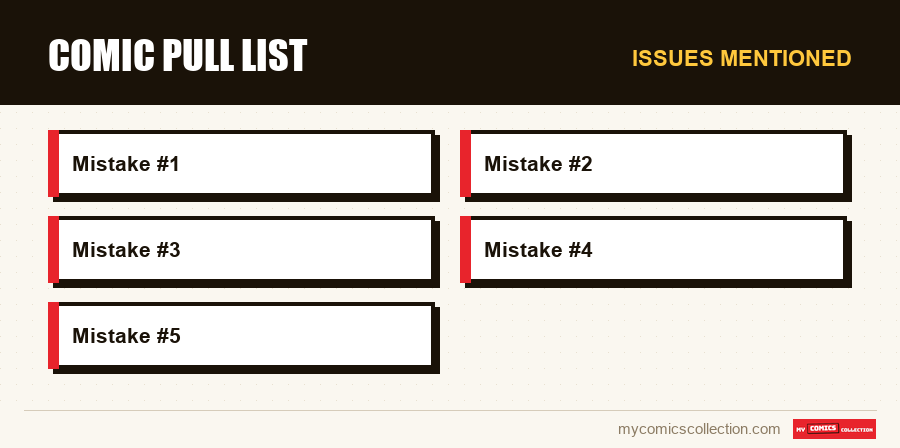
Mistake #1: following too many series right out of the gate. New collectors tend to add 10 or 15 series in the excitement of starting: Spider-Man, Batman, X-Men, Avengers, plus a couple of indie titles… Six months later, they're buried under an unread stack that kills their motivation. The smart move: start with 2 or 3 series max, read every issue you buy, and only expand once you've proven to yourself that you can keep up the pace.
Mistake #2: accidentally following bonus issues. Some Marvel or DC series crank out annuals , specials , and one-shots that don't belong to the main numbering. Check the series page in Upcoming Releases: if it shows 4 releases per month instead of 1, you're probably also picking up the special variants: decide whether you actually want all of them.
Mistake #3: confusing following a series with automatic purchasing. Adding a series to your pull list doesn't trigger any purchase. It's purely a tracking tool. Buying remains manual: on eBay, Comixology, your LCS, or directly on the publisher's site.
Mistake #4: ignoring the auto-wishlist feature. If you want a series to generate a buying alert with every new release, activate the ✨ icon next to the Follow button. See our dedicated guide Auto-wishlist: turn every new release into a buying alert.
Mistake #5: not planning for story arc gaps. A series can take a 3-month break between arcs, or worse, get cancelled with almost no notice (Marvel axed New Warriors and Strikeforce with just a few weeks' warning). Check publisher news regularly or browse our Collector's Guide section so you're never caught off guard.
Digital pull list vs. traditional comic shop pull list
For collectors lucky enough to have a solid LCS nearby, the physical pull list is still a great complement: the shop guarantees your copy is in stock on release day, something neither eBay nor online pre-orders can reliably deliver for high-demand titles. That said, the physical pull list has real limits: it's tied to a single shop (no price comparison), it requires regular in-store visits, and it's restricted to whatever series that shop chooses to carry.
The My Comics Collection digital pull list offers comprehensive editorial coverage (all publishers, every solicited series), full location freedom (buy wherever you want), and historical tracking: you can see at a glance which ASM issues you've been following since January 2026, and cross-reference against your cataloged collection to spot the gaps.
The ideal hybrid setup: a physical pull list at your LCS for guaranteed stock on 2-3 anchor series + a My Comics Collection digital pull list for broad market awareness and discovering new titles.
What if I want to follow more than 3 series?
Nothing stops you: there's no cap on the number of followed series, and tracking is part of the subscription. It starts with a 7-day free trial, no charge during the trial, then continues monthly or yearly at your country's price. Try it first, decide later.
Beyond uncapped following, the subscription includes the full My Calendar view with all filter options, the auto-wishlist that pre-fills your want list with every new release, and every other feature of the app (multi-collection, certified insurance report, and more). For the full list, see our pricing page.
Frequently asked questions
It is the list of comic series a collector buys on regular subscription from their comic shop. The shop sets aside ("pulls") these issues as soon as they arrive, in a box under the customer's name, who comes by each week. The term appeared in American comic shops in the 1970s.
Because distributors began requiring firm orders two to three months before release. To avoid running short on a popular title, or being stuck with unsellable stock, shops had regular customers reserve in advance the series they bought. This model became widespread in the United States and Canada from the 1980s.
Two or three at most. The classic mistake is following 10 or 15 series in a burst of enthusiasm, then drowning six months later under an unread pile. Read every issue you buy and only expand when you keep up the pace.
No: following a series in the pull list is purely a tracking tool and triggers no purchase. Buying stays manual, in store or online. If you want a purchase alert for every release, you need to turn on the auto-wishlist.
The physical pull list guarantees your copy is in stock on release day, but it is centered on a single shop and limited to the series it distributes. The digital pull list covers all publishers, with no location constraint, and cross-references with your already-cataloged collection. The ideal setup is hybrid: the shop for two or three core series, digital for broad monitoring.