Loki's first appearance, in 1962, was in an anthology magazine which later changed its name to that of his main adversary. The original booklet therefore bears a name that the series no longer has, and that almost no one spontaneously associates with the character. Result: the number exists, it is perfectly identifiable by its position in the numbering, but it becomes invisible as soon as we look for it by the name by which the series is known today. As of August 29, 2026, posted requests were split between 27 proposals without external verification, from $21.88 to $9,350.00 (mid-range $999.99), and 30 verified proposals, from $660.00 to $18,000.00 (mid-range $2,830.52). These numbers are too short to be worth measuring.
A series title is not an identifier. It is a commercial decision, revisable, and sometimes revised along the way without the numbering moving a notch. The case of Loki is the clearest illustration of this discrepancy: the character arrived in 1962 in an open-format publication, a collection which welcomed varied stories without a fixed hero, and this publication was then renamed after the name of the hero who had imposed himself on it: the very one to whom Loki serves as an adversary. The cover name changed, the sequence of issues continued. Everything that precedes the change therefore finds itself placed under an abandoned label.
For a reader, the matter is anecdotal: the story can be read independently of what is printed at the top of the cover. For a collector, it is not at all. Search, classify, compare, estimate: all these operations pass through a series name, and a series name that has changed cuts the history into two halves which no longer correspond to each other. It is the mechanics of this division that this article describes, as well as the only method that resists it: finding your way by the continuous numbering rather than by the name.
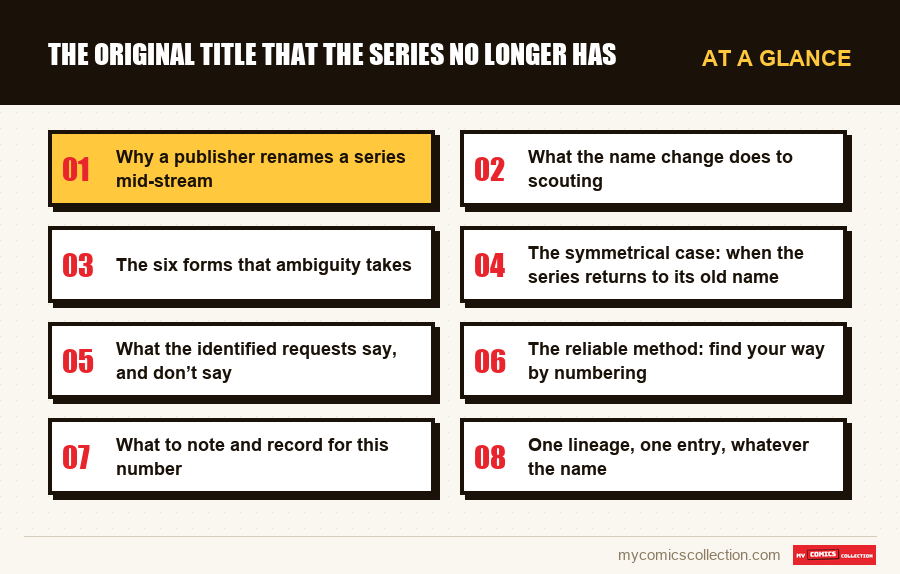
Why a publisher renames a series mid-stream
An anthology magazine functions as a container: it offers several short stories, without commitment to continuity, and serves as a laboratory. Some characters pass through once, others come back, and from time to time one of them takes up all the space. When this shift occurs, the generic title becomes a commercial liability. It no longer says what the reader will find inside, it does not capitalize on the notoriety of the star character, and it requires the buyer at the newsstand to already know the content to know what they are buying. The publisher decides: he puts the hero's name on the cover.
There remains a less visible question: why not start from number 1, which would be much more readable? Because continuous numbering had, in the periodic distribution of the time, an administrative value. A title registered for a long time, with an uninterrupted series of publications, benefited from delivery conditions and postal statuses reserved for established publications. Starting from scratch meant starting over like a new title, with the delays and costs that this entails. The most economical solution was therefore to change the name without changing the meter. This is exactly what was done, and this is why the series concerned present this curious silhouette: a new name placed on an already advanced numbering.
This choice is rational from the publisher's point of view and destructive from the archiving point of view. It creates an object whose identity has two layers: a stable layer, the position in the series of publications, and an unstable layer, the printed name. Catalogues, sellers, search engines and collectors almost always work on the unstable layer, because it is the one that is easily spoken and written.
What the name change does to scouting
One series, two names
The same series of fascicles appears under one name before the switch and under another after. Nothing indicates, on the object itself, that the two belong to the same lineage: only the continuity of the numbers proves it, and it only appears to those who look for it.
A search by title only sees half
Typing the current series name brings back everything that appeared after the change, and none of what came before. The old name does the opposite. Neither query shows the whole thing, and there is no warning that something is missing.
The original booklet seems orphaned
The 1962 issue is linked to a title that the series no longer bears. Presented alone, it looks like an isolated collection unrelated to the character, even though it is the starting point.
Sales descriptions differ
Each seller chooses his label: some use the old name, others the current name, still others combine the two. The same piece is thus described in three ways, and the advertisements never overlap in the same list.
The most costly consequence is not missing an ad. It's to believe that we've done the trick. A search that returns around ten consistent results gives the feeling of having seen the market, even though it has only explored a segment defined by a string of characters. The collector who stops there builds his representation of the price on a sample of which he is unaware of the truncation, and he has no way of noticing his error, because an incomplete list has exactly the same appearance as a complete list.
Amounts noted on August 29, 2026 are requests posted by sellers, not closed transactions. They indicate what is requested, never what has been accepted. The account is kept separately for the copies accompanied by an external verification and for those which do not have one, because these two sets do not obey the same display logic.
Twenty-seven proposals without verification, thirty with: these are modest numbers. A mid-range calculated on around thirty elements gives an order of magnitude, never a measurement. And since all these values come from a single reading, on a single date, they show no movement: there is nothing here to say whether anything is going up or down.
The six forms that ambiguity takes
The truncated query
The collector searches by the name he knows. This name only covers part of the series, and the excluded part is precisely that which contains the origin of the character. The research succeeds technically and fails in practice.
The incorrectly attributed period
A number attached to the current name is spontaneously located after the name change. If the label was applied retroactively by a seller, the mental dating follows the label and is several years wrong.
The retroactive label
Many advertisements refer to old issues by the name that the series later took on, because it is this name that speaks to buyers. This is convenient and false: the booklet never carried it.
The heterogeneous lot
A lot advertised under a single name may contain numbers from both periods. The buyer who thinks by title believes he is buying a homogeneous whole and receives two fragments of the same lineage which he will not be able to classify.
The invisible duplicate
In a personal inventory, the same issue entered once under the old name and once under the new appears as two distinct lines. The duplicate is not seen, since the two entries seem to relate to different series.
Broken reading order
A reading path constructed from the current name mechanically begins after the switch and skips everything that came before, including the character's entrance. The reader discovers an adversary already installed without having seen his arrival.
The symmetrical case: when the series returns to its old name
There is a variation which further complicates the picture. Certain series, decades after having been renamed, return to their original name: for a relaunch, a particular arc, or an editorial operation which plays precisely on the memory of the old title. The movement is then reversed: the historical name reappears on the cover, often accompanied by numbering which also follows the original thread rather than that of the intermediate period.
A third zone is created. The series no longer has two installments but three: the initial period under the original name, the long period under the name of the star character, then the late period under the original name found. Two of these three installments share the same name even though they are separated by decades and entirely different creative teams. The confusion ceases to be a simple omission: it becomes an active telescoping, where two very distant objects are placed under the same label.
This is the most expensive trap of the system, because it produces results. A search by the old name no longer comes up empty: it returns a mix of old issues and recent issues, and the busy buyer comparing prices is actually comparing two unrelated markets. Basic vigilance consists of never validating a piece solely on the agreement of the name, but of demanding that the position in the numbering be consistent with the announced period.
The same logic applies to relaunches which start from a number 1 while keeping the name in force. Here again, a low number can belong to any of the successive editions, and only the cross-reference with the year of publication allows us to decide. The principle remains the same: the name alone is never enough, the name plus the number is rarely enough, the name plus the number plus the date is almost always enough.
Collecting this series?
Track what you own, what you are missing and what your collection is worth. 7 day trial.
Start my trial →What the identified requests say, and don’t say
The reading of August 29, 2026 presents a configuration which deserves to be noted without being overinterpreted. The segment without external verification has 27 proposals, with requests ranging from $21.88 to $9,350.00 and a mid-range at $999.99. The verified segment has 30, between $660.00 and $18,000.00, with a mid-range at $2,830.52. The notable fact is that the verified segment here is the more extensive of the two: the examples accompanied by an external control are more numerous in the window than those which do not have one, which is not the usual arrangement on common pieces.
The difference in amplitude between the two sets is also telling, but not in the way we think. The segment without verification goes very low and the verified segment starts significantly higher: this above all reflects the nature of what is proposed on both sides. A display for a few tens of dollars does not relate to the same object or the same condition as a four-digit display, and the mere fact that a piece has passed through an external inspection already filters what is worth presenting in this way.
We must then repeat the limit, because it controls everything else. Twenty-seven and thirty are low numbers. On such volume, the entry or exit of two or three announcements shifts the midrange considerably. These values are used to know what order of magnitude we are in (the hundred, the thousand, the tens of thousands) and for nothing finer. Treating them as a rating would be tantamount to giving a handful of individual seller decisions the status of a market consensus.
Finally, these figures are silent on any developments. A single survey has no slope. He photographs what was asked on a given day, without saying anything about what was asked six months earlier or what will be asked next. Any phrase like “the price is rising” or “the coin is becoming scarce” would be added by the interpreter, not read into the data. The only legitimate reading is descriptive: this is the range of demands posted that day, this is how it is distributed between the two segments, and this is why we should not ask more of it.
The reliable method: find your way by numbering
Since the name is unstable and the numbering continues, the identification must rely on the second. Concretely, this means abandoning the habit of designating a piece by "such series, such number" and adopting a designation in three terms: the position in the sequel, the year of publication, and the name carried on that date: the latter coming last, as contextual information and not as the key.
This reversal has an immediate effect on searches. Instead of questioning a title, we question a lineage: we identify the entire series of publications, we identify where the change in name is located, and we note the two appellations as two ways of writing the same thing. Any subsequent search is then done in duplicate, systematically, and we know that the result is only complete once the two passes have been carried out.
It also has an effect on the verification of an ad. When faced with a proposal, three elements must agree: the number announced, the year of publication, and the name present on the cover visible in the photo. If the name displayed in the title of the ad does not correspond to that on the cover, this is not necessarily a deception, it is most often a convenience of the seller, but it is a signal that the piece must be identified other than by the description.
For a personal inventory, the most economical rule consists of entering a single line per issue, anchored on the numbering, and treating the name as a simple attribute. A collection organized in this way can withstand without damage that a series changes its name, returns to the old one, or starts from a number 1: the lineage remains unique, and the periods are arranged like successive installments instead of being dispersed into competing entries.
What to note and record for this number
The name given on the date of publication. Record the name actually printed on the 1962 issue, distinct from that which the series subsequently took. It is this mention which will allow, years later, to find the piece in an old catalog or in an advertisement written by a scrupulous seller.
The position in the numbering continues. Write it down as the key to entry, before everything else. This is the only element that the label change has never affected, and therefore the only point of support that remains valid whatever the name used by your interlocutor.
The two names, entered together. Record the original name and the current name of the series side by side, tying them to the same lineage. This double entry avoids invisible duplication, where the same issue occupies two inventory lines because it has been recorded twice under two labels.
The presence or absence of an external audit. The requests noted on August 29, 2026 are divided into two clearly distinct groups according to this criterion: 27 proposals without control, 30 with. An exemplar only compares to those in its own segment, and placing the piece in the wrong set distorts any subsequent reading.
The date of the price statement you keep. Systematically date the amount you note, here August 29, 2026. A figure without a date becomes, after a few months, an impossible statement to place, and since these are requests displayed and not sales concluded, the date is what prevents it from being read as an acquired value.
It actually appears there, but under the old name of this same series. In 1962, the publication was still an anthology with a generic title; it was only renamed after its star hero later, without interrupting the numbering. The booklet therefore belongs to the lineage, it simply bears a label that the series has since abandoned.
Because the continuity of numbering had a practical value in periodical distribution: a title registered for a long time, with an uninterrupted series of publications, retained advantageous delivery conditions that a new publication would have had to regain. Changing the name while keeping the counter was much cheaper than starting from scratch.
By crossing the position in the numbering with the year of publication, then checking the name actually visible on the photographed cover. The title written in an ad often reflects the seller's choice rather than the item; the cover does not lie about the name it bears.
We must stop considering the name as discriminatory, because two very distant sectors now share it. The only security consists of requiring consistency between the number announced and the time: the same title can refer to issues separated by decades, with markets that have nothing to do with each other.
No. These are sums claimed by sellers on a single date, no completed transactions, and the numbers are low: 27 proposals without external verification, 30 with. On such volumes, a few announcements strongly move the mid-range. These values give an order of magnitude and, in the absence of a second reading, show no change.
One lineage, one entry, whatever the name
When a series changes name along the way, an inventory organized by title fragments without warning. By attaching each issue to its position in the continuous numbering, you keep a readable collection even when the cover changes name, and you immediately spot duplicates that two different labels would have hidden.