The first printing premium is not a market rule: it is a consequence of rarity, and it disappears when there are numerous reprints. On a reading carried out on August 30, 2026 on a general American auction site, the fourth drawing of 2009 of the number which opens Old Man Logan was claimed for $8.95 while a 2008 draw of the same number was claimed for $11.00: approximately two dollars difference. Better: the following issue, No. 67 from 2008 announced in high condition, was asked for $14.95, therefore more than the issue which contains the event. Please note, these amounts are those that sellers requested that day, not completed transactions, and the states declared differ from one ad to another.
There are few phrases as repeated in the collecting world as “always take the first print.” It circulates as evidence, applies without distinction of series, period or publisher, and ends up taking the place of a method: we locate the number which contains the event, we verify that it is indeed the original impression, we pay the difference, and the deal is deemed concluded. The reasoning is not absurd. It is simply based on an assumption that no one bothers to state, and that assumption is not always true.
The survey takes place on August 30, 2026 around the first number of Old Man Logan: No. 66 of the series Wolverine, published in 2008: provides a clear counterexample. This is not a theory but a snapshot: 137 advertisements in progress on a general auction site in the American market for unverified copies, and 31 advertisements counted separately for copies passed by a verification body. These two populations do not compare themselves, and neither says what actually sold. What they say, on the other hand, is already instructive: among the cheapest, the order of prices does not at all follow the order that the rule of the first draw suggests.
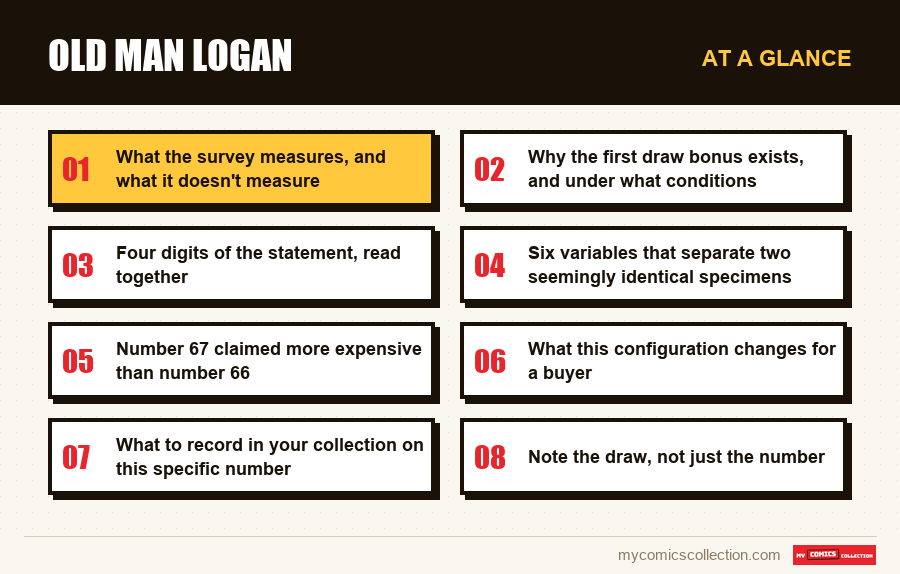
What the survey measures, and what it doesn't measure
A precaution before any reading of the figures, because it completely changes their scope. The amounts quoted here come from active advertisements at the time of the statement: these are sums displayed by sellers who hope to obtain them, not sums that a buyer has actually paid. Between the two there is a gap that nothing, in a snapshot, can bridge. An ad can remain online for months without finding a buyer; another can leave in a few hours, much lower than what its neighbors show. An ad catalog describes an offer, never a demand.
Second precaution: the reading was taken on a single date. A single point on a line does not draw any slope. It would therefore be wrong to write that these prices are rising, falling or stabilizing: none of these three statements is verifiable with the data available. All we can say is what the display looked like on August 30, 2026. The comparisons that follow are internal comparisons on that day, between ads that coexisted at the same time, which is exactly the type of comparison that a snapshot allows.
Third precaution, on the maximum. Among the unverified, the highest listing was at $849.00; among verified ones, at $1,200.00. These two numbers have no reference value. An isolated maximum measures the optimism of a single seller, nothing else, and it only takes one fancy ad to put it at the top of the chart. The median is a much more honest indicator: $38.99 for the 137 unverified listings, $138.00 for the 31 verified listings. It is also necessary to take into account the fact that 31 announcements constitute a modest number: the median of verified is based on a handful of objects, and just one of them removed or added can significantly move it. It is read as a rough indication, not as a rating.
Why the first draw bonus exists, and under what conditions
The mechanism that makes an original print pay more than a reprint is simple, and it has nothing to do with any intrinsic superiority of the paper. A first print is one that existed before we knew the episode would count. It was printed for a common readership, distributed at the ordinary rate, read, folded, transported, partly thrown away. The surviving copies form a closed stock which can only decrease. It is this closure of stock that creates the premium: demand can grow, supply cannot.
A reprint follows the opposite logic. It is decided after the fact, precisely because demand has arisen, and its volume is calibrated on this demand. It therefore arrives on an already attentive market, among already informed buyers, often preserved with more care since we know from the first day that it is a sought-after object. In other words, the reprint partially neutralizes the scarcity that it fills.
The logical consequence is the one that we forget to draw: the first draw bonus only exists on the condition that subsequent draws are rare, late, or both. If the publisher reprints quickly and abundantly, the available stock ceases to be closed and the gap closes mechanically. No circulation figures are available here and there is no question of inventing one; but the presence, in the cheapest ads, of a fourth printing dated 2009 for an issue published in 2008 says at least this: the reprints were sufficiently numerous and close together for a fourth passage to press to have taken place in the year that followed. In this type of configuration, the first draw rule loses most of its explanatory power.
Four digits of the statement, read together
137 annonces non vérifiées
Minimum $8.95, median $38.99, maximum $849.00. The amplitude is considerable and the maximum is not a benchmark. However, the number is sufficient for the median to be readable: the middle of the market displayed is around forty dollars, with a low end under ten dollars.
31 verified ads
Minimum $55.00, median $138.00, maximum $1,200.00. The median is much higher than that of the unverified, but the number of 31 announcements remains modest: this value must be read with explicit reservation, and above all never transposed as is to an uncertified copy.
Two dollars between 2009 and 2008
A fourth drawing from 2009 commanded $8.95, a 2008 drawing of the same number demanded $11.00. On the low end of the posted market, the difference between the original printing and a late reprint that day was within a two-dollar coin.
No. 67 above No. 66
The following issue, dated 2008 and advertised in high condition, fetched $14.95, more than No. 66 fetched $11.00. The booklet which contains the event was therefore not, on that day, the most expensive in the sequence among the least expensive advertisements.
Taken in isolation, each of these figures is easily recounted. Taken together, they depict a market that is much less hierarchical than the surrounding discourse supposes. The main dividing line does not run between the original printing and its reprints: it runs between the agency-verified copies and the others, with a minimum of $55.00 on one side and $8.95 on the other. The factor that really moves the claimed amounts, in this snapshot, is the status certificate, not the draw number.
Nothing in this statement allows us to say that a price is changing. A measurement taken on August 30, 2026, and only on that day, does not contain any trend information: to speak of movement we would need at least two measurements separated in time, conducted in the same way, on the same queries. Any phrase like “this number is going up” would be a pure invention here.
Likewise, the five least expensive listings do not describe five equivalent items. One specifies “Fine 6.0 or better”, another announces a high condition, the others say nothing about their condition. Comparing their prices amounts to comparing objects whose nature we are partially unaware of. The difference of two dollars observed between the fourth drawing and the 2008 drawing is real as a display difference; it does not in itself prove that the two copies would be at the same level once their state has been established.
Six variables that separate two seemingly identical specimens
The rank of the draw
The same issue may exist in the original printing and in several successive reprints. The statement shows at least a fourth, dated 2009. Nothing on the cover of an ad photographed from afar makes this distinction obvious to a buyer in a hurry.
The year covered by the announcement
2008 for the original issue, 2009 for the fourth edition noted. The date displayed in the title of an ad is often the only clue allowing a decision to be made, and it is also the information most easily copied incorrectly by a seller who is describing his lot from memory.
The distribution channel
One of the announcements mentions a “Newsstand” variant, that is to say a second broadcast circuit for the same number. Two copies with strictly identical content can thus be two distinct objects for a collector who keeps a precise inventory.
Verification by an organization
The copies passed by a verification body were counted separately: 31 advertisements, minimum $55.00. They are a separate population, with their own price points, that it would be misleading to mix with the 137 unverified listings.
The declared state
“Fine 6.0 or better” for one, “high condition” for No. 67, no mention for others. These labels are not uniform and do not all come from the same source. A price compared without its state is a number suspended in a vacuum.
Place in the story
No. 66 opens the story, no. 67 continues it. The market displayed does not follow the order of reading: the second was demanded $14.95 compared to $11.00 for the first. The narrative position of a booklet does not determine its price rank.
Collecting this series?
Track what you own, what you are missing and what your collection is worth. 7 day trial.
Start my trial →Number 67 claimed more expensive than number 66
This is the most counterintuitive observation in the survey, and the one that deserves the most caution. In the list of least expensive ads, No. 67 from 2008 appears at $14.95, above No. 66 from 2008 marked at $11.00. A reader accustomed to the logic of the “first number” would have bet the opposite without hesitation, since it is number 66 which brings the entry onto the scene.
Part of the explanation lies in the state: the announcement of No. 67 explicitly claims a high status, that of No. 66 says nothing. We are therefore not comparing the same thing, and we must recognize this frankly rather than building a theory on a difference of four dollars between two asymmetrical descriptions. What observation firmly establishes is something else: on this market, on this date, it was possible to buy the founding booklet cheaper than its immediate sequel. The hierarchy that we think we know was not that of display.
This also recalls a basic reality of the periodical format: a story never fits into a single issue. It is deployed over several consecutive issues, and each of them can circulate with its own dynamic of offer: sellers who liquidate a lot, others who keep the "important" number and sell the following separately, collections dismembered in an irregular manner. The reading order is not transmitted to the price order. To situate each issue in the whole and avoid reasoning on a single isolated issue, an overview of the main runs related to Old Man Logan is more useful than a single number hunt.
What this configuration changes for a buyer
The practical lesson is not “the first draw is worthless.” It is finer and more demanding: before paying a premium on the first draw, you must check that the condition which justifies this premium is met. On an issue that is quickly and widely reprinted, it is not, and the difference observed is reduced to a few dollars, that is to say less than the difference in shipping costs between two sellers.
The corollary is equally useful. If the difference between prints is small, the money spent in excess on this dimension is money that was not used to secure the dimensions that really matter: the condition observed, the quality of the photographs provided, the honest description of the defects, and where applicable the certification by a verification organization. The statement shows a clear line between the verified copies, which start at $55.00, and the others, which start at $8.95. This is where most of the amounts claimed come into play, not in the mention of a draw rank.
Finally, the variant linked to the distribution channel adds an additional layer. Two copies of the same issue, of the same year, can belong to two different circuits and therefore constitute, for those who maintain a serious collection, two distinct entries. A buyer who ignores this distinction will believe he is buying a duplicate when he is completing it, or vice versa. To frame these questions before purchasing, reading a panorama of the universe of Old Man Logan at least allows us to know what objects we are talking about.
What to record in your collection on this specific number
The rank of the draw, not just the number. Noter «Wolverine 66” is not enough when a fourth print sells for less than nine dollars. Without the mention of the printing rank, the inventory line does not allow you to find what you own, nor to verify information later, nor to decide whether a cross-advertisement completes the collection or doubles it.
The year worn by the copy. 2008 and 2009 here designate two different objects for the same number. As the year is often the only information that separates them in the title of an advertisement, it must appear as is in the file, copied from the object and not from a memory of the date of first publication.
The broadcast channel when identified. If the copy falls under the “Newsstand” variant identified in the statement, this mention must be entered in the form in the same way as the number. It is a material characteristic of the object, invisible in a list of numbers and impossible to reconstruct later without having it in front of you.
The state, with its source. A copy described as “Fine 6.0 or better” by a seller and a copy certified by a verification organization do not carry the same information, even if the wording looks similar. The sheet must distinguish a seller's assessment from an external certification, otherwise any future comparison with a displayed price will be biased.
Neighboring numbers already owned. Since No. 67 was claimed more expensively than No. 66 on August 30, 2026, the question “do I already have the sequel?” » has direct economic value. An inventory that does not show at a glance which consecutive issues are present leads to buying back the best-known issue and leaving a gap on the one that costs more.
No. The first draw bonus assumes that subsequent draws are rare or late. On the August 30, 2026 statement, a fourth drawing from 2009 was claimed for $8.95 and a drawing from 2008 of the same number for $11.00, approximately two dollars difference. When an issue is reprinted quickly, the gap closes.
Not from this statement. The listing for #67 at $14.95 claims a high condition, while the listing for #66 at $11.00 lists no condition. Two listings from different states cannot be directly compared. We can only see that that day, on the cheapest advertisements, the following number was claimed more expensive than the one which contains the event.
It is based on only 31 advertisements, which is a modest number. It gives an order of magnitude of the amounts claimed for certified copies, with a minimum of $55.00 and an isolated maximum of $1,200.00 which does not constitute a reference. It should never be applied to an unverified copy.
Neither. The reading was carried out on a single date, August 30, 2026. A single measurement does not contain any trend information: at least two comparable readings, separated in time, would be required to speak of movement. These are also amounts claimed by sellers, not sales concluded.
She reports that the same number circulated through a second distribution channel. Two copies with identical content can therefore constitute two distinct objects for an inventory. It is one more variable, in the same way as the edition rank and the year, which must be noted at the time of purchase because it is very difficult to reconstruct afterwards.
Note the draw, not just the number
An inventory that distinguishes year, print rank, distribution channel and status source tells you in a second whether the ad you are viewing completes your collection or doubles it. My Comics Collection records this information issue by issue, including for neighboring issues that we believe we have.