In 1992, a film starring Catwoman gave rise to an official adaptation booklet: a comic book which tells the film, and not a film based on a comic book. This inverted meaning was the norm at a time when you couldn't watch a feature film at home whenever you wanted. On the announcements noted on August 29, 2026, the bulk of the volume is very accessible - 71 unauthenticated offers between $4.98 and $200.00, with a mid-range at $14.24 - while the 7 authenticated offers range from $55.20 to $5,150.00 for a mid-range at $299.99: a workforce too thin to pull a level, and an isolated maximum which pulls everything upwards. The real interest in these booklets is not financial: drawn from the script and not from the projected copy, they sometimes retain scenes that the final edit has deleted.
There is a category of objects on comic book shelves that we come across without seeing it, because it contradicts the usual order of things. We have become accustomed to cinema drawing on comic strips: a character is born on paper, lives for thirty or sixty years in booklets, then one day finds himself projected on the big screen. The official adaptation does exactly the opposite. The film exists first; the booklet comes after, or rather at the same time, and its job consists of translating into boxes and bubbles what the camera has filmed. The reader does not discover a new story. He rereads, on a support that he can place on a table, a story that he has just seen in the theater.
The 1992 booklet from the film in which Catwoman appears belongs to this family. It is not an episode of the character's regular series, nor a story interspersed in a continuity, nor an issue that can be placed between two others in a reading order. It is a parallel object, produced to accompany a release, with its own industrial constraints and its own calendar. Understanding this category-what it was used for, why it disappeared, and what it leaves behind-completely changes the way we organize it and read it.
A comic strip that tells a film: what was this object really used for?
To understand the usefulness of the official adaptation, we must place ourselves in a material situation that we have almost forgotten: at the beginning of the 1990s, seeing a film and rewatching a film were two very different actions. We see a film because it is shown, at a given time, in a given theater. We see it again if we return to the cinema, or if we wait months, sometimes more than a year, for its availability on a domestic medium, then its appearance on television. Between the session and the second encounter with the film, there is a gap. It is in this hole that the booklet adaptation takes place.
Its first service is mnemonic. The reader who leaves the room has images in his head, but images that fade away: a sequence of scenes, a few lines, an atmosphere. The booklet fixes all of this. It restores the order of the sequences, it restores the dialogues, it allows you to find a specific moment by turning two pages instead of waiting for a replay. For a young viewer, this is often the only way to return to the film at will.
His second serve is what we could call overtime. The film lasts two hours and ends; the booklet remains. We reread it, we lend it, we leave it lying around. He makes the event last beyond the screening, he maintains contact with the universe and the character between the theatrical release and the possible sequel. This is a function that derivative products also fulfill, but the adaptation fulfills it with complete narrative content, not with a simple object bearing the image of the hero.
Its third service is the simplest and undoubtedly the most decisive: to possess. Before films were buyable and stored on a shelf, the booklet adaptation was one of the few ways to have the film at home. Not the film itself, obviously, but its plot, its scenes, its lines, in a form that fits in one hand and can be classified. The adaptation booklet was a materialized film, at a time when film remained, for the most part, elusive.
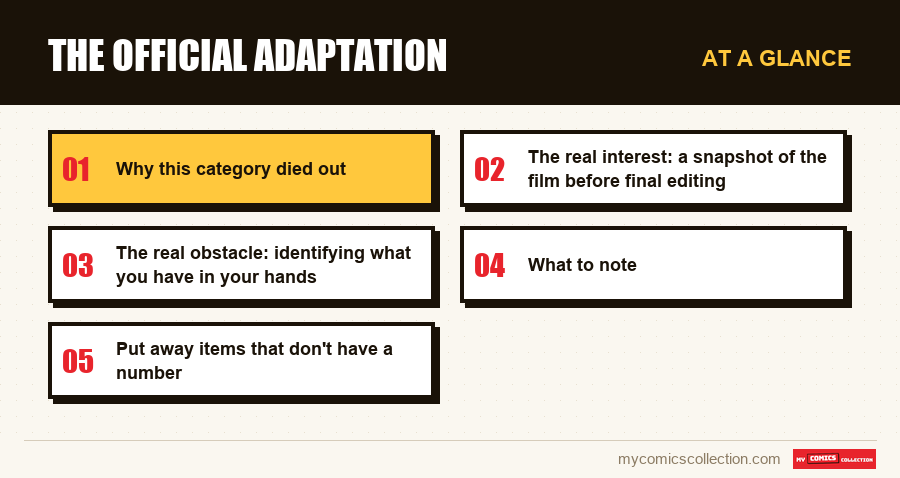
Why this category died out
The film has become available
As soon as a feature film is bought, rented, then read in a few seconds from an online catalog, the central adaptation service evaporates. Why read the film when you can watch it again? The category did not face competition from any other print: it was rendered unnecessary by the availability of the film itself.
The calendar constraint
An adaptation must appear at the time of release, not three months later. It is therefore manufactured quickly, often too quickly, on the basis of a non-definitive material. This constraint weighs on the quality of the drawing, on the staging of the plates, on the rhythm of the story, and it explains a large part of the bad reputation of the genre.
A story without autonomy
Adaptation does not invent anything: it transposes. It therefore has neither the freedom of an original story, nor the value of an entry point into continuity. A reader who discovers the character does not find a beginning there, and a regular reader does not find a continuation. It floats next to the series, without clinging to it.
A painful compression
Fitting two hours of film into a booklet requires cutting, summarizing, overwriting. Scenes become a panel, entire sequences are reduced to a recitative. What the cinema stretches, the comic adaptation compresses, and the compression is visible, especially in the action passages that the film built over time.
We can therefore describe this category without complacency: it is a dated object, often botched under calendar constraints, whose original function has disappeared with the uses that justified it. Many of these booklets are, literally, books that no longer need to be read. And yet they are left with something that nothing else provides: something that has nothing to do with their comic quality.
The important point: an official adaptation is drawn from the screenplay, not from the final copy of the film. The designer works on a text, sometimes on production documents, at a time when the editing has not been stopped. What he puts into boards is the film as it was planned.
Direct consequence: when the final edit removes a scene, this scene can remain in the booklet. The adaptation then becomes the printed testimony of a previous state of the film: a document, and no longer just a derivative product.
The real interest: a snapshot of the film before final editing
This is where the category ceases to be anecdotal. A film is an object that moves until the last moment. The script is rewritten during filming, sequences are shot then abandoned, the order of scenes changes during editing, explanations are deleted because they slow down, secondary characters lose their appearances because a duration has to be maintained. The film we see in theaters is the final result of a long pruning process, and the public normally only has access to this result.
The adaptation in fascicle is made upstream of this pruning. The studio provides the script to the publisher early enough for the comic to be ready on release day; the team that made it has not seen the final cut, for the simple reason that it does not yet exist. She therefore draws what is written. If a scene is included in the script when the file goes to the publisher, it has a good chance of ending up on the boards: even if, six weeks later, it is removed from the film for reasons of pace, duration or readability.
The booklet then functions as a screenshot of an intermediate state. He doesn't say what the film is; it says what the film was supposed to be on a certain date. It's a difference in nature. A derivative product accompanies a work; a document retains an earlier version. And this earlier version, in the case of an old film whose production records are not public, may be the only easily searchable trace of what was cut.
This is not limited to entire scenes. The discrepancies are often found in the details: a reply formulated differently, an explanation given where the film leaves a blank, a different order of sequences, an end of scene which extends by a few panels. A reader who knows the film well immediately spots these shifts, and each of them is information: something has changed between the writing and the projection. The booklet doesn't say why, but it proves that.
We obviously have to keep measure. Not all gaps are cut scenes. Some come from space constraints: the story must fit into a number of pages fixed in advance, so we summarize. Others come from the freedom of the designer, who recomposes an action so that it functions in boxes. Still others are due to errors or approximations, when the team works on incomplete documentation and invents a setting or costume that it has not seen. Reading an adaptation as a document therefore requires distinguishing three things: what has been compressed, what has been reinterpreted, and what really testifies to a previous state of the scenario. It's a reading task, not an obvious one.
This reading grid gives a reason to keep these booklets that simple nostalgia is not enough to justify. A copy lying around for a few dollars in a bin is not a good comic; it can be a good document. And for a character whose screen appearances have been as discussed as those of Catwoman, the question of what the film came close to showing is not without interest. Those who want to compare the screen and paper versions will find a starting point in our comparison between the cinema character and that of the comics.
Collecting this series?
Track what you own, what you are missing and what your collection is worth. 7 day trial.
Start my trial →The real obstacle: identifying what you have in your hands
Single issue or mini-series
Some adaptations are contained in a single issue, others are spread out in two, three or four parts. The same film can therefore exist in both forms depending on the market. A single copy does not say for itself whether it is complete or whether chapters are missing.
The calendar blurs the benchmarks
Published to coincide with a release, the adaptation does not fit into any regular monthly sequence. It has no logical predecessor or successor, which deprives the collector of the simplest way to check that nothing is missing.
Unstable titles
The same object is described in ten ways: by the title of the film, by the name of the character, by the mention “adaptation”, by an indication of format. The announcements noted on August 29, 2026 illustrate exactly this uncertainty, with wording that does not overlap.
Magazine or booklet format
Some adaptations come out in the usual booklet format, others in a larger magazine format, with different pagination. This is not a cosmetic variant: they are separate editions, which do not store or protect in the same way.
The “#nn” case
Among the titles noted is an advert bearing the words “#nn”: in other words, no number. This is the brand of unnumbered publications, where the seller uses a replacement code. Looking for a number that doesn't exist is the best way to find nothing.
Kiosk or specialized circuit
The same adaptation can exist in a newsstand edition and in an edition intended for specialized stores: one of the advertisements noted explicitly mentions a newsstand version. The two look very similar and are easily confused in a quick description.
This disorder has an immediate practical consequence: searching by number, which is the usual reflex of the collector, does not work here. You have to search by title, accept several formulations, and then check on the object itself (pagination, format, edition mention) what the description has not said. This is also the reason why these issues appear poorly in the tracking lists: they do not have the identification key that the rest of the collection has. THE reading guide dedicated to the character allows us to clearly separate what relates to continuity from what relates to these parallel objects.
What to note
The direction of adaptation is reversed, and that changes everything else. A comic taken from a film does not obey the same rules as a comic from which a film is based. It does not fit into any continuity, it does not introduce any character, it produces no consequences for the future. Classifying it with the character's regular episodes gives a collection that seems coherent but is not: we mix a story and its transcription. Better to reserve a separate category for it, even if it only contains a few pieces.
The booklet is drawn from the script, never from the projected copy. This is the only truly valuable point in this category, and it alone justifies keeping a copy. What appears in the plates corresponds to the condition of the film at the time the publisher received the material, several weeks or months before the theater. The deviations from the film that we know are therefore not necessarily errors: they are sometimes the traces of what was removed during editing.
Any discrepancy is not a cut scene, and you have to know how to sort it out. A shorter dialogue may only be a space constraint; a different decor may come from incomplete documentation; a modified sequence may be the work of the designer. Reading the adaptation as a document only after having ruled out these three causes avoids transforming a workshop approximation into a revelation about the production. The booklet proves that something has changed, never why it has changed.
Identification is by title, format and pagination, not by number. Between single-issue publications, mini-series, magazine formats, newsstand editions and copies announced “#nn”, the number is not a reliable key: when it exists. On the advertisements noted on August 29, 2026, the wording varies to the point of not overlapping from one offer to another. A collection sheet only becomes usable if it records the format and edition in addition to the title.
The levels requested are very scattered, and the authenticated part is too thin to conclude. On the August 29, 2026 statement, the 71 unauthenticated advertisements range from $4.98 to $200.00 with a middle of distribution at $14.24: the bulk of the market is therefore very accessible, and several copies of the adaptation are between $4.98 and $7.00. The 7 authenticated listings range from $55.20 to $5,150.00 for a mid-$299.99, but seven bids aren't enough to establish a level, and the high is both very high and isolated. These figures are amounts requested by sellers, not closed sales.
No, and that's precisely what makes it interesting. She tells the story of the film as it appeared in the script sent to the editor, at a time when editing had not been completed. Added to this are compressions due to the number of pages available and layout choices specific to the designer. The result is very similar to the film, but deviates from it in places, sometimes very visibly for those who know the feature film well.
Because its function has disappeared. It was used to rewatch, extend and possess a film that you could not rewatch at home at will. Once a film can be bought, rented and viewed in a matter of seconds, a drawn transcription no longer brings anything to the ordinary viewer. The category has not been replaced: the need it met has died out.
By reading the booklet after watching the film again, and noting each passage present on the paper which has no equivalent on the screen. We must then ask ourselves if this passage could have been added by the author of the adaptation to connect two sequences, or if it resembles a constructed scene, with a beginning, an end and a narrative function. The second case is the right candidate.
That there is no number. This is a notation used for unnumbered publications, common in publications linked to a film release. You should therefore not look for a corresponding figure: identification is then based on the title, format and pagination. In the catalog as in a collection sheet, these publications are treated as distinct editions rather than as numbers in a series.
The available data does not allow a decision to be made. The August 29, 2026 statement only has 7 authenticated offers, compared to 71 without authentication, and the gap between the two authenticated ends is considerable, with a very high and isolated maximum. Seven announcements are not enough to establish a baseline. If you're interested in the item for what it documents about the film, a readable copy does the job.
Put away items that don't have a number
Unnumbered adaptations, magazine formats, newsstand editions: these pieces escape classification by series and disappear from tracking lists. My Comics Collection allows you to save them with their format, their edition and your own notes, so that they stop being holes in your inventory.