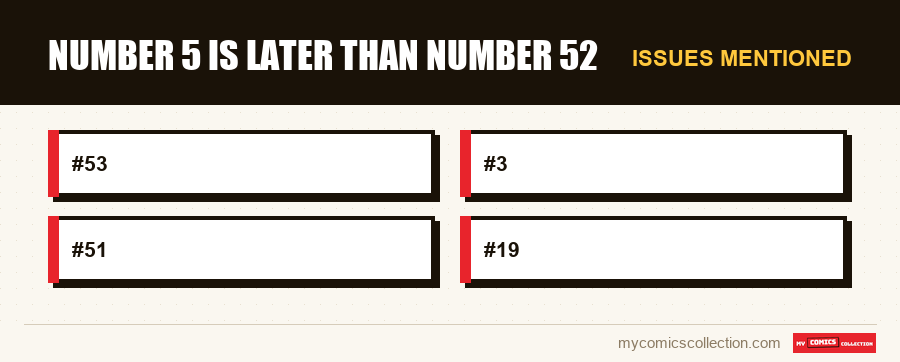
From the same publisher, number 52 of this character is dated 1965 and number 5 is dated 1968. The number decreases as the date advances. As of August 29, 2026, we find simultaneously on sale a #51 dated 1965, A #53 dated December 1965, A #3 dated October 1967 and a #5 dated November 1968, all under the same title and brand. The number alone therefore does not identify anything, and this is the first cause of error when purchasing this character.
This situation is not exceptional for the time, but it is rarely explained, and it systematically traps those who discover the series.
The following shows what the announcements really contain, where this discontinuity comes from, how to identify an issue without making a mistake, and what this imposes on an inventory.
What the ads actually contain
A sequence of fifty
Un #51 dated 1965, a #52 dated 1965, a #53 dated December 1965. Three consecutive issues in the same year.
A single-digit sequence
Un #3 dated October 1967, a #5 dated November 1968. Low numbers, later dates.
A precedent from the 1950s
Un #19 dated 1955 under the same brand, in a context still different from the two previous ones.
What it produces when purchasing
Three issues bearing the same title, the same brand, and three numbering systems that never come together.
These elements come from the ad titles noted on August 29, 2026: these are the indications provided by the sellers, coverage dates included. They do not constitute an editorial reconstruction but an observation of what is circulating today.
The point to remember is inversion: the smallest number is the most recent. A buyer who assumes that a low number corresponds to an old issue is mistaken here by three years in the wrong direction, and often in character.
This is not an isolated anomaly. The same situation is found on other titles from the same publisher, which indicates a practice and not an accident of management.
Where does this discontinuity come from?
Three editorial practices of the time explain this type of sequence, and they were readily combined.
The numbering was inherited from a previous title. Launching a series at number fifty cost nothing and allowed you to benefit from postal rates reserved for established publications. The issue therefore did not count the publications of the character, but those of a line of successive titles.
A title could be revived at number one. When the formula changed (new character under the same name, new team) starting from scratch signaled the break to the newsstand reader, without consideration for documentary coherence.
The series stopped and started again. A publication suspended for several years could restart with the numbering that was judged to be the best seller, and not the one that followed.
None of these decisions were intended to be reread sixty years later. They responded to distribution and postal pricing constraints, of which today only an incomprehensible numbering remains for those who are unaware of their existence.
We must draw a simple rule from this: in ancient periods, a number is a position in a title, not a position in a story.
This distinction resolves most confusion. Two issues bearing the same number can belong to two unrelated series, and two distant numbers can follow each other immediately in the story. Looking for narrative logic in numbering leads nowhere.
How to identify a booklet without making a mistake
Four pieces of information are enough, and four are needed: three is not enough.
Exact title as printed. The variations in wording between periods are significant and sometimes distinguish two series that common language confuses.
The number. Necessary, but insufficient on its own: this is precisely the demonstration of this article.
The cover date. It locates the sequence to which the number belongs, and it is she who reveals the inversion when it occurs.
The publisher's mark. The character has been published by several successive houses, each with its own numbering, and the logo stands out immediately.
These four elements together designate one booklet and only one. Three of them are visible in a cover photograph, which makes identification possible before purchase as long as it is done.
The concrete pitfalls that this creates
Discontinuity produces repetitive errors, which are easy to avoid once named.
The unintentional duplicate
Believing you have a number you don't have, because a booklet with the same number is already stored.
The invisible hole
A sequence appears complete even though it mixes two different sequences.
Reverse reading order
Following the increasing numbers leads to reading the periods backwards.
The bad carrier
Two sequences correspond to two different characters under the same name.
The distorted estimate
Apply to an issue the price level of another identical issue of another series.
Sterile research
Search for a number that never existed in the target sequence.
Why ads don't always help
You might think that the sellers remove the ambiguity. This is often the case, and sometimes not.
Many indicate the date, and that is enough. The titles noted frequently bear the year, sometimes the month: this is the best situation, and it is the majority.
Some only indicate the title and number. The ad then becomes undecidable without a legible photograph of the cover, and you have to decide to ask or pass.
Some use period vocabulary rather than a date. The mentions of golden age or silver age roughly place, but do not distinguish two sequences separated by three years.
Sorting must therefore be done yourself in some cases. The practical rule is to never buy an issue from this period based on the title-number pair alone., regardless of the low price: the error does not cost much, but it permanently pollutes an inventory.
Collecting this series?
Track what you own, what you are missing and what your collection is worth. 7 day trial.
Start my trial →What the catalog solves
This difficulty is exactly what a reference catalog is designed to remove, and it is worth saying how.
It links each number to a dated series. Where the advertisement gives an isolated figure, the catalog places it in a series identified by its publisher and its years of publication.
It allows you to check before buying. Comparing the date of an announcement with the expected sequence takes a few seconds and eliminates all of the confusion described above.
It makes completeness verifiable. Knowing that a sequel has a certain number of issues between such and such a year turns a rough collection into a checklist.
This is the only truly effective remedy. No method based on memory or habit resists a numbering that decreases over time, and trying to do without it guarantees error in the medium term.
It should be added that this verification is retroactive: an inventory compiled without it can be taken issue by issue, provided that the copies have been preserved. What cannot be remedied, however, is the origin of a number resold in the meantime.
What changes over time
The difficulty is not uniform, and it helps to know where it is concentrated.
The ancient periods are the most exposed. Legacy numbering practices were common there, and the period documentation is most lacking.
Recent periods pose a different problem. The relaunches at number one multiply, so much so that several series begin with a first number without any continuing the others.
The middle is the most readable. The intervening decades saw long, continuous series, where the number effectively corresponds to a position in a single sequence.
The same character therefore goes through three distinct numbering regimes. It's not a complication on his part, it's the history of publishing that can be read through him: and a character present since the 1930s has them all.
A consequence on prices
The discontinuity not only complicates identification: it also distorts the reading of the readings, and no one points it out.
A search by title and number aggregates unrelated issues. Questioning the market on a given number simultaneously brings back copies of three sequences, the price levels of which have no reason to coincide.
The median obtained is then a mixture, and not the price of an object. This is one of the reasons why two differently worded questions about this character can give very different results on the same day.
This defect is invisible in the figure. Nothing in a median indicates that it concerns heterogeneous issues, and you have to look at the titles one by one to notice this.
This is also why the statements in this file systematically separate the periods rather than aggregating the character. A single value for a name that covers several series and several carriers means nothing, and calculating it would yield a seemingly solid figure devoid of content.
What to record when faced with discontinuous numbering
The only remedy is documentary, and it fits into five fields.
The year of coverage, systematically. It is the information which distinguishes the sequences from each other, and the only one which is never ambiguous.
The series identifier, distinct from the title. A title can designate four series; it is necessary to note which one, by its beginning and end years.
The carrier concerned. On this character, two sequences correspond to two different men. Without this mention, a collection believes itself to be coherent even though it mixes two subjects.
The known extent of the sequence. Noting that a sequence goes from such to such a number avoids having to search indefinitely for a booklet that does not exist.
Doubt, when it remains. A line marked as uncertain is infinitely more useful than a false line presented as sure: this is especially true here, where the error never shows itself.
Not here, and it's the most confusing inversion. The advertisements noted on August 29, 2026 show a #52 dated 1965 and a #5 dated November 1968 under the same title and the same brand: the smallest number is the most recent by three years. For older periods, the number counts the publications of a title, not the age of an issue.
Because the numbering was inherited from a previous title, which made it possible to benefit from postal rates reserved for established publications. The figure counted the releases of a line of successive titles, not those of the character. None of these decisions were intended to be reread sixty years later.
Ask, or pass. The title-number pairing is never enough during this period, and a legible photograph of the cover remains the only recourse when the title is silent. The mistake costs little money but permanently pollutes an inventory, which is more difficult to repair than a bad purchase.
By noting its extent once and for all (first and last number, start and end years) then ticking. Without this limit, a collection appears complete even though it mixes two sequences, or remains in search of a number which never existed in the targeted sequence.
No. Older periods combine inherited numbering and incomplete documentation; on the contrary, recent periods have increased the number of relaunches at number one, so much so that several series begin with a first number without any continuing the others. The intervening decades are by far the most readable.
Four series, just one title: which one is yours?
Title, number, year and publisher: four are needed to designate an issue from this period.