
In short
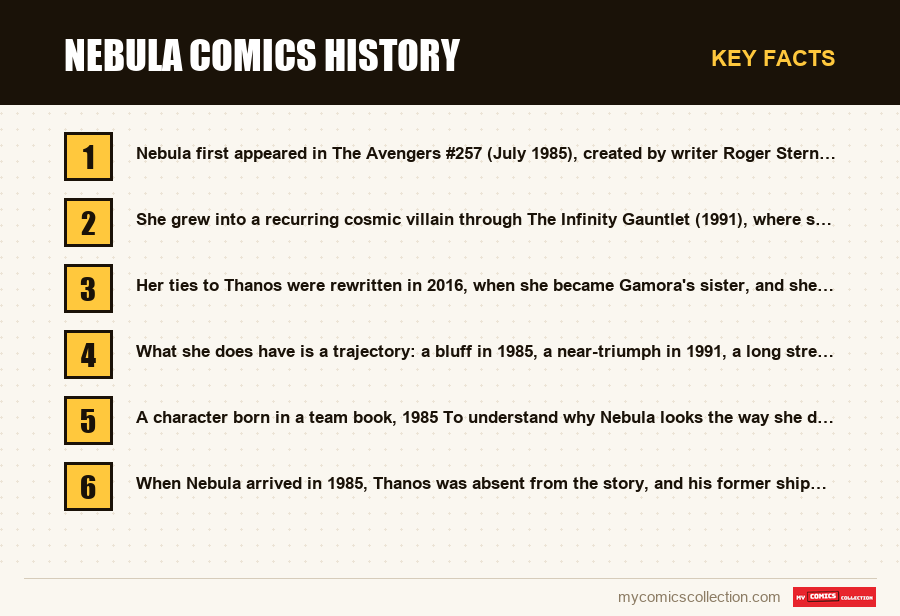
Nebula first appeared in The Avengers #257 (July 1985), created by writer Roger Stern and artist John Buscema. She arrived as a pirate who had seized Thanos's former ship and claimed to be his granddaughter. She grew into a recurring cosmic villain through The Infinity Gauntlet (1991), where she briefly held the Gauntlet. Her ties to Thanos were rewritten in 2016, when she became Gamora's sister, and she starred in her own mini-series in 2020.
Nebula is one of the strangest cases in Marvel's cosmic line. She has no long-running series of her own, no single writer who owns her, and a family tree that changed after she had already been in print for thirty years. What she does have is a trajectory: a bluff in 1985, a near-triumph in 1991, a long stretch as a cyborg and a prisoner, a retcon in 2016, and a solo story in 2020.
The credits, issue numbers and cover years below were checked against published issue data, and where a year is the only date given, that is deliberate. What each period does to Nebula is our own reading of those pages.
A character born in a team book, 1985
To understand why Nebula looks the way she does, start with where she was born. She did not debut in a cosmic title. She debuted in The Avengers, a series then written by Roger Stern. Nebula fits the shape of a supporting menace: introduced sideways, inside a team story that is mostly about other people.
John Buscema drew her, and that matters for her look. Buscema's Avengers were solid, heroic and grounded in classic anatomy, so a villain with a pirate's swagger and a space-opera costume had to read as credible inside that visual grammar. That first look is the one the later cybernetic redesigns have to be measured against.
The timing also helps explain the character. When Nebula arrived in 1985, Thanos was absent from the story, and his former ship was there for the taking. A new villain who claimed his legacy could therefore borrow his menace without having to share a page with him. That is the whole engine of her debut, and it is the engine her creators would later have to deal with.
The granddaughter claim: The Avengers #257 to #260
The Avengers #257, cover-dated July 1985, is her first appearance. The surrounding plot runs through issue #260, with the storyline starting a little earlier, in #255. In it Nebula has taken Sanctuary II, the ship that had belonged to Thanos, and she announces that she is his granddaughter. That claim is the foundation of the character, and it is worth reading carefully: it is a claim, made by the character, about herself.
For collectors, this is the point where the character's identity sits on a lie that nobody in the story can immediately check. With Thanos absent, the claim carries weight in the story. The result is a villain whose power is partly borrowed credibility.
The early run also fixes her tone. She is vain, ambitious, and willing to bluff on a cosmic scale, and she does not yet have the sad, hard edge that later writers add. If you read these issues and then the 2020 series, the contrast shows how far the character was developed later.
Infinity Union and the late 1980s: Avengers #311 to #318
She returns in The Avengers #311 to #318, covering December 1989 to June 1990. This is the arc that turns her from a pirate with a story into a genuine danger. She uses an atomic compressor built by Dr. Harker and the Infinity Union, a device-driven scheme to gain absolute power, and in doing so she nearly causes a second Big Bang. Sersi removes her brain implant, depriving her of her powers.
Two things stand out for a long-run reader. First, the scale: in 1985 she was hijacking a ship, and in 1989 the threat is to the universe itself. Second, the pattern of how her power works. It comes from a device, an implant or a compressor, and not from anything innate. That is a quiet but important design choice, because it explains why she keeps losing power and then finding another route back. Every later chapter of her history repeats that structure.
Issue #318, cover-dated June 1990, is a good marker for the end of this arc if you are assembling the run issue by issue.
The Infinity Gauntlet, 1991: the near-triumph
The Infinity Gauntlet (1991) is the moment when Nebula stops being a villain you meet in the Avengers and becomes a figure in the central cosmic saga. Starlin scripts every chapter, while Pérez draws the opening three and part of the fourth before Lim finishes the run. The series is cover-dated July to December 1991.
Her role is bound to the story's structure. In issue #1 Thanos is resurrected, and when he meets the character who calls herself his granddaughter he is offended by her claims of kinship and nearly kills her. That scene sets up her whole arc in the series: the bluff from 1985 is finally tested by the person it was about, and it fails.
By issues #5 and #6 the roles have reversed. Nebula steals the discarded Gauntlet and banishes Thanos to drift through interstellar space, and she later uses it to heal herself. Later she removes the Gauntlet after Warlock disrupts the gems, and Warlock takes it for himself. Starfox then captures her and returns her to Titan for trial.
The twist in her history is that the pirate who claimed Thanos's legacy briefly held the most powerful object in the Marvel universe, and lost it because of the structure of the story rather than a defeat on the battlefield. She is the instrument that undoes Thanos, and she is also the proof of how thin her own claim was. For a collector the six issues are the center of gravity for the character.
Cyborg and prisoner, 1992 to 1995
After the Gauntlet, Nebula's story moves into the Silver Surfer family of titles and into a run of darker, more fragmented appearances. Silver Surfer Annual #5 (1992) shows Firelord confronting her in the Titanian prison, with a flashback to the murder of her father that leaves her catatonic.
Then Silver Surfer vol. 3 #69 to #73 (August to October 1992) takes her out of the prison. Geatar frees her, and Doctor Mandibus converts her into a cyborg. This is the origin of her mechanical look, and it is what most readers now think of as her default appearance: part human, part machine, with the machine parts the result of other people's decisions.
She continues in Secret Defenders #9 and #10 (November and December 1993), where she recruits an army to attack Titan and sends the Silver Surfer to Titan's surface strapped to a bomb. War Machine frees him, and the Surfer deals with her shortly afterward. In Silver Surfer vol. 3 #110 (November 1995) she is working as a showgirl on Syllogonia when she spots the Silver Surfer and Genis-Vell, and she attacks at once before the Surfer subdues her.
Read together, these appearances show a pattern: she is always an antagonist in someone else's book, and each arc ends with her stopped.
Do you collect this series?
Track what you own, what you are missing and what your collection is worth. 7-day trial.
Start my trial →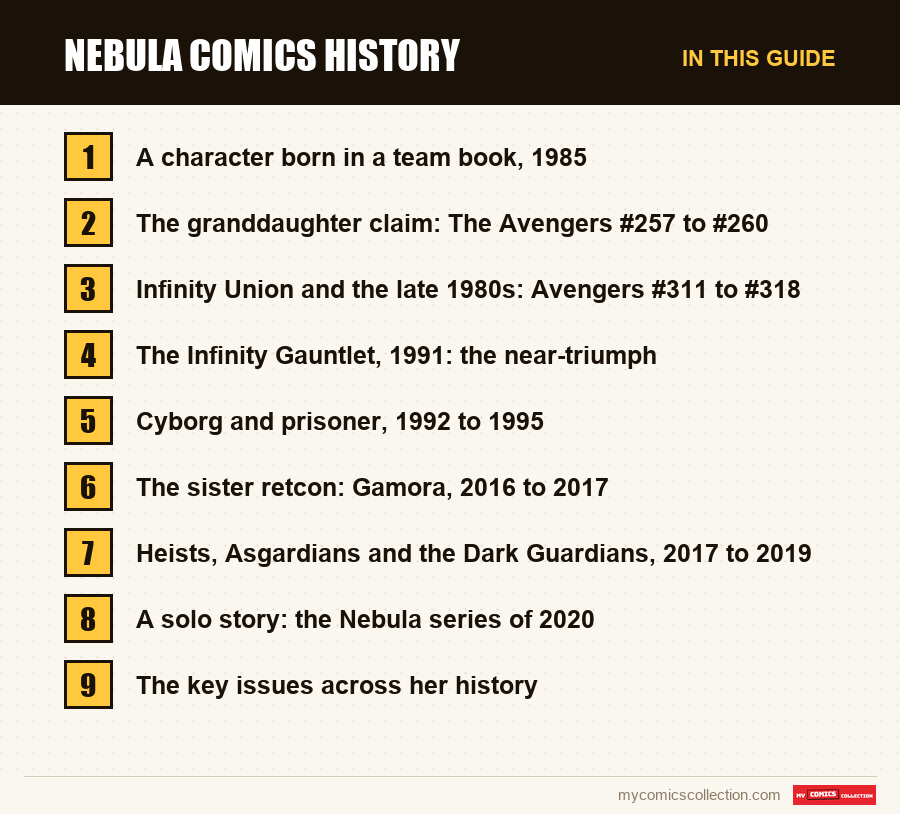
The sister retcon: Gamora, 2016 to 2017
For thirty years the established line was the one she invented herself: granddaughter, then rejected. The change comes with the Gamora series of 2016, which reveals that Nebula was raised alongside Gamora by Thanos. In other words, the relationship becomes sisters rather than a grandchild's claim.
It is a significant shift, and a collector should read it as an editorial change of direction rather than a continuation of the 1985 story. The earlier material still stands as printed, but the character's family position is now different, and readers who start with the later books will meet a Nebula whose bond with Thanos is not a bluff at all. The shift is tied by commentators to the screen version of the character, and that reading is plausible, but the comics themselves do the work in the issues.
Our page on Gamora's history covers that side of the relationship, and the reading guide for the best Nebula comics places the retcon alongside the older issues. For the purposes of this timeline, the important point is that 2016 is a hinge: before it, she is a pretender, and after it, she is family.
Heists, Asgardians and the Dark Guardians, 2017 to 2019
The next few years put her into three very different settings. In Thanos vol. 2 #1 to #12 (2017) she joins a heist with Starfox, Tryco Slatterus and Thane. She shoots Thane, who is later possessed by the Phoenix Force, and Thanos eventually leaves them stranded in the witches' domain. The crew finds a Phoenix Egg instead of a prisoner, and Nebula's grand-uncle Eros, Starfox, is part of it.
Then Asgardians of the Galaxy #1 to #5 (2018 to 2019) sends her after a mighty cleaver held by a dwarven enclave, and she completes the God Quarry's trial, but the warp capabilities of her teleporting axe have been tampered with. It is a small, odd corner of her history, but it is a useful reminder of how the character gets used: as a hunter with a goal, dropped into whichever cosmic title needs an antagonist.
Finally, Guardians of the Galaxy vol. 6 #2 (2019) places her after Thanos's funeral, joining Starfox's Dark Guardians. This is notable because the arc does not end with her stopped. She changes sides, or at least changes teams, which shows how far the character has moved from the villain of 1985.
A solo story: the Nebula series of 2020
The 2020 Nebula mini-series is written by Vita Ayala, and Jen Bartel's art fronts the cover of #1. It gives the character something her whole history had lacked: sustained attention from a single writer, with the story told from her point of view.
It is also a good test of the material. Because the series is short and focused on her, it works as an entry point for readers who know the character from the screen and want a single book. It does not require the 1985 issues or the 1991 Gauntlet saga, although both enrich it. The structure of the character's history, in which power always comes from something external, is visible here in a more reflective register.
If you collect by creator, this is the book to place beside Stern and Buscema's 1985 issues, because the two books bracket thirty-five years of the character and show how differently she can be written.
The key issues across her history
- The Avengers #257 (July 1985): first appearance, by Roger Stern and John Buscema, with the Sanctuary II claim of being Thanos's granddaughter.
- The Avengers #311 to #318 (December 1989 to June 1990): the Infinity Union arc, where she nearly causes a second Big Bang.
- The Infinity Gauntlet #1 (July 1991): Thanos is resurrected, takes offense at her kinship claim and nearly kills her.
- The Infinity Gauntlet #5 and #6 (November and December 1991): she takes the Gauntlet and banishes Thanos before Warlock takes it.
- Silver Surfer vol. 3 #69 to #73 (August to October 1992): Doctor Mandibus converts her into a cyborg.
- Gamora (2016 to 2017): the retcon that raises her alongside Gamora.
- Thanos vol. 2 #1 to #12 (2017): the heist with Starfox and Tryco Slatterus.
- Nebula (2020): the mini-series written by Vita Ayala.
How to follow Nebula in a collection
The first decision is how to define the collection. A character with no series of her own can be tracked in two ways: by hunting the single issues, or by following the story through collected editions. Because her appearances are scattered across the Avengers, the Silver Surfer family, the Thanos books and the Guardians titles, a checklist by issue number is the only reliable way to avoid gaps.
Start with the 1985 issues, The Avengers #257 to #260, because they define the character. Then add The Infinity Gauntlet, which is easy to find in reprint and gives the most important story. After that the sequence depends on your interest: the Silver Surfer issues for the cyborg origin, Gamora for the retcon, and the 2020 Nebula series for a read centered on her.
Two practical warnings. Check the volume number when you buy Silver Surfer and Guardians of the Galaxy issues, because several series with the same title have been numbered and relaunched over the years, and the issue numbers in this article refer to the specific volumes named. Also check the cover date rather than the on-sale date when you match an issue to a listing, since the dates here are cover dates. A short companion piece on where to start explains the same sequence from a reader's point of view, and the Thanos hub shows how her story fits into the larger saga.
Frequently asked questions
Issue #257 of The Avengers, dated July 1985, carries her debut, with Stern on script and Buscema on art. The surrounding storyline continues through issue #260, with Nebula holding Thanos's former ship, Sanctuary II, and claiming to be his granddaughter.
It depends on the period. In 1985 she claims to be his granddaughter, and in The Infinity Gauntlet #1 (1991) Thanos is offended by the claim and nearly kills her. The Gamora series of 2016 then reveals that Thanos raised her alongside Gamora, which makes her Gamora's sister.
Yes, in The Infinity Gauntlet (1991), written by Jim Starlin. She steals the Gauntlet after Thanos discards it, banishes him into interstellar space and uses it to heal herself. Warlock later disrupts the gems, and she removes the Gauntlet before Warlock takes it.
She has a mini-series called Nebula from 2020, written by Vita Ayala, with Jen Bartel on the cover of #1. Before that her stories ran in other books, including The Avengers, Silver Surfer, Secret Defenders, Thanos and Asgardians of the Galaxy.
The 2020 Nebula series is the most focused entry point. For the historical thread, read The Avengers #257 to #260 first, then The Infinity Gauntlet. A separate guide on this site lays out a fuller reading order for the character.
If you own The Avengers #257 or another Nebula issue, find out where it stands before you decide how to keep it.
Estimate my comic