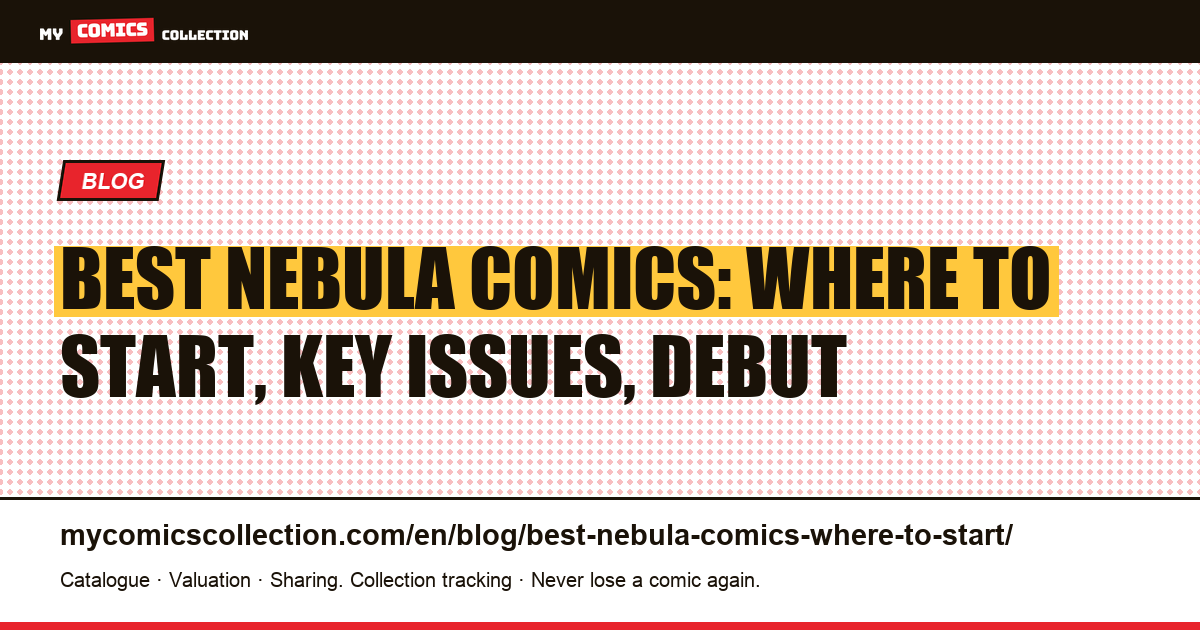
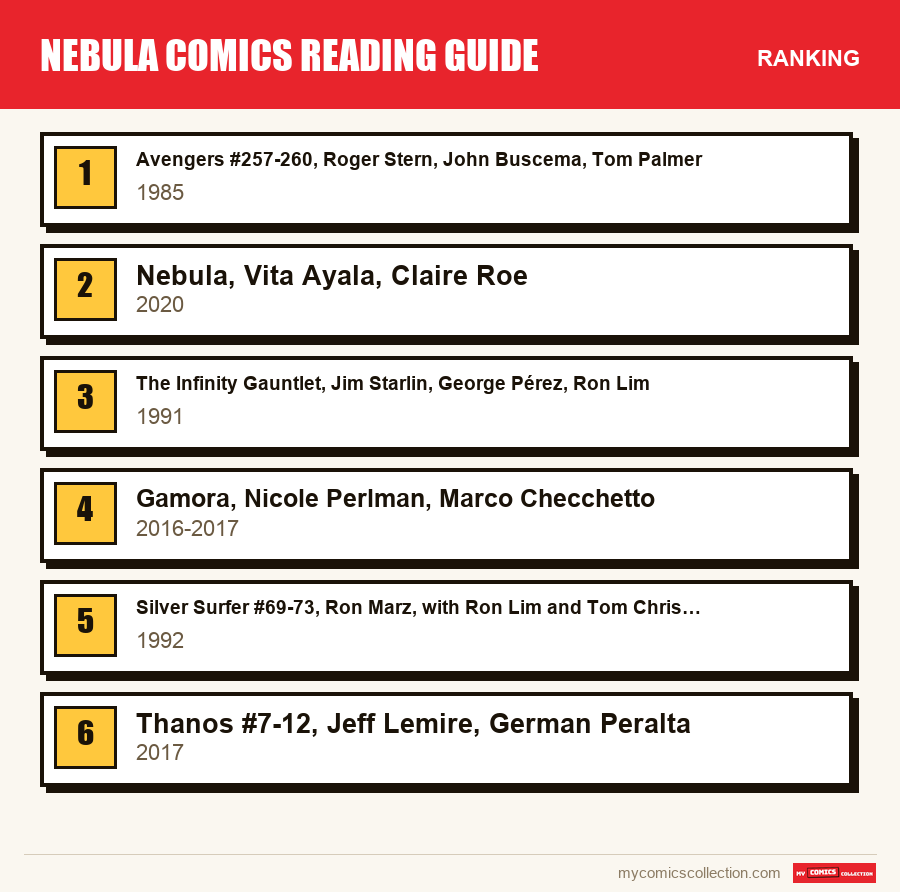
The best Nebula comics start with Avengers #257-260 (1985), by Roger Stern and John Buscema, where she makes her first appearance, then move on to her Nebula miniseries (2020), by Vita Ayala and Claire Roe. Round it out with The Infinity Gauntlet (1991) and Gamora (2016-2017). Her first appearance, and the key issue to hunt, is Avengers #257, cover-dated July 1985.
Nebula first presents herself as Thanos's granddaughter, then as Gamora's sister: one figure, tied to Thanos by bonds that change depending on the writer. That blur is what makes the character hard to pin down. She has no long series that follows her from her debut, and the stories where she matters are scattered across forty years of publication. This selection picks six, says what role she plays in each (sometimes central, sometimes shared) and proposes a reading order for those who discover the character after the Guardians of the Galaxy movies.
As always in this guide, only verified information (creators, issue numbers, dates) is stated as fact; the analysis is our own, with no reproduction of protected art or dialogue.
Her first appearance
Nebula is born in The Avengers #257, cover-dated July 1985. Roger Stern writes the issue, John Buscema pencils it, and Tom Palmer inks it and, with Buscema, signs the cover. She bursts in as a subplot: Monica Rambeau, then Captain Marvel, is swept off into space, and Nebula has seized Sanctuary II, Thanos's ship, by declaring herself his granddaughter. The entrance is discreet, and that is what makes it interesting: the character does not debut as a headliner, but as a threat laying the groundwork.
For the reader, the consequence is simple, and it guides the rest of the list. This issue works as a historical landmark and as the start of a thread that runs through issue #260, but it does not deliver a complete portrait. The character will be better understood through the stories that follow. Our page on Roger Stern places this writer in the history of the series.
1: Avengers #257-260, Roger Stern, John Buscema, Tom Palmer (1985)
The subplot runs across four issues, and Nebula plays the part of a shadowy adversary: she holds Thanos's ship and claims his legacy. The Avengers remain the stars of the series, and it must be said plainly: you do not read these issues for Nebula alone, but to see how a supporting character lays the foundations of her future.
Why read them first: because all of Nebula's later relationships with Thanos are defined in relation to this founding lie. Who this arc is for: patient readers of the late Bronze Age who enjoy Stern and Buscema's work on the Avengers. How to read it: in issue order, accepting that attention is shared with the team's main plot. Reprinted volumes of this period save you from chasing the original single issues, whose spines and corners call for a careful eye if you are after a collector's copy. Always read the cover date printed at the top of the page: it, and not the newsstand ship date, is the reference used in this guide.
2: Nebula, Vita Ayala, Claire Roe (2020)
Five issues: Vita Ayala on writing, Claire Roe on art, Jen Bartel on covers, Mike Spicer on colors. It is her first solo series: Nebula hunts a powerful device, and her path leads her toward forces she knows as well as others that surprise her.
What this story brings: an inside point of view. The reader finally sees Nebula act for herself, and not in the shadow of Thanos or Gamora. Who it is for: recent readers, coming from the movies, who are looking for a self-contained story. How to read it: first if you are just starting, or right after the 1985 issues if you like going back to the source. Its short format makes it the most accessible read on the list.
3: The Infinity Gauntlet, Jim Starlin, George Pérez, Ron Lim (1991)
Six issues published from July to December 1991: Jim Starlin writes the whole thing, George Pérez pencils the first three and part of the fourth, then Ron Lim takes over. Nebula is not the protagonist here. Thanos takes the lead, and the heroes of the Marvel universe organize around him. But her role is decisive near the end: after pretending to be related to Thanos, she takes hold of the Gauntlet in her turn, until Warlock takes it from her.
What this story brings to Nebula: it takes her from a ship usurper to an adversary able to wield the most powerful weapon in the universe, if only for a time. Who it is for: those who want the cosmic peak of the era. How to read it: keeping in mind that Nebula occupies only one segment. Our page on The Infinity Gauntlet #1 and the one on the Gauntlet key issues help you spot the copies.
4: Gamora, Nicole Perlman, Marco Checchetto (2016-2017)
This five-issue series, written by Nicole Perlman and drawn by Marco Checchetto, follows Gamora, her sister Nebula and Thanos. In the first issue, Thanos gives his adoptive daughter a sinister birthday present: the death of the Badoon, the reptilians who destroyed her people. The series thus ties Nebula to Gamora as adoptive sisters raised by Thanos, a framework that movie fans already know.
What this series brings: a sibling relationship. The character of Gamora takes the front, but Nebula plays the second lead. Who it is for: readers coming from the movies, who find their anchor point here. How to read it: after the 2020 miniseries, or in its place if you prefer family stories. Our page on the history of Gamora places this series within its heroine's path.
Do you collect this series?
Track what you own, what you are missing and what your collection is worth. 7-day trial.
Start my trial →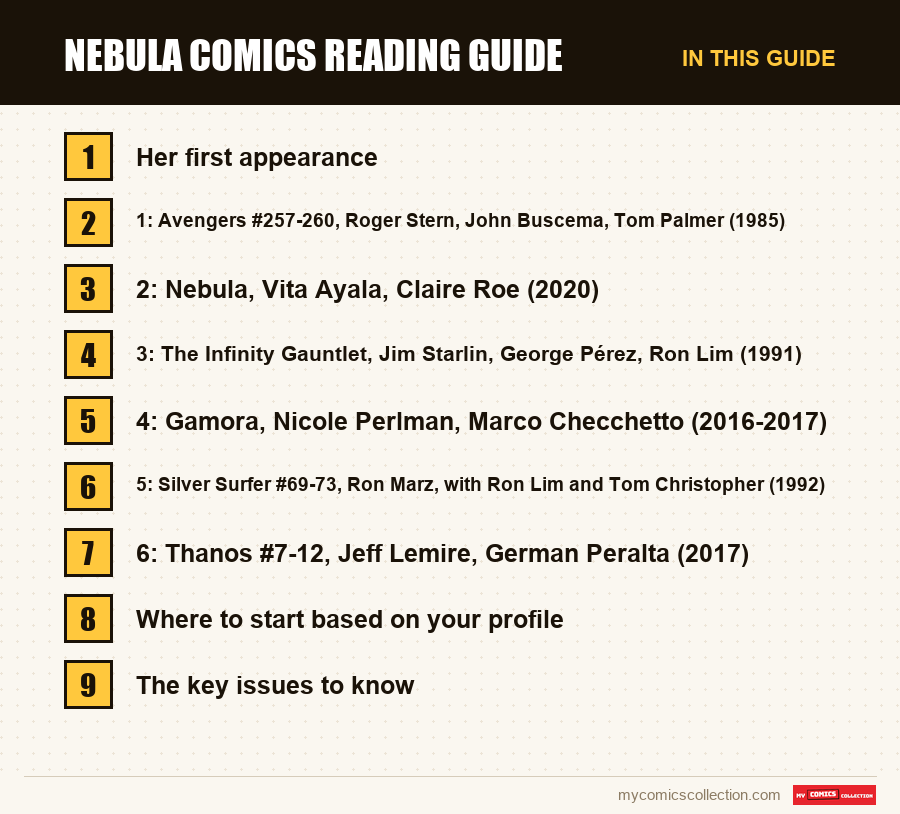
5: Silver Surfer #69-73, Ron Marz, with Ron Lim and Tom Christopher (1992)
In the 1987 Silver Surfer series, these issues are written by Ron Marz. Ron Lim draws issue #69 and Tom Christopher is credited on art for issue #72. Nebula is turned into a cyborg there by Doctor Mandibus, and issue #72 shows the finished work: she has become partly robotic, while remaining herself. The Surfer remains the hero; Nebula plays a recurring character, victim and threat all at once.
What this story brings: Nebula's transformation into a cyborg. Who it is for: readers of 1990s cosmic Marvel, who are extending The Infinity Gauntlet. How to read it: right after the Gauntlet, keeping in mind that Nebula is not the subject of the title. To place the Surfer in the bigger picture, see the Silver Surfer hub.
6: Thanos #7-12, Jeff Lemire, German Peralta (2017)
In the Thanos series launched in 2016, writer Jeff Lemire tells of the ordeal the Titan imposes on his son Thane at the God Quarry, with German Peralta on art for this arc. Nebula appears there, abandoned on site with Starfox and Tryco. She is therefore not the star: she belongs to the supporting cast, and you do not dive in for her.
What this story brings to Nebula: one more scene in her conflicted relationship with Thanos, seen through Thane's emancipation. Intended audience: those who follow Thanos closely. How to read it: as a complement, after the previous five entries. For the context around the Titan, see our Thanos reading guide.
Where to start based on your profile
You are coming from the Guardians of the Galaxy movies: pick up the 2020 Nebula miniseries, then Gamora (2016-2017) for the relationship between the two sisters. In the 2014 film, the character is played by Karen Gillan, who reprises the role in other films of the franchise, and our movie versus comics page on the 2014 film compares the two versions.
You are an archive reader: open Avengers #257, then follow it through issue #260, before moving on to The Infinity Gauntlet. You like 1990s cosmic Marvel: chain the Gauntlet and Silver Surfer #69-73. You want to understand Thanos's family: Gamora, then Thanos #7-12.
In every case, keep in mind that the character's identity depends on the era and the writer. A reader who picked up the 2020 miniseries without having read the 1980s would miss no essential information, which makes it the safest choice for a newcomer.
The key issues to know
With no long series under her name, Nebula is collected through scattered milestones, from the 1985 single issue to the 2020 miniseries, and not by completing a run of issues. Each milestone answers a different question: origin, power, family or independence.
Here are the landmarks, with no price at all, because a market value moves faster than this text. To place a copy of Nebula, look for completed sales of the same issue, in the same condition and the same edition, and walk away when a listing stays vague on any of those three points.
- Avengers #257 (July 1985): first appearance of Nebula, created by Roger Stern and John Buscema. It is the character's benchmark issue.
- Avengers #318 (June 1990): the issue where Nebula gains near-divine power thanks to the Infinity Union, a device she has stolen.
- The Infinity Gauntlet #1 (July 1991): start of Jim Starlin's miniseries. Nebula is only a cast member there, but the issue opens the series in which she will take the Gauntlet.
- The Infinity Gauntlet #5 and #6 (November and December 1991): the episodes where Nebula seizes the Gauntlet.
- Silver Surfer #72 (1992): Doctor Mandibus finishes turning Nebula into a cyborg.
- Gamora #1 (December 2016): opening of Nicole Perlman's series, which unites Nebula with Gamora.
- Guardians of the Galaxy #2 (April 2019): Nebula joins the Dark Guardians there after Thanos's funeral.
- Nebula #1 (2020): first issue of her miniseries, with a cover by Jen Bartel.
To place these landmarks in the bigger picture, see our page on the history of the Guardians of the Galaxy in the comics.
Frequently asked questions
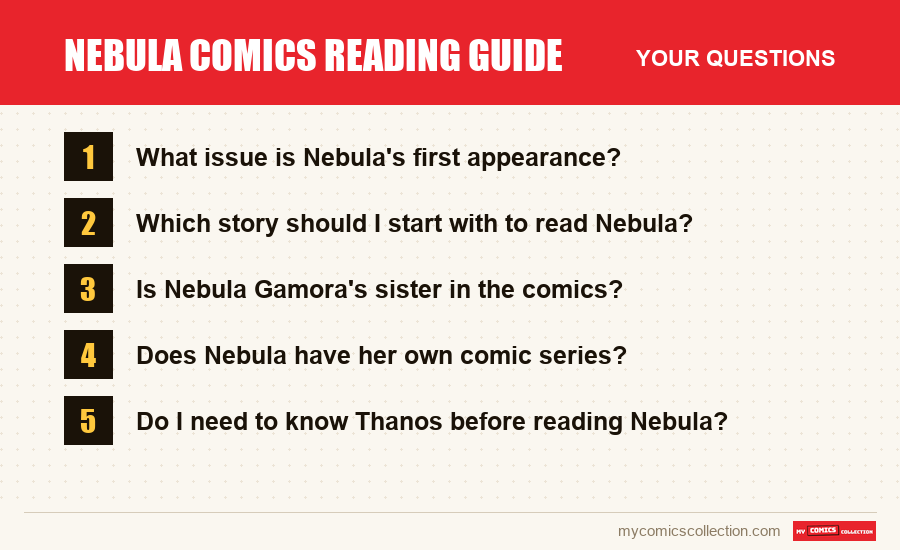
Nebula first appears in The Avengers #257, cover-dated July 1985. Roger Stern is the writer, John Buscema provides the pencils and Tom Palmer the inks. She bursts in as a subplot, after taking Thanos's ship and presenting herself as his granddaughter.
For a self-contained, recent story, read the Nebula miniseries by Vita Ayala and Claire Roe (2020). For the origins, pick up Avengers #257-260 (1985). These two entry points read independently of each other, and you can choose according to your taste.
Nicole Perlman's Gamora series (2016-2017) presents them as adoptive sisters raised by Thanos. Originally, in 1985, Nebula claimed to be his granddaughter. The family tie therefore varies with the era and the writer, which explains the blur around the character.
Yes, since 2020: the Nebula miniseries, by Vita Ayala and Claire Roe, in five issues, with covers by Jen Bartel. Before that, she appeared in series devoted to other characters, such as Avengers, Silver Surfer or The Infinity Gauntlet.
No, not for the 2020 miniseries, which reads on its own. For The Infinity Gauntlet and Silver Surfer #69-73, it is better to know the broad strokes of Thanos, since Nebula is not the subject there. Our Thanos reading guide is a good starting point.
Do you own Avengers #257 or an issue of The Infinity Gauntlet? Get it appraised by comparing its condition to actual completed sales.
Appraise my comic