
In short
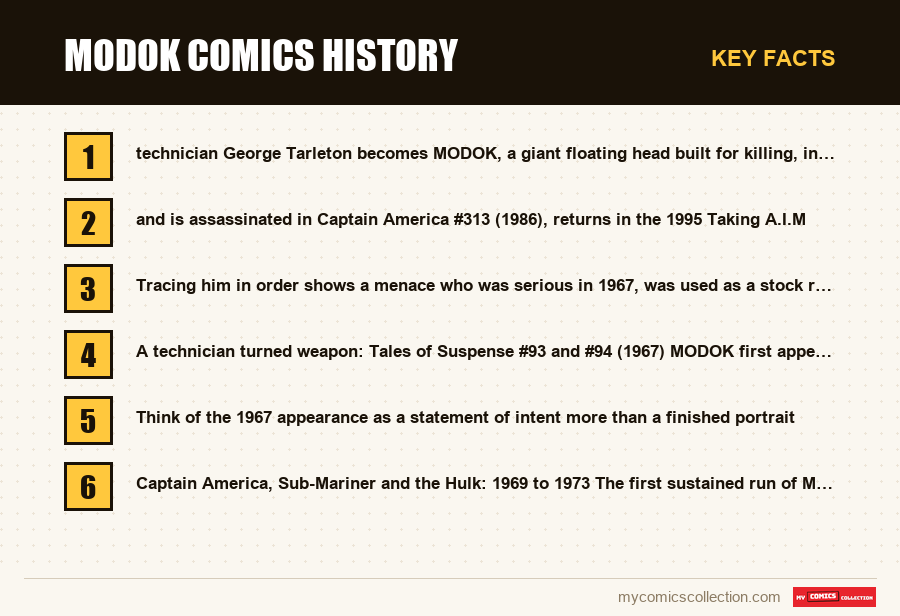
A.I.M. technician George Tarleton becomes MODOK, a giant floating head built for killing, in Tales of Suspense #93 and #94 (1967), from Stan Lee and Jack Kirby. He becomes Captain America's recurring enemy, loses the leadership of A.I.M. and is assassinated in Captain America #313 (1986), returns in the 1995 Taking A.I.M. storyline, and turns into a comic figure in the 2010s.
MODOK is one of the rare Marvel villains whose design is also his whole job description. A huge head, a hovering chair and a mind that never stops scheming leave very little room for subtlety, and yet the character has lasted more than half a century because writers keep finding a new angle on the same absurd body. Tracing him in order shows a menace who was serious in 1967, was used as a stock rival in the 1970s, died in the mid-1980s and came back as a figure of comedy and pathos.
Every credit, issue number and year in this guide was checked against published records before it went in, and where a cover month was not confirmed you will find the year alone. The reading of what each era does for the character is our own analysis, offered as a way to organize a collection, not as an official chronology.
A technician turned weapon: Tales of Suspense #93 and #94 (1967)
MODOK first appears in Tales of Suspense #93 and takes center stage in #94, both from 1967, in the Captain America half of that split title. Stan Lee and Jack Kirby are the credited creators, and Kirby draws the debut. That matters for a collector, because the two issues sit in the Captain America half of a split title, and the character is introduced alongside the machinery of A.I.M., the organization he will eventually lead.
The premise carries the whole later history. George Tarleton is a technician at A.I.M. A.I.M. scientists turn him into a super-intelligent being meant to study and improve the Cosmic Cube. The early name is MODOC, which stands for Mental Organism Designed Only for Computing, and the result turns on its makers, kills them and takes over. The name then shifts by one letter and one word to MODOK, Mental Organism Designed Only for Killing. The acronym is sometimes printed with other first words, but the logic is the same: a human being shaped into a tool and then rebelling against the people who made it.
Think of the 1967 appearance as a statement of intent more than a finished portrait. The giant head, the chair and the ruthless intellect are all in place, and the third meeting with Captain America is where the origin is revealed to readers. What is missing is the long personal rivalry that only later writers will build around the character, which is why the next stretch of his history is worth reading in order.
Captain America, Sub-Mariner and the Hulk: 1969 to 1973
The first sustained run of MODOK stories appears in Captain America. He returns in issues #117 to #120 (1969), then in #124 (1970) and again across #130 to #133 (1970 and 1971). In these issues the character returns again and again to plague Captain America, the hero of his debut.
In 1972 he moves to Sub-Mariner volume 2 for issues #47 to #49, where the Cosmic Cube and Doctor Doom enter his story in a run that shows how easily the character travels between Marvel series. A year later the larger leap arrives in The Incredible Hulk volume 2 #167 to #170 (1973). MODOK abducts Betty Ross and turns her into the Harpy, a transformation that gives the Hulk title one of its most uncomfortable Bronze Age plots, and that gives MODOK a personal cruelty his 1967 self had not yet displayed.
Readers who follow Captain America, Namor and the Hulk in the early 1970s will meet him in three different series between 1969 and 1973, which is why a MODOK checklist ends up scattered across several books rather than gathered in one.
Iron Man, Ms. Marvel and the late 1970s
In Iron Man #74 and #75 (1975), MODOK joins the Black Lama's War of the Super-Villains and loses to Iron Man. It is a team-up of villains that fails, a pattern that will repeat for decades: MODOK is brilliant at assembling alliances and poor at keeping them. In 1977 he turns up in two places at once. Ms. Marvel #5, #7, #9 and #10 (1977) pit him against Carol Danvers, with MODOK attempting to control her and later hiring Deathbird to kill her, and both plans fail. The same year, Iron Man Annual #4 gives him another outing in the Iron Man orbit.
What changes in this phase is the scale of his ambitions. He is no longer only an organizational leader with a private army. He is a would-be master of heroes, trying to bend a new character to his will at the very moment when Ms. Marvel is establishing herself. Reading the 1977 issues in order shows a villain who always has a plan and almost never a margin for failure, which is exactly what makes the later comic version possible.
The early 1980s extend the pattern with guest spots rather than landmarks. Marvel Team-Up #104 (1981) and Marvel Two-in-One #81 and #82 (1981) place him against pairs of heroes, and The Incredible Hulk volume 2 #287 to #290 (1983) features a failed bid to use the Abomination. In the same storyline he turns Katherine Waynesboro into Ms. MODOK, a first female counterpart, and returns her to human form when she demands it. The method is consistent: MODOK appears, makes a plan and loses.
Deposed and assassinated: the end of the first MODOK (1986)
The turning point of the first half of his history is his fall from power. A.I.M. deposes him because of his obsession with revenge against metahumans. Then the Serpent Society assassinates him at the request of A.I.M., a death that appears in Captain America #313 (1986).
It is an unusual end for a villain of this stature, because it comes not from a hero but from his own side. The organization he once led treats him as a liability, and the contract killers of the Serpent Society finish the job. A.I.M. then uses his remains as a supercomputer, a macabre detail that fits the character, since the technician who became a tool is now used as one after death. His corpse returns in Iron Man #205 (1986), operated remotely by a rogue A.I.M. agent against Iron Man, and A.I.M. temporarily replaces him with MODAM, a more loyal female counterpart.
For collectors, Captain America #313 is the key issue of this stretch. It closes a first life of the character that began in 1967 and defines everything that follows: the question of how a villain whose head is a machine can be brought back, and what he will be when he returns.
Taking A.I.M. and the return of 1995
MODOK comes back in 1995 in the crossover known as Taking A.I.M., which runs through Avengers #386 to #388 and Captain America #440 and #441 (May to July 1995). The structure is revealing: the revival is split between the two books that have always shaped his enemies, the Avengers and Captain America, so that the story reunites the character with the organization and the heroes who defined him.
After the resurrection he does not return as the same leader. He agrees to aid the Headmen and then reneges, is lobotomized by a group of U.S. Naval Intelligence and a drug cartel, recovers and exploits the situation until S.H.I.E.L.D. captures him. He later joins the Intelligencia, a secret organization of genius-level villains. The point of this phase is that MODOK no longer reigns over A.I.M. as an unquestioned sovereign. He is a survivor who must reconstruct himself, and writers can use him as a schemer in other people's stories.
Do you collect this series?
Track what you own, what you are missing and what your collection is worth. 7-day trial.
Start my trial →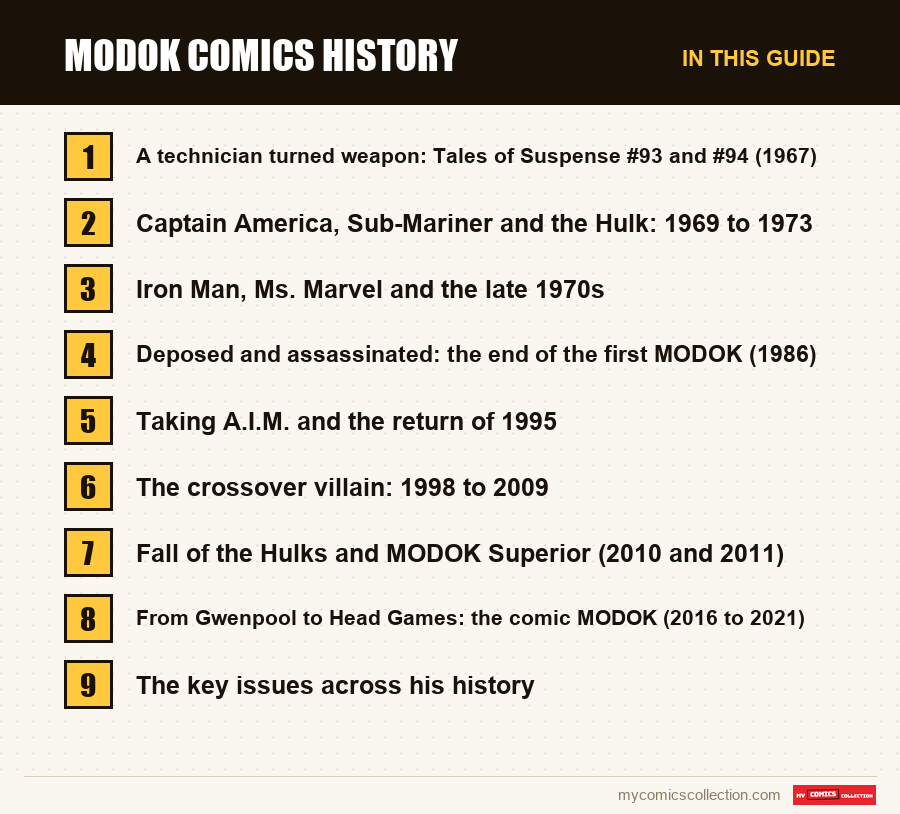
The crossover villain: 1998 to 2009
The late 1990s and the 2000s use MODOK as a supporting villain across the shared universe. He appears in an Iron Man and Captain America Annual in 1998, in Wolverine volume 2 #142 and #143 (1999), in The Defenders volume 2 #9 and #10 (2001), in Captain America and the Falcon #9 (2005) and in Cable and Deadpool #11 (2005). These are guest roles for completists rather than landmarks.
The tone also changes. By the mid-2000s MODOK appears in humor titles such as Wha...Huh? #1 (2005) and the GLA holiday special (2006), and in X-Men #200 and Uncanny X-Men #488 (2007) he is part of a bigger event cast. Two longer projects stand out: the miniseries Marvel 1985 (2008) and Super-Villain Team-Up: MODOK's 11 (2008), a five-issue miniseries that gives him a title of his own. M.O.D.O.K.: Reign Delay #1 follows in 2009, and he appears in The Incredible Hulk volume 2 #600 (2009).
Fall of the Hulks and MODOK Superior (2010 and 2011)
The next reinvention is also the most radical. During the Fall of the Hulks storyline, Amadeus Cho restores George Tarleton to human form, leaving him without his memory. Separately, one of the brains cloned from MODOK is allowed to develop naturally, receives his mind and becomes a new MODOK, known as MODOK Superior. His debut is in Hulk volume 2 #29 (2011), created by Jeff Parker and Gabriel Hardman, with Mark Robinson drawing the debut issue.
This split is the most useful device the character has ever received. The human Tarleton can be a figure of pathos, a technician who has lost everything, while MODOK Superior can be a pure villain without any need to explain himself. MODOK Superior fights the Avengers, Scarlet Witch and Ms. Marvel, and later becomes the archenemy of Gwen Poole, the character known as Gwenpool. For the collector, the lesson is that a MODOK checklist after 2011 needs to know which of the two is on the page.
From Gwenpool to Head Games: the comic MODOK (2016 to 2021)
The comedic potential of the character is fully used in The Unbelievable Gwenpool #1 to #25 (2016 to 2018), where MODOK Superior is a long-running antagonist. He also appears in West Coast Avengers volume 3 #4 (2019), a reminder that the character is now a recognizable presence in other teams' books.
The most complete modern portrait is M.O.D.O.K.: Head Games #1 to #4, published across 2020 and 2021 alongside the animated series about the character. It builds on the idea that MODOK Superior has hallucinated a family life, and it takes the family background of George Tarleton, including his father Alvin, who founded A.I.M. The miniseries is a late and affectionate return to the one question the 1967 debut raised and never answered: what is left of the person once the weapon is built?
Here the trajectory closes a loop. The character began as a human who was turned into a tool, died when his organization decided he was a problem, and is now a figure whose comedy depends on the sadness underneath it.
The key issues across his history
- Tales of Suspense #93 (1967): MODOK makes his entrance, from the Lee and Kirby team.
- Tales of Suspense #94 (1967): the second half of the debut, with Kirby on the art.
- Captain America #117 (1969): the start of the first long run of MODOK stories, which continues through #120.
- The Incredible Hulk volume 2 #167 (1973): the start of the storyline that makes Betty Ross the Harpy, running to #170.
- Iron Man #74 (1975): the War of the Super-Villains, which continues in #75.
- Ms. Marvel #5 (1977): the start of the issues in which MODOK tries to control Carol Danvers, which continue through #10.
- Captain America #313 (1986): the Serpent Society assassinates MODOK.
- Hulk volume 2 #29 (2011): the debut of MODOK Superior, by Jeff Parker and Gabriel Hardman.
How to follow MODOK in a collection
Start with the two Tales of Suspense issues, then follow the character where he is a villain of a single series: Captain America for 1969 to 1971, The Incredible Hulk for 1973, Iron Man and Ms. Marvel for the middle of the decade. Treat Captain America #313 as the dividing line, and keep the post-1995 appearances in a separate section, since most are guest roles rather than landmarks.
Two numbering traps deserve attention. First, the Hulk and Iron Man titles have restarted several times, so always write the volume next to the number: The Incredible Hulk volume 2 #167 and the 2011 Hulk #29 are different books. Second, MODOK Superior and the original MODOK are different characters, so a checklist of the 2010s should tag each issue with the one it features. If you want a shorter route, the miniseries are the most accessible entry points, and our guide to the best MODOK comics ranks them. For the heroes he keeps meeting, the Iron Man hub and the Captain America hub list the series around him, and the Tales of Suspense guide explains the split title that carried his debut.
Frequently asked questions
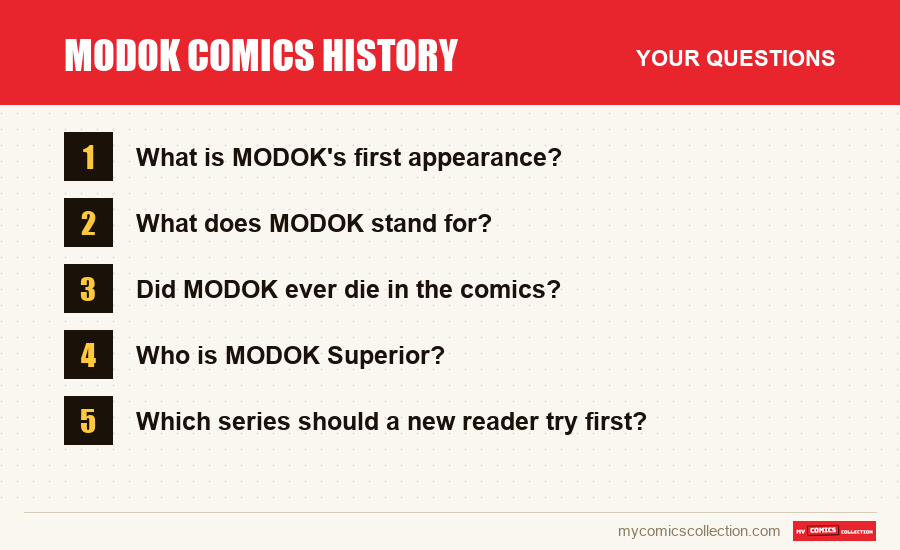
MODOK first appears in Tales of Suspense #93 (1967) and takes center stage in #94 (1967), in the Captain America half of the title. Stan Lee and Jack Kirby created him, and Kirby drew the debut. If you want the origin of the character, look for both issues together.
It stands for Mental Organism Designed Only for Killing. The character began as MODOC, Mental Organism Designed Only for Computing, a super-intelligent being created at A.I.M. from the technician George Tarleton. After turning on his creators and taking control of the organization, he renamed himself MODOK.
Yes. The Serpent Society assassinates him at the request of A.I.M. in Captain America #313 (1986), and A.I.M. uses his corpse as a supercomputer. He returns in the 1995 Taking A.I.M. storyline, which runs through Avengers and Captain America, and has remained active since.
MODOK Superior is a new MODOK grown from one of the brains cloned from MODOK, while Amadeus Cho restores George Tarleton to human form during Fall of the Hulks. He debuts in Hulk volume 2 #29 (2011), created by Jeff Parker and Gabriel Hardman, and later becomes the archenemy of Gwenpool.
For the origin, read Tales of Suspense #93 and #94. A complete modern story is easy to find: the five issues of Super-Villain Team-Up: MODOK's 11 (2008) stand alone, and so do the four of Head Games.
Found a Tales of Suspense #93 or #94 in your boxes? Get an estimate of its condition and value in a few minutes.
Estimate my comic