The most successful adaptations of the MCU do not come from the origins of the characters but from recent runs, published between 2005 and 2012. The Winter Soldier Movie Adapts a 2005 Run; the one about the Civil War of Heroes, an event from 2006; the series on the archer, a run from 2012. In other words, the numbers that counted were not forty but five: and they were plentiful and cheap at the time they were chosen. This is the most useful lesson of twenty years of adaptations.
The story of this ensemble is almost always told through its films, its recipes and its actors. Told by its sources, that is to say by the comics from which each project drew, it says something completely different, and something much more useful for those who collect.
This article retraces what each phase looked for in the comics, identifies the pattern that emerges, and draws from it a rule applicable to any universe under construction today.
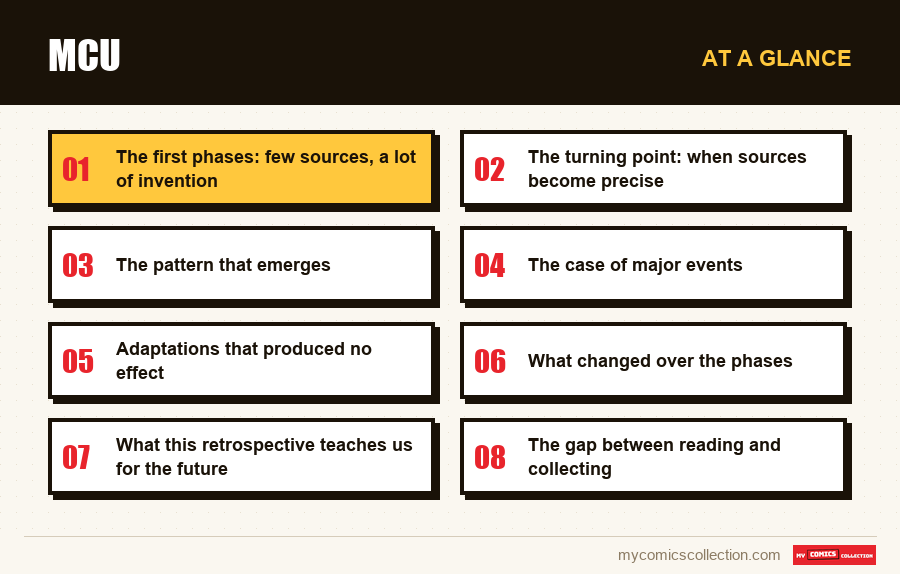
The first phases: few sources, a lot of invention
The beginnings draw relatively little from identified stories. Origin films tell origins, and an origin doesn't need a reference run: it's in the character's first issues, known to everyone.
Two notable exceptions all the same. The first film dedicated to the man in armor takes up the idea of a 2005 story about injected rather than coated armor, and its third part returns to it even more explicitly. And the first team-up film borrows heavily from a modern retelling of the group published in the early 2000s.
For a collector of the time, the effect was limited and diffuse. Without a named source, the request focused on the first appearances: already expensive, already identified, and therefore unlikely to constitute an opportunity.
The turning point: when sources become precise
The Winter Soldier → a 2005 run
The second film dedicated to the captain directly adapts the arc written by Ed Brubaker from 2005, which brings back a character that forty years of continuity had left dead.
This is one of the clearest cases: a precise, recent issue, which has become a sought-after item on the modern market.
The Civil War → a 2006 event
The third film of the same character takes the title and the device of an editorial event of 2006: a census law which divides the heroes into two camps.
The film deviates widely from the original story, but the source is explicitly claimed.
The goalkeepers → a run from 2008
The formation brought to the screen is not that of the 1960s but that recomposed in 2008 by Dan Abnett and Andy Lanning. The film adapts the latter, not the former.
The archer → a run from 2012
The TV series takes the tone, supporting character and even layout of Matt Fraction and David Aja's run: one of the most faithful adaptations of the entire set.
The pattern that emerges
Taken end to end, these choices draw a constant logic, and it contradicts what most collectors anticipated.
The screenwriters did not seek out the founding stories of the 1960s but modern rereadings, usually published in the twenty years preceding the film. The reason is simple: a recent story is already written for a contemporary readership, with a rhythm, a psychology and issues that are transposed without updating work.
This has a considerable consequence for the market. At the time these runs were chosen, their numbers were worth a few dollars and were found in abundance. The pieces that were to become sought-after were, at the decisive moment, absolutely banal.
And symmetrically, the first appearances of the 1960s, on which all the speculative attention was focused, moved much less than these recent issues in proportion, because they were already valued before the first film was released.
The rule to remember from twenty years of adaptations. What rises is not what is old, it is what suddenly becomes identifiable.
A 2005 booklet that no one was looking for becomes a target the day a film claims its arc. An already renowned 1963 booklet no longer has any room for discovery: its price has long since taken into account its importance.
The case of major events
One category of sources deserves separate treatment, because it behaves differently from all the others: editorial events adapted for the screen.
An event-a story that spans several series and involves the majority of the characters-was printed in considerable print runs. It is the format most ordered by booksellers, precisely because everyone buys it. Twenty or thirty years later, copies are still circulating massively.
Conséquence : adapting an event creates almost no tension. The public coming from the film looks for the story, immediately finds it in collections or in abundant booklets, and nothing comes up. It's the exact opposite of a twelve-issue confidential run.
There is one exception, and it is instructive: numbers where a personnage appears for the first time inside an event. These escape the rule, because their interest lies not in the event but in what they contain: a first appearance remains a first appearance, whatever the edition of the booklet which carries it.
Adaptations that produced no effect
Honesty requires pointing out the other half of the picture, which speculative articles readily ignore.
Several films and series have had no measurable effect on the comics they were inspired by. The reasons are repeated: either the source was never named publicly, or it was already widely available in a collection, or the project was poorly received and curiosity died down before reaching the booklets.
We must add a more subtle case: the adaptations which inventent the essential. A film that takes a character and writes a new story for him does not return any number, regardless of its success. The public leaves the room without knowing what to read, and the market does not move.
Of all the projects produced, the proportion of those which actually moved a price remains in the minority. This is a useful corrective to the idea that an adaptation is mechanically worth an increase.
Collecting this series?
Track what you own, what you are missing and what your collection is worth. 7 day trial.
Start my trial →What changed over the phases
Le passage aux séries
Series often adapt shorter, newer runs than films, making their sources easier to identify, and their numbers easier to find.
Multiple sources per project
Late drafts mix three or four runs. The demand is evenly dispersed, and no number focuses attention.
The generalization of collections
Recent sources are all available in volume. The public who came from the film bought these volumes, which were reprinted, and never increased in value.
Characters already adapted
Many figures return a second time on the screen. The discovery having already taken place, the effect of the second adaptation is significantly weaker.
What this retrospective teaches us for the future
The exercise is only of interest if it produces a method applicable to what is being built today. Three lessons emerge.
Look for the run, not the character. This is the central lesson. The strongest price movements concerned recent issues that had become identifiable, not first appearances that were already valued.
Be wary of what exists in collection. A run available in volume absorbs demand from the general public without the booklets moving. The relative rarity of the format matters as much as that of the content.
Check who named the source. The adaptations whose arc was publicly claimed produced clear effects; those where the source was inferred by commentators, much less.
These three points are transposed as they are to any universe being constructed, and they do not require any privileged information.
The gap between reading and collecting
A final observation, which follows from all of the above and which few articles make.
The runs that provided the best adaptations are also, very often, excellent reads, and they remain accessible. A run from 2005 or 2012 can be found in its entirety in a collection for the price of two used booklets, and it can be read without knowing the continuity that surrounds it.
Autrement dit, the best use of this cartography is not speculative but bibliographic. It indicates where there are stories that stand on their own, written for a modern reader, and validated by the fact that it was deemed useful to bring them to the screen.
A reader who follows this list without purchasing anything other than volumes gets a selection of remarkable quality for a modest budget. This is probably the most useful thing these twenty years of adaptations have produced for the French-speaking public.
What to record about these purchases
Buying adaptation sources creates an inventory problem that the classic collection does not pose: we acquire for a reason external to the story.
The run and its year. In this segment, belonging to a specific run is the information that determines the price: more than the character or the title of the series. An isolated booklet of a sought-after run is not valued like its first chapter.
The status of the number in this run. First chapter, appearance of a secondary character, or intermediate episode: these three positions do not react in the same way to an exit.
The format, and the existence of a collection. Knowing that a run is available in volume allows us to anticipate that the demand from the general public will never reach the booklets.
An inventory that covers these fields makes it possible to carry out, a few years later, the exercise that this article has just done on the scale of a universe: to note what has really changed, and why.
Frequently asked questions
Because a story written in the last twenty years is already aimed at a contemporary readership: its rhythm, its psychology and its issues are transposed without updating work. The founding stories from the 1960s, on the contrary, require a complete rewriting, which makes them less convenient as sources.
They have increased, but proportionally less than the recent fascicles that have suddenly become identifiable. A famous first appearance is already valued before any adaptation: its price has long taken into account its importance, and there is little room for discovery left.
No, and it’s even the opposite for a majority of them. An adaptation without a named source, a source already widely available in collection, or a poorly received project produces no measurable effect. The proportion of projects having actually moved a price remains in the minority.
Collections for reading, booklets for collecting, and the two should never be confused. The public coming from the cinema buys volumes en masse, which temporarily sells them out in bookstores without giving them the slightest resale value: they are reprinted.
It applies directly to it, since it is not based on any privileged information: look for the run rather than the character, check who named the source, and be wary of what already exists in the collection. These three reflexes arise before any purchase, on any ad.
The run matters more than the character
In this segment, an isolated booklet is not valued like the first chapter of an identified run.