The DCU does not draw from chance: each of its announced projects is based on an identifiable run, and knowing which one completely changes what to look for. Certains adaptent une minisérie précise: in which case the demand is concentrated on a few numbers. Others adapt a personnage without a reference text: in which case it is dispersed over decades. This distinction predicts market behavior better than any casting rumor.
An honest clarification before we begin: the calendar of a universe under construction is constantly moving. Announced projects are reordered, some change format along the way, others are abandoned without public explanation. This article therefore deliberately does not map release dates but sources, which they do not change.
This is also what makes it useful longer than a news article: a film can slip by two years or change director, but the run it is inspired by remains exactly the same and continues to designate the same numbers.
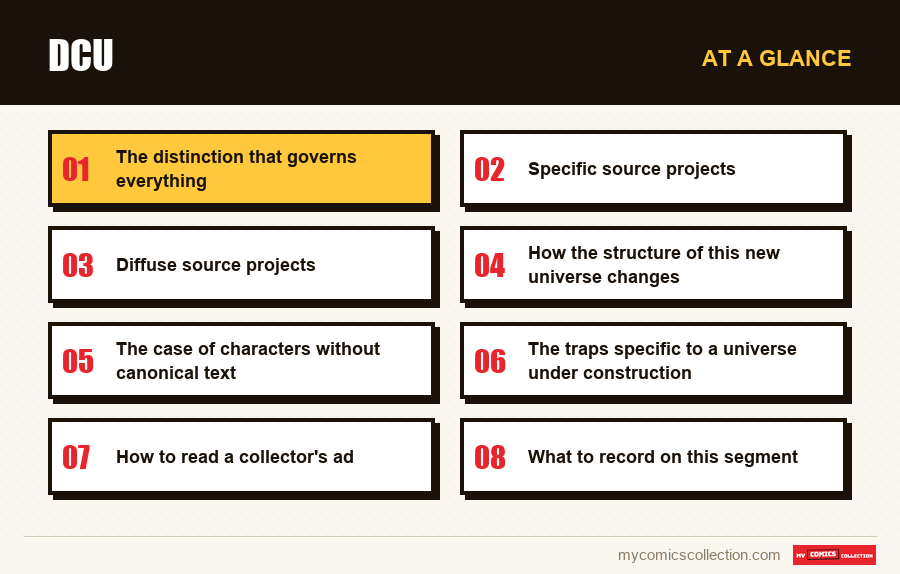
The distinction that governs everything
Before looking at project by project, we must make a difference that most speculation articles ignore.
Adapt a miniseries: a closed, signed story, published in a few issues: concentrates demand on these specific issues. Buyers who come from the film know what to look for, find it, and the offer is limited by nature since a miniseries only has a few issues.
Adapt a character without reference text disperses the request. Not knowing what to buy, the public falls back on the first appearance, often overpriced, or on collections. The effect on individual fascicles is weaker and more diffuse.
This distinction is verified constantly, and it gives a usable rule: the size of a market movement depends less on the popularity of the film than on the accuracy of its source.
Specific source projects
A recent miniseries adapted directly
The project dedicated to Superman's cousin is based on an eight-issue miniseries published in 2021-2022, written by Tom King and drawn by Bilquis Evely.
This is the clearest case of the lot: a recent, closed story, the title of which is cited as a source. The request has an identified subject.
A founding run of the 1990s
The project about the team from the WildStorm label refers to the run of Warren Ellis and Bryan Hitch, who redefined the presentation of the genre in the late 1990s.
Around twelve issues, a recognizable graphic identity, and a title that has long been confidential in France.
A father-son duo from a specific run
The project bringing together Batman and his son is based on the stories of Grant Morrison, who introduced the character of Damian Wayne in the mid-2000s.
Here the source is a long run rather than a miniseries, but its entry point is dated and identifiable.
A hero created in the 1980s
The project dedicated to the greedy time traveler refers to his creation by Dan Jurgens in 1986, and his subsequent characterization as a comic duo.
Two sources therefore, fifteen years apart, which do not call the same numbers.
Diffuse source projects
Other announcements do not refer to any single text, and this should be stated clearly rather than inventing a reference.
The Man of Steel film, released in 2025, was presented as drawing on several influences rather than an adaptation. The titles cited relate to stories that redefine the character (a story in twelve chapters by Grant Morrison and Frank Quitely, in particular) without any being transposed scene by scene.
For a collector, the consequence is direct: there is no obvious number to aim for here. The demand is spread across several collections, and the effect on period issues remains limited.
The same reasoning applies to projects devoted to creatures, teams or territories rather than an identified story. An announcement that does not name a run does not create a target, and it is infinitely better to observe this frankly than to create a source by deduction to give yourself something to buy.
This is actually the main service that an article of this type can provide: saying that there is nothing to aim for is useful information, whereas most publications on the subject feel obliged to offer a list no matter what.
The reflex that avoids most errors. Before buying based on an ad, find out if a specific run is cited by the authors of the project: not by speculation sites.
If so, the target is this run. If not, the ad says nothing about what you'll need to own, and waiting for the release is generally less expensive than betting on a deduction.
How the structure of this new universe changes
One point distinguishes this construction from those that preceded it, and it has consequences for a reader.
The announced projects cover very different registers: classic superhero, horror, comedy, military espionage. This is not a hesitation of editorial line but an assumed choice: the idea that a shared universe can accommodate different genres without standardizing them.
For those who go back to the comics, this means that the sources do not belong to the same market segment. A WildStorm run from the late 1990s, a 2021 miniseries, and a character from 1986 fall into three distinct collectible logics, with unrelated availability and pricing.
This has a practical advantage: there is no coherent “DCU collection” to build. We can follow one source and ignore the others without the whole appearing incomplete, which was not the case with universes built around a single continuity.
The case of characters without canonical text
Some of the announced projects concern figures that comics have used for decades without ever dedicating a reference story to them. This case deserves separate treatment, because it produces particular market behavior.
When a character doesn't have a canonical run, the demand born of an adaptation has nowhere to land. It then refers to two objects by default: the first appearance, often old and already expensive, and recent collections, which are reprinted and do not increase in value.
The result is a two-speed market. A number already identified as key before the announcement goes up again; the rest of the character's bibliography barely moves, even when it contains excellent stories.
For a reader, this is a rarely reported opportunity: the best stories of a character without a canonical text remain cheap after its adaptation, precisely because no one knows they exist. The film creates demand for a single item and leaves the rest untouched.
Collecting this series?
Track what you own, what you are missing and what your collection is worth. 7 day trial.
Start my trial →The traps specific to a universe under construction
Le calendrier bouge
Announced projects are reordered, postponed or abandoned. Buying in anticipation of a date amounts to betting on the most unstable information on file.
Sources reported are not as good as sources cited
Many “references” circulate without ever having been confirmed by anyone involved. The difference is decisive for who buys.
An adaptation can move away from its source
A run cited as an influence is not a scenario. The film can only maintain one tone, and demand falls once disappointment is noted.
The peak often precedes the release
Prices rise upon announcement and correct frequently afterwards. Buying at release is buying at the peak.
How to read a collector's ad
Three questions are enough to gauge what an ad actually entails, and they are asked in this order.
Is a run named, and by whom? A quote by the director or screenwriter is infinitely better than a commentator's deduction. Without a name, there is no target.
Is this run short or long? An eight-issue miniseries creates a rapid shortage; a run of fifty issues absorbs the demand without noticeable tension.
Is the text old or recent? A 2021 narrative was printed in the modern era and can be found in abundance. A 1999 run enjoyed larger print runs than you might think, but it had twenty-five years to disperse.
These three answers give a more reliable estimate than any numerical forecast, and they do not require any paid data.
A fourth question deserves to be added, less obvious: has the mentioned run already been adapted before? A text brought to the screen for the first time has generally had its key numbers identified and purchased on this occasion. The second pass then produces a much weaker effect, the discovery having already taken place: a factor that speculation articles almost systematically omit.
What to record on this segment
Collecting adaptation sources poses a particular inventory problem: we acquire objects for a reason external to the story itself.
The reason for the purchase, and its date. This is the most useful field and the one that no one fills in. Knowing in six months that a booklet was purchased when a project was announced allows us to measure what this anticipation really produced, and to adjust the next time.
The role of the number in the source. First chapter of a miniseries, appearance of a character, or simple episode of a mentioned run: these three statuses do not react in the same way to a release.
Le format. Booklet or collection. Regarding recent sources, most of the demand from the cinema public is for collections, which do not increase in value: information to be known before confusing popularity with rarity.
An inventory that has these fields answers the question every anticipatory buyer ends up asking: is my method working, or am I just remembering my good bets?
Questions fréquentes
Because it is constantly changing in a universe under construction, and a calendar article is out of date a few months after its publication. The sources do not change: a project can slip by two years, the run it is inspired by remains the same.
By checking who cited it. A reference stated by the director or screenwriter of the project has a value that a commentator's deduction does not have, and the distinction is decisive when one commits money. In the absence of a direct quote, it is better to assume that there is no identified source.
The price movement usually occurs on the announcement, with a frequent correction afterwards. Buying at the time of release therefore often means buying at the peak. That said, anticipation remains a bet: it assumes that the project succeeds, that it retains its source and that it is well received.
Booklets if the objective is collection, collections if the objective is reading. The public coming from the cinema buys collections en masse, which temporarily out of stock in bookstores without giving them any value: confusing this demand with a rarity is the most common error in this segment.
Not really, and that's actually good news. The announced sources fall into unrelated segments (a run from the late 1990s, a miniseries from 2021, a character from 1986) with very different prices and availability. We can therefore follow one source and ignore the others without the whole appearing incomplete.
Note why you bought, not just what
This is the only way to know, six months later, if your anticipation method really works.