In short
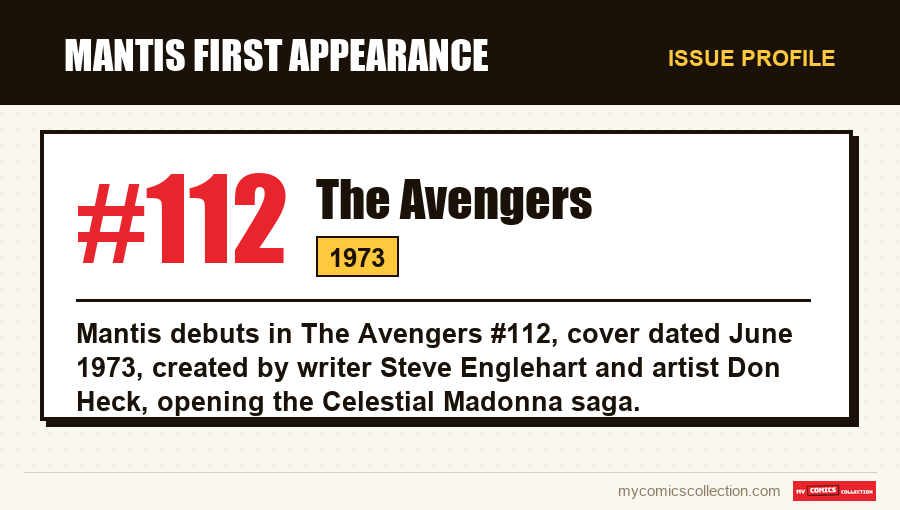
Mantis first appears in The Avengers #112, cover dated June 1973, created by writer Steve Englehart and artist Don Heck. The issue opens the "Celestial Madonna" saga. She enters as a barmaid in a Vietnamese tavern who helps the Avenger Swordsman recover his self-respect, then follows him toward the team. She is an acquaintance of the team here, not yet an ally.
Few debut issues carry as much hidden plot as The Avengers #112. On its surface it is a quiet character story about a fallen hero in a bar. Underneath, it plants the first piece of a mystery that Steve Englehart would pay off in a double wedding two years later. This guide covers the number, its credits, what it sets in motion, and how to buy a copy with care.
What was confirmed before writing: June 1973 as the date of #112, the Englehart and Heck credit, the dates of every later issue named, and the saga's turning points. The plot summary is kept brief, and the argument about why collectors chase this book is our own reasoning, with no market figure.
June 1973, Englehart and Heck: the credits in full
Volume one of The Avengers reached number 112 with a June 1973 cover date. Two creators are credited with the debut of Mantis: Steve Englehart as writer and Don Heck as artist. In a collection record, "Englehart, Heck" is the right credit line for the character, and the issue is the opening chapter of what became the Celestial Madonna saga.
The date fits the monthly rhythm of Englehart's tenure. His run on the series began with issue #105, dated November 1972, and ended with issue #152, dated October 1976. Counting forward month by month from #105 puts number 112 in June 1973, which matches the cover date, and the next landmark, issue #114 in August 1973, follows two months later.
Heck had a long history with the title before this issue. He took over as penciler from Jack Kirby with issue #9 in October 1964, the issue that introduced Wonder Man, and drew the series through issue #40 in May 1967. He returned to the title in the early 1970s, and his credits on the title include issues #108 through #112. So the number 112 also closes a stretch of Heck issues, which gives the book a place in discussions about the artist, not only the character.
One more credit worth noting is that Heck also drew the debut of Swordsman, the hero who anchors Mantis's first story. Swordsman first appears in The Avengers #19, dated August 1965, created by Stan Lee and Don Heck. The same artist therefore gave the world both halves of the pair, eight years apart.
How Mantis is introduced
The issue places Mantis in a tavern in Vietnam, where she works as a barmaid. There she meets Swordsman, who is at a low point in his career. She helps him regain his self-respect, and when he decides to rejoin the Avengers she follows him. That is the shape of her role in this debut: she stands at the center of a scene about another character's recovery.
Two details are worth fixing in your notes. The setting is a tavern in Vietnam, and Mantis's job there is that of a barmaid. Both facts are specific to this debut, and later stories build a much larger biography on top of them, so a catalog entry should keep the original scene separate from the later backstory.
Her connection to the team becomes official two issues later. Swordsman rejoins the Avengers in issue #114, dated August 1973, and Mantis becomes an ally of the group at that point. If you are assembling the story in sequence, issues #112 through #114 form a natural unit, with #112 as the debut and #114 as the return to the team.
It is worth restating where the saga goes from here. The "Celestial Madonna" name belongs to the storyline the issue opens, and the explanation arrives only in the 1974 and 1975 issues. A reader who stops at #112 has the introduction but not the answer, which is a good reason to plan the follow-up purchases in advance.
Who created her and in what editorial setting
Steve Englehart wrote the series for four years, and the Mantis storyline is among the longest threads of that run. The character is regarded as his creation, and he later reworked her for another publisher as the character Willow in Justice League of America #142. That later use is a footnote for collectors, but it shows how much of the concept belonged to the writer personally.
The setting is the Bronze Age of the title. Roy Thomas wrote the series before Englehart, and Gerry Conway followed him. Within Englehart's tenure, several large arcs shaped the book: "The Avengers Defenders War" in issues #115 to #118 (September to December 1973), which crossed into The Defenders #8 to #11; the Celestial Madonna saga in issues #129 to #135 (November 1974 to May 1975), with a companion strand in Giant-Size Avengers #2 to #4; and the Serpent Crown storyline in issues #141 to #144 and #147 to #149.
Seen against that list, issue #112 is the opening note of a long composition. The Defenders War follows the debut by a few months, and the Celestial Madonna payoff arrives after that. A reader who starts at #112 follows a thread that runs through the whole middle of Englehart's tenure.
For the artists who shaped this era of the title, the guide to The Avengers key artists sets Heck's work next to that of his predecessors and successors. For the broader run, the guide to Bronze Age key issues shows where number 112 sits among the other landmarks of the decade.
Why this number is a key issue
The case for this issue as a key rests on three supports: the character became a long-term fixture, the story it opens has a clear payoff, and the issue is a Bronze Age comic that is easiest to appreciate in sound condition.
The character support is straightforward. Mantis appears in Silver Surfer volume 3 #4 and #5 (1987) and #9 (1988), in West Coast Avengers volume 2 #37 (October 1988), and in the eight-issue Avengers: Celestial Quest (2001). In July 2008 she joins the cast of Guardians of the Galaxy volume 2 as a counselor on Knowhere, and she appears in Empyre: Avengers #1 in September 2020.
The screen support came in 2017, when Pom Klementieff played an adapted version of the character, as the daughter of Ego, in the film Guardians of the Galaxy Vol. 2, and again in Avengers: Infinity War in 2018. The film version differs from the comic book version, so a buyer should keep the two in separate mental boxes. The comics debut is the 1973 issue, and the comic character's backstory has nothing to do with Ego.
The story support is the quiet strength of the issue. The Celestial Madonna saga that begins here is resolved in the pages of the 1974 and 1975 issues: Mantis is revealed as the Celestial Madonna, Swordsman dies protecting her from Kang, and she marries a member of the Cotati. Because the payoff is clear, the debut is easy to explain to a new collector, which helps its standing as a conversation piece.
An honest assessment also needs a caution. Demand for the book spiked with the film, and that kind of attention can fade or return with the next adaptation. This guide makes no prediction either way. The method that holds up in any market is to buy the best copy you can afford and verify it, not to chase a headline.
Do you collect this series?
Track what you own, what you are missing and what your collection is worth. 7-day trial.
Start my trial →
Reprints and issues often confused with it
Because the debut sits in the middle of a saga, several neighboring issues are mistaken for it. The following list separates them.
- The Avengers #111. The issue before the debut. It does not introduce Mantis, so a listing that calls it the first appearance is wrong.
- The Avengers #114 (August 1973). The issue in which Swordsman rejoins the team and Mantis becomes an ally. It is an important follow-up and not the debut.
- Giant-Size Avengers #2 (November 1974). The issue in which Swordsman dies at Kang's hands while Mantis witnesses it. It is a story issue, not an introduction.
- Giant-Size Avengers #4 (June 1975). The wedding issue, in which Mantis marries a Cotati and the Vision weds the Scarlet Witch. Heck drew the grand finale of the saga.
- The 2008 Guardians of the Galaxy issue #1 (July 2008). The issue in which she joins that team. It belongs to the modern Guardians collection, not to the debut conversation.
When a listing says only "Mantis first appearance," confirm the series title, the number 112, and the June 1973 date before you do anything else. If any of those three details is missing from the description or the photographs, ask the seller.
For readers who want the story without the original comics, the Celestial Madonna saga has been collected in various editions over the years. Check the contents list of any edition against the issue numbers above, since collected editions of this era group the issues differently from one printing to the next.
Inspecting a 1973 copy before paying
These steps are method and not price guidance. They apply to most comics of the early 1970s.
Identify the book. Confirm the series name, the volume, the issue number 112, and the June 1973 cover date, and compare the cover to a trusted catalog image. A cover that does not match is a red flag.
Check for the usual Bronze Age faults. Look for spine stress lines, corner blunting, cover creases, staple rust, and tanned pages. Comics of this period often show subtle color breaks along the spine, so ask for a photograph taken in raking light.
Look for restoration and cleaning. A copy that looks very bright for its age deserves a question. Color touch, pressed creases, and cleaned covers are possible, and they must be disclosed.
Read the label of a graded copy. Confirm that the title, number, and date on the label match the book, note any remark about page quality or restoration, and verify the certification number with the grading service itself before paying.
Check completeness. Make sure the cover is attached, the interior pages are secure, and no page has been cut or removed.
Mind the seller's wording. Phrases such as "high grade" or "well preserved" are opinions. Ask for dimensions of defects, photographs of the back cover, and the return policy.
The guides to fakes and reprints and to grading explain how to apply those checks to a full run of the title.
The later issues that matter next
After #112, a collector tracing the character can follow a short, checked list.
- The Avengers #114 (August 1973). Swordsman rejoins the team and Mantis becomes an ally. A direct continuation of the debut.
- Giant-Size Avengers #2 (November 1974). Swordsman dies at Kang's hands, and Mantis witnesses his death. The guide to Kang the Conqueror places his role in this story among his larger appearances.
- The Avengers #129 to #135 (November 1974 to May 1975). The main storyline of the Celestial Madonna arc, with companion issues in the giant-size series.
- Giant-Size Avengers #4 (June 1975). Mantis marries a Cotati, and the Vision marries the Scarlet Witch. The guide to the Scarlet Witch follows that second wedding from her side.
- West Coast Avengers volume 2 #37 (October 1988). The story in which her psyche fractures into multiple versions.
A reader who prefers the modern team can skip ahead to volume 2 of Guardians of the Galaxy, issue #1 of July 2008, where she settles on Knowhere; the best Guardians runs serve as a map.
Frequently asked questions
Mantis first appears in The Avengers #112, cover dated June 1973, created by writer Steve Englehart and artist Don Heck. The issue begins the "Celestial Madonna" saga and introduces her as a barmaid in a Vietnamese tavern who helps Swordsman regain his self-respect.
No. In issue #112 she is a new acquaintance who follows Swordsman toward the team. She becomes an ally of the Avengers when Swordsman rejoins in issue #114, dated August 1973. Treat #112 as her introduction and #114 as her first step into the group.
The film character, played by Pom Klementieff in Guardians of the Galaxy Vol. 2 (2017) and Avengers: Infinity War (2018), is an adapted version, shown as the daughter of Ego. The comic character debuts in The Avengers #112 in 1973 and has a different backstory.
Don Heck drew the issue, written by Steve Englehart. Heck had penciled the series earlier, from issue #9 in 1964 through issue #40 in 1967, and returned for full art on issues #108 to #112. He also helped create Swordsman, who first appears in issue #19 in 1965.
The main arc runs in The Avengers #129 to #135, dated November 1974 to May 1975, with companion issues in Giant-Size Avengers #2 to #4. Don Heck drew the grand finale, which includes a double wedding: Mantis marries a Cotati and the Vision marries the Scarlet Witch.
Own The Avengers #112 or another Englehart-era issue and want to know where your copy stands?
Estimate my comic