A French booklet stamped “extra-series” and bearing the number 34 is not an exceptional publication: it is the thirty-fourth episode of a parallel line which regularly appears alongside the main series. The French statement of August 30, 2026, in euros, shows in five advertisements three competing numbers of the same title (a second volume, a third series and a special line) for a request "Spider-Man Panini France" which has 192 advertisements, with a minimum of €2.50, a median of €4.20 and a maximum of €75.00. These amounts are those claimed by sellers that day, not completed transactions, and none of these 192 listings relate to a verified copy. Practical consequence: the number written on the cover is never enough to identify a French issue, and the publication date to the nearest month remains the only reliable key to organizing a collection.
The word “special issue” in French carries a promise of exception. He evokes the number that we will only see once, the commemorative album, the print detached from the ordinary calendar. In comics publishing in France, this reading is almost always false. A special issue most often refers to a second periodical publication, launched in parallel with the main title, with its own rhythm, its own summary and, this is the point that counts for a collector, its own numbering starting from 1. This line does not stop after a publication: it advances month after month and ends up accumulating dozens of issues. The statement of August 30, 2026 provides a direct demonstration of this, with an advertisement describing a “Spider-Man Special Edition No. 34” dated May 2011, offered at €3.00. Thirty-four issues, it's not an exception: it's a series in its own right that ran for years.
This confusion has very concrete consequences as soon as we keep an inventory. A French collection of comics is not a series of integers: it is a stack of publication lines which all reuse the same title name and which all start their counting again from zero. The characters revolving around the Spider-Man universe, including Madame Web, appear throughout these lines without any number alone allowing us to know which one we are in. The collector who notes “No. 34” in his table has not recorded information: he has recorded an ambiguity. This article uses the French statement of August 30, 2026 to show what this ambiguity costs, and what to replace it with.
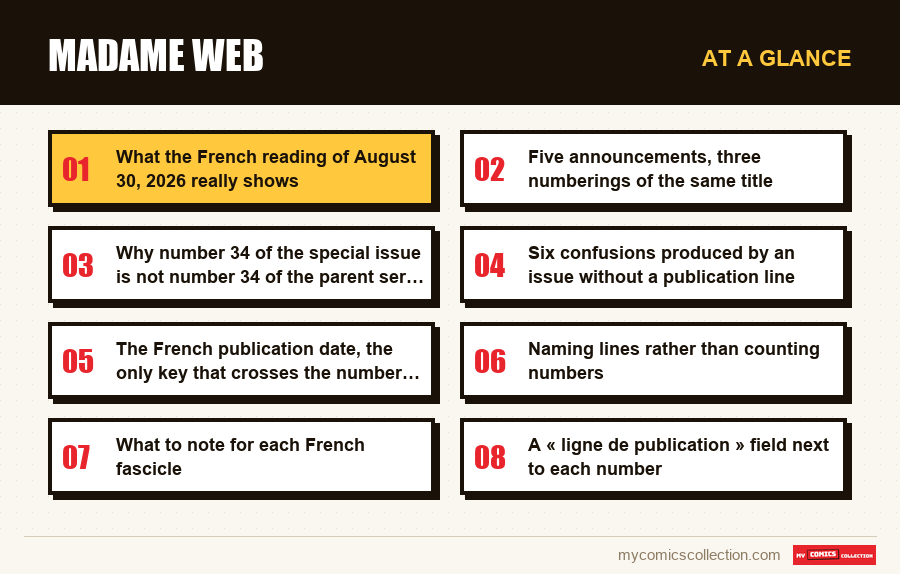
What the French reading of August 30, 2026 really shows
A clarification of method is necessary before any comment, because it changes the scope of each figure cited here. Unlike the usual American statements on this site, this one relates to the French market and the amounts are expressed in euros. These are sums displayed by sellers on August 30, 2026, that is to say requests, and not sums actually collected: no one paid these prices, they were only claimed. The 192 ads for the query “Spider-Man Panini France” are distributed between a minimum of €2.50 and a maximum of €75.00, with a median of €4.20. A statement taken on a single date cannot show any evolution: there is no previous measurement with which to compare these amounts, so no trend can be deduced, either upwards or downwards. As for the maximum of €75.00, it says nothing about the market: it indicates what a seller hopes to obtain, at thirty times the median, and there is nothing to confirm that anyone will give it to him.
Five announcements, three numberings of the same title
A special issue arriving at No. 34
« SPIDER-MAN Hors Série N° 34 Marvel France comics Panini mai 2011 », claimed €3.00. Thirty-four accumulated issues indicate a periodic line established over time, not a one-off publication. The word « hors-série » here qualifies the relationship to the main title, not the rarity of the object.
A n° 33 in a second volume
“SPIDER-MAN N°33 Le Grand Jour (V2 Panini 2002)”, fetched €2.75. The mention V2 indicates a numbering starting from 1 for a new volume. This 33 and the 33 of any other line of the same title are two unrelated objects, separated by years and by an entirely different summary.
A No. 10 in a third series
« SPIDER-MAN N° 10 Marvel France 3ème Série Panini Avril 2013 », claimed €3.00. The seller specifies « 3ème Série » because he knows that the number alone would be unusable. This is the third start from scratch documented by this single survey of five announcements.
Two numbers without declared line
« Panini comics Marvel Spider-man #103 Aout 2008 » at €2.50 and « BD/Comics: Spider-man - #108 - Panini Comics » at €2.80 indicate no post line. The first is dated to the nearest month, the second has neither month nor year: it is the least situable announcement of the five.
Five announcements are therefore enough to reveal three distinct numbers of the same title: a second volume, a third series, a special line. This is not a borderline case nor an archivist's curiosity, it is the ordinary structure of French comics publication, where a successful title is relaunched, declined and doubled over the years. It should be added that five advertisements constitute a very small number, and that no conclusion on a price level can be drawn from it: these five lines are used here to document an editorial organization, not to establish a value. What they firmly establish, on the other hand, is that a number written on a French cover only has meaning in relation to its line of belonging.
Of the 192 advertisements noted, none concerns a verified copy. In this market, the publication line to which a booklet belongs is therefore attested by nothing other than the description written by the seller. There is no third party that confirms that a “special issue no. 34” is indeed what its title announces.
This absence does not invalidate the advertisements: it shifts the burden of proof to the buyer. A legible photo of the cover and the title, where the line mention, the month and the year appear, replaces here the certificate which does not exist. Without these elements, an announced number remains an unverified statement.
Why number 34 of the special issue is not number 34 of the parent series
Two issues bearing the same number but belonging to two different lines have no common property. They do not appear in the same year, do not contain the same episodes, do not cost the same cover price, and are not necessarily aimed at the same readership. The number 34 describes a position within a sequence, and a position only has meaning once the sequence is named. Writing “34” without naming the sequence is like writing “third” without saying third of what.
The mechanism is all the more tricky as the two lines coexist over time. A special issue does not follow the main series: it appears alongside it, in the same points of sale, often with a similar model. In a given month, a reader could take home two fascicles with the same title name, one belonging to the regular series and the other to the parallel line, with two numbers with no connection between them. Thirty years later, these two objects are found in the same box, and nothing on the edge says which one belongs to which.
An inventory line that only retains the number silently merges these two objects. The collector thinks he has one number when he has another; he believes he has a gap in his series even though the missing issue belongs to a line that he does not collect; he buys back a number that he already has because the seller's description mentions a line that he had not noted. None of these errors are noticed: they produce an inventory that looks coherent and describes a collection that does not exist.
The remedy is not to memorize the editorial history of each title, an impossible task on the scale of an entire collection. It consists of treating the publication line as a field in its own right, with the same rank as the number. “Special issue 34” is complete data; “34” is not one of them. This discipline costs a few seconds per entry for entry and permanently eliminates an entire family of errors.
Six confusions produced by an issue without a publication line
Search finds nothing
Searching for « n° 34 » in an inventory that mixes three numberings returns several unrelated issues, or none if the line was entered otherwise. The search field becomes unusable exactly when it would be useful.
L'ordre chronologique s'effondre
Sorting by ascending number places the 10 of the third series before the 33 of the second volume, while the first was published in 2013 and the second in 2002. Sorting produces a reverse chronology without warning of anything.
Le doublon invisible
Two issues from different lines with the same number trigger an unwarranted duplicate alert, or worse, are merged into a single entry. A copy then disappears from the inventory while remaining in the box.
L'achat en double
When faced with an ad mentioning a line missing from the inventory, it becomes impossible to know if the booklet is already owned. Doubt pushes you either to repurchase or to let a truly missing number pass.
The false hole in the series
A sequence that jumps from 33 to 35 seems incomplete, while 34 perhaps belonged to another line never collected. The list of gaps fills up with objectives that are not objectives.
L'ordre de lecture faussé
Reading a French set in the order of numbers, all lines combined, does not restore any continuous story. The episodes clash, and the confusion is attributed to the original writing rather than the classification.
Collecting this series?
Track what you own, what you are missing and what your collection is worth. 7 day trial.
Start my trial →The French publication date, the only key that crosses the numberings
Four of the five announcements noted bear a French date to the nearest month: August 2008, May 2011, April 2013, and the year 2002 for the second volume. This precision is not anecdotal, because the date is the only attribute which keeps the same meaning from one line to another. A month of publication never starts from scratch. He orders a special issue, a second volume and a third series on the same axis, without any knowledge of editorial history being necessary.
An inventory built on the date behaves differently from an inventory built on the number. Chronological sorting becomes exact again regardless of the mixed rows. Issues from the same period naturally group together, which reflects the real experience of the reader of the time, who bought on newsstands what appeared that month, without worrying about which line contained which numbering. The gaps become readable as empty periods rather than as absent integers.
The date also makes the announcements comparable to each other. Two issues described by different sellers, with different title conventions, become identifiable once the month and year are given: a “special issue” from May 2011 is a unique object, while a “no. 34” is not. This is precisely why serious sellers list it, four out of five here, and why the fifth ad, the one which indicates neither month nor year, is the most difficult to attach to anything despite a perfectly ordinary asking price of €2.80.
The fact remains that the date, like the rest, is only stated here by the seller. With zero copies verified out of 192 advertisements, nothing corroborates it from the outside. It is simply the easiest information to check yourself: it appears in the title of the booklet, and a photo is enough to confirm it. It is this practical verifiability, as much as its neutrality with regard to numbering, which makes it the best key available on this market.
Naming lines rather than counting numbers
A bearer title mechanically produces several publication lines over time, and the August 30, 2026 statement catches three at once for a single title name. The right reaction is not to find out which one is “the real one”: they all are, each in its own context. The correct reaction is to consider that the name of the title is never enough to locate a number, and that it is necessary to systematically add the missing marker.
This rule changes the way we read an ad. A description which specifies “V2”, “3rd Series” or “Special Edition” is no more talkative than another: it is simply complete, and it deserves to be preferred to a description which is satisfied with a crossbar followed by a number. At an equivalent asking price, and these five advertisements range from €2.50 to €3.00, a negligible difference: the advertisement which names its line is better than the one which does not name it, because it is the only one of the two to describe an identifiable object.
For a character whose appearances are scattered, such as Madame Web's reading thread shows, this requirement becomes decisive. Following such a character through the French edition requires knowing in which line each appearance was published, otherwise the list of booklets to find is filled with references that point to nothing. The same problem arises, on another scale, for the editorial history of the main Spider-Man title, whose French translations are spread over several successive lines.
Finally, this rigor protects against frequent disappointment among readers who come through the film adaptation. Those who discover the character through the comparison between the 2024 film and the comics often look for “the” corresponding French number, when what they are looking for is distributed between several lines, on several dates, under several numberings. Understanding publication structure before looking for a number saves months of misdirected research.
What to note for each French fascicle
La ligne de publication. This is the field that is most often lacking and most seriously lacking. Note explicitly whether it is the main series, a special issue, a numbered volume (“V2”) or a numbered series (“3rd Series”), repeating word for word the statement printed on the cover rather than a personal reformulation. Without this field, the number that accompanies it does not designate any specific object, as shown by the three numberings coexisting in a statement of five advertisements.
The month and year of French publication. Not the American date of the content, not the year alone when the month is available: the exact mention made by the French edition, such as "May 2011" or "April 2013". It appears in four out of five advertisements, it appears in the title of the booklet, it is independent of any numbering, and it is on it that the chronological sorting of the entire collection must be based.
The episode title when printed. The announcement of the second volume bears the mention "Le Grand Jour" in addition to its number, and this character string is a much more discriminating identifier than the number 33. Copy this title as is: it allows you to recognize a booklet in a photo, to find it in a textual search, and to remove the ambiguity when two lines compete for the same number.
The publisher and the original mention. The five advertisements cite a publisher, and some add a mention of French collection. This information conditions the very existence of the lines: a change of publisher or editorial program is precisely what triggers the numbering restarts. Noting the editor means giving yourself the means to explain later why one sequence ends abruptly and why another begins at 1.
The price paid, shipping included. Record what the booklet actually cost you after shipping is added, not the amount shown in the ad. In this market where the median of requests stands at €4.20 and where the minimum drops to €2.50, shipping can represent a majority share of the actual expense. It is also the only numerical data in your inventory which corresponds to a completed transaction, while all the values recorded on August 30, 2026 are only requests from sellers.
No. The statement of August 30, 2026 contains a special issue at number 34, which reflects a regular publication spread over time, and its claimed price of €3.00 is in the same range as the other announcements noted, between €2.50 and €3.00. The term describes the publication's position in relation to the main title, not its circulation or availability. No conclusion on rarity can be drawn from five announcements, numbers far too small for that.
The mention appears on the cover or in the masthead, with the French publication date. Look for an indication of the type “special issue”, a volume number or a mention of a series, then note the month and year which accompany it. If the cover bears nothing of the sort, the date alone is enough to place the issue in time, which is already essential for ordering a collection.
Because this statement relates to the French market, unlike the American measurements usually published here. The 192 advertisements recorded on August 30, 2026 concern French editions sold in France, and their amounts are displayed in euros. They are therefore not comparable to the dollar statements for the original editions, which are subject to different supply, demand and shipping costs.
Of the 192 advertisements, none concerns a copy passed by a verification body. In practice, anything stated on the posting line, date or condition is based solely on the seller's description. It is therefore up to the buyer to ask for clear photos of the cover and the bear, which are the only parts allowing you to check what is advertised yourself.
No. This amount is the highest claimed among the 192 announcements on August 30, 2026, compared to a median of €4.20. An isolated extreme reflects the expectation of a seller at the time he writes his ad, not an amount that a buyer would have agreed to pay. None of these values correspond to a concluded transaction, and a measurement taken on a single date does not allow any movement to be confirmed, in one direction or the other.
A « ligne de publication » field next to each number
Record the line, the month of French publication, the episode title and the price paid including shipping for each issue, and your numbers cease to be ambiguous. My Comics Collection allows you to keep this inventory, sort it by actual date rather than by number, and identify at a glance the issues whose line has never been filled in.