In short
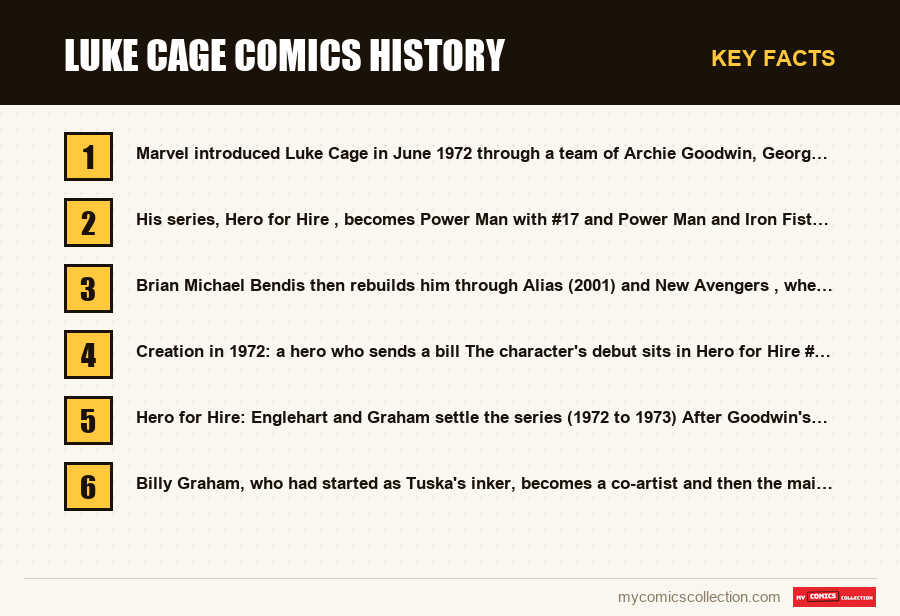
Marvel introduced Luke Cage in June 1972 through a team of Archie Goodwin, George Tuska, Roy Thomas and John Romita Sr. His series, Hero for Hire, becomes Power Man with #17 and Power Man and Iron Fist with #50, running to #125 in 1986. Brian Michael Bendis then rebuilds him through Alias (2001) and New Avengers, where he joins the Avengers, marries Jessica Jones and later leads the team.
Luke Cage is a character who has been written out of fashion, written back in and rewritten by a different kind of writer each time. He starts as a street-level hero for hire, becomes half of a long-running partnership, almost disappears in the 1990s and returns as one of the anchors of the Avengers. Following that trajectory is a way of following Marvel's changing idea of what a New York hero is for.
The dates, issue numbers and creator credits in each period below were matched to a published publication history of the character; anything that could not be confirmed, such as the exact issue of some team debuts, was left out, and the explanation of what each period changes for Cage is analysis.
Creation in 1972: a hero who sends a bill
The character's debut sits in Hero for Hire #1, dated June 1972. Archie Goodwin, George Tuska, Roy Thomas and John Romita Sr. are all credited in the character's creation, with Romita designing him and Tuska becoming the series' main artist. Goodwin wrote the opening four issues, Tuska penciled and Billy Graham inked.
In that issue the wrongly convicted Carl Lucas, held at Seagate Prison, undergoes Dr. Noah Burstein's experiment, escapes to New York and takes the name Luke Cage. He then sells his services as a hero for hire, the concept that gives the series its title. For the later history, the important feature is that Cage's heroism begins as a job, with a client and an invoice. That transactional start explains much of the character's later relationship with the Avengers, which is a decision to give up the invoice. The dedicated first appearance guide goes deeper on the issue itself.
Hero for Hire: Englehart and Graham settle the series (1972 to 1973)
After Goodwin's four issues, Steve Englehart takes over as writer from #5. Billy Graham, who had started as Tuska's inker, becomes a co-artist and then the main artist from #13 in 1973. The series is still finding its tone: the change of writer at #5 and the change of artist by #13 mark the two steps by which the opening creative team gives way to a second one.
Cage also begins to appear outside his own book. He guest-stars in The Amazing Spider-Man #123 (1973), illustrated by Gil Kane and John Romita Sr. A collector reading the character in order should treat that issue as a crossing point: it is the moment where the hero for hire is shown to share a city with Spider-Man, and the series' street-level world starts to connect to the rest of the Marvel line.
Power Man: a new name and a rotating cast of writers (1974 to 1977)
With #17 in 1974 the series is renamed Power Man, and the numbering carries on from the earlier run. The practical lesson for a collector is that the same continuous sequence appears under more than one title, and a listing may name only one of them. Cage himself changes less than the name suggests; the new title shifts the emphasis from the hire concept to the hero's strength.
The series also passes through several writers in these years. Don McGregor writes #28 and #30 to #35, and Marv Wolfman becomes writer from #36 in 1976. In the same year Cage fills in for the Thing in Fantastic Four #168, a stint that puts him on a team book. Chris Claremont and John Byrne later become the series' creative team. The era is uneven but productive, and it supplies the connections that will matter when Cage joins a team in the 2000s.
Power Man and Iron Fist: a partnership that outlasts the premise (1978 to 1986)
Danny Rand's Iron Fist joins as co-star at #48, and #50 in 1978 puts both names on the cover. The pairing changes the series from a solo book about a hero for hire to a buddy comic about two men with different temperaments and a shared business. For readers who know the characters only from later decades, this run is where the idea of Cage and Danny Rand as partners is established.
The creative teams rotate through the 1980s. Jo Duffy writes from #56 and remains until #84 in 1982, with Kerry Gammill and then Denys Cowan among the artists of her run. Kurt Busiek writes the series in 1983 and 1984. Christopher Priest writes #111 to #125, with M. D. Bright as artist for the closing stretch, and the series is cancelled with #125 in 1986. That is a fourteen-year run under one continuous numbering, and for a collector it is the long middle of the character's history.
The quiet years: Cage, Marvels and Heroes for Hire (1992 to 1996)
After the cancellation Cage is used less often, and the next decade is marked by attempts to find a new format for him. Cage (1992) runs twenty issues. In Marvels (1994), Alex Ross uses the actor Jim Brown as a model for Cage's design, a detail that ties the character's look to a specific model. Heroes for Hire (1996) revives the Cage and Iron Fist pairing and is cancelled after nineteen issues.
What these years show is that the character is considered valuable but not yet reimagined. Each format returns to a version of the 1970s premise, and none stays on the shelves long. The period reads as a long wait for a writer who would reconceive him.
Alias and Cage: the character is rebuilt (2001 to 2002)
That writer is Brian Michael Bendis. In Alias (2001), Bendis redesigns Cage as a supporting character and as the romantic interest of Jessica Jones. The change keeps the powers and the history but alters the tone: the former hero for hire is now a supporting presence in another character's story.
The following year Brian Azzarello, Richard Corben and José Villarrubia create Cage (2002) for Marvel's Max imprint, a different take on the character for an adult audience. The two projects are very different in style, but together they mark the end of the quiet period. After 2001, the question facing Marvel is no longer whether Cage can sustain a series but how to use a character who has been made newly relevant.
Do you collect this series?
Track what you own, what you are missing and what your collection is worth. 7-day trial.
Start my trial →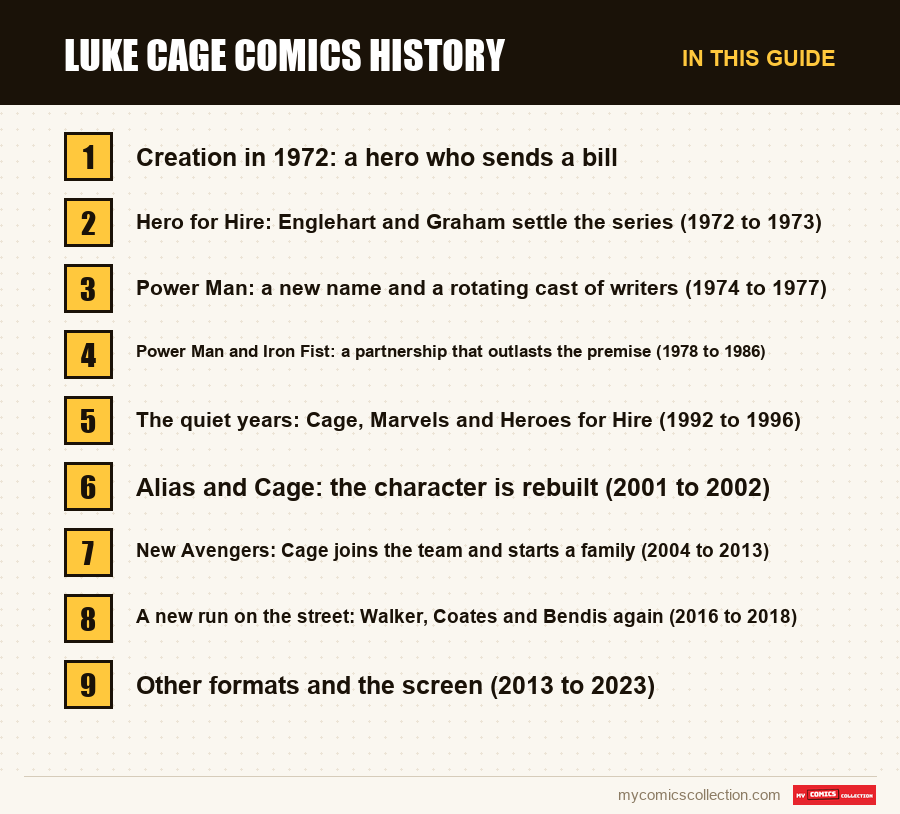
New Avengers: Cage joins the team and starts a family (2004 to 2013)
Bendis then makes Cage a main character in New Avengers, which runs from 2004 to 2010, and puts him on the team. Cage shaves his head in issue #2, a visual change that has defined the look of the character for readers who came to him in the 2000s. The decision to put him on the Avengers roster moves Cage from the edge of the Marvel universe to its center, and it is the long consequence of the transactional premise from 1972: he becomes a hero who no longer sends a bill.
The personal story runs through other books. In The Pulse (from 2004), issues #11 to #14 (2005 to 2006) cover the birth of the daughter of Cage and Jessica Jones. The New Avengers Annual #1 (2006) covers the wedding. House of M: Avengers (2008) and Luke Cage Noir (2009 to 2010) follow, and The New Avengers: Finale (2010) closes the original series. When The New Avengers relaunches in 2010, Cage is the team leader. Later he appears in The Mighty Avengers and Captain America and the Mighty Avengers from 2013 to 2015.
A new run on the street: Walker, Coates and Bendis again (2016 to 2018)
In 2016 Power Man and Iron Fist returns with David F. Walker as writer and Sanford Greene as artist, a revival of the title that defined the 1980s. Walker then writes Luke Cage in 2017, with Nelson Blake involved in the arc Sins of the Father. The series moves into the Marvel Legacy renumbering, and the arc Caged covers #166 to #170, with Guillermo Sanna and Marcio Menyz as artists. The series is cancelled after #170 in 2018.
Cage also appears elsewhere. In 2017, The Defenders comes from Brian Michael Bendis and David Marquez, and The Crew is written by Ta-Nehisi Coates. The Legacy numbering is worth noting for a collector: because the 2017 series carries a count that reaches back through earlier volumes, a listing for Luke Cage #166 refers to a 2017 comic, not a 1970s one.
Other formats and the screen (2013 to 2023)
Alongside the main line, Cage has been published in a number of one-off and limited formats. Avengers Origins: Luke Cage (2013) is written by Michael Benson and Adam Glass. CAGE! by Genndy Tartakovsky (2016) is a comic take on the character. Luke Cage: Everyman (2018) is a Marvel Digital Original written by Anthony Del Col with art by Jahnoy Lindsay. Luke Cage: Gang War (2023) is written by Rodney Barnes with art by Ramon Bachs, and follows Cage's time as mayor.
The character also reaches a larger audience through live-action television. The comparison of the series with its source comics sets out how the screen version draws on this long history. The effect for a collector is to widen the audience for the 1970s books without changing which issues matter.
The key issues across his history
- Luke Cage, Hero for Hire #1 (1972): the debut, written by Archie Goodwin and drawn by George Tuska, with Billy Graham inking.
- The Amazing Spider-Man #123 (1973): Cage guest-stars, illustrated by Gil Kane and John Romita Sr.
- Power Man #17 (1974): the series takes the Power Man title and keeps its numbering.
- Fantastic Four #168 (1976): Cage fills in for the Thing.
- Power Man and Iron Fist #50 (1978): the title takes both names after Iron Fist becomes co-star in #48.
- Power Man and Iron Fist #125 (1986): the final issue of the long numbered run.
- Alias (2001): Brian Michael Bendis redesigns Cage as Jessica Jones's romantic interest.
- The New Avengers Annual #1 (2006): Cage and Jessica Jones marry.
How to follow Luke Cage in a collection
Begin with the debut and the numbered run, treating Hero for Hire, Power Man and Power Man and Iron Fist as a single sequence from #1 to #125. When you search, use all three titles, because a seller may list only the one printed on the cover of that issue. Then decide whether to follow the story forward in publication order or by creator: the Bendis material from Alias into New Avengers reads best as one stretch.
The main trap is the number of titles that share the name. The 1970s and 1980s run, the 1992 Cage, the 2002 Cage and the 2017 Luke Cage are all different publications, and the Legacy numbering means a modern issue can carry a number as high as #166. For a reading list built on quality rather than date, the guide to where to start with Luke Cage picks entry points, while this page keeps to publication order. For the team side of the story, the Avengers hub collects the books where he serves.
Frequently asked questions
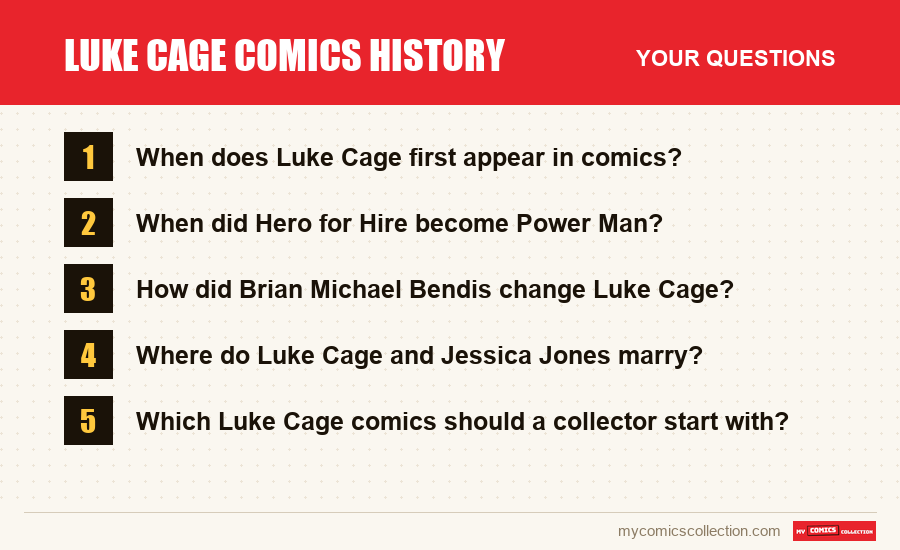
Cage debuts in the June 1972 cover-dated Hero for Hire #1. Archie Goodwin wrote the opening issues, George Tuska penciled and Billy Graham inked, and John Romita Sr. designed the character. Roy Thomas is also credited among the creators.
The 1974 renaming to Power Man happens at #17 and the count simply continues. Iron Fist joins at #48, and in 1978 #50 makes the title Power Man and Iron Fist. The numbered run ends with #125 in 1986.
In Alias (2001), Bendis redesigned Cage as a supporting character and the romantic interest of Jessica Jones. In New Avengers, which ran from 2004 to 2010, he made Cage a main character and a member of the Avengers, and he later led the relaunched team.
The wedding is in The New Avengers Annual #1 (2006). Their daughter's birth is covered earlier in The Pulse issues #11 to #14, published in 2005 and 2006, so the family story starts before the ceremony.
Start with Luke Cage, Hero for Hire #1 and the numbered run to #125 under all three titles. Then add Bendis's Alias and New Avengers, and the 2016 Power Man and Iron Fist and 2017 Luke Cage by David F. Walker for the recent chapter.
If a Hero for Hire #1 or a Power Man and Iron Fist issue sits in your collection, a quick valuation shows where it stands.
Estimate my comic