To read the best Luke Cage comics, start with Hero for Hire #1-4 (1972), where Archie Goodwin and George Tuska set up the hero for hire, then move on to Power Man #48-50 (1977-1978), which gives him Iron Fist as a partner. Today's readers will find their easiest way in with Power Man and Iron Fist by David F. Walker and Sanford Greene (2016). For collectors, the key issue is Hero for Hire #1, his first appearance, cover-dated June 1972.
Luke Cage has crossed five decades without ever settling into a single genre: a blaxploitation hero in 1972, half of a comedic duo in the late 1970s, an adult and dark figure under Brian Azzarello, then a team pillar with the Avengers. That variety makes choosing a first read less obvious than it looks, and that is what this ranking tries to settle.
As always in this guide, only verified information (creators, issue numbers, dates) is stated as fact; the analysis is our own, with no reproduction of protected art or dialogue.
His first appearance
Luke Cage is born in Hero for Hire #1, cover-dated June 1972. Archie Goodwin writes the issue, George Tuska draws it, Billy Graham inks it and John Romita Sr. provides the cover. The story follows Carl Lucas, a wrongly accused prisoner who comes out of an experiment run in his prison with skin that blows cannot dent, then settles in New York as Luke Cage to offer his services for pay.
The period is precise: Goodwin and Tuska sign issues #1-3, Goodwin stays on script for issue #4 with Billy Graham on art, and Steve Englehart takes over starting with issue #5. The series changes its title with issue #17 to become Power Man. Our page devoted to this first issue details how to identify the copy; here, we focus on what to read next.
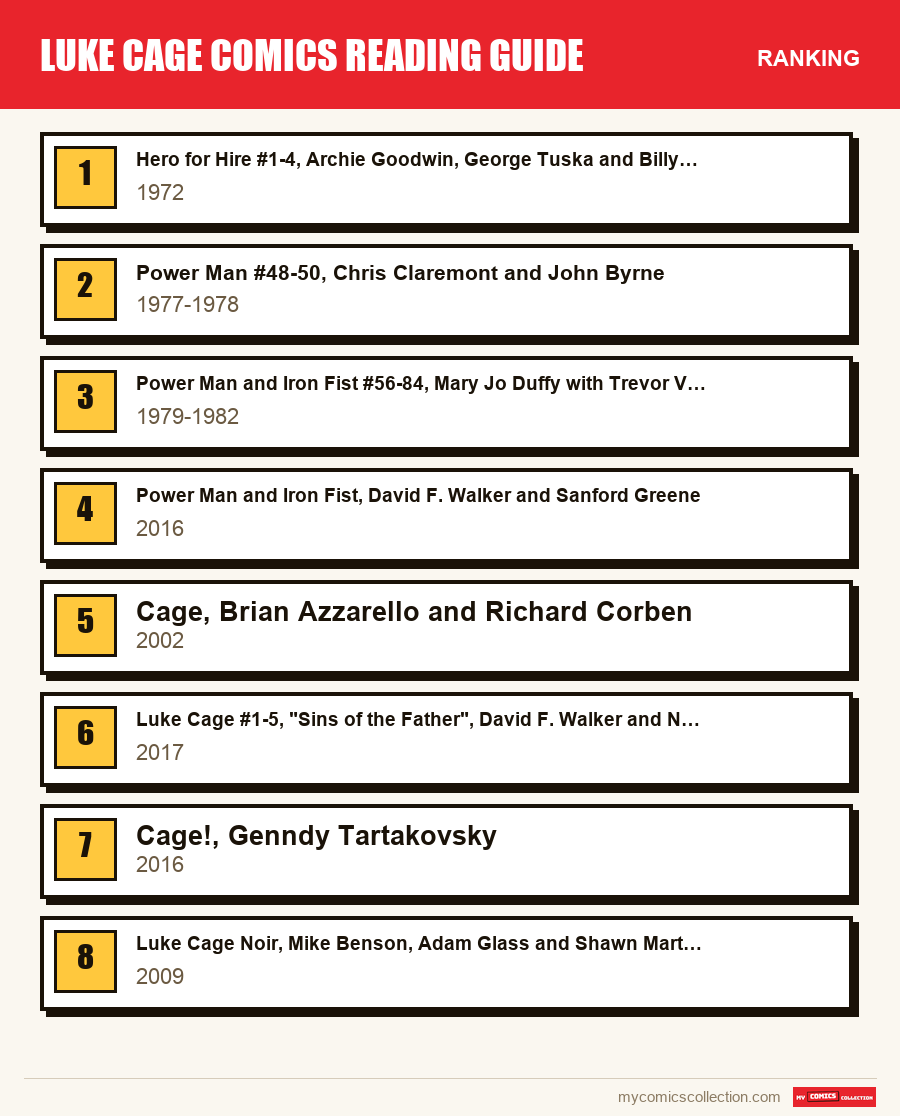
1: Hero for Hire #1-4, Archie Goodwin, George Tuska and Billy Graham (1972)
These four single issues are the foundation. Goodwin sets up the setup that still defines Cage: an ex-convict who sells his strength, in New York. His original enemy, Willis Stryker, is the former friend who got him convicted, and Doctor Noah Burstein, who was in charge of the experiment, will become a recurring figure in his mythology.
The style is that of 1972: abundant captions and Tuska's layouts, more classic than daring. These four issues ask a little indulgence from today's reader, but they show the character as he was first conceived, before any reinterpretation.
Who is it for? Readers who like going back to the source and Bronze Age collectors. How to read it? In one sitting, from issue #1 to issue #4, and stop there: it is with Steve Englehart, starting with issue #5, that the series takes on a different look, more serialized.
2: Power Man #48-50, Chris Claremont and John Byrne (1977-1978)
In 1977, Cage's series sells less, and Marvel gives him a partner. Chris Claremont and John Byrne sign these issues, the first of which is dated December 1977, and Iron Fist, already created elsewhere, joins the series in a three-part story. The title becomes Power Man and Iron Fist starting with issue #50.
What matters here is not the fight between the two heroes, but the chemistry that takes hold: one is a pragmatic ex-convict who bills for his interventions, the other a more idealistic martial arts adept from K'un-Lun. The contrast is enough to hold a duo together for nearly a decade.
For whom? For the reader who wants to understand why the two characters are inseparable in the minds of many fans. How? Read these three issues in one block, then move straight on to the next period.
3: Power Man and Iron Fist #56-84, Mary Jo Duffy with Trevor Von Eeden, Kerry Gammill and Denys Cowan (1979-1982)
Mary Jo Duffy takes over the script with issue #56, dated April 1979, and keeps it through issue #84. Trevor Von Eeden draws her first issues, Kerry Gammill holds the pencils from issue #61 (1980) to issue #79 (1982), and Denys Cowan succeeds him afterward. The tone is light and character-centered, with few fights.
This period fixed the image of the duo for several generations of readers, and it is the one recent creators invoke when they return to the pair. It does require accepting the conventions of the 1979 comic, though: abundant captions, episodic adventures, plots that stretch across several issues with no single guiding line.
Who is it for? Anyone who enjoys a light tone and character-driven series. How to read it? In blocks of four to six issues, without trying to chain everything together: the series is best savored by episodes.
4: Power Man and Iron Fist, David F. Walker and Sanford Greene (2016)
The 2016 series is the most accessible modern entry. The first issue came out in February 2016, written by David F. Walker and drawn by Sanford Greene; Flaviano also draws issues of the series. It relaunches the duo after the 2011 miniseries by Fred Van Lente and Wellinton Alves, which came out of Shadowland (see the Daredevil hub) and had introduced Victor Alvarez as the new Power Man; here, Luke Cage takes the spot back.
Walker writes a funny, nervy serial built around the two men's friendship, and Greene gives it a highly expressive line. The series reads with no continuity prerequisites.
For whom? Readers who have never opened a 1978 single issue and want a recent door in. How? Start with the first collected volume, The Boys Are Back in Town, then keep going if the tone suits you.
5: Cage, Brian Azzarello and Richard Corben (2002)
Five issues published under the adult Marvel MAX imprint, outside current continuity. Brian Azzarello writes, Richard Corben draws, José Villarrubia colors. This brutal, uncompromising version moves clearly away from the tone of the 1970s.
Reception was divided: some readers see it as one of the most ambitious texts on the character, others find it too far from the Cage they love. Corben's art and Villarrubia's dark colors are not to everyone's taste either.
Who is it for? Adult readers who appreciate radical reinterpretations and crime fiction. How to read it? Without knowing any continuity, since the story stands alone, preferably in a collected edition that gathers the five issues.
Do you collect this series?
Track what you own, what you are missing and what your collection is worth. 7-day trial.
Start my trial →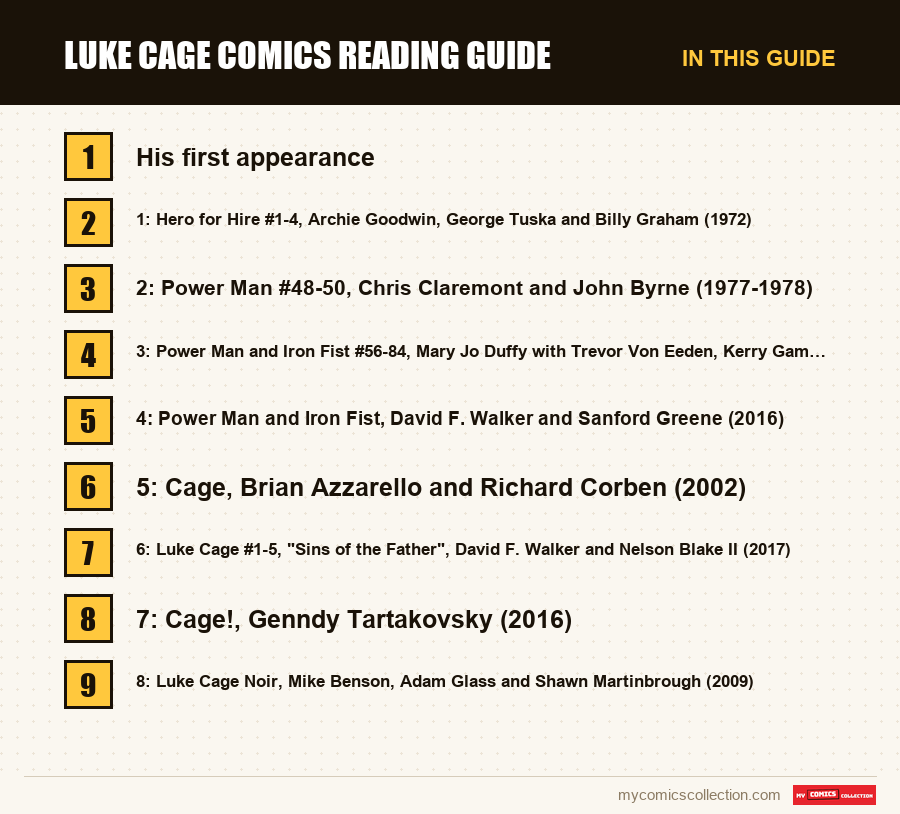
6: Luke Cage #1-5, "Sins of the Father", David F. Walker and Nelson Blake II (2017)
The same David F. Walker returns with an ongoing series. Drawn by Nelson Blake II and colored by Marcio Menyz, it opens with the death of Doctor Noah Burstein, Cage's mentor, which sends him to New Orleans for the funeral and plunges him into an investigation of his own past.
The series was later renumbered from #166 to #170 as part of Marvel Legacy, before ending in 2018. The collection of the first five issues forms a coherent whole, which makes Cage a noir-novel vigilante rather than a party hero.
For whom? For those who want a solo Cage, adult but without Corben's extreme darkness. How? In the collected edition, following Power Man and Iron Fist if you liked Walker.
7: Cage!, Genndy Tartakovsky (2016)
Four-issue miniseries, written and drawn by the creator of Samurai Jack, Genndy Tartakovsky, with Stephen DeStefano on inks. Announced in 2007, it only came out in October 2016 for its first issue. The action takes place in 1970s New York, with open nods to the blaxploitation films Cage comes from.
The graphic style is highly stylized, with elongated silhouettes and flat color areas, which divides opinion: some readers praised the energy, others criticized the way certain Black characters are depicted. It is a curiosity read, not an entry point.
Who is it for? Animation fans and lovers of retro homages. How to read it? As a complement, after having read at least one of the classics above.
8: Luke Cage Noir, Mike Benson, Adam Glass and Shawn Martinbrough (2009)
As part of the Marvel Noir line, Luke Cage is transposed to the 1920s, with a four-issue series written by Mike Benson and Adam Glass and drawn by Shawn Martinbrough. The hero moves through a period setting.
The miniseries takes the character's skeleton (the prison, the invulnerable skin, the hero who gets paid) and places it in a period setting. The exercise will mostly interest readers of the Noir line.
For whom? Readers who like alternate versions and period atmospheres. How? After reading the fundamentals, to gauge how much transposition the character can bear.
Where to start based on your profile
If you are discovering the character. Pick up Power Man and Iron Fist by Walker and Greene (2016). No prerequisites, a light tone, and the dynamic of the duo is readable in a single collected volume.
If you are coming from the Netflix series. Read Luke Cage #1-5 (2017) first, then Hero for Hire #1-4. Our comparison between the series and the comics details what the adaptation keeps.
If you like the classics. Chain Hero for Hire #1-4, Power Man #48-50 and the Duffy period. It is the historical itinerary, from hero for hire to duo.
If you prefer adult crime fiction. Choose Azzarello and Corben's Cage (2002), then Luke Cage Noir (2009).
If you want to see Cage on a team. He is one of the central characters of the first New Avengers series, written by Brian Michael Bendis, of which he becomes the leader in the 2010 relaunch. He is a member of a collective there, not the sole protagonist, which explains why we do not rank it here. The same Bendis took Cage up in Alias (2001), where he plays a supporting role next to Jessica Jones: see our history of Jessica Jones and the Brian Michael Bendis page.
The key issues to know
To build a collection around Luke Cage, here are the milestones, sorted by reason of interest rather than by price, which we do not quote:
- Hero for Hire #1 (June 1972): Cage's first appearance. It is the character's key issue, detailed on its page.
- Hero for Hire #17 (1974): the moment the title becomes Power Man, a useful landmark for identifying the series in listings.
- Fantastic Four #168 (1976): Cage briefly replaces the Thing there, from the pen of Roy Thomas. He is not the hero in it, but it is a memorable appearance.
- Power Man #48 (December 1977): the start of the partnership with Iron Fist, in the Claremont and Byrne arc.
- Power Man and Iron Fist #50 (1978): the first issue under the two-name title.
- Power Man and Iron Fist #125 (1986): the last issue of the original series, which ends with the death of Iron Fist.
- New Avengers #1 (2005): Cage's arrival with the Avengers in Bendis's team.
- Power Man and Iron Fist #1 (2016): the modern launch by Walker and Greene.
Before buying one of the keys above, read the title printed on the cover and in the indicia: the original series carried three successive names, and listings mix them up. Issues #48-50 of Power Man are sought as milestones by Claremont and Byrne fans as much as keys by Iron Fist fans.
Frequently asked questions
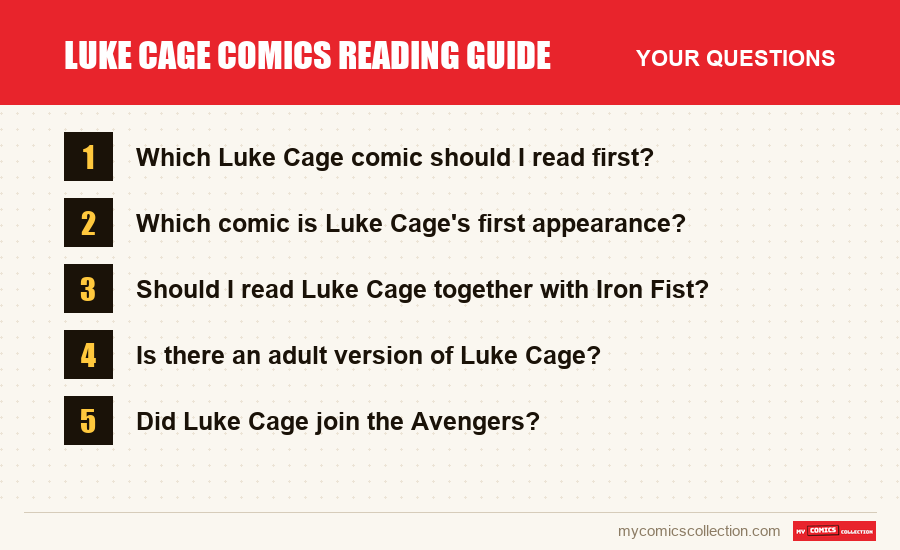
The most accessible is Power Man and Iron Fist by David F. Walker and Sanford Greene (2016), which requires no prior knowledge and presents the duo with humor. If you would rather go back to the source, open Hero for Hire #1-4, written by Archie Goodwin starting in 1972.
In Hero for Hire #1, cover-dated June 1972. Archie Goodwin writes it, George Tuska draws it, Billy Graham inks it, and John Romita Sr. provides its cover. The title becomes Power Man starting with issue #17, then Power Man and Iron Fist with issue #50.
Not necessarily, but many of his best periods come as a pair. Iron Fist joins the series in Power Man #48-50, written by Chris Claremont with John Byrne on art. Mary Jo Duffy's period and the 2016 series rest on this duo.
Yes, Cage (2002), five issues from the Marvel MAX imprint written by Brian Azzarello and drawn by Richard Corben, with colors by José Villarrubia. This version reads outside continuity. Luke Cage Noir (2009), which transposes the hero to the 1920s, offers another dark option.
Yes, in New Avengers, Brian Michael Bendis's first series, where he is a central character. He takes over leadership in the 2010 relaunch. He is a teammate there, which explains why that series is not in the ranking of his best solo comics.
Did you find a Hero for Hire or a Power Man in a box? Get it appraised before you put it away or sell it.
Appraise my comic