On August 29, 2026, a 2012 limited series dedicated to Carnage posted forty offers online: twenty-eight regular copies, with sellers asking for between $6.55 and $350.00 with a midpoint at $15.02, and twelve verified copies, asking for between $109.99 and $1,149.00 with a midpoint at $184.99. Twelve verified for twenty-eight ordinary ones is a high proportion for such a recent publication. It does not signal a burning demand: it signals that the offer offered in the issue has become poorer, because in a modern limited series the only copies that a seller has an interest in putting online in isolation are those whose verification justifies the individual announcement. The rest circulates in complete sets, invisible to those looking for a single booklet.
Forty ads, all segments combined, for a limited series published in 2012. The figure seems anecdotal until we compare it to what a publication from the same decade on the same market place usually produces. A regular contemporary series, carried by such an exposed character, normally generates hundreds of unit proposals, stacked on top of each other, where the same cover costs ten times over with a difference of a few dollars. Here, no. Twenty-eight ordinary copies claimed on August 29, 2026, and twelve verified copies of which the cheapest is requested seven times above the distribution midpoint of the ordinary segment. The two segments do not overlap: there is, on that day, no ordinary announcement above the verified floor, and no verified announcement below.
The reflex reading consists of seeing in this proportion of verified copies the sign of a tense market, where collectors would compete for rare copies. This reading is probably false, and the opposite is more likely. A high share of verified copies on a modern short series does not measure the intensity of demand: it measures what remains when we remove from display everything that is not worth offering separately. On a recent limited series, an ordinary copy alone does not justify the work of an announcement, a photo, packaging and shipping. It therefore joins a lot, a complete set, a group resale, and it disappears from searches made by number. What remains individually are the copies that verification has made worthy of an individual display case. The high proportion is a symptom of depletion of unit supply, not a thermometer of buyers' appetite.
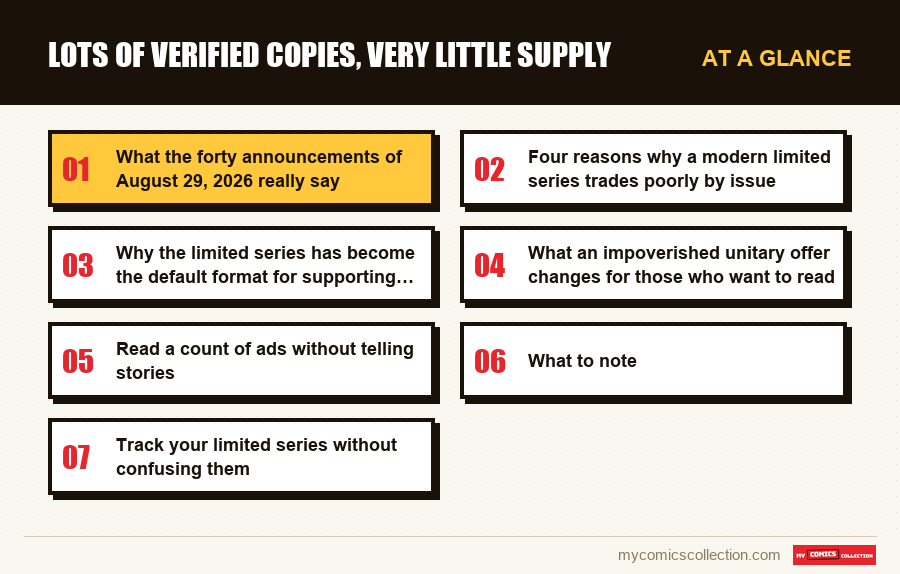
What the forty announcements of August 29, 2026 really say
Let’s take the raw data without dressing it up. Ordinary segment: twenty-eight proposals, amounts claimed ranging from $6.55 to $350.00, distribution midpoint at $15.02. Verified segment: twelve proposals, from $109.99 to $1,149.00, mid-distribution at $184.99. These are amounts requested by sellers on a given date, not completed transactions. No one paid these amounts. An ad is a sales intention, and nothing else; it can remain online for months without finding a buyer, be renewed automatically, or reflect a seller who tests a price without conviction. The maximum of $350.00 in the ordinary segment, like that of $1,149.00 in the verified segment, reflects an individual hope and not a level observed on the market.
Two observations nevertheless resist this caution. The first is the relationship between the two segments: the verified floor is more than seven times above the ordinary midpoint, and the two sets do not overlap at all. This is not a difference of degree but a clear separation, as if two different populations of objects coexisted under the same name. The second is the volume itself: twenty-eight ordinary propositions, it is an extremely narrow unit offering for a series of this period. It is these two facts, the relationship and the narrowness, which carry the analysis. The price levels mean nothing at all.
Four reasons why a modern limited series trades poorly by issue
A calibrated draw, not a mass draw
A limited series is not printed to attract a readership: it is printed to satisfy an already identified demand. The publisher adjusts as closely as possible to retailer orders, without the overproduction cushion that accompanies a regular series intended to last. The number of copies physically in circulation is therefore mechanically lower from the first day, and it does not benefit from any subsequent massive reprinting. Fewer copies in circulation means fewer copies available for resale, regardless of public desire.
A public that is already a collector, not a passing public
A regular series catches occasional readers: someone buys a booklet on a newsstand, reads it, forgets it in a box, and resells it ten years later without knowing it. A limited series devoted to a secondary character hardly catches anyone by chance. It is bought by people who already knew what they were buying, often in specialized stores, often by reservation. These buyers keep. The stock that could supply the second-hand market remains, for years, in established collections.
Immediate conservation, not gradual wear
The casual reader bends, horns, stacks. The informed collector protects from the moment of purchase. In a modern limited series, the proportion of copies preserved in excellent condition is therefore high: which has a counter-intuitive consequence on supply: when everyone has a good copy, no one needs to buy theirs. The replacement flow, which supplies a large part of the second-hand market on older series, is not triggered.
Resale by set, not by booklet
This is the decisive point. A limited series forms a unique mental object: we bought it in full, we put it away in full, we resell it in full. The seller who sells his collection will not write an advertisement per issue for ordinary copies of low unit value; it offers the whole thing at once, often with other titles, in a bundle. This lot does not appear in a search by number. The visible unit offer is therefore emptied from the top as well as from the bottom, and only those copies remain on display whose individual value justifies a separate announcement.
These four mechanisms add up instead of offsetting each other. Fewer printed copies, a public that keeps, copies in good condition therefore never replaced, and resale in complete sets: each stage removes booklets from the unit display case. At the end of the chain, twenty-eight ordinary proposals for a 2012 series, this is no longer an anomaly, it is the expected result. And if the twelve verified copies weigh so heavily in the total, it is because they are the only ones that the process has not removed: the verification gives to a copy an individual value legible enough to make a separate announcement worth it. They are not overrepresented because they are desired; they are over-represented because the others have gone elsewhere.
Methodological reservation, to be read before any conclusion. The research that produces these forty ads is highly porous. It brings back booklets belonging to several neighboring series of the same editorial family, whose titles are similar to the point that a commercial search engine does not distinguish them, as well as publications with no connection that the name of the character is enough to bring up. Part of the twenty-eight ordinary proposals therefore probably does not concern the series in question.
On counts of twenty-eight and twelve advertisements, no midpoint supports a firm conclusion: removing three poorly matched advertisements would significantly shift the distribution middle of the ordinary segment. This is why none of what follows is based on a price level. All that matters here is the relationship between the two segments (a clear separation, too wide to be an artifact of sorting) and the general narrowness of the unitary offer, which remains narrow even if we generously exclude dubious announcements.
Why the limited series has become the default format for supporting characters
Test without commitment
A publisher who launches a regular series makes a long-term commitment to retailers, authors and readers. A limited series announces its end on its first day. It allows you to check whether a secondary character has an independent publication without jeopardizing two years of the calendar. This risk calculation alone explains the proliferation of the format since the 2000s.
A schedule controlled from start to finish
The duration being known in advance, the story is written and often drawn largely before the publication of the first issue. Delays, mid-stream team changes and filler episodes, which spoil so many regular series, are becoming the exception. The result is more homogeneous, which makes the whole thing easier to recommend and keep.
A finished object, therefore salable in one block
A limited series constitutes a complete commercial unit, reusable as is in bound volume, in digital edition, in reprint. The publisher produces an item that continues to sell long after the end of the issue. This second life has a direct effect on the second-hand market: the reader who simply wants to read the story no longer has any reason to hunt for booklets.
Full recommenceability
A regular series that ends is a public failure. A limited series that ends has simply fulfilled its contract, and nothing prevents launching another one the following year with a different team and a new angle. The secondary character can thus return indefinitely without ever bearing the mark of cancellation.
A numbering that starts from zero
Each limited series starts its own numbering again. For the publisher, this is a commercial advantage: a first issue always attracts more orders than a mid-term issue. For the collector, this is a source of lasting confusion, since several publications of the same character share identical numbers without having any connection between them.
A gateway without prerequisites
A limited series is designed to be read without prior knowledge. It reminds you of what you need to know, closes in on itself and requires no follow-up. It is the most welcoming format for a reader who discovers a character, and paradoxically one of the most difficult to bring together in the booklet, precisely because those who own it keep it whole.
Collecting this series?
Track what you own, what you are missing and what your collection is worth. 7 day trial.
Start my trial →What an impoverished unitary offer changes for those who want to read
We must distinguish two gestures that common vocabulary confuses: bringing together a limited series, and finding it by number. The first is simple. A complete set appears regularly, precisely because resale is done in blocks, and it often costs less than the sum of the issues taken separately. The second is strangely difficult. Searching for an isolated booklet from this series amounts to interrogating a segment which has been emptied by the mechanisms described above, and where the little that remains is either poorly matched to the search, or verified and therefore displayed at a level unrelated to the object of reading.
This asymmetry has an immediate practical consequence. The collector who is missing a single issue in the middle of a set finds himself in the most uncomfortable position on the market: what he is looking for exists in number, but he is locked up in complete lots that no one will break for him. He waits, or he buys the entire set for a single lack. The rarity he experiences is not a physical rarity: it is a rarity of sales format.
It also explains why the gap of more than seven times between the verified floor and the ordinary environment should not be read as a bonus to the state. A verified copy is not just a copy whose condition has been noted by a third party; it is a copy that we considered profitable to take out of a lot and offer it alone, assuming the cost of the process. The fact that the two segments do not overlap says above all this: between the reading copy for a few dollars and the verified copy for three figures, there is nothing on display, because what should be there is not offered individually. It's a hole in the offer, not a level of value.
For those who build a collection around this character, the rule of conduct is therefore the opposite of intuition. On a modern limited series, we look for the whole thing first and then, accepting that unitary research gives misleading results. The details of what the character's editorial universe covers, with his parallel publications and his homonyms, are covered in our panorama of the Carnage universe; the chronology of publications is included in the history of the character in comics.
Read a count of ads without telling stories
An ad count is a snapshot of sales intentions, never a record of transactions. This distinction, often recalled then immediately forgotten, changes everything that we can draw from it. A seller who posts a high amount expresses hope, possibly ignorance, sometimes a deliberate strategy of waiting: leaving an ad online indefinitely costs little, and a single sale at this level is enough to justify months of posting. Adding up these hopes and taking an average does not produce a market value, but an average of hopes.
What a count can measure, on the other hand, is the structure of the offer: how many proposals, distributed how, in which segments. It's geometry, not accounting. And it is precisely at this level that the data from August 29, 2026 speaks for itself. The clear separation between the two segments, the total absence of recovery, the low number of ordinary proposals: three formal observations, none requiring us to believe the amounts displayed.
The corollary is that we must be wary of conclusions that rely on a middle point. Out of twenty-eight ads, some of which are poorly matched by a porous search engine, the distribution environment is a fragile value. Out of twelve announcements, it is even more so. Neither can be used to assert that a booklet is "worth" anything, nor that a level has moved in one direction or the other: nothing in a single date count allows us to speak of evolution, since there is no second date to compare to.
Still, the mismatched data itself says something. The fact that a search spontaneously brings back issues from neighboring series from the same publishing family illustrates the central problem of modern collecting around a secondary character: the multiplication of limited series, each starting from scratch, produces a tangle of similar titles that neither commercial engines nor human memory can properly disentangle. An up-to-date catalog is more useful here than a bargain hunter's flair, because the problem is not to estimate, but to identify.
What to note
The proportion of verified copies reads backwards on a recent limited series. Twelve verified for twenty-eight ordinary ones does not signal an influx of buyers but an evaporation of unit supply. Ordinary copies have not physically disappeared; they left the numbered showcase to join complete sets. What remains visible individually is what the verification has made profitable to display alone. Before interpreting a high proportion as a signal of demand, we must ask ourselves where the missing copies have gone.
The lack of overlap between the two segments is a hole, not a bearing. On August 29, 2026, no regular listings reached the verified low of $109.99, and no verified listings went down to the regular midpoint of $15.02. A fluid market produces a continuum, with intermediate quality exemplars at intermediate levels. Here, the middle space is empty because it is not supplied: the good, unverified copies go in batches. This void describes the sales mechanics, not the value of the items.
Twenty-eight proposals are the number to remember, not the amounts. For a 2012 series attached to a widely exposed character, such a narrow unitary offering is the main anomaly of the survey. It is due to the calibrated edition, to a public which has kept it since the purchase, to copies in good condition which no one needs to replace, and above all to a resale which is done in sets. None of these causes are signals of value; all are format signals.
Research is porous, and this porosity is part of the subject. The engine brings back issues from several neighboring series of the same family and unrelated publications. This is not just statistical noise to be discarded: it is the direct consequence of the limited series format applied serially to a secondary character, each new publication starting from a new numbering under a similar title. Identifying precisely what we hold is more important than estimating it.
To read, aim for the whole; to complete, be patient. Bringing together a modern limited series is one of the simplest gestures in collecting, because the market offers it as it has been preserved: whole. Finding an isolated booklet in the middle of this set, on the other hand, is disproportionately difficult, and the difficulty is not a question of price but of retail availability. The informed collector therefore reverses the usual order: he buys the block, then fills in the gaps elsewhere.
Not necessarily, and on a recent limited series it's rarely even the right reading. A high proportion firstly reflects the fact that ordinary copies are not offered individually: their individual value does not justify the work of a separate announcement, and they come in sets. What remains displayed in the number is therefore mechanically dominated by the verified copies, without any additional buyer having intervened. Proportion describes what is exposed, not what is desired.
On August 29, 2026, the verified segment floor was claimed at $109.99, compared to a regular midpoint at $15.02, with no overlap between the two sets. This gap mainly measures the distance between two ways of selling: a copy slipped into a lot and a copy taken out of the lot to be offered alone after verification. It doesn't say that one issue is worth seven times more than another, and it doesn't say anything about what someone would actually pay for it.
Because the series has been kept whole and is being resold whole. The owner of a modern limited series stores it as a unique object and separates it in the same way, often within a larger lot. No one has any interest in breaking this set apart to sell a regular booklet for a few dollars. The result is that a complete set appears regularly online while an isolated issue is left to wait: the opposite of what we observe in a long regular series.
No, and caution is required on both sides. The numbers are very small, twenty-eight and twelve proposals, and the research is porous: it brings back issues from neighboring series in the same family as well as unrelated publications. Removing a few mismatched ads would be enough to significantly shift the result. These midpoints are only used to locate two segments relative to each other; they do not in any way constitute an estimate of value.
It is an advantage to reading and a constraint to completion. When reading, the story is closed, written in advance, with no filler episodes, and bringing the whole thing together often costs less than the sum of the booklets taken one by one. Upon completion, the numbering which starts from zero with each new publication and the multiplication of similar titles make identification difficult, and the lack of a single issue can immobilize a series for a long time. It's a generous format for reading, stingy for hunting.
Track your limited series without confusing them
Numberings that start from scratch, neighboring titles, sets purchased in bulk with an issue missing: My Comics Collection holds the inventory for you, identifies each publication in the catalog and shows you at a glance what is really missing from your series.