Loki: when half the results are not comics
A query “Loki Journey into Mystery 85” launched on August 30, 2026 on a general American auction site brings up 29 ordinary advertisements, the five least expensive of which do not contain the booklet sought: a 2011 issue of the relaunched series, another title, a set of three issues whose wording cites the booklet without selling it, a decorative metal plate reproducing the cover, and a British reissue in pocket format. These objects have their own audience and value, but none compare to the original booklet. Once discarded, the rest becomes too meager to carry the slightest statistical indicator.
There is a stubborn illusion among those who begin keeping a collection: believing that a search engine queried with the right words returns the right objects. The reasoning seems solid. The title is correct, the number is correct, the category displayed advertises comics, so the results are comics. Except that the engine doesn't understand what a booklet is. It matches character strings present in a wording freely written by a seller. And a seller has every interest in including in his wording the words that buyers type, even when the object he is offering is not the one that these words designate.
The August 30, 2026 statement on which this article is based illustrates the phenomenon in an almost caricatured manner. The amounts discussed below are prices claimed by sellers on this specific date, on current listings: never completed transactions. They say what you ask for, not what you get. The examples passed by a verification body were counted separately from the others, because mixing the two populations would amount to adding objects whose condition is guaranteed by a third party with objects whose condition is based solely on the word of the seller.
What exactly the August 30, 2026 statement says
The query “Loki Journey into Mystery 85” returns 29 listings for unverified copies that day. Of this population, the lowest asking price is $4.49, the median is $800.00, and the highest is $9,350.00. At the same time, 31 advertisements concern copies passed by a verification body: minimum $660.00, median $2,749.99, maximum $18,000.00. Two populations, two scales, no reason to confuse them.
The first instinct is to look at the gap between $4.49 and $9,350.00 and conclude that the market is erratic. This is a false reading. The gap does not measure market instability, it measures the heterogeneity of what the engine has gathered under the same query. In other words: the bottom of the list does not describe a cheap booklet, it describes another object. And until we remove it, no calculation carried out on the whole makes sense.
It is also necessary to state a limit that the size of the survey imposes itself. Twenty-nine announcements are not many. A median calculated on twenty-nine observations does not firmly describe a market level: it gives a fragile order of magnitude, sensitive to the removal or addition of a few lines. Amputated from the intruders identified below, this population goes down further, and statistical reasoning must then give way to the individual examination of each announcement. Finally, this reading was taken on a single date. A single photograph shows no movement: it does not allow us to say that prices are rising, nor to say that they are falling, nor even to say that they are stable.
The five cheapest ads, one by one
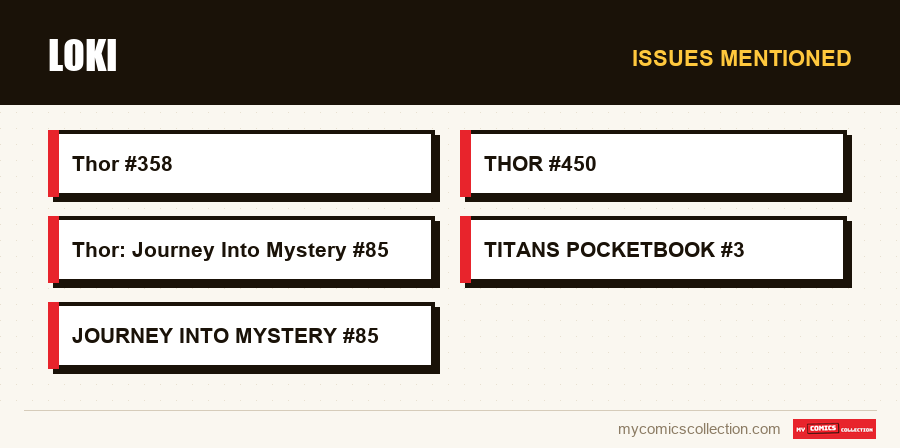
The most instructive thing in this survey is not the top of the list but its bottom. Here, in ascending order, is what the five lowest asking prices actually cover.
$4.49: one issue of a revived series
The label "Journey Into Mystery 623 Marvel 2011 Fear Itself Loki Cover" describes a 2011 issue with the same series title, with a three-digit number and a cover dedicated to the character. It's a perfectly legitimate item, released under the same series name, but separated from the sought-after issue by decades. The query only caught it because three out of five words matched.
$4.99: another title
“Thor #358 VF+ Newsstand” does not belong to the series or numbering referred to. The connection was made through the character and the editorial proximity between the two series. An engine which expands in this way is of service when we explore, and of service when we measure.
$9.99: a bundle that says what it doesn't sell
« THOR #450, 451 & 452 […] JOURNEY INTO MYSTERY 85 LOKI » offers three numbers and says it clearly. The booklet you are looking for appears in the reference title, not the content title. The announcement is accurate; it is the research that is captured.
$21.88 and $59.99: a decorative item and a foreign reissue
“Thor: Journey Into Mystery #85 NEW METAL SIGN” is a metal plate reproducing a cover: it is not a comic book. “TITANS POCKETBOOK #3 ~ 1ST LOKI ~ BRITISH ~ JOURNEY INTO MYSTERY #85” is a British reissue in paperback format, a collector's item in its own right, but distinct from the original booklet.
Five ads, five different reasons for being there, and not one that sold what the query asked for. What these five lines have in common is that none of them lie. Each correctly describes what they offer. The misunderstanding arises entirely from the hasty reading of a list sorted by increasing price, where the eye retains a number before having read the wording which accompanies it.
Keep a reading order: the wording first, the price then. As long as we have not determined what object it is, the amount displayed is not information, it is an attention trap.
A very low amount on a reputedly expensive request should trigger an audit, never an enthusiasm. In this survey, the five lowest prices are all explained by the nature of the object, none by a bargain.
Three families of intruders, three words that betray them
The five examples fall into three recurring families, and each can be identified by a word in the title. Learning these three signals saves considerable time, because they can be read without opening the ad, directly in the list of results.
The decorative object that reproduces a blanket. It is indicated by a word designating the support: in the statement, “METAL SIGN”. The wording includes the title of the series and the number because it is this cover that is reproduced. The object is honest and clearly described. It simply does not enter into any comparison with the booklet: neither the same manufacturing method, nor the same circuit, nor the same conservation logic.
The lot whose wording cites a booklet that it does not contain. It is indicated by a list of numbers, here “#450, 451 & 452”, or by a word indicating the grouping. This is the most vicious case of the three, and it deserves to be precise about what is at stake. The seller correctly describes his merchandise: three numbers, stated. He adds a note which explains the link with the famous booklet. Nothing is false. But the effect is real: the ad places itself in a search to which it does not respond. There is no deception, there is capture.
The foreign reissue in another format. It is indicated by an indication of origin or format: here “BRITISH” and “POCKETBOOK”. This family requires more nuance than the other two, because the object is indeed a comic book publication, with its own editorial history, its own fans and its own market. An early reissue in another country may be rare and sought after for its own sake. What it is not is a substitute for the original fascicle in a value calculation.
These three families are not specific to this character or this series. They reappear as soon as a cover becomes famous enough to be translated into objects and sought-after enough for its title to serve as lexical bait. What varies from one case to another is the vocabulary used, never the mechanics.
Why these objects have their legitimacy
None of the above condemns discarded objects. The distinction to be made is not between the noble and the contemptible, it is between categories which are not measured with the same instrument.
A metal plate reproducing a cover has an assumed decorative use. It sticks, it doesn't keep in a pouch, it doesn't sell to the same audience. No one buys it thinking they are buying a booklet, and its price reflects a decoration market, not an old collection market.
A set of three issues provides a real service to anyone who wants to fill a reading gap or move forward with a long series at little cost. Its default is not to exist but to occupy a place in a list of results where it does not answer the question asked.
As for the foreign reissue in paperback format, it is often a legitimate collector's item and sometimes more difficult to find than the original edition in certain states. It documents the international circulation of a story, which has its own historical value. Simply, its rarity, its condition, its paper and its format obey other rules, and its price says nothing about the price of the original edition. This distinction between successive editions of the same content is found throughout the reading of a long series, as shown in our reading guide dedicated to the character.
The right posture therefore consists of filtering without prioritizing. We remove these announcements from the calculation because they describe something else, not because they are worth less.
What happens to the calculation after the intruders are removed
This is the point that most busy readers miss. The question is not just “what price to choose”, it is “are there enough ads left to choose a price”.
We start from 29 unverified advertisements. That's not much. On a population of this size, the median of $800.00 constitutes an indicative benchmark, not a firm measure of a market level: the removal of a few lines is enough to move it significantly. However, we have just identified five lines to be removed, and there is no guarantee that inspection of the following announcements would not reveal others.
The rest therefore becomes very small. On such a small number, no statistical indicator has any meaning: neither the mean, nor the median, nor the range. You must then change method and reason ad by ad, reading each description, each photograph, each mention of condition, and assuming that the conclusion will be a reasoned judgment rather than a figure.
It's an uncomfortable reversal, because a single number reassures and reasoned judgment requires work. But a figure calculated on a heterogeneous and tiny population only appears reassuring: it gives false precision to an uncertainty which itself remains unresolved.
The same caution applies to the maximum displayed. An isolated amount of $9,350.00 among the unverified, or $18,000.00 among the verified, reflects the hope of a seller on a given date. An ad can stay online indefinitely at a price no one will ever pay. The top of an ad list is not an observed price, it is a demand.
Collecting this series?
Track what you own, what you are missing and what your collection is worth. 7 day trial.
Start my trial →The special case of repeating numbering
An additional difficulty deserves to be isolated, because it alone explains the first of the five announcements. The same series title can start from scratch and then find, decades later, a numbering which crosses its own old numbers. Result: two very different issues can have similar numbers, under an identical title, with the same character on the cover.
In the survey, number 623 of 2011 and number 85 sought relate to this phenomenon: same series title, two eras, two objects with no relationship of value. A search engine has no way of deciding, since the two labels share most of their words. Only a reader who knows the editorial history of the title can tell the difference, and even then, as long as they pay attention. This renumbering mechanism is detailed in our article on numérotation restaurée.
The practical consequence is simple: on a title that has had several lives, the number alone is never enough to identify an issue. The year must be added, and preferably an indication of the editorial period. A collection sheet which only records the title and number deliberately leaves ambiguity which will be paid for at the time of valuation or resale.
This caution also applies to neighboring titles that intersect in the results. The second lowest price in the statement belongs to another series, attached to the same publication universe; the editorial links between these titles are traced in our history of the Thor series in comics, and the broader framework of teams and crossovers in our histoire des Avengers.
A sorting method applicable to any query
The survey studied is only of interest if it produces a reproducible routine. Here are the six checks to pass on a results list before getting anything out of it.
Lire le libellé entier
The ad title can be read in full, word by word, before even looking at the price. Almost all of the intruders in the statement are unmasked in the wording alone, without opening the form. A word of support, origin or format is enough.
Chercher une année
A year present in the wording often resolves the question of the editorial era. Its absence is not reassuring: it requires opening the advertisement to identify which life of the title the proposed issue belongs to.
Locate the support word
A statement designating a material or wall object indicates a decorative item. The reproduced cover may be exactly what you are looking for; the object does not belong to the same category and leaves the calculation without discussion.
Count the announced numbers
Several numbers listed, or a grouping mention, indicate a lot. Then check if the booklet you are looking for appears in the content or only as a reference in the wording. In the survey, it was the second hypothesis.
Vérifier la cohérence titre-numéro
A three-digit number under a title whose original edition ends lower indicates a relaunch. This is the control that removes the $4.49 ad from the statement, without needing to know the details of each publication.
Isoler format et origine
An indication of country or reduced format designates a reissue. Legitimate collector's item, separate market, non-transposable price. We record it separately rather than removing it from the field of vision.
These six checks happen in seconds once you get used to them, and they transform an unmanageable list into two or three truly comparable ads. It's not much, but it's honest, and two comparable ads are better than a median calculated on thirty disparate objects.
What to note in your collection
The object type deserves a field of its own. Booklet, collection, reissue, derivative object: these four types are not sold to the same public, are not insured according to the same rules and are not stored in the same containers. A card which only bears the title and number silently mixes incomparable objects, and the mixture is only discovered at the worst moment, when it is necessary to estimate or give up.
The editorial period must accompany the issue. On a revived title, the number alone is ambiguous: the statement contains at least one issue whose three-digit number belongs to a modern revival of the same series. Recording the year of publication next to the issue removes this ambiguity once and for all, and avoids having to reopen the issue to decide.
The country and the edition format change the nature of the line. A British paperback reissue is a collector's item to be kept as such, with its own value, but it does not replace the original edition in an inventory. Writing it down without mentioning the format amounts to creating, years later, confusion that no one will be able to sort out.
The provenance of a lot must remain attached to each copy. A booklet entered in a batch of three issues has a different history from a booklet purchased alone: the price paid is not individually attributable to it, and its condition has rarely been described line by line. Recording the origin avoids later assigning a fictitious purchase value to a copy whose real cost was shared.
Verification status is noted as data, not quality. The statement counts verified copies separately precisely because they form a distinct population, with their own asking price levels. A collection which does not distinguish the copies passed by a verification body from the others deprives itself of the only division which makes its lines comparable to each other.
By a word in the label designating the support or material. In the statement dated August 30, 2026, the advertisement for $21.88 bore a mention of a metal plate in full. The object faithfully reproduces a cover, which explains the presence of the title and number in the wording, but it is not a comic book and it is not included in any price comparison with a booklet.
No. The $9.99 ad for the statement clearly lists the three issues it offers and mention of the famous issue is included for reference. Nothing is wrong there. The effect nevertheless remains that of search capture: the ad appears in a query to which it does not respond, and a reader in a hurry may believe the low price before having read the actual content.
It cannot serve as a firm reference. It concerns only 29 advertisements, which constitutes a low number, and these 29 advertisements include at least five objects which are not the booklet sought. Once these lines are removed, the rest becomes too small for a statistical indicator to retain meaning: it is then necessary to examine the announcements one by one.
Because the two populations have neither the same size nor the same scale of asking prices. The survey yields 29 unverified listings with a median of $800.00, and 31 verified listings with a median of $2,749.99. Merging them would produce an intermediate value which would not describe either of the two realities and would hide the only usable information: the state is guaranteed in one case, declared in the other.
Neither. It was taken on a single date, August 30, 2026, and a single measurement contains no movement information. It would take several surveys spaced over time, constructed with the same sorting method, to consider talking about evolution. In addition, these are amounts claimed on current advertisements, not concluded sales.
Note the type of object, not just the number
A collection which distinguishes booklets, collections, reissues and derived objects remains readable ten years later. My Comics Collection lets you save the era, format and proofing status of each copy, so your lines remain comparable to each other.