To read Larry Hama, start with G.I. Joe: A Real American Hero #21, the silent issue of March 1984, then Wolverine #75 and what follows. Go back to the first G.I. Joe issues at Marvel (1982), try Nth Man (1989), work through the series up to the final issue 155 (1994), and finish with the IDW revival. Six steps, from a single issue to more than a hundred and fifty.
Larry Hama is a writer of rare longevity: 155 issues of a series adapted from a toy line, without changing writers, then a long presence on Wolverine. This continuity has a downside for today's reader: it is hard to know where to take hold of a body of work covering more than ten years of monthly publication, with artists succeeding one another and a story advancing installment after installment.
As always in this guide, only verified information (creators, issues, dates) is stated as fact; the analysis is our own, with no reproduction of protected pages or dialogue.
This guide is not a career portrait: it offers an itinerary. The principle is to start from the shortest and most self-contained piece, a single issue, then widen out. Hama's work divides into two families that do not demand the same patience: the G.I. Joe military saga, which reads continuously and is all the better appreciated for having watched it breathe over several years, and the Marvel superhero stories, shorter, taken arc by arc.
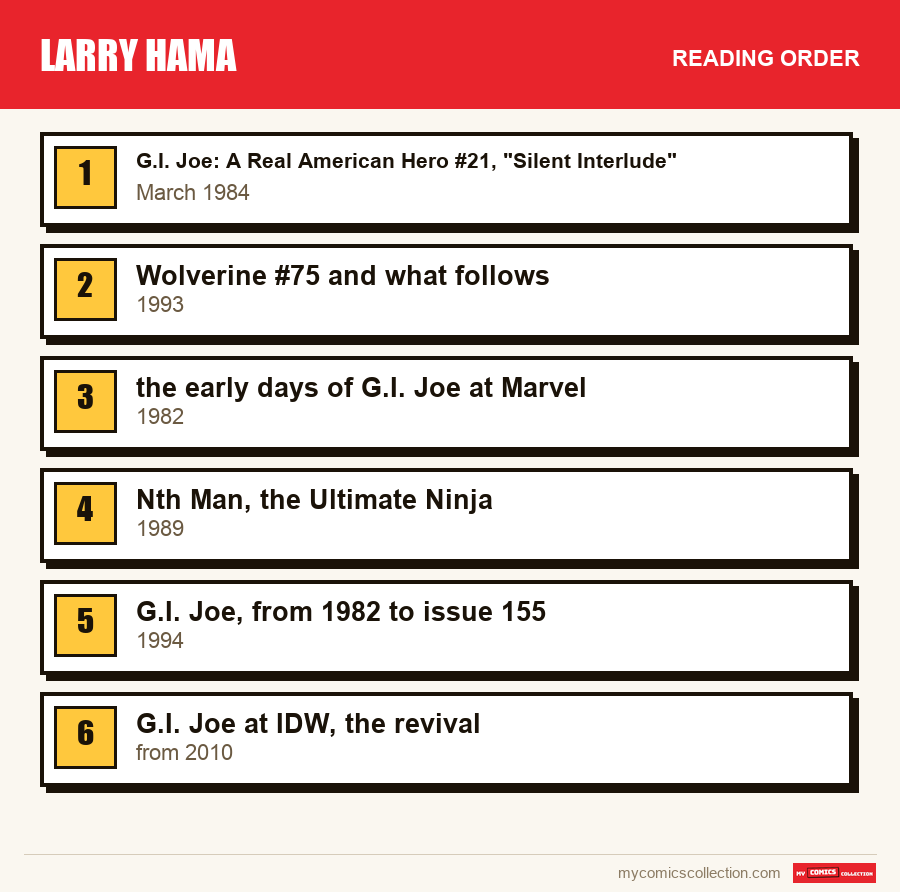
Step 1: G.I. Joe: A Real American Hero #21, "Silent Interlude" (March 1984)
The best first contact fits in a single issue. In issue 21 of the Marvel series, dated March 1984, Hama tells, without dialogue or captions, a clash between Snake Eyes and Storm Shadow, two ninjas who have everything against each other and who are bound by the Arashikage clan organization. The challenge is to tell it through the drawing alone, and the result reads in ten minutes, even for someone who has never opened an issue of the series.
Why this entry rather than issue 1? Because it immediately shows what distinguishes Hama's writing: economy of means, a sense of rhythm, attention to physical action. The issue is also a collecting milestone; we analyze it in the feature devoted to G.I. Joe #21.
Effort level: very low. One issue, no prior reading, an ending in itself.
Step 2: Wolverine #75 and what follows (1993)
Let us move to Marvel and its most popular character. Hama writes the regular Wolverine series from issue 31, and issue 75, drawn by Adam Kubert, comes right after the loss of the adamantium: Logan faces the consequences of a skeleton reduced to bone, in a rawer light than in the previous years. It is one of the most cited chapters of the regular series, because it durably changes what Wolverine is capable of.
This step fits well in second place on the path: the story is a milestone known to X-Men fans, it reads without having followed everything, and the stakes are understood within two pages. To place the episode within the series, our feature on the 1988 regular Wolverine series details its landmarks.
Effort level: low to medium. One key issue, then the rest of the period if the desire comes. The period before issue 75 is less necessary than you might think, since each chapter recalls the essentials.
An extension exists for those who want to stay in Wolverine's universe: the Weapon X miniseries, four issues published in 1995 during the Age of Apocalypse event, written by Hama. It shows the same writer on different ground: an alternate-reality Logan, a world where alliances switch sides, and a short format that forces each scene to tighten. It does, however, assume a minimum of familiarity with the event surrounding it.
Step 3: the early days of G.I. Joe at Marvel (1982)
The first issue of G.I. Joe: A Real American Hero appears at Marvel in June 1982, drawn by Herb Trimpe. Hama lays out the framework there: an elite team recruited by the American army to counter Cobra, a terrorist organization led by Cobra Commander. The tone is that of a military thriller, with missions carried out by a handful of specialists, not that of a toy advertisement. The characters bear code names, and their file cards, which Hama also wrote for the toy line, give each one a past that feeds the scenes.
It is a turning point: you are entering a serial. The first five or six issues can be read in one sitting and let you know whether the atmosphere suits you. The strength of the beginning is that the series does not yet have its ramifications; the drawback, that the stakes are more modest than they will later be.
Effort level: medium. Several issues, an expanding universe and a roster of characters to get used to.
Step 4: Nth Man, the Ultimate Ninja (1989)
After two steps centered on licenses and a very well-known hero, here is a title of Hama's own creation at Marvel: Nth Man, the Ultimate Ninja, launched in 1989. The series blends superpowers, martial arts and a mythology of its own, far from the house's established figures. It is the best proof that Hama is not limited to the two most famous series.
This step is riskier than the previous ones: the title is less widely distributed, less reprinted and less documented than Wolverine or G.I. Joe. It is meant for readers who want to see the writer outside the frameworks imposed by a license or a star hero. The pleasure comes from discovering an openly B-movie kind of work, more than from a reference read.
Effort level: medium. A short series, but single issues harder to gather than for the main titles.
Do you collect this series?
Track what you own, what you are missing and what your collection is worth. 7-day trial.
Start my trial →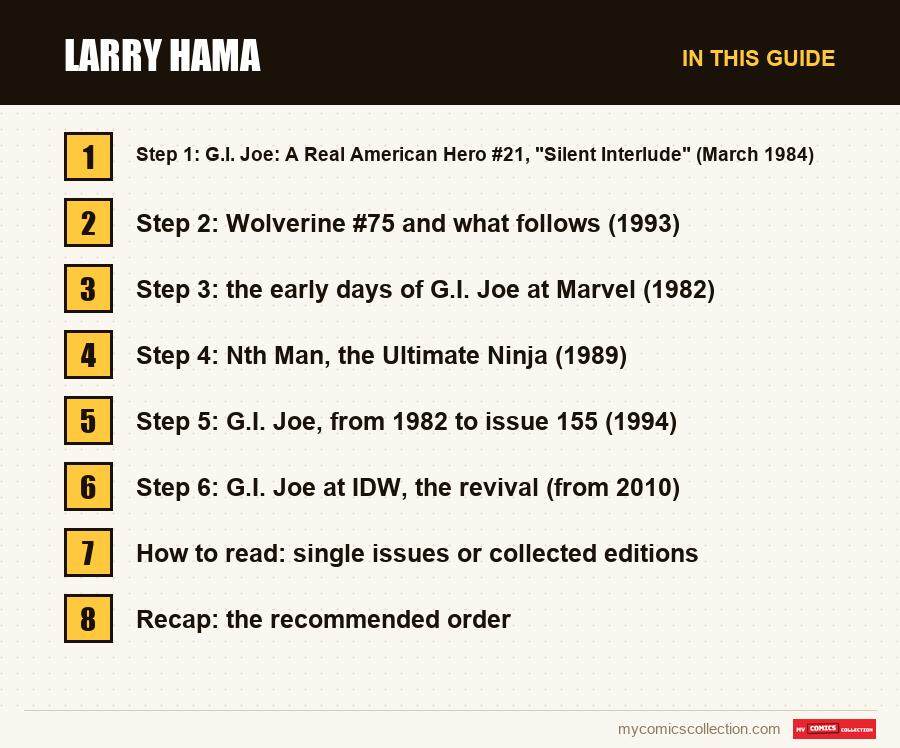
Step 5: G.I. Joe, from 1982 to issue 155 (1994)
The heart of the work is here: 155 issues, from 1982 to 1994, written for the most part by Hama. Reading this series in full means following a war that changes face: the Cobra organization evolves, the Joes renew themselves, the stories of Snake Eyes and Storm Shadow continue, and you measure the world-building carried out over more than a decade. The final issue, 155, closes the Marvel series in 1994.
What strikes you as you go is the patience of the serial. Hama lets threads lie dormant for months, brings back a supporting character when you had forgotten them, and accepts that the war is never completely won. The writer worked under an unusual constraint: a line of action figures dictated part of the cast, and characters whose toy had just come out had to be made to exist. The result is a gallery of remarkably lively supporting roles, where every specialist, from the bomb disposal expert to the pilot, gets a scene.
The difficulty lies in the length and the dependence on the serial: some chapters pick up threads laid dozens of issues earlier. A reader who has already tasted steps 1 and 3 will know whether to continue; otherwise, it is better to stop at issue 21 and a selection of arcs.
Effort level: high. More than a hundred and fifty single issues to read in order, or a large run of collected editions.
Step 6: G.I. Joe at IDW, the revival (from 2010)
The last step extends the thread. In 2010, IDW relaunches the G.I. Joe: A Real American Hero series with Hama writing, taking up the numbering where Marvel had left it. It is a direct sequel, both demanding and touching: it assumes you know the end of the Marvel series and the relationships among the main characters, and it proves that Hama kept working on the same universe for years.
There is also a collector's pleasure in reading this sequel: seeing a writer return to a universe left sixteen years earlier, with the same voice and concerns that have matured, is rare in a genre dominated by relaunches handed to new teams. The film Snake Eyes, released in 2021, put the character back in the spotlight, but reading remains the best way to understand why he became a cult figure.
This step will mainly interest the reader who has finished the original series. The characters have aged, the war against Cobra has changed in nature, and the art passes from one generation to the next. Without the five previous steps, you will lack landmarks; with them, you will savor the gap.
Effort level: high. A long series that presupposes reading the previous one.
How to read: single issues or collected editions
For G.I. Joe, two formats coexist: the original Marvel single issues, which please those who love the object, and collected editions from IDW that gather the issues in order. If you simply want to read, the collected edition is cheaper and spares you from chasing rare issues. If you love the object, the early issues of the series and issue 21 are regular collecting landmarks, and our feature on G.I. Joe #21 details what to look at before buying.
For Hama's Wolverine, the 1990s single issues are not rare, and the collected editions of the regular series remain the simplest solution. For Nth Man, count on single issues rather than collected editions. In every case, assess your copy by comparison with completed sales rather than listings, and read the condition description in full.
Recap: the recommended order
- Step 1: G.I. Joe: A Real American Hero #21 (March 1984), the silent issue.
- Step 2: Wolverine #75, after the loss of the adamantium, and Hama's period from issue 31.
- Step 3: G.I. Joe: A Real American Hero #1 (June 1982), with Herb Trimpe.
- Step 4: Nth Man, the Ultimate Ninja (1989).
- Step 5: the G.I. Joe series up to issue 155 (1994).
- Step 6: the IDW revival from 2010.
If you only have one issue to read, take issue 21. If you want the complete saga, plan on long months. If your interest lies in Wolverine, step 2 is enough to judge Hama's contribution.
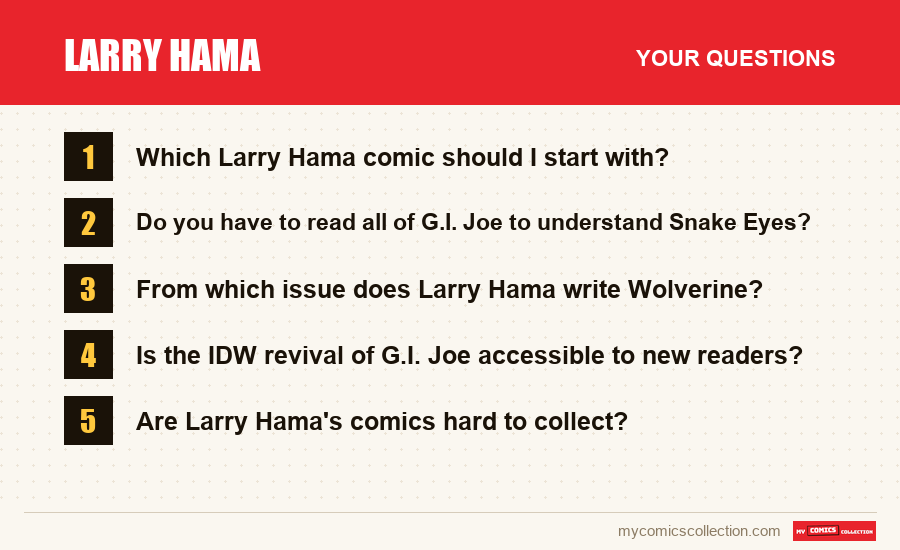
Frequently asked questions
With G.I. Joe: A Real American Hero #21, the silent issue of March 1984: one issue, no prior reading, and a demonstration of how Hama tells stories through images. If you prefer Marvel, Wolverine #75 is the second entry.
No. Issue 21 tells the clash between Snake Eyes and Storm Shadow with no text at all, and stands on its own. The complete series, 155 issues from 1982 to 1994, then enriches the context, but it is not a prerequisite for grasping the essence of the rivalry.
From issue 31 of the regular series launched in 1988, according to the landmarks we use in our features on the series. Issue 75, drawn by Adam Kubert, is the chapter of that period most often cited by readers.
Not really. IDW continues the Marvel series' numbering from 2010 with Hama writing, and assumes you know the characters and the 1994 ending. Read issue 21 and a few arcs of the original series first before coming to it.
It depends on the title: G.I. Joe #1 and #21 are the most sought-after landmarks, the series' ordinary issues remain easy to find, and Nth Man demands more patience. Compare completed sales rather than listings before setting your budget.
Do you own a G.I. Joe from 1982 to 1994 or a Wolverine from Hama's period? Appraise each issue according to its condition before keeping, trading or selling it.
Appraise my comic