Jaka's Story is the arc cited by those who consider Cerebus as a major work, and it is the most atypical of the whole. After hundreds of pages of political and institutional satire, the story narrows down to a few characters in a confined space, alternates comic strips and prose passages, and almost entirely abandons the comic register. It is also the only arc where the main character is not the subject: and probably the hardest to read of all.
A reader who arrives here after two arcs of satire finds something else: an intimate, slow story that ends badly.
This article explains what changes, why the mix of prose and images works, what the arc asks of the reader, and where to place it in a journey.
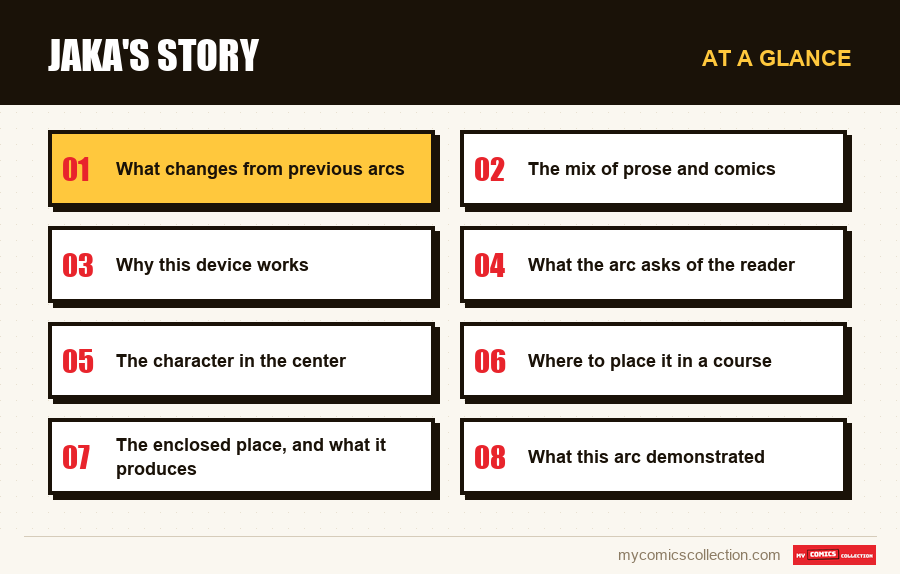
What changes from previous arcs
The contrast is stark, and it is deliberate. Four movements occur at the same time.
The scale. We go from institutions, cities and power structures to a few people in a small space. The world doesn't disappear but it remains off-camera, which is more stifling than ignoring it.
The rhythm. The previous arcs advanced by maneuvers and reversals. This proceeds through daily scenes (meals, conversations, expectations) the accumulation of which constitutes the story.
The tone. The comic survives in places but ceases to be the dominant regime. What replaces it is not gravity but something more uncomfortable: a dull tension from which we don't know where it will come from.
The center. The character who gives his name to the series is no longer the subject. He is present, he acts, but the story is interested in someone else:and it is this movement that makes the arc so special.
The mix of prose and comics
Two alternating regimes
Illustrated prose chapters are interspersed between the drawn sequences, telling the childhood of a character in another register.
It is not a complementary device but a part of the story, which cannot be skipped without losing the essential.
A time gap
Prose tells the past, images tell the present. The reader gradually understands how one produced the other.
An effect otherwise impossible
A childhood told in a comic strip would have shown the facts. Told in prose, it conveys the way it is remembered: it’s something else.
An assumed slowdown
These passages break the rhythm of reading. It's uncomfortable, and it's precisely what gives the present of the story its suspended character.
Why this device works
Mixing prose and images fails more often than it succeeds. It is worth understanding what, here, prevents him from falling.
The first point is that the two registers do not tell not the same thing. A complementary device that would repeat in words what the images showed would be redundant. Here the prose covers a time that the images do not, making it necessary rather than decorative.
The second is that the transition from one regime to another produces meaning. The present is drawn, therefore immediate, factual, observable. The past is written, therefore filtered, reconstituted, subject to doubt. The form says something about the status of what we read, without the text having to state it.
The third is length. These passages are developed enough to establish a proper tone, but spaced out enough for us to return to the images with pleasure. A heavier dosage would have produced two books juxtaposed.
What the arc asks of the reader
Patience
Almost nothing happens during long sequences. The tension comes from waiting itself, which involves accepting not to move forward.
Endurance
The ending is harsh, and the story spares no one. Several readers cite it as one of the most trying moments of their practice of the medium.
To accept the prose
A reader who comes looking for comics must agree to read written chapters. Those who skip them lose half of the device.
To give up comedy
Those who followed the series for its lively satire will find something else here. The change of register caused more than one to drop out.
Why this arc divides as much as the rest of the work, but differently. The debates on Cerebus usually relate to the positions of its author. Here, the disagreements are purely literary: some consider this arc to be the pinnacle of the medium, others to be a pretentious and interminable experiment.
These are readers who have read the same book and draw opposing judgments from it: which, for once, resembles a real discussion about a work.
The character in the center
A structural shift is worth considering, because it explains part of the effect produced.
In previous arcs, the series followed a protagonist who moved through institutions. The other characters existed in relation to him-allies, obstacles, instruments. This is the normal structure of a hero story.
Here, the title character becomes a element of someone else's decor. He acts, he influences what happens, but he is no longer the one whose point of view we follow. The story focuses on a woman whose childhood, choices and what results from them we discover.
This inversion produces an unusual effect: the reader, accustomed to seeing the world through the eyes of the protagonist, finds himself looking at it from the outside. What passed for comic clumsiness becomes, seen in this way, frankly worrying.
This is the only arc where we understand the effect that this character has on others, and this retroactive understanding modifies the reading of everything that precedes.
Where to place it in a course
The question arises because the recommendations differ.
After the previous two arcs, this is the obvious and most defensible position. Point of view inversion only works if you have first followed the protagonist from the inside for hundreds of pages.
As a possible stopping point, it's a serious option. A reader who ends here will have read the political satire, the institutional satire and the intimate arc: three registers, each brought to its conclusion.
Jamais en premier, despite its reputation. This is the most important advice: a reader who begins with this arc would see a slow story about characters he does not know, whose main effect, the retroactive rereading of what precedes, would be completely inaccessible to him.
Collecting this series?
Track what you own, what you are missing and what your collection is worth. 7 day trial.
Start my trial →The enclosed place, and what it produces
Almost the entire arc takes place in a small space from which the characters hardly ever leave. This choice is not an economy of means: it does a precise job.
A closed session removes the possibility of avoidance. In previous arcs, a disgruntled character could leave, change faction, or disappear for a few chapters. Here, no one can leave the room:which forces each tension to resolve itself on the spot or to accumulate.
This device also produces a time distortion. Without external events to mark the days, the duration becomes elastic: we do not know whether a week or three months have passed between two scenes, and this indeterminacy is consistent with the lives that the characters lead.
It finally makes the exterior seem threatening without having to show it. What comes from outside is rare, and therefore always important. The story can thus maintain a dull anxiety for hundreds of pages without any threat being formulated -the anxiety is due to the structure of the setting rather than the content of the plot.
This is the know-how of a playwright rather than a comic book scriptwriter, and this explains why this arc is often compared to theater works rather than other series.
What this arc demonstrated
Beyond its own quality, it established something that mattered to the medium.
That a monthly genre publication could devote hundreds of pages to an intimate story, without action, without external issues, with prose chapters, and retain its readership, was not self-evident at the turn of the 1990s.
What the attempt showed was that an audience existed for it even within the genre readership. It was not a question of attracting other readers but of demonstrating that existing readers could follow elsewhere.
It's a lesson that many authors have learned: the audience of a series is often more willing to travel than we think, provided that we have built enough trust to take them along.
What to check before purchasing this volume
Two specific points, which arise directly from the system described above.
The readability of prose passages. They are composed in reduced size on illustrated pages, which makes them particularly sensitive to printing quality. On a mediocre print, these chapters become painful to read, and since you cannot skip them, a substantial part of the volume suffers.
L'ouverture à plat. Several sequences are based on double-page compositions. A rigid spine which swallows the fold directly cuts off these pages, as with any work composed on this scale.
These two checks are in addition to the usual precautions on thick collections: condition of the spine as a priority, range of numbers contained. They ask themselves before purchasing, by message, in a few seconds.
Ce qu'il faut noter
An unusual field becomes relevant on this specific volume.
If you have read the prose passages. Many readers skip them without admitting it, then keep an incomplete memory of the arc. Writing it down allows you, years later, to know if you really read this book or only its drawn half.
Votre impression, datée. This is the arc of the work on which opinions most often turn over time. Readers who found it interminable consider it, ten years later, to be the best thing they have read, and the opposite also happens.
These two notes answer a question that this arc poses more than any other in the work: what did I really read about it, and what did I think about it at the time?
Questions fréquentes
We can, but we lose half of the device. These passages do not repeat what the images show: they cover a time that the drawn story does not cover, and it is their articulation with the present that produces the effect of the arc. Skipping them is like reading a different, and poorer, book.
Because the arc reverses the point of view: it becomes an element of someone else's decor. This inversion allows the reader to see from the outside a character that he followed from the inside, and what passed for comic clumsiness becomes, seen in this way, frankly worrying.
This is the worst possible choice, despite its reputation. Its main effect is based on the retroactive rereading of what precedes: without having followed the protagonist from the inside for hundreds of pages, what remains is only a slow story about unknown characters.
On an emotional level, yes: the ending is harsh and the story spares no one. In terms of attention too, since almost nothing happens during long sequences and the tension comes from the wait itself. This is not a reading that one undertakes absent-mindedly.
Because the same device produces opposite effects depending on the reader's disposition: what appears to some as a successful formal experiment appears to others to be pretentious and interminable. It is, for once on this work, a purely literary disagreement: unrelated to the controversies surrounding its author.
Have read, or have read half drawn
In a volume that alternates prose and images, this is a distinction that the inventory should bear.